
Blockchain Payments: Invest in the Future of Enterprise-Grade Crypto Rails
Blockchain payments: Invest in the Future is more than a catchy phrase for us at Web3 Enabler—it captures the dual opportunity we are building: a powerful enterprise-grade payments platform inside Salesforce and a way for everyday investors to participate in our growth through our current Republic fundraiser. We are bringing Blockchain Payments directly into the heart of business operations so companies can run global treasury and payments natively inside their CRM and commerce stack.
We are in the early days of this journey, but we are already live with customers, cleared key Salesforce security reviews, and now opening our cap table to the broader public via Republic. With a minimum investment of $400, you can join us as we scale Blockchain Payments and help enterprises move money across borders faster, cheaper, and with far greater flexibility than legacy rails.
What We Built: Blockchain Payments on Salesforce Core and Clouds
At the center of our product is Blockchain Payments, our application that handles both treasury operations and payment collection directly inside Salesforce. Salesforce is divided into a core transactional system and a series of clouds, and we run natively on that core while connecting out to the most important clouds that sales, finance, and commerce teams use every day.
Today, Blockchain Payments offers add-ons for Sales Cloud, Revenue Cloud, and Commerce Cloud, allowing payments to be tied directly to opportunities, orders, invoices, payment groups, and B2B purchase orders. For more detail on how we connect payment data into CRM workflows, we recommend exploring Sales Cloud Data Integration for Unified Customer Insights and our guide on Salesforce Payments API Integration: Connect Crypto Payments to Your CRM.
Sales Cloud, Revenue Cloud, and Commerce Cloud Integration
On Sales Cloud, Blockchain Payments links directly to opportunities and orders so revenue teams can see, in Salesforce, when and how payments are actually made. On Revenue Cloud, we connect payments to invoices and payment groups, giving finance teams a precise, auditable view of cash flow objects and settlement status within their existing billing processes.
On Commerce Cloud, our integration routes payments through B2B purchase orders to solve a core challenge of crypto and stablecoin settlement times. Whereas Bitcoin may take roughly an hour for six confirmations, and networks like Solana or Base can settle in seconds or near-instantly, many commerce flows expect immediate confirmation. We address this by tying blockchain settlement to purchase order logic rather than assuming instant clearance, creating a robust experience for B2B buyers and sellers. If you want to see how digital assets fit into B2B workflows, take a look at Digital Assets in Sales Cloud: Token-Based Contracts and Commissions and B2B Crypto Payments: Enabling Faster Vendor Transactions.
Global On-Ramps and Off-Ramps: From Bank Rails to Stablecoins and Back
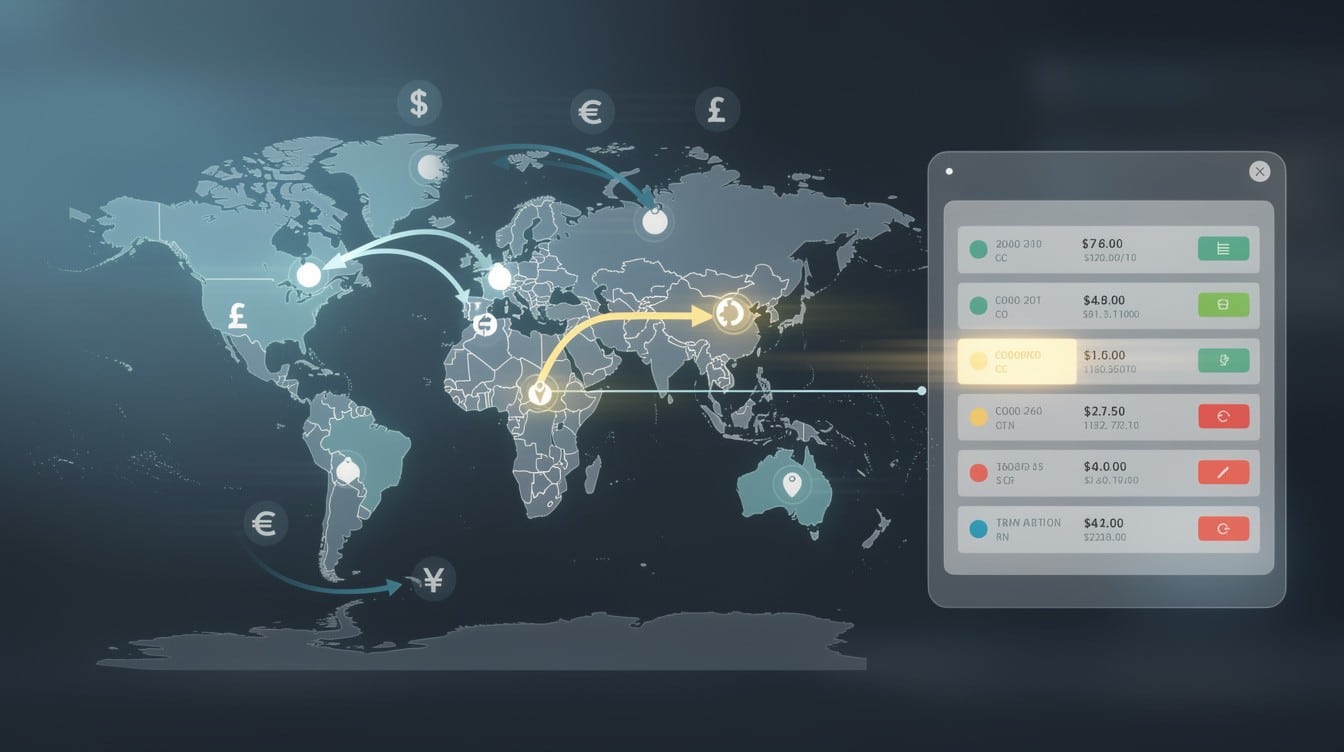
A key part of our Blockchain Payments vision is enabling frictionless movement between traditional bank accounts and digital assets. With our platform, businesses can on-ramp and off-ramp in the United States, Europe, Mexico, Brazil, and the UK directly from their local banking rails into stablecoins and back out into fiat currencies.
For example, we enable scenarios where British pounds, euros, or dollars come in, are converted into stablecoins such as EURC, USDC, or USDT, and then sent on-chain to contractors or employees. Those recipients can then choose whether to convert to a local currency or keep the funds in crypto if they themselves operate globally. To understand how this fits into broader cross-border and stablecoin strategies, see Stablecoin Interoperability Salesforce: Bridging Wallets and Workflows and Cross Border Settlement Automation: Accelerating International Payments.
Serving Distributed Teams and Vendors Worldwide
One of our clients in the UK operates with a distributed workforce across Africa. Instead of building individual banking connections into every country, they run treasury from their Salesforce org using Blockchain Payments. Each contractor, vendor, or employee is modeled as an account in Salesforce and can connect either a local bank account or a crypto wallet.
When that client sends payments, our system handles the heavy lifting: British pounds or other base fiat currencies are converted into stablecoins such as USDC or EURC and transmitted to the recipients. Contractors then can off-ramp into their local currencies or continue operating on-chain. We see this as a concrete example of why blockchain payments: invest is compelling—enterprises are already using these rails to replace expensive, slow international transfers.
Why Traditional Cross-Border Payments Are So Painful
The motivation behind Blockchain Payments is not hype; it is the reality that traditional international payments are slow and costly. Sending a cross-border wire often costs $30–$50 in fees before any exchange rates are applied. On top of that, it is common to pay 6%–8%, and in some cases up to 10%, in foreign exchange spread and intermediary bank charges. This is especially true when payments cross through multiple correspondent banks.
For many U.S.-based businesses, the pain can be invisible. An occasional card payment to Europe hides the complexity behind card networks and FX markup. But businesses that pay vendors, contractors, or partners internationally on a recurring basis see the true cost directly in their margins. Our work with Blockchain Payments is aimed at removing that friction by leveraging stablecoins and efficient chains to streamline cross-border cash movement. For deeper context on settlement flows, our piece on USDC Payments Workflow: Automating Global Settlements provides a complementary view.
Incoming Payments: Liquidation Wallets and Local Bank Settlements
On the inbound side, Blockchain Payments offers a feature we call the liquidation wallet. Businesses can receive stablecoins from anywhere in the world, while we automatically convert and route funds into their traditional bank accounts via the appropriate local transfer system.
In the U.S., we support settlement via ACH or wire. In Europe, we leverage SEPA. In Brazil, we connect through PIX, and in Mexico, through SPEI. Whatever the local bank transfer mechanism, we map stablecoin inflows to fiat outflows, so finance teams can think in terms of bank balances rather than wallets while still gaining all the benefits of accepting digital assets. To see how this type of orchestration can extend into broader finance operations, explore Establishing Stablecoin Payments Governance Across FinOps.
Same-Day or Next-Day Cash in the Bank
From the perspective of the business, the experience is simple. Customers or partners send stablecoins; those payments land in the liquidation wallet; then the funds settle to the designated bank account on a same-day or next-day basis, depending on banking arrangements. That means teams can accept crypto-native payments without introducing complexity to their internal cash management routines.
Because everything is integrated with Salesforce, the state of those payments—requested, in-flight, settled—is visible alongside accounts, opportunities, and invoices. This visibility then feeds into other Salesforce layers, including Artificial Intelligence agents built on Data Cloud. For more on how we power service and advisory use cases with real-time payment data, see Real-Time Wallet Visibility in Service Cloud: Arming Agents with Live Crypto Balances and Client Wallet Salesforce Visibility: Empowering Advisors With Real-Time Crypto Insights.
Outbound Payments: Gasless Stablecoin Transfers on Enterprise-Friendly Chains
On the outbound side, Blockchain Payments gives enterprises the ability to send payments globally using stablecoins, while we abstract away much of the blockchain complexity. We are chain-agnostic and support stablecoins across more than a dozen networks, including UTXO-based chains such as Bitcoin, Doge, and Litecoin for specific use cases.
For day-to-day business payments, we focus heavily on stablecoins and efficient networks. We currently support Base and Solana for gasless transactions, where we cover the gas fees because they are so low. This makes it easy for finance teams to send funds in stablecoins while we handle routing, gas, and confirmations under the hood. If your team is exploring how to bring stablecoin use into marketing, support, or loyalty contexts, we break down additional patterns in Stablecoins in Salesforce Marketing Cloud: Tokenized Promotions and Loyalty and Stablecoins in Salesforce Service Cloud: Streamlining Claims, Payouts, and Support.
Venmo, PayPal USD, and Currency Flexibility
A particularly interesting use case we see involves U.S.-only consumer rails such as Venmo. A company in Europe, for instance, might receive payments via Venmo when working with U.S. customers. Venmo allows conversion of balances into PayPal USD, and from there, those funds can ultimately be routed into currencies like Mexican pesos or Brazilian reais using stablecoins and appropriate off-ramp partners.
What matters is that Blockchain Payments sits inside Salesforce as the orchestration layer, allowing these otherwise fragmented flows to be represented in one system of record. This is a core reason we believe blockchain payments: invest is a timely strategy—businesses can harness consumer fintech tools and institutional rails together to expand global commerce. To see how these patterns extend into e-commerce and tokenized experiences, we suggest reviewing How Stablecoins for Ecommerce Are Redefining Global Transactions and NFTs in Experience Cloud: Community Ownership, Access and Rewarding Engagement.
Licensing Model: Pay Only for the Users Who Need Blockchain Payments
We designed our licensing to align closely with how teams actually work. When you install Blockchain Payments, you pay us on a per-user basis—but only for the users that actually need access. If three people in your accounting department use Blockchain Payments, then you need three licenses. If 30 sales reps are actively accepting Blockchain Payments in the field, you might choose to license all 30.
Conversely, if most of your crypto-related logic runs through Commerce Cloud automations and only two people in finance need to see the details, then you only license those two. Customer service reps who need visibility might receive licenses if they directly work with payment data. Meanwhile, AI agents do not require separate licenses because they operate on top of Data Cloud, not directly against the core transactional database. This keeps Blockchain Payments affordable and scalable as your organization grows. For enterprises mapping broader blockchain rollouts, our article on How to Implement Enterprise Blockchain Solutions and How to Drive Enterprise Blockchain Adoption Successfully provide a strategic blueprint.
Security, Compliance, and Salesforce AppExchange Readiness
Security and trust are non-negotiable when dealing with payments data. We have already cleared Salesforce security review for our Commerce Cloud and Revenue Cloud integrations, and we are preparing those packages for listing on the AppExchange. This is in addition to our existing Blockchain Payments package that runs on Salesforce core and integrates with Sales Cloud.
Operating in a regulated environment also means thinking carefully about KYC, AML, and data governance. Our broader approach to compliant crypto onboarding, tokenization, and treasury management in Salesforce is laid out in resources like KYC Compliant Salesforce Blockchain: A Practical Compliance Blueprint, Cryptocurrency Onboarding KYC: Faster Verifications With Confidence, and Tokenization in Financial Services Cloud: Asset Tokenization and Custody Workflows. These all support our overarching mission: to bring enterprise-grade blockchain capabilities into the systems companies already trust.
The Investment Opportunity with Republic: Blockchain Payments: Invest Alongside Us
Alongside building Blockchain Payments, we are opening a regulated investment opportunity via Republic. We are conducting a Reg CF raise—short for Regulation CF—under SEC rules that allow early-stage companies like ours to raise money from the general public in smaller increments that aggregate into a single investment vehicle.
Our current target is to raise between $50,000 and $200,000 through Republic, with a minimum investment of $400 for participants on that platform. This Reg CF raise complements larger individual checks between $25,000 and $200,000 that we are receiving outside the platform. The key point is that blockchain payments: invest now means you can participate in the same early-stage phase of our journey that was historically limited to institutions and insiders.
Potential Return Scenarios and Valuation Context
We are conducting this raise at a $10 million valuation. If we execute a moderate exit in the $50 million to $100 million range, that could represent approximately a 5x to 10x return on invested capital. In a stronger scenario—an exit between $250 million and $500 million—a $1,000 investment could turn into roughly $25,000 to $50,000.
If we truly “hit it out of the park” and approach a $1 billion outcome over the coming years, the upside becomes even more significant, though, as with all startups, nothing is guaranteed. What we can say is that this Republic raise is an SEC-regulated, aboveboard process. We file with federal regulators, and our goal is to build a durable, enterprise-focused business that brings blockchain and Salesforce together at scale. For those looking at blockchain from a broader international-payments angle, we also recommend our article on How to Receive US ACH Payments in Mexico: Rails, Conversion, and Compliance and our piece on Cross Border Settlement Automation: Accelerating International Payments.
How to Participate: Joining Our Journey on Republic
If you have ever wondered how to invest pre-IPO in a technology company that is building real infrastructure for global payments, this is your opportunity. Through Republic and the Reg CF framework, you can invest as little as $400 and become part of our cap table alongside larger institutional and individual investors.
To join our journey, visit Republic.com and navigate to our dedicated page at Republic.com/Web3Enabler, as referenced in our video. There you will find offering details, disclosures, and a simple flow to commit capital. As an investor, you will receive regular update emails from us, and we plan to share swag, ongoing product news, and ways to engage as we deepen our Salesforce integrations and expand our Blockchain Payments footprint. For those thinking about how this investment fits into the broader enterprise blockchain landscape, resources like How to Drive Enterprise Blockchain Adoption Successfully and Digital Assets in Sales Cloud: Token-Based Contracts and Commissions can help frame the bigger picture.
Why Now: Enterprise Blockchain Adoption Is Entering a New Phase
We believe we are entering a new phase of enterprise blockchain adoption—one that is less about speculation and more about integrating real-world financial workflows. Companies want to accept and send stablecoins without leaving their existing tools. They want to pay global teams, vendors, and partners without being crushed by wire fees and FX spreads. They want KYC, compliance, and auditability built in from day one.
That is exactly what we are delivering with Blockchain Payments inside Salesforce, and it is why blockchain payments: invest is a thesis we are willing to build our company around. As we continue to onboard clients, expand chain support, and deepen cloud integrations, our goal is to become the default way enterprises connect digital assets to CRM, commerce, and revenue operations. If this vision resonates with you—as a business leader, technologist, or investor—we invite you to learn more across our content library, including Establishing Stablecoin Payments Governance Across FinOps and How Stablecoins for Ecommerce Are Redefining Global Transactions, and to consider joining us via Republic as we build the future of global payments together.