



Sales teams are moving beyond traditional commission structures. Blockchain technology now makes it possible to automate payments, reduce processing delays, and create transparent incentive systems through digital assets in Sales Cloud.
We at Web3 Enabler see token-based contracts as a practical solution for companies tired of manual commission calculations and slow payment cycles. This post covers how smart contracts, stablecoins, and tokenized rewards work together to streamline compensation.
How Token-Based Contracts Work in Sales Cloud
Tokenization in sales agreements converts commission rights and payment obligations into digital units on a blockchain. Instead of waiting for accounting to calculate commissions and finance to process wire transfers over three to five business days, smart contracts execute automatically when predefined conditions are met.
A salesperson closes a deal worth $100,000 at a 5% commission rate. The smart contract recognizes the closed deal in Salesforce, calculates $5,000 instantly, and initiates a stablecoin payment without manual intervention. This removes the friction that currently plagues commission structures.
Why Speed Matters in Commission Workflows
Traditional systems require sales managers to verify deals, accounting to audit calculations, and finance to initiate payments through banking rails that add delays. Smart contracts collapse this workflow into seconds. Stablecoins like USDC and USDT are backed by cash and short-term US Treasuries, making them suitable for business transactions rather than speculative holdings.
When a sales rep receives commission in stablecoins, the payment lands directly into their wallet with cryptographic proof of settlement. This creates an immutable audit trail that satisfies compliance requirements without requiring manual verification or third-party confirmation.
Native Integration Keeps Teams in Salesforce
Web3 Enabler integrates token-based flows natively into Salesforce, so teams never leave the CRM to manage settlements or verify payments. The integration captures wallet addresses alongside customer records, links commission calculations to deal stages, and routes stablecoin transfers directly from your treasury account.
Cross-Border Settlements Cut Costs and Time
A global sales team spread across North America, Europe, and Asia traditionally waits ten business days for international wire transfers to clear, with correspondent bank fees consuming 2–4% of each payment. Blockchain settlement completes in under an hour for a fraction of the cost.
A company paying $50,000 daily in cross-border commissions saves roughly $15,000 per month in wire and currency conversion fees, reaching payback in under two months. Sales reps get paid faster, which improves retention and motivation. Finance teams reduce reconciliation work by approximately two hours per person per day because on-chain transactions are final and immutable, eliminating disputes over payment status.

Real-time wallet visibility in Salesforce gives treasury a single view of all commission obligations without switching platforms or manually aggregating data from multiple systems.
Audit Trails and Regulatory Alignment
Token-based contracts generate native audit trails that strengthen financial controls. Every commission calculation, payment trigger, and settlement confirmation records on-chain with timestamps and cryptographic signatures. This creates transparent evidence for auditors and regulators without requiring manual log collection or third-party verification.
Tax treatment follows the timing of stablecoin receipt rather than banking notification, which can accelerate tax reporting cycles. Organizations should confirm with their tax advisors how their jurisdiction treats stablecoin income recognition, as rules continue evolving. Tokenized instruments must comply with existing securities laws and employment regulations, so contracts should clearly define whether tokens represent wages, bonus incentives, or equity equivalents.
The SEC has confirmed that tokenized instruments remain subject to the same registration and disclosure requirements as traditional counterparts, and tokenization does not bypass regulatory obligations. Salesforce-native implementations on the AppExchange provide 100% integration with your existing financial controls, so compliance workflows remain within the CRM without relying on external wallets or platforms that introduce additional counterparty risk.
With settlement infrastructure in place, the next step involves automating how commissions distribute across your sales organization and how incentive structures reward performance at scale.
Automated Commission Distribution Across Your Sales Organization
Smart contracts eliminate the delays that plague traditional commission payouts. The moment a deal closes in Salesforce, the smart contract reads the deal amount, applies the commission percentage, calculates tiered bonuses or clawback conditions, and initiates a stablecoin transfer to the rep’s wallet within seconds. Accounting bottlenecks disappear entirely.
A sales organization processing $500,000 in weekly commissions across 50 reps previously required three to five business days for calculations, approvals, and banking settlement. Token-based payouts complete in minutes, so reps see funds in their wallets before the deal record fully syncs across systems. This speed shift matters because compensation delays directly correlate with sales retention. Companies that pay commissions within 24 hours see significantly lower turnover among top performers compared to those using traditional 30-day cycles.
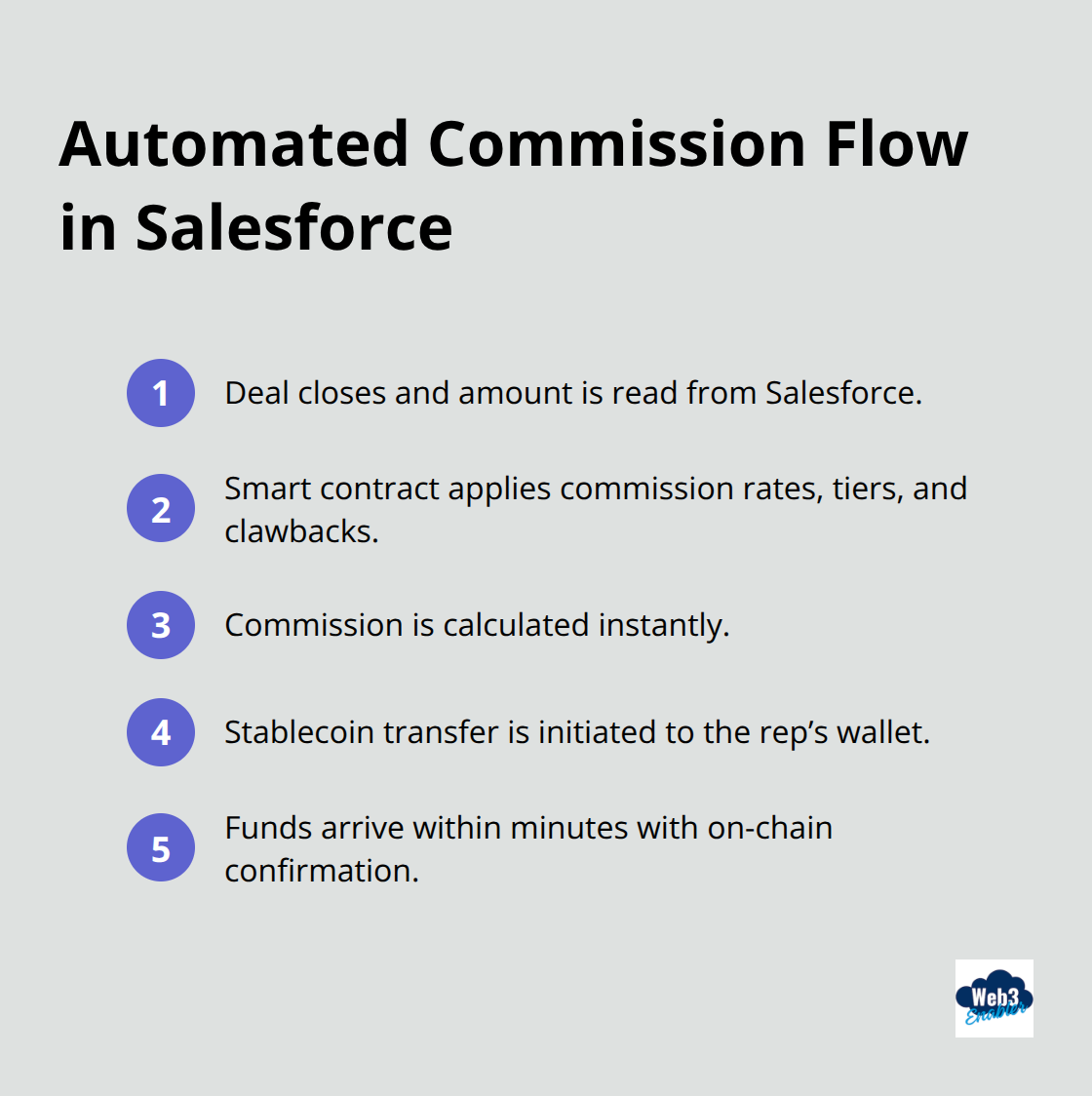
Real-time visibility also prevents disputes. Sales reps verify their commission calculations instantly by viewing the smart contract execution and blockchain settlement confirmation within Salesforce, eliminating arguments over whether accounting applied the right rate or whether a payment actually posted.
Performance Incentives Tied to Verifiable Actions
Tokenized reward systems move beyond simple commission calculations to create incentive structures that reward specific behaviors and outcomes. A company might structure commissions so that closing deals worth over $250,000 triggers a 6% base rate plus a bonus token allocation that vests over three months if the customer renews. Another approach ties tokens to activity metrics: a rep who logs 15 qualified discovery calls in a month earns a fixed token bonus deposited automatically.
These structures work because blockchain records every transaction immutably, so bonus eligibility becomes transparent and contestable only through clear logic, not subjective interpretation. This scale proves tokenized payments work at enterprise velocity.
The key is designing incentives that reward actions your CRM can measure directly: deal closure, customer expansion, retention milestones, or activity completion. Avoid incentives tied to vanity metrics like pipeline size or forecast accuracy, which don’t reflect actual value creation and breed gaming behavior.
Operational Cost Reduction Through Immediate Settlement
Traditional cross-border commission payouts incur wire fees, currency conversion spreads, and correspondent bank charges that collectively consume 2–4% of each payment. A global sales team with reps across five continents paying $100,000 weekly in commissions loses $8,000–$16,000 monthly to these intermediaries.
Stablecoin settlements eliminate correspondent banks entirely because payments move directly on-chain from your treasury wallet to rep wallets in under one hour, with transaction fees under $5 per transfer regardless of amount or geography. The math is immediate: $100,000 weekly becomes $400,000 monthly savings simply from removing banking fees.
Beyond direct savings, on-chain settlement collapses reconciliation cycles. Finance teams currently spend 4–6 hours monthly matching banking confirmations, payment records, and accounting entries for commission runs. Blockchain settlements create cryptographic proof of every transaction, so reconciliation shifts from manual spreadsheet matching to automated verification within Salesforce. One accounting manager can handle twice the transaction volume because on-chain records are final and immutable. This efficiency gain lets smaller finance teams scale commission programs without adding headcount.
Phased Rollout for Measurable Results
Implementation should prioritize high-volume corridors first-pay your top 20 reps via stablecoin before converting your entire organization-to validate the workflow and measure actual cost savings before full rollout. Most organizations achieve positive ROI within 60–90 days once they process their first month of live commissions through blockchain settlement.
With operational efficiency gains in place, the next step involves addressing the legal and compliance framework that governs token-based compensation structures.
Legal and Compliance Considerations for Token-Based Sales Compensation
Token-based compensation structures must comply with employment law, securities regulations, and tax codes that vary significantly by jurisdiction. The SEC’s July 2025 guidance confirms that tokenized instruments remain subject to the same registration and disclosure requirements as traditional counterparts, and tokenization itself does not bypass regulatory obligations. This means a token representing a commission or bonus carries the same legal weight as a cash payment or equity grant, so your contracts must explicitly define whether tokens constitute wages, performance bonuses, or equity equivalents. Employment agreements should specify vesting schedules, clawback conditions, and conversion rights to fiat currency, because ambiguity invites audit risk and creates disputes with regulators. The distinction matters: a token classified as deferred compensation triggers different tax treatment than one classified as immediate wages. Consult employment counsel in each jurisdiction where your sales team operates, because some regions impose restrictions on how quickly commissions must pay out, and blockchain settlement that completes in minutes may actually exceed legal requirements in ways that create unexpected tax consequences.
Tax Treatment and Reporting Requirements
Tax authorities treat stablecoin receipt as taxable income at the moment the wallet receives the payment, not when the rep converts to fiat currency. This creates a timing advantage because your company recognizes expense deductions when the smart contract executes and payment settles on-chain, while reps report income in the same period. The Internal Revenue Service has not yet issued comprehensive guidance on token-based compensation, so work with a tax advisor experienced in digital assets to document your methodology and timing. Some organizations structure token payments to land on specific dates that align with payroll cycles, which simplifies withholding calculations and reduces audit exposure.

Cross-border complications arise when reps operate in countries with different tax years or reporting requirements; a rep in Singapore receiving stablecoin commissions from a US-based company may face tax obligations in both jurisdictions simultaneously. Native Salesforce integration captures payment timestamps and wallet addresses automatically, creating the documentation trail that tax authorities increasingly request during audits. Implementation should include a tax reporting protocol that maps each stablecoin payment to the corresponding commission calculation, deal stage, and rep location, because manual reconciliation between blockchain records and tax filings introduces errors that trigger compliance reviews.
Finance teams should establish a quarterly reconciliation process comparing on-chain settlement records to general ledger entries and tax accrual accounts, which catches discrepancies before they escalate into audit findings that cost significantly more to remediate.
Audit Trails and Financial Controls
Blockchain settlement produces audit trails that exceed the documentation standards traditional payment systems generate. Every smart contract execution records the deal amount, commission calculation, approval timestamp, and settlement confirmation with cryptographic signatures that prove neither the calculation nor the payment was altered after execution. This immutability satisfies financial audit requirements without requiring manual log collection or third-party verification. However, your Salesforce configuration must link commission calculations to the underlying deal records so auditors can trace backwards from a stablecoin payment to the customer agreement that triggered it.
Internal controls should prevent deal records from changing after a smart contract executes, because post-settlement modifications create audit exceptions that regulators scrutinize heavily. Most organizations implement a read-only deal record state once a commission smart contract deploys, which prevents accidental changes that would disconnect the payment from its source documentation. Reconciliation frequency matters: monthly reconciliation of stablecoin payments to commission accruals catches errors early, while quarterly or annual reviews allow discrepancies to compound and create larger audit findings.
Documentation and Disclosure Standards
Document your control procedures in writing, including who has authority to approve commission structures, how deal amounts are validated before smart contract execution, and what happens if a payment fails or needs reversal. Financial statement disclosure should address token-based commissions if they represent a material portion of sales expenses, because auditors require clear explanation of how you measure and record these transactions. This documentation becomes especially important if your organization operates across multiple jurisdictions, where regulators may request evidence that your token-based structure complies with local employment and compensation laws.
Final Thoughts
Token-based commissions in Sales Cloud deliver three measurable outcomes that matter to finance and sales leadership: settlement speed collapses from days to minutes, operational costs drop by 30–50% on cross-border payments, and audit trails become automatic and immutable without adding manual work. Start with your highest-volume commission corridors and your most geographically dispersed sales team, where cost savings and speed gains are most visible. Process your first month of live commissions through blockchain settlement to validate the workflow and measure actual savings before converting your entire organization, with most teams reaching positive ROI within 60–90 days.
The future of sales compensation flows through digital assets in Sales Cloud. As stablecoin adoption accelerates and regulatory clarity improves, companies that move first gain competitive advantage in sales talent retention and operational efficiency. Token-based structures reward verifiable actions-deal closure, customer expansion, activity completion-rather than vanity metrics, which aligns compensation with actual value creation.
Web3 Enabler provides the infrastructure to implement token-based commissions natively within Salesforce, enabling organizations to accept and send stablecoin payments, streamline global settlements, and gain real-time visibility into on-chain transactions for faster reconciliation and reduced operational risk. As a certified Salesforce ISV Partner, we offer native blockchain utility directly to Revenue Cloud. Explore how Web3 Enabler can modernize your sales compensation structure.
Frequently Asked Questions
How do token-based contracts work within Salesforce Sales Cloud?
Token-based contracts convert commission rights into digital units on a blockchain. When a deal reaches a “Closed/Won” stage in Salesforce, a smart contract automatically calculates the commission and triggers a stablecoin payment. This eliminates manual spreadsheets and the typical 3–5 day delay associated with traditional bank transfers.
What are the benefits of paying sales commissions in stablecoins?
The primary benefits are speed and cost reduction. Stablecoin settlements (like USDC) occur in minutes rather than days. For global teams, this removes international wire fees and currency conversion spreads, which can eat up 2% to 4% of every payment. Businesses can save thousands monthly by bypassing traditional banking rails.
How does blockchain improve commission audit trails?
Every smart contract execution and payment is recorded on-chain with a cryptographic signature and timestamp. This creates an immutable, transparent audit trail within Salesforce. Finance teams can verify exactly when a commission was calculated, approved, and settled without manual log collection or third-party confirmation.
Is token-based compensation compliant with SEC regulations?
Yes, provided it follows standard disclosure and registration requirements. Recent guidance confirms that tokenized instruments are subject to the same laws as traditional compensation. Web3 Enabler’s native Salesforce integration ensures that these flows remain within your existing financial controls and compliance workflows.
Can stablecoin payments reduce sales team turnover?
Research suggests a direct correlation between payment speed and sales rep retention. By shifting from a 30-day “black box” accounting cycle to near-instant commission payouts, companies improve motivation and trust among top performers, leading to lower turnover rates.