


Your finance team probably has crypto holdings scattered across wallets, exchanges, and spreadsheets. It’s a mess.
Here at Web3 Enabler, we’ve seen this problem kill productivity and create compliance nightmares. The good news? Crypto holdings in Salesforce can change everything.
The Visibility Crisis Every Finance Team Faces
Your Crypto Data Lives Everywhere But Nowhere
Your finance team manages crypto across at least five different systems right now. Wallets sit in one place, exchange accounts in another, and someone tracks everything in a spreadsheet that hasn’t seen an update since last Tuesday. This fragmentation destroys productivity. When holdings scatter across platforms with no single source of truth, finance teams waste hours reconciling data manually, miss market movements while copying numbers around, and struggle to answer basic questions like how much crypto the company actually owns.
Compliance Becomes a Nightmare
Regulators don’t care that your data lives in five places-they want clean audit trails and real-time reporting. If you can’t produce a comprehensive view of your holdings within minutes, you’re already behind. Data breaches create serious regulatory exposure, and when your crypto data sits in spreadsheets and disconnected dashboards, you’re not just risking operational inefficiency. You’re creating compliance exposure that your legal team should lose sleep over.
The Real Cost: Decisions You Can’t Make
The time wasted on manual updates hurts, but the real damage comes from decisions you can’t make. Finance teams need to understand their exposure across different assets, track which holdings face risk, and respond to market conditions fast. When data fragments across systems, treasury visibility becomes reactive instead of proactive. You play catch-up constantly.
Why Salesforce Changes Everything
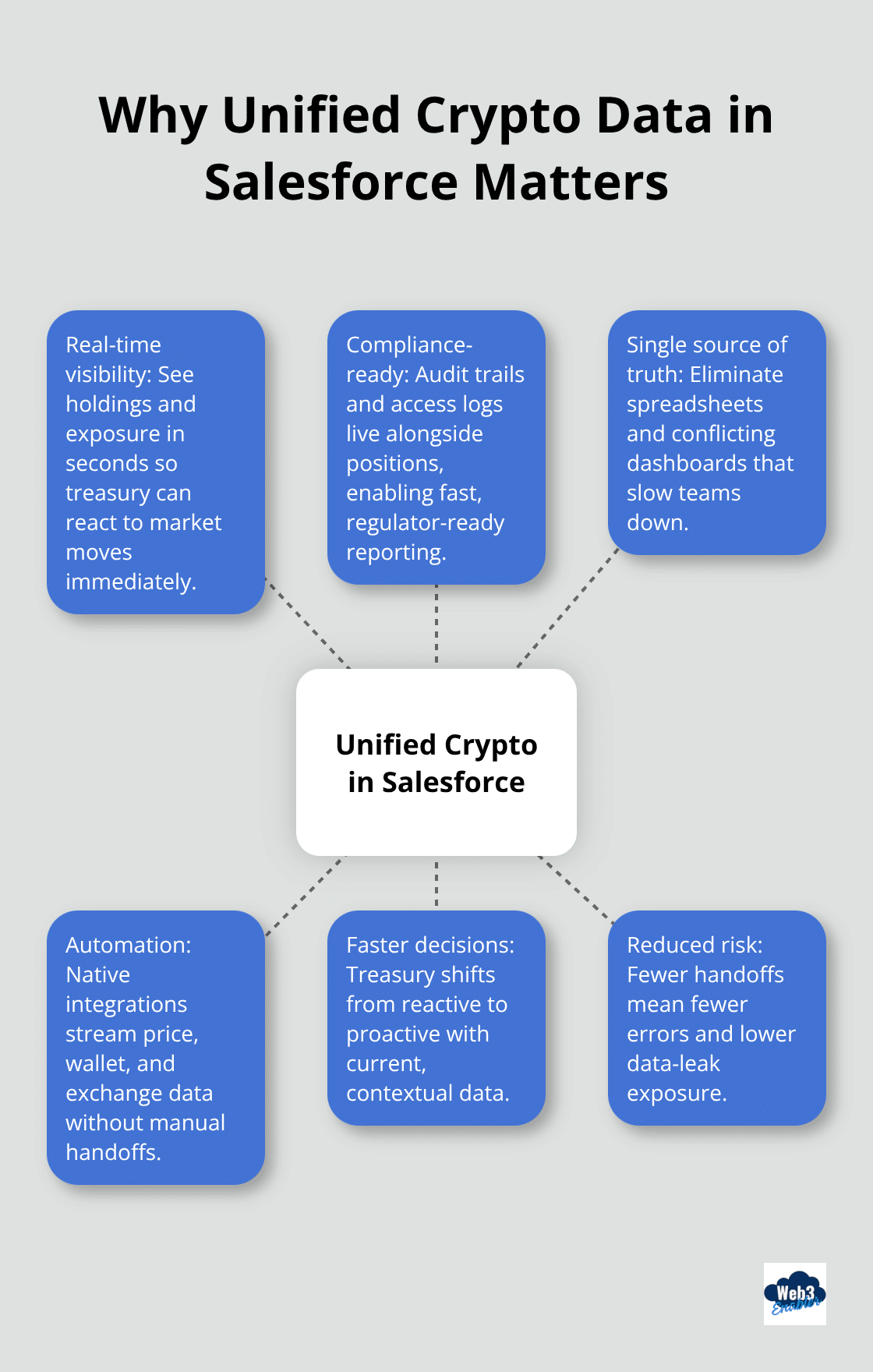
Salesforce already houses your customer data, financial records, and business operations in one place. Connecting your crypto holdings directly into Salesforce means your treasury data lives alongside the client information and financial metrics you track there already. No more switching between platforms. No more manual exports. No more spreadsheets that become unreliable the moment someone forgets to update them.
The Path Forward
Your finance team needs a single platform that connects blockchain wallets and exchange accounts directly to your Salesforce instance. This gives your treasury team real-time visibility into crypto holdings without leaving the platform they use every day. The question isn’t whether you can afford to unify your crypto data-it’s whether you can afford not to.
Why Salesforce Is Your Crypto Treasury’s Natural Home
Your Salesforce instance already knows everything about your customers, revenue, and financial position. It’s the system your team logs into every morning. It’s where deals live, where customer data sits, and where your business intelligence happens. The problem right now is that crypto holdings exist in complete isolation from this ecosystem. You’ve built this massive repository of business context in Salesforce, then you’re running separate tools, spreadsheets, and dashboards just to track crypto. That’s backwards.
Salesforce handles real-time data from dozens of business systems through native connectors and APIs. Your CRM syncs with your accounting software. Your ERP feeds transaction data directly into dashboards. Your payment processors push settlement records automatically. Crypto holdings should follow the same pattern. When you connect blockchain wallets and exchange accounts directly into Salesforce, you eliminate the manual handoff that’s destroying your team’s efficiency right now. Data flows automatically from your blockchain infrastructure into the same platform where your finance team already makes decisions. No exports. No copy-paste. No version control disasters where someone updates the wrong spreadsheet. This is how modern finance operations work.
Treasury Data That Actually Moves at Market Speed
Real-time visibility means your finance team sees holdings updates within seconds, not hours or days. When you manage crypto assets, market conditions change constantly. A price movement that matters for your hedging strategy doesn’t wait for someone to manually refresh a spreadsheet. Salesforce’s native integration with data platforms like Kaiko and Messari means your treasury dashboards reflect current market conditions without any operational lag. You get price feeds, volume data, and on-chain metrics flowing directly into your dashboards.
Your team can set alerts based on actual holdings data, not guesses about what you own. This matters for compliance too. Regulators expect you to demonstrate real-time understanding of your exposure. When your crypto data lives in Salesforce alongside your audit trails and compliance records, you can generate comprehensive reports in minutes instead of days. Having this data unified in one system isn’t optional anymore-it’s becoming table stakes for any organization holding meaningful crypto positions.
Stop Paying the Tax of Fragmented Systems
Your team currently wastes time translating data between systems. Someone pulls information from an exchange API, another person checks blockchain explorers, a third person updates the spreadsheet, and finance reconciles discrepancies. Each handoff introduces error. Each system adds complexity. Salesforce becomes your single source of truth. When treasury data, customer records, and financial metrics live in the same platform, your team answers questions faster.
How much USDC do you hold across all exchanges? One dashboard. What’s your total exposure to Ethereum? Another dashboard. How does your crypto position affect your client advisory relationships? That’s where Salesforce really shines, because your client data and your treasury data exist in the same system. Blockchain Payments enables your Salesforce Org to easily accept, track, report on, and automate based upon cryptocurrency transactions. Your finance team gets the visibility they need without IT spending months building integrations.
The Data Integration That Actually Works
Most organizations try to bolt crypto visibility onto their existing systems through clunky APIs and manual processes. You end up with dashboards that lag behind reality, spreadsheets that contradict each other, and compliance reports that take weeks to assemble. Native Salesforce integration changes this equation entirely. Your blockchain wallets and exchange accounts connect directly to your Salesforce instance (through secure, audited connections). Price data, transaction history, and holdings information flow automatically into your dashboards. Your team stops fighting with data and starts making decisions based on what they actually own.
The compliance benefits matter just as much as the operational ones. When your crypto holdings live in Salesforce, you create permanent audit trails that regulators can review. Every transaction, every price update, every access to sensitive data gets logged automatically. You’re not scrambling to reconstruct what happened three months ago-the system already knows. This becomes increasingly important as regulatory frameworks tighten around stablecoin reserves, customer asset protection, and operational transparency.
Your finance team now has everything they need to understand crypto exposure in real time, which means they’re ready to build the custom dashboards and automated compliance workflows that actually protect your organization.
How to Actually Connect Your Crypto to Salesforce
Start With Your Exchange Accounts
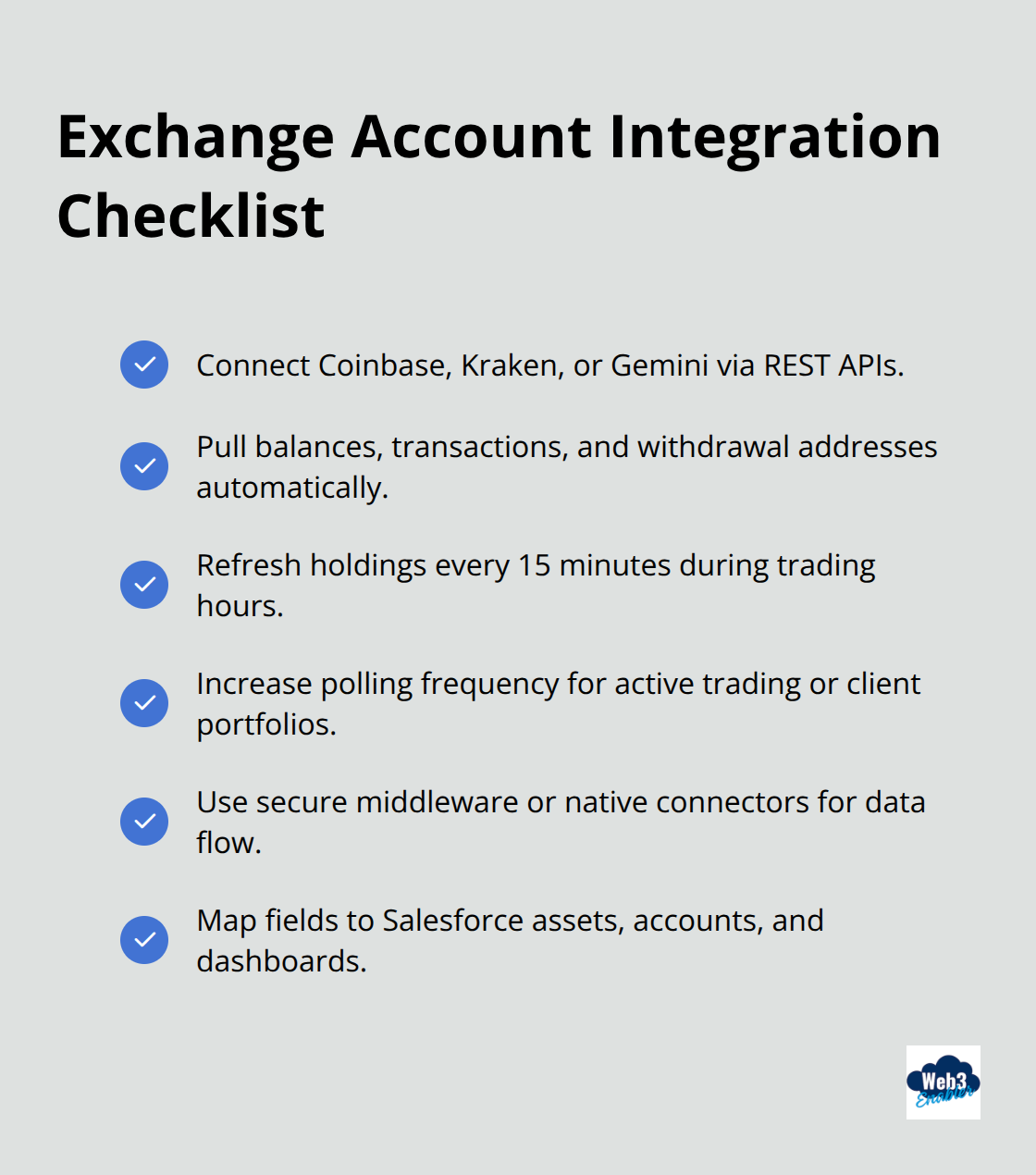
Your Salesforce instance needs to know what you own, where you own it, and what it’s worth right now. This means connecting your blockchain wallets and exchange accounts directly into the platform where your finance team already works. The technical setup matters less than the data flow-you need real holdings data from your actual custody solutions feeding into Salesforce dashboards automatically.
Start with your primary exchange accounts first. Most major exchanges expose API endpoints that return current balances, transaction history, and withdrawal addresses. Coinbase, Kraken, and Gemini all offer REST APIs that connect to Salesforce through middleware solutions or native connectors. The API connection should pull your holdings every 15 minutes during trading hours, more frequently if you actively trade or manage client portfolios.
Track Your Blockchain Wallets With On-Chain Data
Your blockchain wallets require a different approach than exchange accounts. Hardware wallets like Ledger and Trezor don’t expose public APIs, so you track addresses directly using on-chain data providers. Kaiko provides real-time market data across dozens of exchanges with WebSocket feeds, making it ideal for treasury dashboards that need sub-second price updates. Messari offers standardized project data and API access for low-latency pricing across thousands of assets.
BitInfoCharts delivers granular on-chain metrics like supply changes and wallet activity that help you anticipate market shifts. The Sfox API consolidates liquidity feeds across multiple venues into a single unified view, which means your team sees total exposure without manually checking five different platforms. This integration layer sits between your wallets, exchanges, and Salesforce-data flows in automatically, your dashboards stay current, and your team stops doing manual reconciliation.
Build Dashboards That Show What Actually Matters
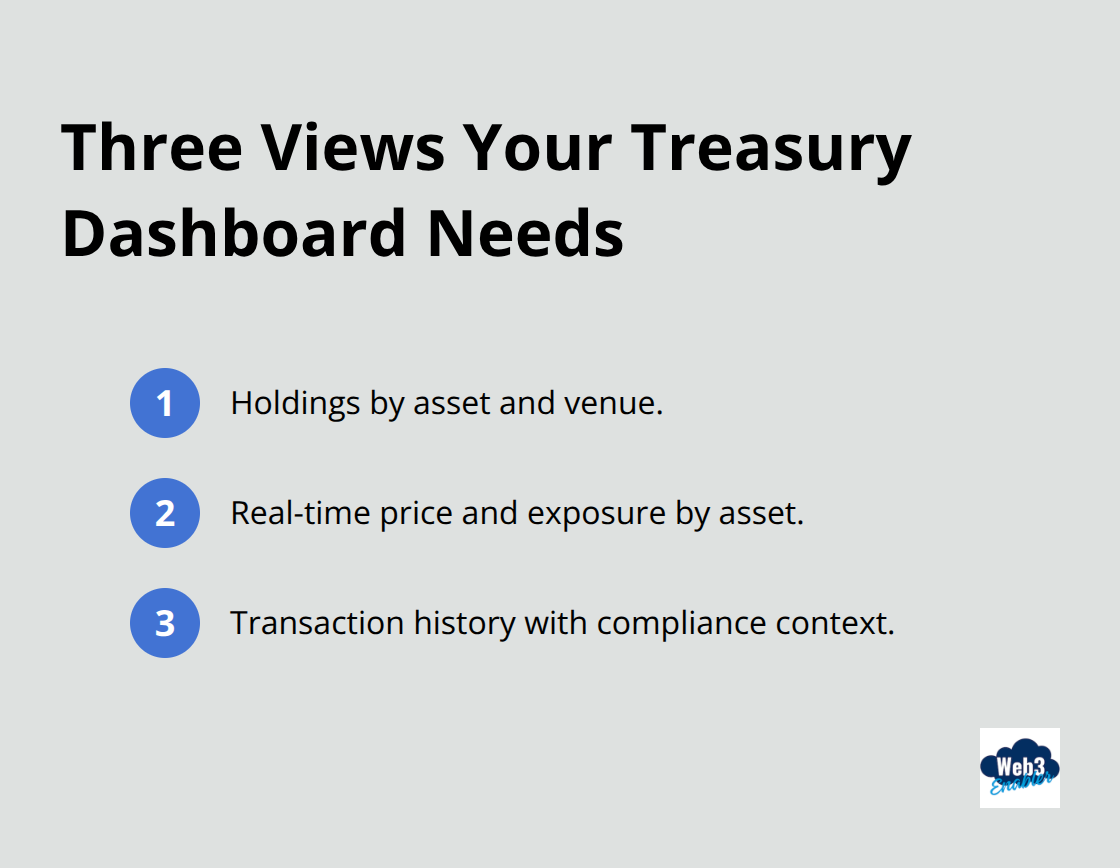
Your custom dashboards should surface three distinct views: current holdings by asset and venue, real-time price exposure across your portfolio, and transaction history for compliance. Use TradingView for charting if your team needs 100+ technical indicators and multi-chart layouts to monitor price action, though basic Salesforce charts handle most treasury use cases.
For compliance, Whale Alert tracks large transfers in real time and sends alerts when significant moves happen-your team knows immediately if holdings shift unexpectedly.
The audit trail matters just as much as the dashboard. Every API call that pulls data into Salesforce creates a timestamp and record. Every access to sensitive treasury information gets logged automatically. This permanent record satisfies regulatory requirements without your team doing extra work. Set attribute-based access controls so junior staff only see holdings summaries while senior finance and treasury staff access full transaction details. Time-limited access for contractors or temporary team members prevents long-tail data exposure after they leave.
Generate Compliance Reports That Regulators Actually Want
Your compliance reporting dashboard should pull directly from these audit logs-regulators want to see who accessed what, when they accessed it, and what they changed. Most organizations spend weeks assembling this information from scattered sources. With native Salesforce integration, the system generates comprehensive compliance reports in minutes.
The data quality matters more than the number of data sources. Cross-check key figures across multiple authoritative sources before trusting them in your dashboards. CoinMarketCap shows market cap and 24-hour volume, but data quality varies, so verify critical holdings against Kaiko or Messari prices. TensorCharts offers order-book heat maps that reveal trading pressure behind your holdings, helping you understand whether price moves reflect real demand or temporary volatility. Your Salesforce dashboards should refresh continuously during market hours, pause updates during low-volume periods, and alert your team when price movements exceed thresholds you define.
FAQ: Crypto Holdings in Salesforce
Why is Salesforce better than spreadsheets for tracking crypto treasury?
Spreadsheets are static and prone to human error; in 2026, a “stale” spreadsheet is a compliance risk. By connecting your exchange APIs and on-chain wallets directly to Salesforce, your treasury data becomes a “live” object. This creates a Single Source of Truth where your crypto holdings sit alongside your traditional financial metrics and customer data, eliminating manual data entry and version control disasters.
How often does the data sync from exchanges and wallets?
Most institutional setups utilize a tiered sync strategy. Standard exchange balances (from Coinbase, Kraken, etc.) typically refresh every 15 minutes via REST APIs. For active trading or high-value treasury monitoring, sub-second updates can be achieved using WebSocket feeds from providers like Kaiko or Messari, ensuring your dashboards reflect current market conditions without operational lag.
Can Salesforce generate compliance reports for regulators?
Yes. Under the 2025 Corporate Digital Asset Reporting Act, regulators demand clean audit trails. Because Salesforce logs every API call and record update, you can generate comprehensive Proof of Reserve and Exposure Reports in minutes. This turns a weeks-long manual audit process into a simple dashboard export, satisfying both legal teams and external auditors.
Do we need to store private keys inside Salesforce for this to work?
No. For security, Salesforce only requires public wallet addresses and API keys with read-only permissions. Your private keys remain securely in your hardware wallets (like Ledger) or institutional cold storage. Salesforce acts as the “Intelligence Layer”—it tracks the value and activity of your assets without ever having the authority to move or withdraw them.
What happens if a major market move or an unauthorized transfer occurs?
Because the data is native to Salesforce, you can use Flow Builder to set automated alerts. For example, if your total exposure to an asset like USDC shifts by more than 10%, or if a “Whale Alert” detects a significant move from one of your watched addresses, the system can instantly notify your treasury lead or trigger a hedging workflow.
Final Thoughts
Your finance team has wasted enough time hunting for crypto data across five different systems. The fragmentation stops now. When crypto holdings in Salesforce become your single source of truth, everything shifts-your team moves faster, compliance becomes manageable, and you actually know what you own at any given moment.
Salesforce native solutions eliminate the operational chaos that costs your organization time and credibility. Real-time dashboards replace spreadsheets. Automated audit trails replace manual reconciliation. Your treasury team gains the visibility they need without IT spending months on custom integrations. Organizations managing meaningful crypto positions already consolidate their holdings data into Salesforce and discover that unified visibility transforms how they operate.
We at Web3 Enabler built Salesforce native solutions specifically for this problem. Our tools connect blockchain technology directly to your existing corporate infrastructure without requiring custom development or external platforms. If you’re ready to stop flying blind on crypto holdings, explore Web3 Enabler to see how native blockchain solutions simplify treasury management and compliance for your organization.