



Digital currency wallets hold real value, which means they attract real threats. Cyberattacks on financial institutions increased 38% year-over-year in 2025, and wallet breaches now cost companies an average of $4.45 million per incident.
At Web3 Enabler, we’ve seen firsthand how wallet security automation transforms risk management for financial services teams. By automating security controls directly within Salesforce, you reduce manual errors, maintain compliance effortlessly, and protect your digital assets without slowing down operations.
Why Wallet Security Matters Now
The Real Cost of Wallet Breaches
Cyberattacks on financial institutions jumped 38% year-over-year in 2025, and wallet breaches now cost companies an average of $4.45 million per incident. These numbers represent far more than abstract risk-a single compromised private key drains an entire digital asset position in seconds. Unlike traditional banking, blockchain transactions are irreversible. Once funds leave a wallet, they’re gone forever. The CERT-In advisories throughout 2026 have documented a sharp rise in cyber incidents targeting digital transactions, making wallet security existential for any institution holding digital assets.
The Regulatory Imperative
Financial institutions face a hard choice: invest in robust wallet security automation or accept mounting risk. Most institutions are choosing investment, with 88% of financial institutions committing budget to digital asset infrastructure in 2026 according to Fireblocks’ latest survey of 638 decision-makers. Regulatory pressure compounds this urgency. MiCA in the EU, the GENIUS Act and OCC guidance in the US, and MAS/HKMA standards in APAC all demand strict custody controls, immutable audit trails, and real-time transaction monitoring.

Non-compliance carries hefty fines and reputational damage that extends far beyond the wallet itself. A security incident doesn’t just cost money in stolen assets-it erodes customer trust, triggers regulatory investigations, and disqualifies institutions from future digital asset opportunities. Mid-sized banks (5,000–19,999 employees) are the most aggressive adopters, with 72% spending $1 million or more on digital asset infrastructure, because they understand that wallet security automation is no longer optional.
Why Automation Wins Over Manual Processes
Financial services teams that automate security controls within their existing CRM workflows gain a decisive advantage: they satisfy compliance requirements while eliminating manual errors that plague spreadsheet-based approaches. Automated monitoring catches suspicious transactions in real time, generates audit-ready logs instantly, and keeps security decisions locked inside your system where they belong. Web3 Enabler’s platform on Salesforce demonstrates how this integration works-combining blockchain visibility with Salesforce’s native automation and compliance tools to create a unified environment where finance and operations teams collaborate without friction.
The firms that move first establish control over their digital asset operations before threats escalate further.
How to Monitor and Control Wallet Activity Inside Salesforce
Wallet security automation inside Salesforce transforms how financial teams detect threats and maintain compliance. Rather than juggling separate systems, you monitor on-chain transactions, enforce access controls, and generate audit trails directly within the CRM where your finance and operations teams already work. This integration eliminates friction from manual handoffs and reduces the window for human error. When a transaction occurs on the blockchain, Salesforce captures it in real time, cross-references it against your compliance rules, and flags anomalies instantly.
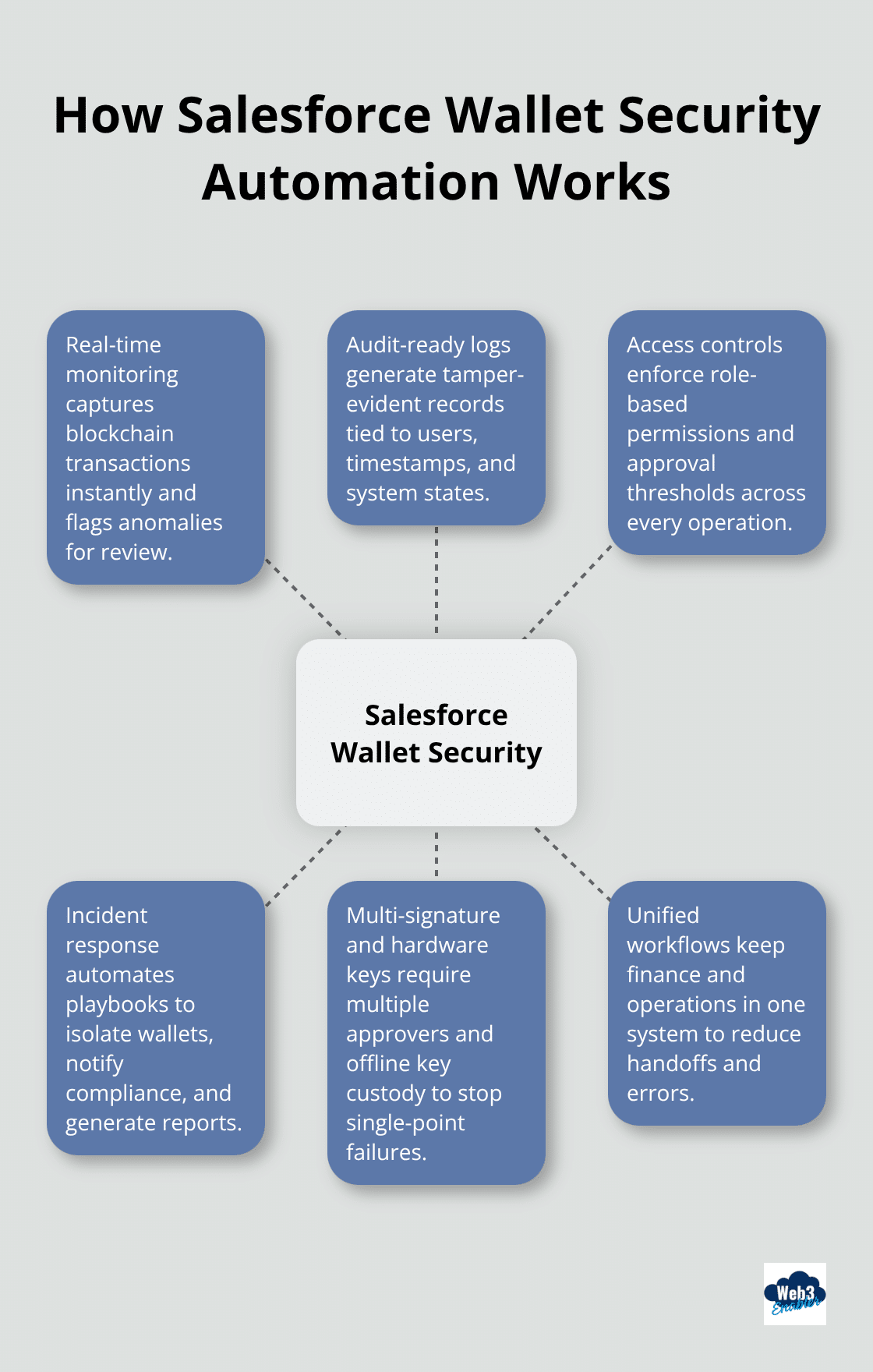
You see which wallet moved funds, when it happened, who authorized it, and whether it violated any policy-all in one place. The result is faster threat detection and audit-ready documentation that regulators expect.
Real-Time Detection Replaces Reactive Response
Financial institutions that automate transaction monitoring catch suspicious activity within seconds rather than hours. Automated monitoring is a foundational control for wallet security, yet most teams still rely on manual review processes that introduce delays and miss threats. Automated anomaly detection within Salesforce flags transactions that deviate from normal patterns-unusual amounts, unfamiliar recipient addresses, transactions outside business hours-and routes alerts to compliance officers immediately. You set thresholds once and the system enforces them consistently across every transaction.
This speed matters because wallet-targeted attacks move fast; a compromised private key can drain an entire position in minutes. Real-time monitoring gives you the response window to act before damage escalates. Combine this with multi-signature controls and hardware wallet integration, and you eliminate single-key failure modes that attackers exploit. Financial institutions that automate this detection now report faster incident response times and fewer successful breaches than competitors still using spreadsheets.
Compliance Audit Trails Built Into Your Workflow
Regulators demand immutable records of every transaction, every approval, and every control check. Manual logging fails this test because entries are incomplete, inconsistent, or simply forgotten. Salesforce automation creates tamper-evident transaction records tied to user identities, timestamps, and system states. Every wallet operation generates an audit log entry automatically-no manual data entry, no gaps.
When MiCA audits or OCC examinations arrive, your compliance team pulls reports directly from Salesforce showing exactly who authorized what, when, and why. This level of visibility satisfies regulatory requirements while dramatically reducing audit preparation time. Governance and role-based access controls within Salesforce mean only authorized personnel can approve high-value transactions or modify security settings, with every change logged. Financial institutions following this approach report faster regulatory approvals and lower compliance costs compared to institutions managing audit trails manually.
Access Controls That Prevent Unauthorized Transactions
Role-based access controls within Salesforce restrict who can initiate, approve, or modify wallet transactions. You assign permissions based on job function-a junior analyst views transaction history but cannot approve transfers, while a treasury manager can approve transactions up to a set limit. Salesforce enforces these rules automatically across every operation. If someone attempts to exceed their authority, the system blocks the action and logs the attempt. This prevents insider threats and limits damage if an account is compromised (the attacker can only perform actions the legitimate user could perform).
Multi-signature requirements add another layer: high-value transactions require approval from multiple authorized signers before execution. A single compromised credential cannot drain your wallet. Hardware wallet integration stores private keys offline, so even if someone gains access to your Salesforce environment, they cannot move funds without physical access to the hardware device. These controls work together to create redundancy that stops most attacks.
Visibility That Drives Faster Incident Response
When a security incident occurs, speed determines whether you contain it or suffer catastrophic loss. Salesforce dashboards show wallet activity in real time, so your security team sees suspicious transactions as they happen. You can immediately freeze the affected wallet, revoke access tokens, or trigger additional verification steps without waiting for manual investigation. Incident response playbooks within Salesforce automation can execute automatically-isolating a compromised wallet, notifying compliance officers, and generating incident reports without human intervention.
This automated response capability (combined with immutable audit logs) means you can demonstrate to regulators exactly what happened, when you detected it, and what actions you took. Your incident response time shrinks from hours to minutes, and your documentation is complete before the incident even concludes. Teams that implement this level of automation report significantly lower breach impact and faster recovery compared to institutions relying on manual processes.
The next chapter explores how to build and maintain the employee training and access management procedures that keep your security controls effective over time.
Building Security Layers That Actually Work
Multi-Signature Controls Stop Single-Point Failures
Multi-signature controls eliminate the single-point-of-failure risk that makes wallets attractive targets. Instead of one person or one key authorizing transactions, you require approval from multiple authorized signers before any transfer executes. This means a compromised credential cannot drain your wallet alone. MPC wallet signing reduces single-key compromise risk by distributing cryptographic authority across multiple independent participants.
Hardware wallets store private keys offline, creating an additional barrier. Even if someone gains access to your Salesforce environment, they cannot move funds without physical possession of the hardware device. The combination of multi-signature requirements and hardware wallet integration creates genuine redundancy. Set approval thresholds based on transaction size: routine payments under $50,000 might require one signature, while transfers above $500,000 require three signers from different departments. This approach balances operational speed with security.
When you integrate these controls directly into Salesforce workflows, access rules enforce automatically-no manual workarounds, no exceptions that undermine the system. Role-based permissions restrict who can initiate, approve, or modify transactions, and every action logs with user identity and timestamp. A junior analyst cannot approve high-value transfers regardless of circumstances; the system prevents it.
Independent Audits and Penetration Testing Reveal Hidden Gaps
Regular security assessments reveal gaps that automation alone cannot catch. Conduct independent third-party security audits of your wallet infrastructure at least annually, with penetration testing that specifically targets your Salesforce integration and private key management. Bug bounty programs incentivize external researchers to find vulnerabilities before attackers do-allocate budget for this because the cost of discovery through bounty is minimal compared to breach costs.
Update wallet software, Salesforce security patches, and operating systems immediately when vendors release fixes; delayed patching is how attackers gain entry. Automate firmware updates for hardware wallets to eliminate the human error of manual version management. Test your backup and recovery procedures quarterly to confirm they actually work-do not wait for a crisis to discover your recovery phrase is corrupted or incomplete. NIST guidelines recommend maintaining immutable audit logs of all wallet operations with tamper-evident records so regulators can verify nothing was altered post-incident. Implement zero-trust principles for wallet access, requiring continuous verification of user identity and device state before granting permissions-never trust a session simply because someone authenticated once that day.
Employee Training Transforms Controls Into Practiced Behavior
Employee training transforms security controls from technical checkboxes into lived practice. Phishing attacks targeting wallet credentials succeed because employees click suspicious links or share access information under social pressure. Train finance and operations staff to recognize phishing tactics: urgent language claiming account compromise, generic greetings instead of names, poor grammar, and requests to verify credentials via email links. Legitimate services never ask for private keys, recovery phrases, or full passwords via email or chat.
Conduct quarterly phishing simulations where your security team sends fake phishing emails to employees and tracks who falls for the trap-use results to identify individuals needing additional training. Establish clear incident reporting procedures so employees know exactly who to contact if they suspect a compromise, and assure them reporting quickly prevents larger problems rather than triggering punishment.
Access Management Procedures Balance Security With Operational Reality
Access management procedures must balance security with operational reality. Enforce 12-character minimum passwords with complexity requirements, and mandate password changes every 90 days for accounts with wallet access. Deploy password managers across your finance team so employees use genuinely random passwords instead of variations on a theme they can remember.

Enable two-factor authentication for all wallet-related accounts using hardware keys or authenticator apps rather than SMS, which is vulnerable to SIM swapping attacks. Conduct quarterly access reviews where managers confirm that each team member still needs their current permissions-people change roles but retain old access, creating unnecessary risk. Document every access grant and revocation with business justification so auditors can verify that permissions match actual job functions. Salesforce automation enforces these access controls consistently across your wallet operations, so your team focuses on legitimate transactions rather than security administration.
Final Thoughts
Wallet security automation transforms from a competitive advantage into a baseline requirement for financial institutions managing digital assets. Institutions that integrate security controls directly into Salesforce rather than deploying separate tools eliminate friction, respond to threats in seconds instead of hours, and generate audit-ready documentation automatically. The cost of a single breach far exceeds the investment in proper automation, making this shift essential for any organization holding digital currencies.
Implement multi-signature controls and hardware wallet integration to eliminate single-point failures, conduct regular security assessments to catch gaps before attackers exploit them, and train your team to recognize real-world threats. These practices work together to create genuine resilience that financial institutions report as faster incident response, lower breach impact, and smoother regulatory approvals compared to competitors still managing wallets manually. Wallet security automation keeps your operations secure and compliant without slowing down your business.
We at Web3 Enabler bring wallet security automation directly into Salesforce, combining blockchain visibility with native CRM controls so your finance and compliance teams collaborate without switching between systems. Start by auditing your current wallet security practices against the controls outlined here, then contact us to explore how blockchain-powered payments within Salesforce can transform your digital asset operations into a secure, compliant, and efficient engine for modern finance.