



Global payments are broken. Cross-border transactions still take days, cost thousands in fees, and create friction between your sales team and treasury operations. Stablecoins fix this.
We at Web3 Enabler have seen enterprises cut settlement times from days to minutes and eliminate intermediaries that drain margins. Stablecoin onboarding for enterprises isn’t a future experiment-it’s happening now, and your competitors are already moving.
Why Enterprises Are Moving to Stablecoins
Settlement Speed Transforms Cash Flow
Traditional cross-border payments route through correspondent banks, each adding delays and fees. The average transaction takes 3-5 days to settle. Stablecoins settle in minutes on blockchain rails, and this speed directly impacts your cash flow. When Chainalysis analyzed real economic activity in 2025, they found adjusted stablecoin volume reached 28 trillion dollars-a figure that excludes wash trading and internal transfers. That volume reflects actual payments, remittances, and settlements happening today.
For enterprises managing global operations, this speed advantage translates to working capital relief. Axiym’s TreasuryOS eliminates pre-funding across 140+ currencies and reduces working capital needs by 70-90 percent. If your enterprise processes high-volume international payments or manages supplier networks across multiple regions, you hold capital that stablecoin settlement could free up immediately.
Cost Reduction Compounds Across Regions
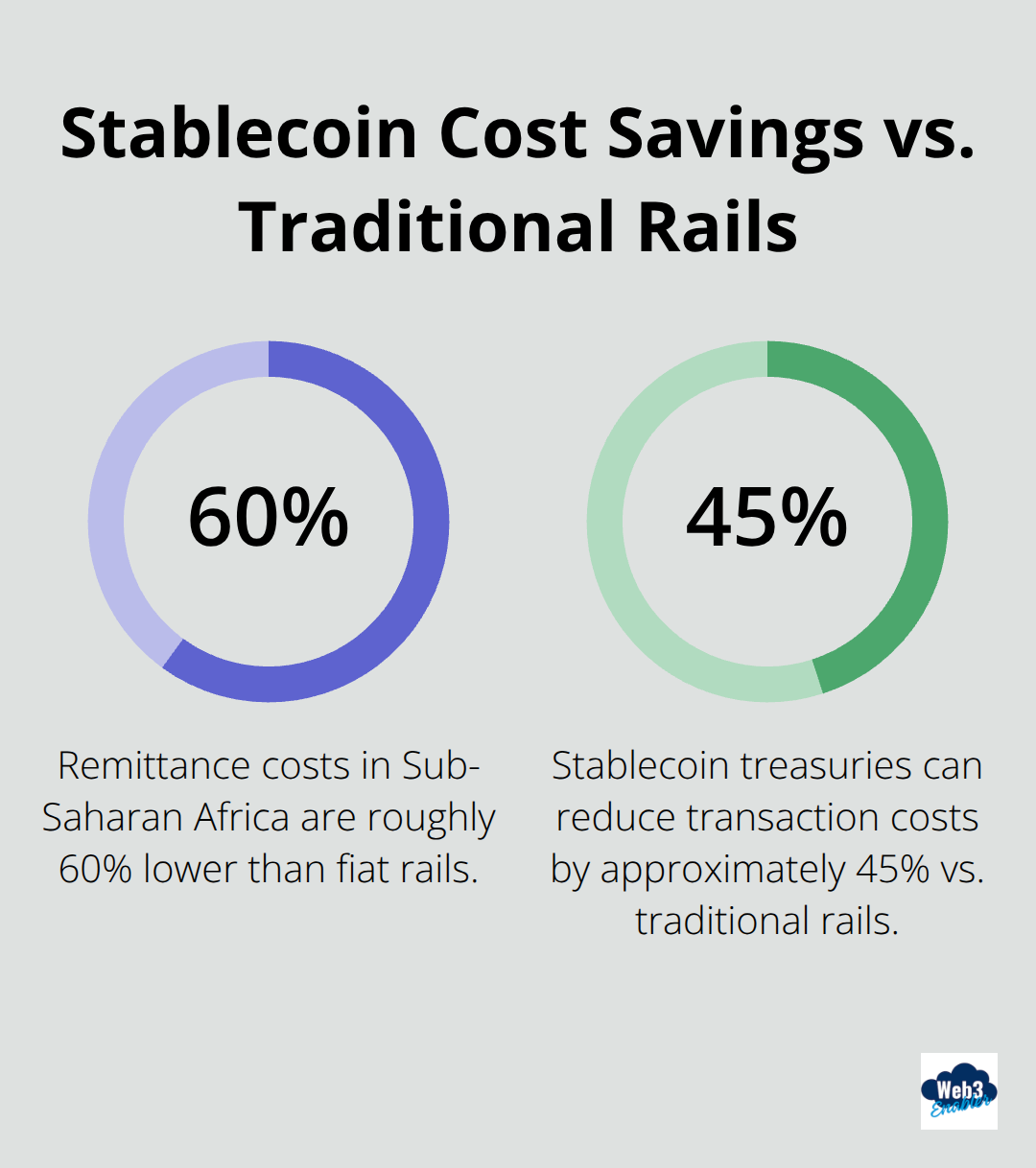
The cost difference between stablecoins and traditional rails widens dramatically in emerging markets. Chainalysis reported that stablecoin remittance costs run about 60 percent cheaper than traditional fiat rails in Sub-Saharan Africa-a gap that expands where correspondent banking fees spike. Fewer intermediaries mean lower fees, and blockchain transparency shows exactly where your money moves.
This cost reduction isn’t theoretical. Enterprises handling cross-border payroll, supplier payments, or customer refunds see measurable savings within the first quarter of deployment. Your finance team stops absorbing hidden banking fees and starts controlling transaction costs directly.
Real-Time Liquidity Visibility Changes Operations
On-chain transactions are immutable and instantly visible, eliminating reconciliation delays that plague traditional banking. Your finance team stops waiting for settlement confirmations and starts managing liquidity with actual data. This growth reflects confidence that stablecoins will become standard infrastructure, not a niche experiment.
Your competitors already moving to stablecoins gain operational advantages now-faster settlements, lower costs, better liquidity visibility, and reduced reconciliation overhead.
Connecting Payments to Your Salesforce Workflows
Web3 Enabler integrates stablecoin payments directly into Salesforce, so your finance, sales, and operations teams collaborate in one environment instead of juggling separate banking portals and legacy systems. This consolidation means your treasury operations connect seamlessly to your sales process, your revenue recognition automates against on-chain settlement data, and your compliance team maintains full auditability within the CRM.
The speed, cost, and transparency advantages of stablecoins are operational reality for enterprises moving now. Your next step is understanding how to implement these capabilities within your existing Salesforce environment.
Building Stablecoin Payments Into Salesforce
Your Salesforce environment already manages customer relationships, revenue pipelines, and financial data. Stablecoin payments belong in that same system, not scattered across banking portals and separate wallets. When a customer payment arrives on-chain, your revenue recognition triggers automatically, your treasury dashboard updates in real time, and your compliance team audits the entire transaction without switching platforms. This consolidation matters because your finance team stops reconciling data across systems and starts making decisions based on unified, live information.
Automatic Revenue Recognition Eliminates Timing Gaps
Traditional cross-border payments create a timing gap between invoice issuance and actual settlement. Your revenue team estimates when funds will arrive, books the revenue, then reconciles discrepancies weeks later. Stablecoin payments settle in minutes, so your Revenue Cloud records revenue at the moment of on-chain confirmation rather than guessing at settlement dates. This accuracy eliminates manual journal entries and the errors that accompany them.
Commerce Cloud merchants experience the same benefit. When a customer pays in stablecoins, the transaction settles instantly and your order-to-cash cycle compresses from days to minutes. Your finance team no longer tracks down delayed payments or manages currency conversion delays; they manage actual cash flow with real settlement data.
Treasury Visibility Connects to Sales Pipeline
Your treasury team currently manages liquidity separately from your sales team’s pipeline visibility. Stablecoin integration connects these functions within Salesforce, so your treasury dashboard shows not just current balances but also incoming payments from opportunities that are closing. This visibility lets your finance team anticipate liquidity needs and position stablecoin holdings strategically instead of reacting to surprises.
When your sales team closes a large deal with a customer in emerging markets, your treasury team immediately sees the payment method and prepares for settlement without traditional banking delays. Financial Services Cloud advisors gain similar visibility-they see client wallet balances, stablecoin positions, and on-chain transaction history within the CRM, enabling them to provide informed guidance on digital asset allocation and liquidity management.
Real-Time Settlement Data Drives Operational Efficiency
On-chain transactions are immutable and instantly visible, eliminating reconciliation delays that plague traditional banking. Your finance team stops waiting for settlement confirmations and starts managing liquidity with actual data. Stablecoin treasuries can cut settlement from days to under 30 seconds and reduce transaction costs by approximately 45% compared to traditional fiat rails. Your Salesforce integration works the same way-it removes friction between the moment a payment settles on-chain and the moment your accounting system reflects it.
This operational shift matters most for enterprises with global customer bases and high-volume payment flows. Your compliance team maintains full auditability within the CRM, your operations team automates reconciliation against on-chain data, and your treasury team makes faster decisions with complete visibility. The next step is understanding how to automate the specific payment flows and reconciliation processes that consume your team’s time today.
How Enterprises Are Actually Using Stablecoins Today
Financial Institutions Accelerate Settlement and Free Capital
Financial institutions move stablecoins from pilot projects into production operations. Stripe’s acquisition of Bridge in 2024 signals serious institutional momentum-Stripe now enables unified global payments across 125+ payment methods including stablecoins, covering 195 countries and 135+ currencies. Mastercard’s partnership with BVNK demonstrates similar conviction from legacy payment networks. These moves reflect enterprises solving real operational problems, not experimental initiatives.
A financial institution reducing settlement times from 3-5 business days to seconds gains immediate working capital relief. Axiym’s TreasuryOS already processes $1 billion in stablecoin transactions on Avalanche, cutting pre-funding requirements by 70-90 percent across 140+ currencies. For treasury teams managing global operations, this capital efficiency directly impacts quarterly cash flow and eliminates the pre-positioning of funds that traditional correspondent banking demands.
E-Commerce Merchants Cut Costs and Compress Order-to-Cash Cycles
E-commerce platforms expanding into emerging markets face a different constraint: payment processing costs that devour margins. Chainalysis data shows stablecoin remittances cost roughly 60 percent less than traditional fiat rails in Sub-Saharan Africa. A Commerce Cloud merchant processing $10 million annually in cross-border transactions saves hundreds of thousands in fees through stablecoin rails instead of card networks.
The transaction settles instantly, your order-to-cash cycle compresses from days to minutes, and your reconciliation overhead drops because on-chain settlement is immutable and auditable. Web3 Enabler integrates this capability directly into your Salesforce environment, so merchants see stablecoin payments flow into Commerce Cloud orders without managing separate wallets or banking portals.
Revenue Cloud Teams Eliminate Timing Gaps in Revenue Recognition
Treasury teams using Revenue Cloud automate revenue recognition against actual on-chain settlement data rather than estimating when bank transfers will arrive. This eliminates timing gaps and manual journal entries that create audit friction. Your finance team records revenue at the moment of on-chain confirmation, not weeks later when traditional banking finally settles the transaction.
Operational Friction Disappears Across All Use Cases
The pattern across financial institutions, merchants, and treasury teams is identical: stablecoins remove operational friction, compress timelines, and free up capital that traditional banking locks away. Settlement happens in minutes instead of days, costs drop by 60 percent in emerging markets, and your teams stop reconciling data across disconnected systems.
Final Thoughts
Stablecoin onboarding for enterprises delivers three immediate operational wins: settlement speed that compresses days into minutes, cost reduction that hits 60 percent in emerging markets, and liquidity visibility that eliminates reconciliation delays. Your finance team stops managing capital tied up in correspondent banking and starts controlling cash flow with real-time on-chain data. Your sales team closes deals faster because payment settlement no longer creates timing gaps in revenue recognition.
Stripe’s acquisition of Bridge, Mastercard’s partnership with BVNK, and Axiym’s $1 billion in processed transactions demonstrate that stablecoin adoption is production reality, not experimental pilots. Your competitors are already capturing these benefits through operational efficiency that compounds quarterly. The enterprises moving now position themselves ahead of those still waiting for regulatory clarity or market maturation that has already arrived.
Start your digital asset strategy by assessing your current cross-border payment volumes and identifying where settlement delays and banking fees consume the most operational overhead. Web3 Enabler provides the only native blockchain platform on the Salesforce AppExchange, enabling your finance, sales, and operations teams to collaborate within a unified CRM (accepting and sending stablecoin payments, automating revenue recognition against on-chain settlement data, and gaining real-time visibility into transactions without leaving Salesforce). Connect with Web3 Enabler to map your specific payment flows into Salesforce and begin implementation.