



Treasury teams managing stablecoins across borders face a painful reality: settlements take days, systems don’t talk to each other, and visibility into digital assets remains fragmented. Real-time wallet visibility changes this equation entirely.
At Web3 Enabler, we’ve built real-time wallet visibility directly into Salesforce Financial Services Cloud so your treasury operations can see exactly what’s happening with your stablecoin positions the moment it happens. No more manual reconciliation delays. No more hidden costs buried in traditional payment infrastructure.
Why Your Treasury Can’t See Stablecoin Movements in Real Time
Treasury teams managing cross-border stablecoin positions operate in a world of artificial delays and disconnected systems. When you send a stablecoin payment across borders, settlement happens in minutes on-chain, yet your treasury systems won’t reflect that movement for hours or even days. A 2025 McKinsey and Artemis Analytics report found that stablecoin business payment volume reached approximately $390 billion, with flows across B2B transfers, payroll, remittances, and capital-markets activities. Despite this volume, most treasury teams still rely on manual spreadsheets and periodic batch reconciliations to track positions. Your finance team receives a wallet notification instantly, but your core banking system, your compliance dashboard, and your accounting records remain out of sync. This gap between on-chain reality and your internal records creates operational risk, decision delays, and hidden reconciliation costs that compound across dozens of daily transactions.
The Real Cost of Fragmented Data Sources
Your stablecoin treasury likely sits across multiple venues: exchange accounts, custody wallets, internal hot wallets, and DeFi positions. Each system operates independently with different data refresh cycles, different APIs, and different formatting standards. One exchange updates balances every five minutes, another every hour. Your custody provider sends daily statements. Your internal wallet infrastructure pushes events in real time but in a format your accounting team can’t easily interpret.
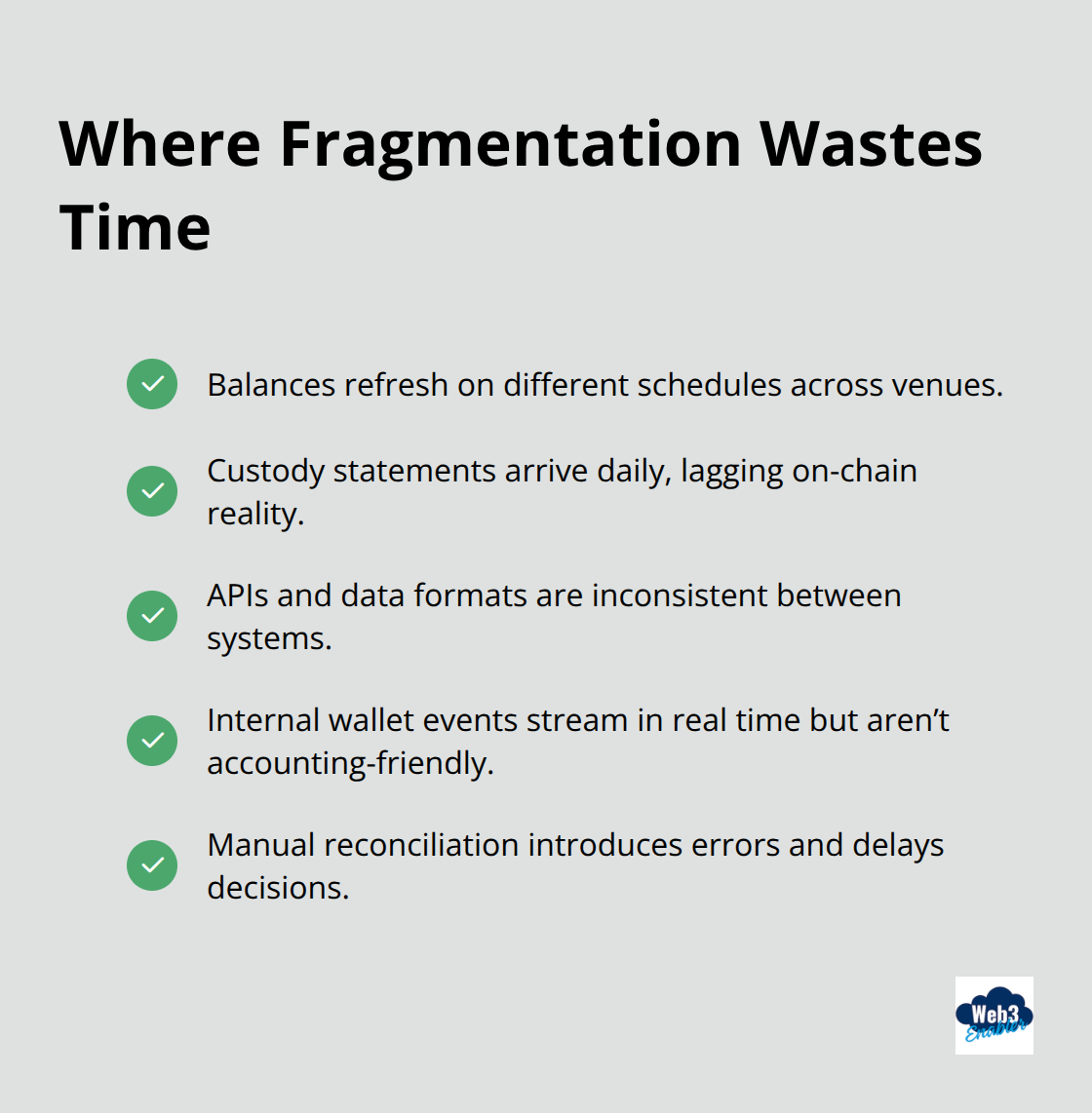
Treasury teams waste significant hours each week manually reconciling these sources, cross-checking blockchain records against exchange feeds, and hunting for discrepancies. This manual work introduces errors, delays settlement decisions, and keeps your liquidity management stuck in reactive mode rather than proactive optimization. The moment you need to reallocate capital across wallets or respond to a market opportunity, you’re already working with stale data.
Compliance Reporting Without Full Auditability
Regulatory requirements around stablecoin transactions continue tightening. The US GENIUS Act established a federal framework requiring 100 percent reserve backing and monthly disclosures. The EU’s MiCA regulation demands detailed transaction tracking and reserve verification. Most treasury teams generate compliance reports by exporting data from multiple systems, converting formats manually, and assembling narratives that are difficult to audit. When an examiner asks about a specific transaction from three weeks ago, your team searches through email threads, spreadsheet versions, and scattered notes rather than pulling an immutable, timestamped record from a unified system. This fragmentation exposes your organization to audit failures, regulatory friction, and the real possibility that you cannot prove transaction legitimacy when challenged.
Moving Toward Unified Visibility
Building auditability into your treasury operations means capturing every on-chain movement, every wallet interaction, and every compliance decision in a single, verifiable source of truth. Real-time visibility into your on-chain balances and stablecoin holdings directly within Salesforce eliminates that gap. This unified approach eliminates the manual reconciliation cycles that currently consume your team’s time and introduces the operational transparency your compliance and finance departments need to respond confidently to regulatory scrutiny. The next section shows how to implement this visibility in your own treasury operations.
Unified Visibility Across All Wallet Positions
Your liquidity manager sees exact positions across all wallets and exchanges without hunting through spreadsheets or calling custody providers. Your compliance officer pulls an immutable transaction record with full timestamps and counterparty details in seconds. Your CFO receives accurate treasury dashboards that reflect on-chain reality, not yesterday’s closing balances.
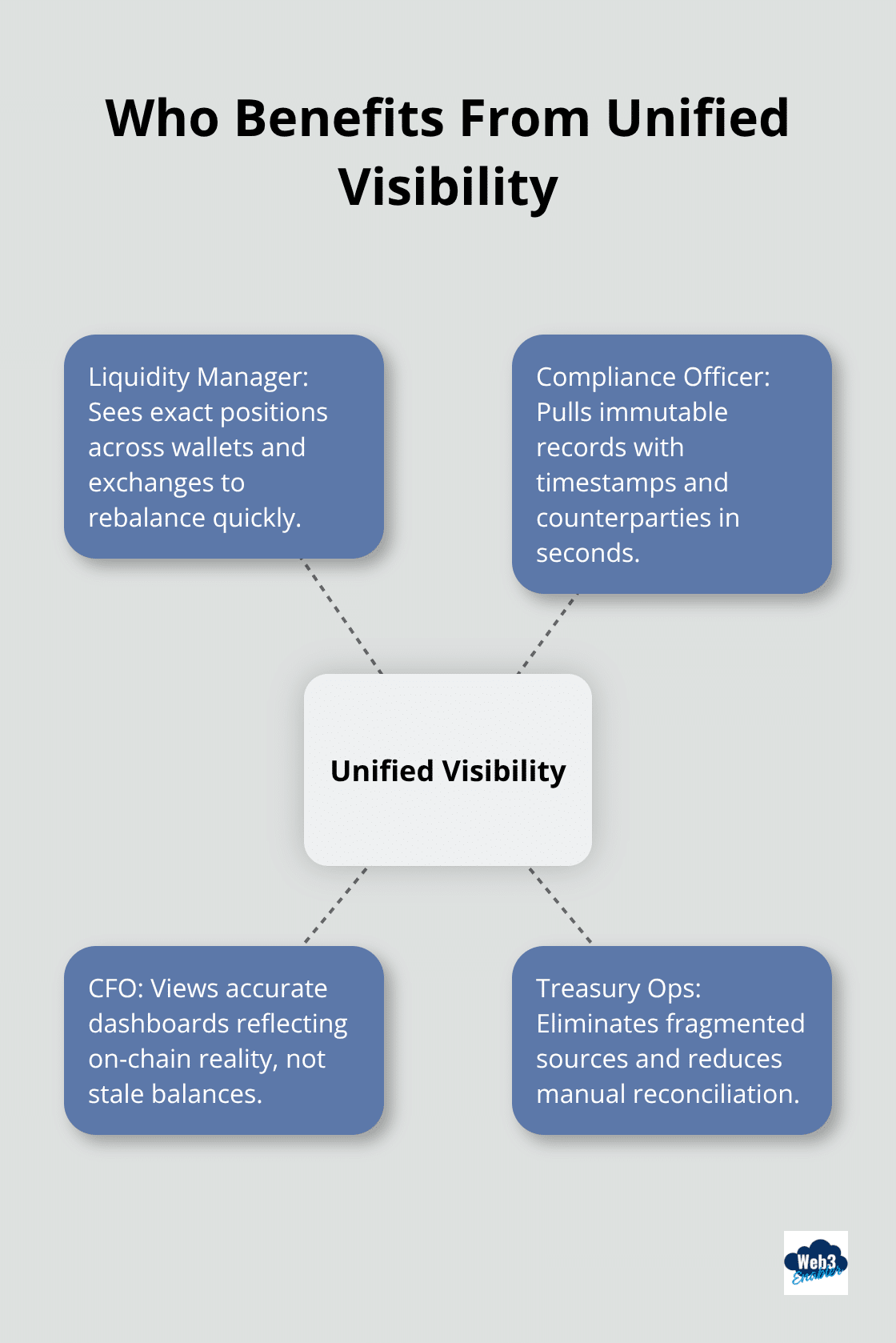
This unified approach eliminates the fragmented data sources that currently plague most treasury operations.
Native Salesforce Objects Enable Seamless Automation
The practical advantage extends beyond speed. Blockchain Payments for Salesforce brings blockchain-powered visibility as native Salesforce objects, meaning your existing automation rules, approval workflows, and reporting queries work seamlessly with on-chain data. When a large stablecoin inflow arrives, FSC automatically triggers a liquidity rebalancing workflow without manual intervention. When a transaction requires compliance verification, FSC flags it against your embedded policy guardrails and routes it to the right team member for approval.
Immutable Audit Trails for Regulatory Confidence
Your audit trail captures every action-every view, every decision, every adjustment-in an immutable ledger that satisfies regulatory examiners. Most treasury teams using traditional systems cannot answer a regulator’s question about a three-week-old transaction without reconstructing data from multiple sources. With FSC’s on-chain integration, you pull a single audit report that shows the transaction, its settlement path, its compliance status, and every downstream decision made in response. This level of auditability directly addresses the MiCA and GENIUS Act requirements for transparent, traceable stablecoin movements.
Moving From Reactive to Proactive Treasury Management
Real-time visibility transforms how your treasury team operates. Instead of discovering discrepancies during monthly reconciliation cycles, your team identifies and resolves issues as they occur. Liquidity decisions shift from reactive responses to market conditions into proactive optimization based on current, accurate data. Your compliance team moves from manual verification processes into automated policy enforcement that catches exceptions before they become problems. The next section shows how to integrate stablecoin positions directly into your FSC environment and activate these capabilities in your own operations.
Setting Up Real-Time Stablecoin Tracking in Your Treasury
Integrating stablecoin positions into Salesforce Financial Services Cloud requires three concrete steps: establishing data pipelines from your wallets and exchanges, configuring FSC objects to capture on-chain movements, and automating compliance workflows that respond to transactions as they settle. Start with mapping your current wallet infrastructure. Document every custody provider, exchange account, and internal wallet where stablecoins sit. Most treasury teams discover they have seven to twelve disconnected positions when they audit thoroughly. Native APIs and middleware pull wallet balances and transaction details into FSC as native Salesforce objects. This means your existing automation rules, approval workflows, and reporting queries work immediately without custom development. When USDC settles in your Coinbase custody account, FSC receives that transaction within seconds and automatically updates your liquidity position. Your treasury dashboard reflects the change instantly. Your compliance system flags any transaction exceeding your policy thresholds and routes it for review before settlement completes.
Automating Compliance Without Manual Verification
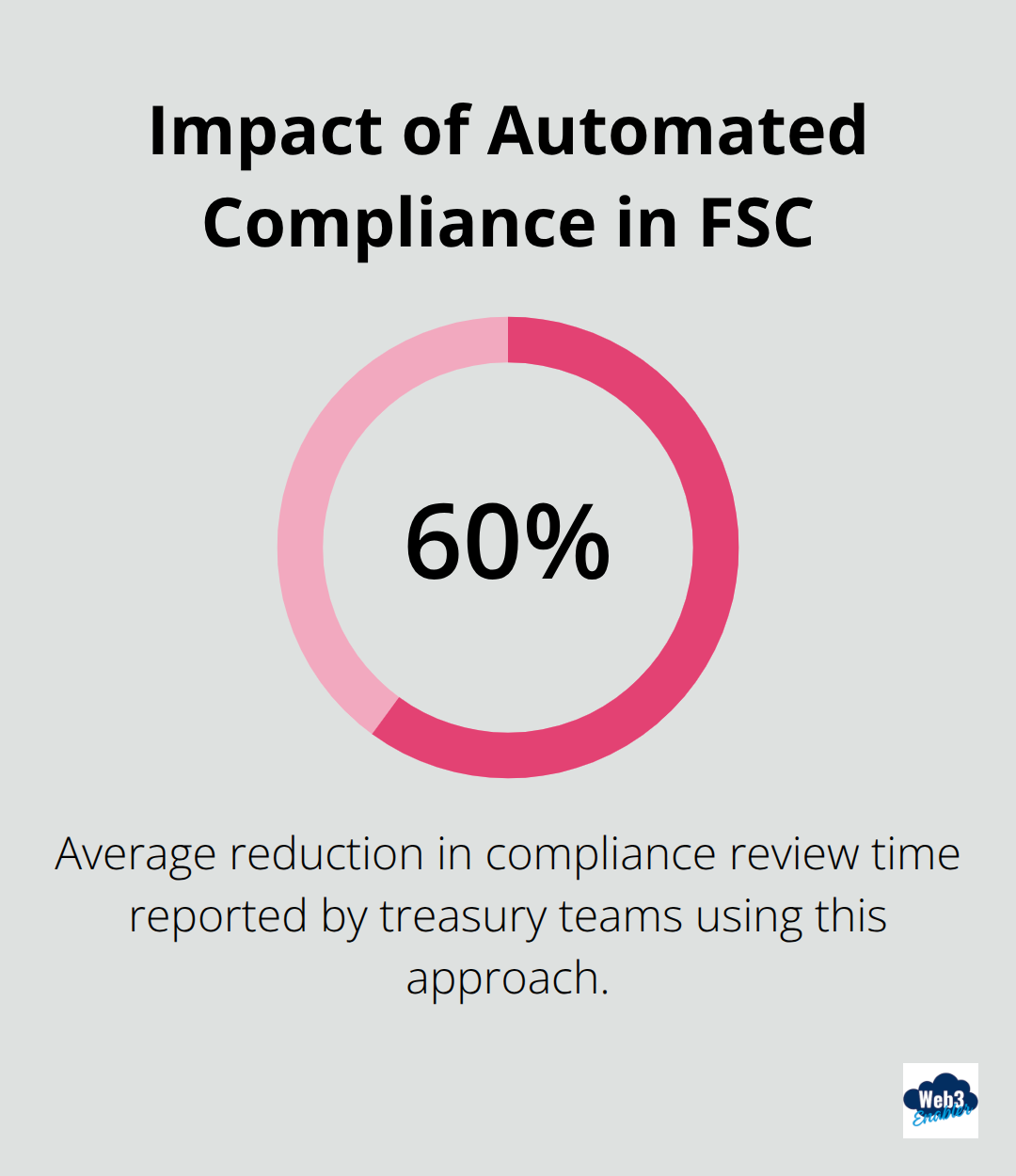
Regulatory requirements under MiCA and the GENIUS Act demand transaction-level auditability and reserve verification. Most treasury teams handle this through manual spreadsheets and quarterly reviews, which creates audit risk and delays regulatory responses. FSC automates this through embedded policy guardrails that enforce compliance rules at transaction time. Set rules once-require KYC verification for counterparties exceeding $500,000, flag cross-border transfers to high-risk jurisdictions, enforce reserve ratios across stablecoin holdings-and FSC enforces them continuously without manual intervention. Every transaction produces an immutable audit record with timestamps, counterparty details, compliance status, and settlement path. When regulators request documentation of your stablecoin movements from a specific date, you pull a single report from FSC rather than reconstructing data from email threads and spreadsheets. Treasury teams using this approach reduce compliance review time by roughly 60 percent and eliminate the reconciliation errors that typically surface during regulatory exams.
Connecting On-Chain Events to Your Existing Workflows
The operational advantage comes from treating on-chain movements as triggers for your existing FSC workflows. When a stablecoin inflow arrives from a client settlement, FSC automatically creates a liquidity alert for your treasury manager. When an outbound transfer requires multilevel approval, FSC routes it through your standard approval chain with full on-chain context visible to approvers. When a settlement completes, FSC automatically updates your revenue recognition records in Revenue Cloud (if you use it for billing). This eliminates the manual step where your finance team receives a blockchain notification, then manually updates your core systems hours later. Organizations that implement real-time tracking reduce settlement-to-record time from hours to minutes and eliminate the data-entry errors that plague manual processes.
Mapping Wallet Sources and Data Connectors
Your stablecoin positions likely span multiple venues: exchange accounts, custody wallets, internal hot wallets, and DeFi positions. Each system operates independently with different data refresh cycles, different APIs, and different formatting standards. One exchange updates balances every five minutes, another every hour. Your custody provider sends daily statements. Your internal wallet infrastructure pushes events in real time but in a format your accounting team cannot easily interpret. Connecting these sources through FSC creates a single source of truth. Native data connectors pull information from each venue on a consistent schedule and transform it into standardized Salesforce objects. Your treasury team accesses all positions through a single dashboard rather than logging into seven different platforms. This unified view eliminates the manual reconciliation work that currently consumes significant hours each week.
Building Auditability Into Your Treasury Operations
Compliance reporting without full auditability exposes your organization to regulatory friction and audit failures. Most treasury teams generate compliance reports by exporting data from multiple systems, converting formats manually, and assembling narratives that are difficult to verify. When an examiner asks about a specific transaction from three weeks ago, your team searches through email threads, spreadsheet versions, and scattered notes rather than pulling an immutable, timestamped record from a unified system. FSC captures every on-chain movement, every wallet interaction, and every compliance decision in a single, verifiable source of truth. Your audit trail shows the transaction, its settlement path, its compliance status, and every downstream decision made in response. This level of auditability directly addresses MiCA and GENIUS Act requirements for transparent, traceable stablecoin movements.
Final Thoughts
Treasury teams that activate real-time wallet visibility in Salesforce Financial Services Cloud transform how they operate. Your finance team stops waiting for batch reconciliations and makes liquidity decisions based on current, accurate data. Your compliance team moves from manual verification into automated policy enforcement that catches exceptions before they become regulatory problems.
The shift from fragmented systems to unified visibility eliminates operational friction that consumes your team’s time. Manual spreadsheets disappear, reconciliation cycles compress from days to minutes, and audit trails become immutable records that satisfy regulatory examiners without reconstruction. Organizations implementing this approach report roughly 60 percent reductions in compliance review time and eliminate the data-entry errors that typically surface during regulatory audits.
Web3 Enabler brings real-time wallet visibility directly into your Salesforce environment through native blockchain integration on Financial Services Cloud. Start with a pilot project focused on your highest-volume stablecoin corridors, map your wallet infrastructure, and measure the impact on reconciliation time and settlement accuracy. Contact Web3 Enabler to modernize your stablecoin treasury operations within Salesforce.