

Your finance team tracks payments across a dozen systems. Settlement confirmations arrive hours or days late. Compliance audits require manual digging through spreadsheets.
Cross-border payments visibility shouldn’t be this painful. At Web3 Enabler, we’ve seen how fragmented data creates bottlenecks that slow down global operations and drain resources.
Why Your Payment Systems Create Invisible Bottlenecks
The Hidden Cost of Opacity
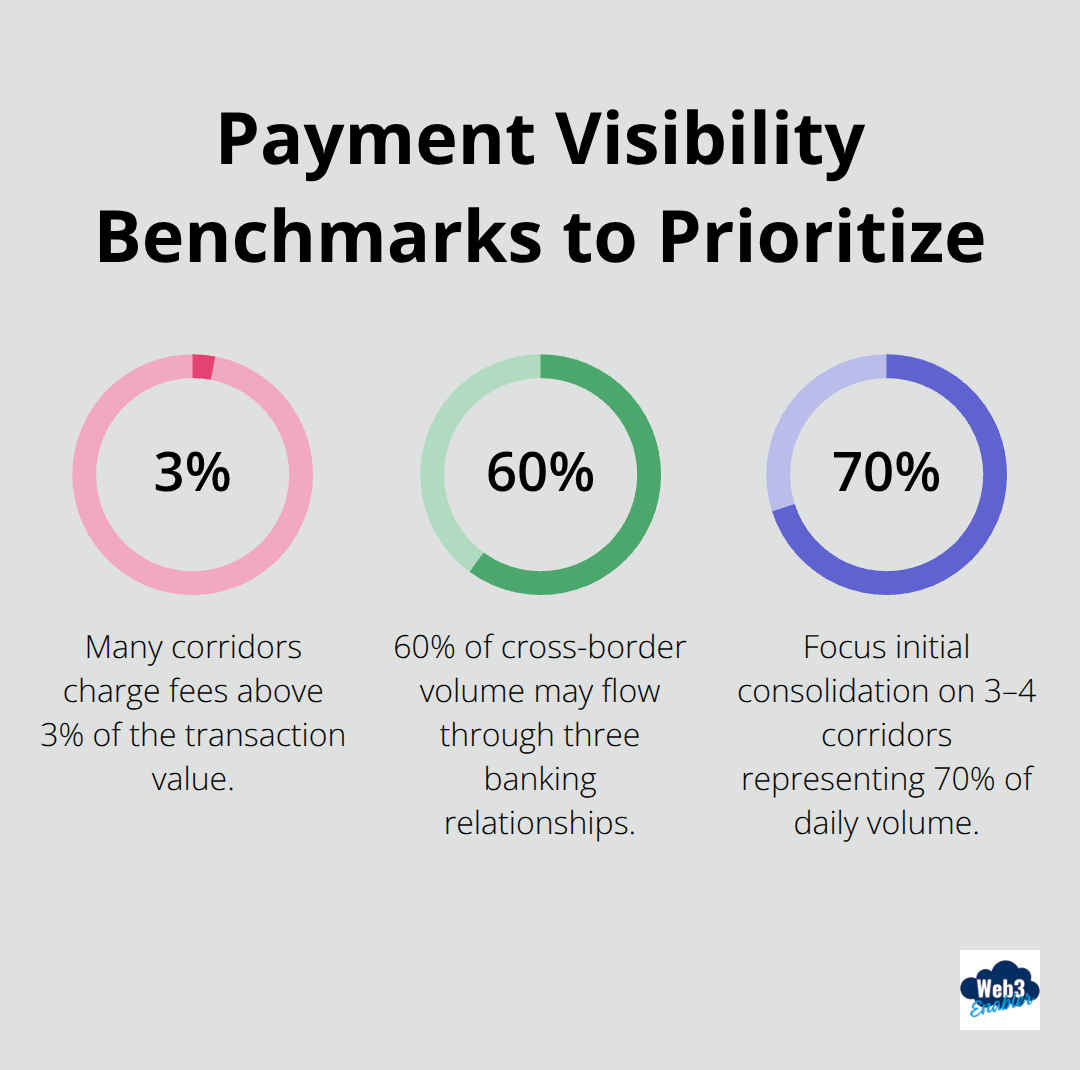
Nearly a quarter of cross-border corridors charge fees above 3% of the transaction value, according to SWIFT data, yet most finance teams cannot see where that cost actually comes from. Settlement confirmations arrive hours or days late because they travel through correspondent banking networks that operate in silos. Each bank in the chain processes information independently, then passes it downstream with no real-time visibility into where the payment sits.
The Compliance Audit Nightmare
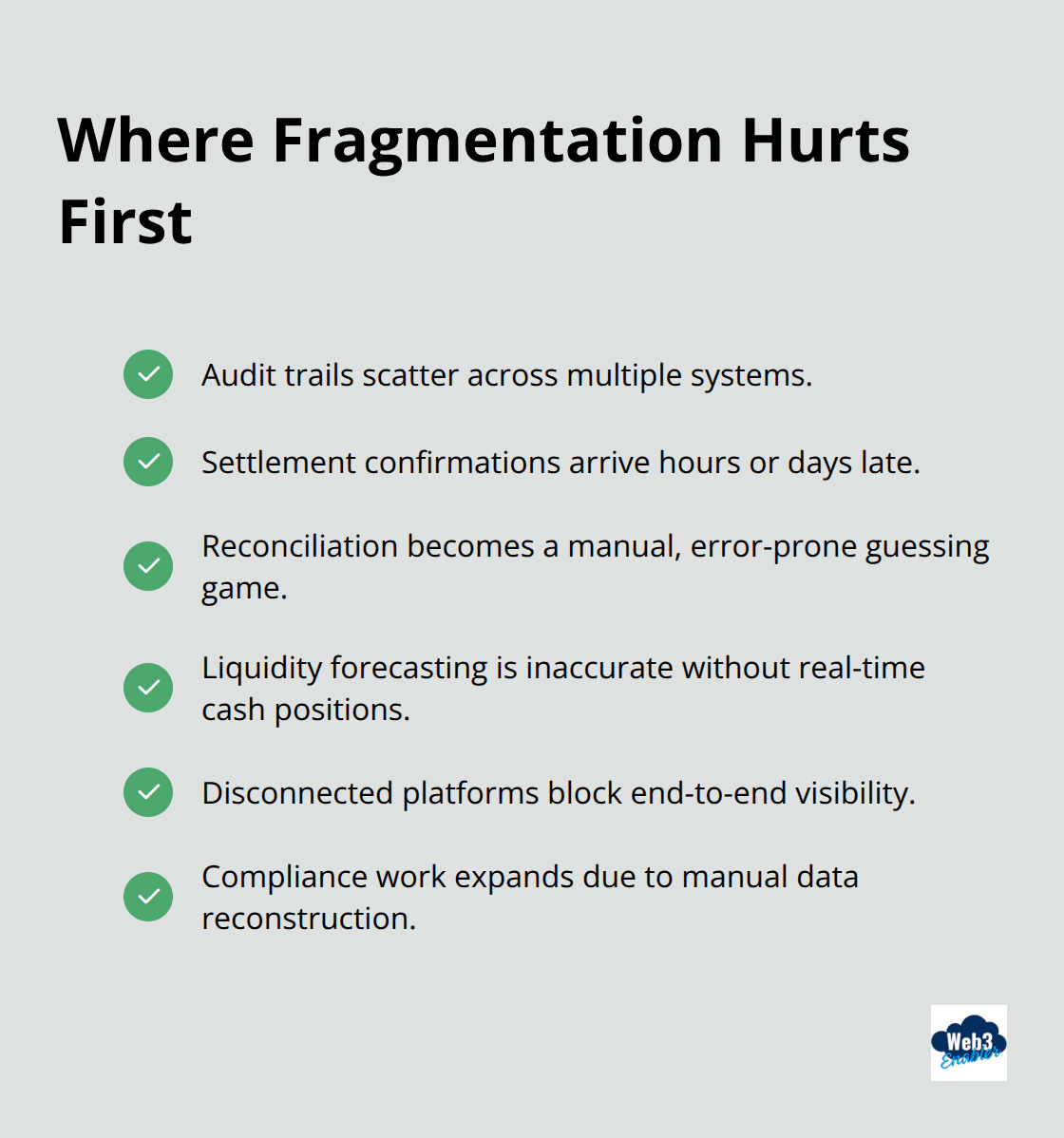
Compliance teams face an even worse problem: audit trails scatter across multiple systems, forcing manual spreadsheet work to reconstruct transaction flows for regulators. When a payment takes four days to settle, your team cannot tell if it stalled at the originating bank, an intermediary, or the receiving bank. This opacity creates a cascade of problems that ripple through your entire operation.
How Fragmentation Drains Resources
Reconciliation becomes a guessing game where finance staff spend hours matching confirmations across systems, often discovering discrepancies only after settlement completes. Liquidity forecasting becomes inaccurate because you cannot track cash positions in real time across time zones and currencies. Compliance cannot generate auditable trails without reconstructing transactions from fragmented data sources. The root cause is structural: traditional cross-border rails were built before real-time technology existed.
The Standards That Still Fall Short
SWIFT introduced gpi tracking with Universal End-to-End Transaction References (UETR) to improve transparency, and ISO 20022 adoption is accelerating to bring richer data fields. Yet most organizations still operate across disconnected systems that cannot talk to each other. Your accounts payable system does not speak to your bank portal. Your bank portal does not sync with your compliance platform. Each system holds partial information, and nobody has a complete picture.
What Fragmentation Costs You
This fragmentation directly hits your bottom line through delayed decision-making, manual labor costs, and compliance risk exposure. The financial impact compounds when you factor in the hours your team spends hunting for transaction status across platforms, the delays in cash forecasting, and the regulatory exposure from incomplete audit trails. Organizations that consolidate their payment data gain an immediate competitive advantage-they move faster, spend less on manual work, and reduce compliance risk. The question is not whether you need unified visibility, but how quickly you can build it.
What Changes When You See Payments in Real Time
When settlement confirmations arrive instantly instead of days later, your finance team stops reacting and starts leading. Real-time visibility into cross-border transactions means you know exactly where each payment sits in the settlement chain the moment it moves. SWIFT gpi tracking with Universal End-to-End Transaction References provides this capability across traditional corridors, but blockchain-based settlements compress the timeline even further. On-chain transactions settle in minutes rather than hours, and every step becomes verifiable immediately. Your compliance team pulls auditable trails in seconds instead of reconstructing them from fragmented spreadsheets. Your treasury team forecasts cash positions with actual data instead of estimates.
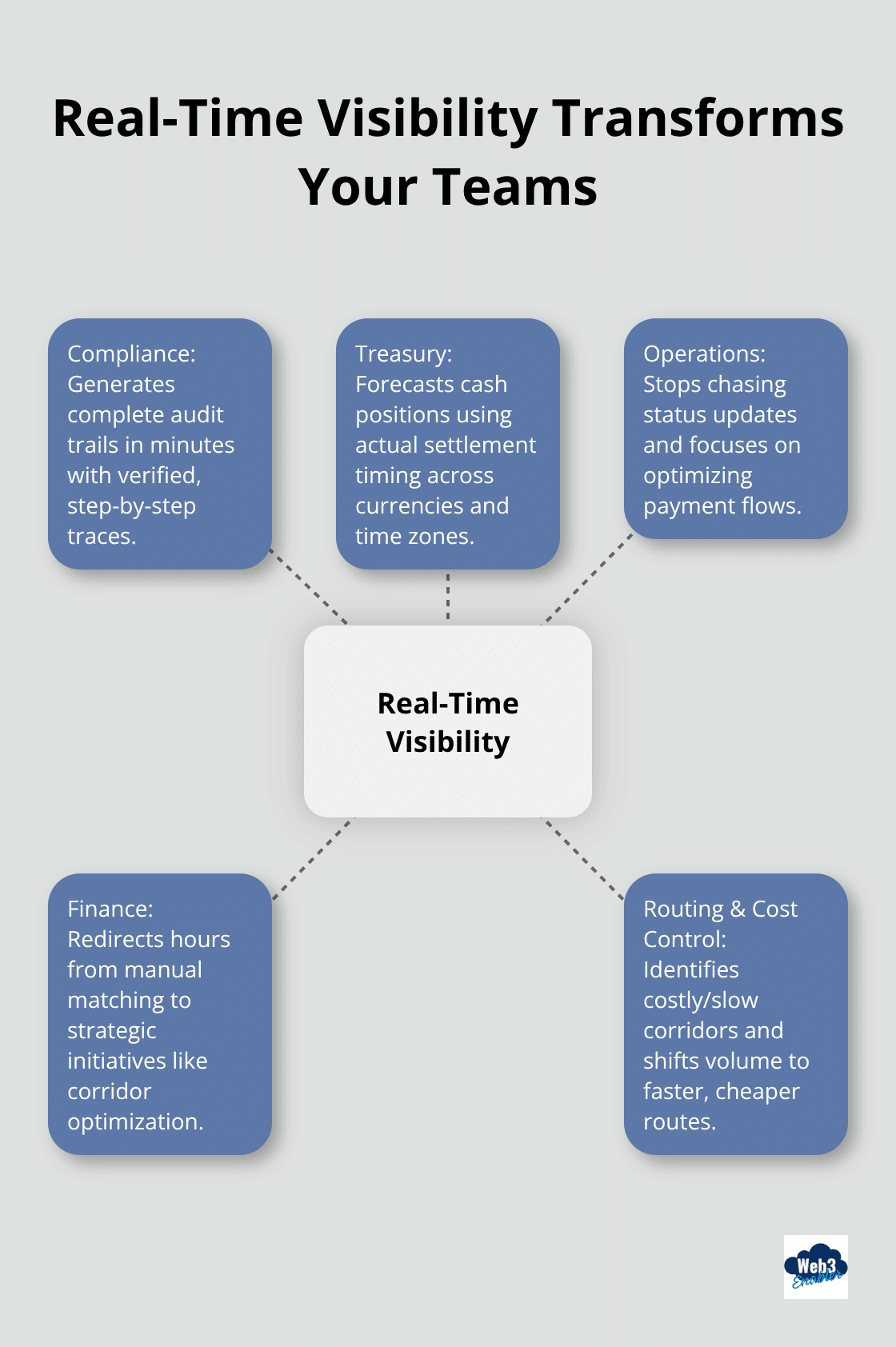
Your operations team stops chasing status updates and starts optimizing payment flows. This shift from manual investigation to automated visibility eliminates entire categories of work that currently consume your team’s bandwidth.
Settlement Speed Accelerates Decision Making
When you consolidate payment data from multiple rails into a single platform, reconciliation shifts from a manual process to an automated one. Deloitte research shows that greater visibility lowers total cost-to-serve for corporates through reduced manual handling and delays. A finance team that previously spent four hours daily matching confirmations across systems redirects that effort toward strategic work like optimizing payment corridors or negotiating better rates. Accenture data confirms that cloud-native platforms with API integrations unify diverse payment data into a single, scalable view, enabling near real-time status updates that reduce uncertainty for beneficiaries. For companies processing high-volume cross-border payments, this automation compounds quickly. If your organization processes fifty international payments daily, automated reconciliation saves roughly two thousand hours annually compared to manual matching.
Data Drives Better Routing and Cost Control
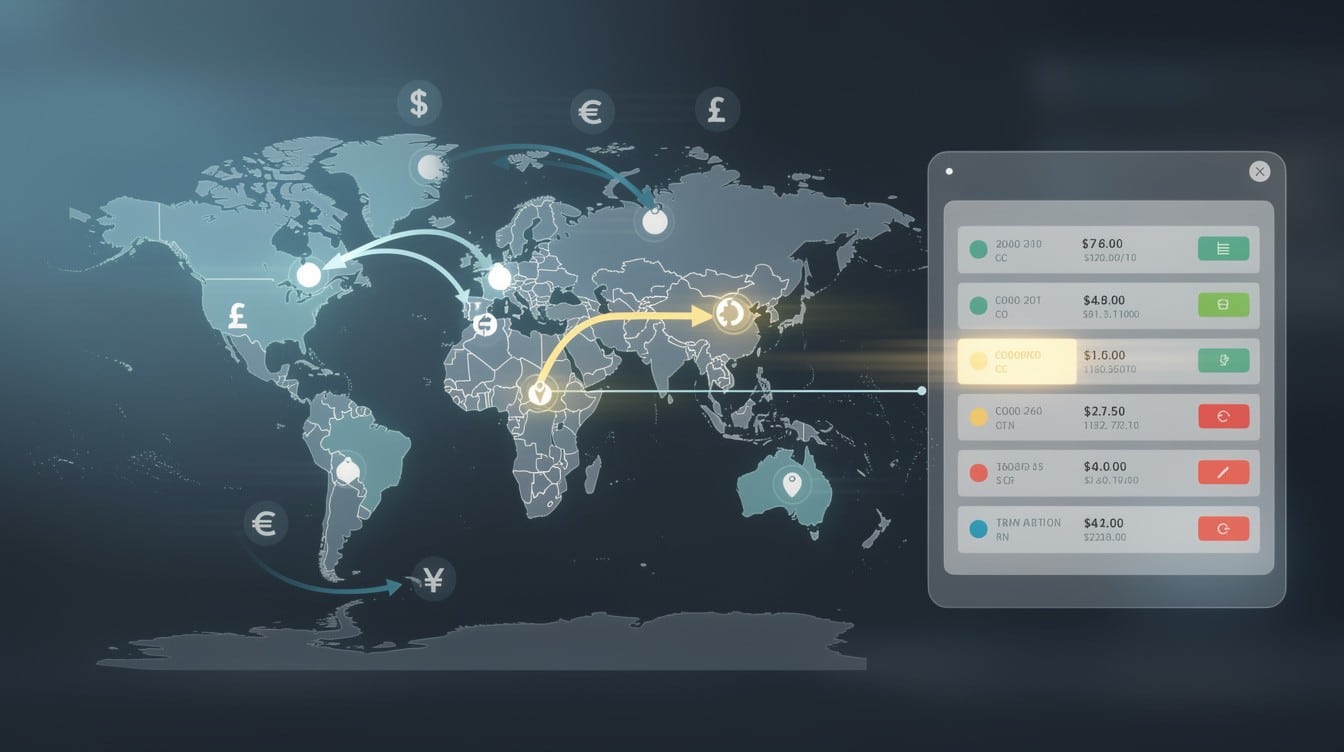
Organizations with end-to-end visibility identify which payment corridors cost too much and which routes settle fastest, then shift volume accordingly. McKinsey research confirms that end-to-end visibility supports liquidity forecasting across currencies, time zones, and entities, reducing idle cash. When your team sees that payments to certain regions consistently take longer or cost more than alternatives, you have concrete data to challenge your banking partners or explore fintech alternatives. Real-time KPI tracking across corridors reveals performance gaps immediately. SWIFT recommends monitoring time-to-credit, STP rates, exception rates, cost per payment, and liquidity coverage. Teams that track these metrics actively reduce their average corridor costs and settlement times within months. Your finance team moves from accepting whatever fees banks charge to actively optimizing based on performance data.
Compliance Gains Auditable Trails Without Manual Reconstruction
Compliance teams currently spend hours reconstructing transaction flows from fragmented systems to satisfy regulatory requirements. Real-time visibility transforms this process entirely. Every transaction step (initiation, routing, settlement) becomes immediately traceable and auditable within a unified platform. Your compliance team generates complete audit trails in minutes rather than days, with full documentation of where each payment traveled and how long it spent at each stage. This capability matters especially when regulators ask questions about specific transactions-your team answers with verified data instead of estimates. The auditable trail also strengthens your anti-money-laundering controls and reduces reputation risk, which compliance leaders identify as their top concern when evaluating new payment methods.
Moving Beyond Traditional Rails Requires New Infrastructure
Traditional cross-border systems (correspondent banking, SWIFT networks) operate in silos because they were built before real-time technology existed. Blockchain-based settlements offer a different model: every transaction settles on-chain with immediate finality and complete transparency. This infrastructure shift enables your teams to see payments move in real time and verify settlement status without waiting for bank confirmations. Web3 Enabler integrates blockchain transactions directly into Salesforce, giving your teams unified visibility without switching between systems. Your accounts payable team sees confirmation status in the same system where they initiated the payment. Your compliance team audits the entire transaction flow without leaving Revenue Cloud or Financial Services Cloud. This integration eliminates the context-switching that currently fragments your team’s attention and slows decision-making.
The visibility advantage compounds when you combine real-time settlement data with automated routing intelligence. Your operations team can now see which corridors perform best and which ones create bottlenecks, then make informed decisions about where to send future payments.
Building Your Payment Visibility Stack
The real work starts when you move beyond understanding the problem and select the systems that will give you actual visibility. Most organizations start by mapping their current data sources: which banks they use, which payment corridors move the highest volume, which systems currently hold transaction records, and where gaps exist between systems. Accenture research shows that cloud-native data platforms with API integrations unify diverse payment data into a single, scalable view, but the selection process matters more than the technology itself.
You need to identify which payment rails your organization actually uses most frequently. If 60% of your cross-border volume flows through three specific banking relationships, those three corridors deserve priority integration. SWIFT gpi tracking works well for traditional corridors, but if your organization also processes stablecoin settlements, you need infrastructure that captures both traditional and blockchain-based transactions in one unified view. Web3 Enabler integrates blockchain transactions directly into Salesforce, meaning your finance team sees both traditional wire transfers and on-chain settlements in the same dashboard without switching systems. The integration eliminates manual data entry and reduces the reconciliation errors that currently plague most finance teams.
Start with Your Highest-Volume Corridors
Your first integration should target the corridors where your organization moves the most money. If you process fifty international payments daily across twelve different country pairs, focus initial consolidation on the three or four corridors representing 70% of that volume. This approach delivers immediate ROI because automation saves the most time where volume is highest.
A finance team that previously spent four hours daily reconciling payments in three major corridors sees that time cut to thirty minutes once data consolidates into a single platform. Once you prove the model works in those three corridors, expanding to secondary routes becomes straightforward because your team understands the process and your systems already handle the data integration.
The key metric to track during this phase is STP rate (straight-through processing), which measures the percentage of payments that settle without manual intervention. After consolidating data from your primary corridors, that number should jump to 85-95% because exceptions become visible immediately instead of discovered days later.
Connect Your Compliance and Treasury Systems
Your compliance team needs real-time access to audit trails without reconstructing transactions from spreadsheets, and your treasury team needs cash position visibility across all currencies and time zones simultaneously. This requires connecting your accounts payable system, your bank portals, and your compliance platform into one data layer.
Gartner research emphasizes that data governance and quality controls are foundational to trusted insights, which means establishing a canonical data model before you integrate systems. Define exactly what each data field means (settlement date, value date, FX rate applied, fees charged) so when data flows from different sources, your system interprets it consistently.
Your compliance team should then build dashboards showing transaction status by corridor, exception reasons, and settlement time distribution. When your team sees that payments to Brazil consistently take three days while payments to Singapore settle in one day, that visibility drives conversations with your banking partners about which routes to prioritize. Treasury teams benefit from dashboards that show cash positions across all currencies updated in real time, enabling more accurate liquidity forecasting. McKinsey research confirms that end-to-end visibility supports liquidity forecasting across currencies, time zones, and entities, reducing idle cash significantly. A finance team that previously kept excess cash in each currency to buffer against settlement delays can reduce those reserves once they see actual settlement timing.
Automate Exception Handling and Reporting
Once your data consolidates into a single platform, automation becomes possible. Accenture research shows that AI and machine learning can automatically categorize delays, predict bottlenecks, and suggest routing optimizations. Your system should flag payments that exceed expected settlement time automatically, so your operations team investigates exceptions rather than waiting for complaints from internal stakeholders.
Build alerts that trigger when a payment to a specific corridor takes longer than the historical average for that route, signaling potential problems before they become crises. For compliance reporting, automation means generating audit trails and transaction reports in minutes instead of days. Your compliance team no longer reconstructs transactions from fragmented data. Instead, they query the consolidated platform and receive complete documentation of every transaction step, every FX rate applied, and every fee charged.
This capability transforms compliance from a reactive function that responds to audits into a proactive one that monitors transactions in real time. Your reporting infrastructure should track time-to-credit, exception rates, cost per payment, and liquidity coverage across all corridors. When these metrics update daily instead of monthly, your team identifies problems and opportunities weeks earlier than competitors still using manual reporting.
Final Thoughts
Your finance team no longer accepts fragmented data as the cost of global business. Cross-border payments visibility now becomes achievable through unified platforms that consolidate traditional banking rails and blockchain settlements into a single source of truth. When your accounts payable team initiates a payment in Salesforce, your compliance team sees the audit trail in real time, and your treasury team tracks cash positions across currencies simultaneously, your entire operation accelerates.
Finance teams that previously spent thousands of hours annually on manual reconciliation redirect that effort toward strategic work, while compliance teams that once reconstructed transactions from spreadsheets now generate auditable trails in minutes. Treasury teams that estimated cash positions based on incomplete data now forecast with actual settlement timing, and your organization catches problems before they become crises because you see payments move through settlement chains instantly. When your finance team routes payments based on actual corridor performance rather than assumptions, you lower costs measurably and reduce operational risk significantly.
We at Web3 Enabler help financial institutions and enterprises build unified visibility directly within Salesforce, combining blockchain settlements with your existing workflows so your teams see all transactions in one place without switching systems. Web3 Enabler integrates blockchain transactions into Financial Services Cloud, Commerce Cloud, and Revenue Cloud, giving your organization the infrastructure to move from fragmented data to scalar insights. The competitive advantage belongs to organizations that see their payments clearly and act on that visibility first.