



Your Salesforce instance handles customer relationships. It should also handle payments-especially when those payments cross borders and need to move fast.
Stablecoin payment workflows in Salesforce cut through the friction of traditional banking. No waiting days for wire transfers. No hidden fees eating into margins. At Web3 Enabler, we’ve seen businesses move from spreadsheet chaos to automated, on-chain transactions that settle in minutes.
Why Stablecoin Payments Matter Right Now
Traditional wire transfers take three to five days to settle and cost $25 to $50 per transaction, which adds up fast when you pay vendors across multiple countries. Blockchain-based stablecoin payments settle in under 5 minutes instead, with transaction costs that run roughly 90% cheaper than wire transfers. For a company sending $100,000 to a supplier in Southeast Asia, that’s the difference between waiting nearly a week and paying thousands in fees versus having funds arrive within hours for a fraction of the cost. B2B cross-border payments on blockchain are projected to exceed $4.4 trillion in 2024, representing about 11% of total B2B cross-border payments globally. This isn’t theoretical anymore-real finance teams already move money this way because the math works.

Stablecoins Eliminate the Volatility Trap
Cryptocurrency prices swing wildly, which makes them useless for actual business payments. Stablecoins like USDC and USDT maintain a 1:1 peg to the US dollar, so you know exactly what you send and receive. Your vendor in Singapore gets paid in a currency they recognize, at a price that doesn’t fluctuate between the moment you approve the payment and the moment it settles. The recipient can convert to local currency immediately if they want, or hold it as USDC-that choice matters in regions where local currency inflation erodes earnings. When you integrate stablecoin payments directly into Salesforce, your finance team approves payments through the same system they already use for everything else, with no separate tools or wallets to manage.
Real Businesses Already Use Stablecoins for Payments
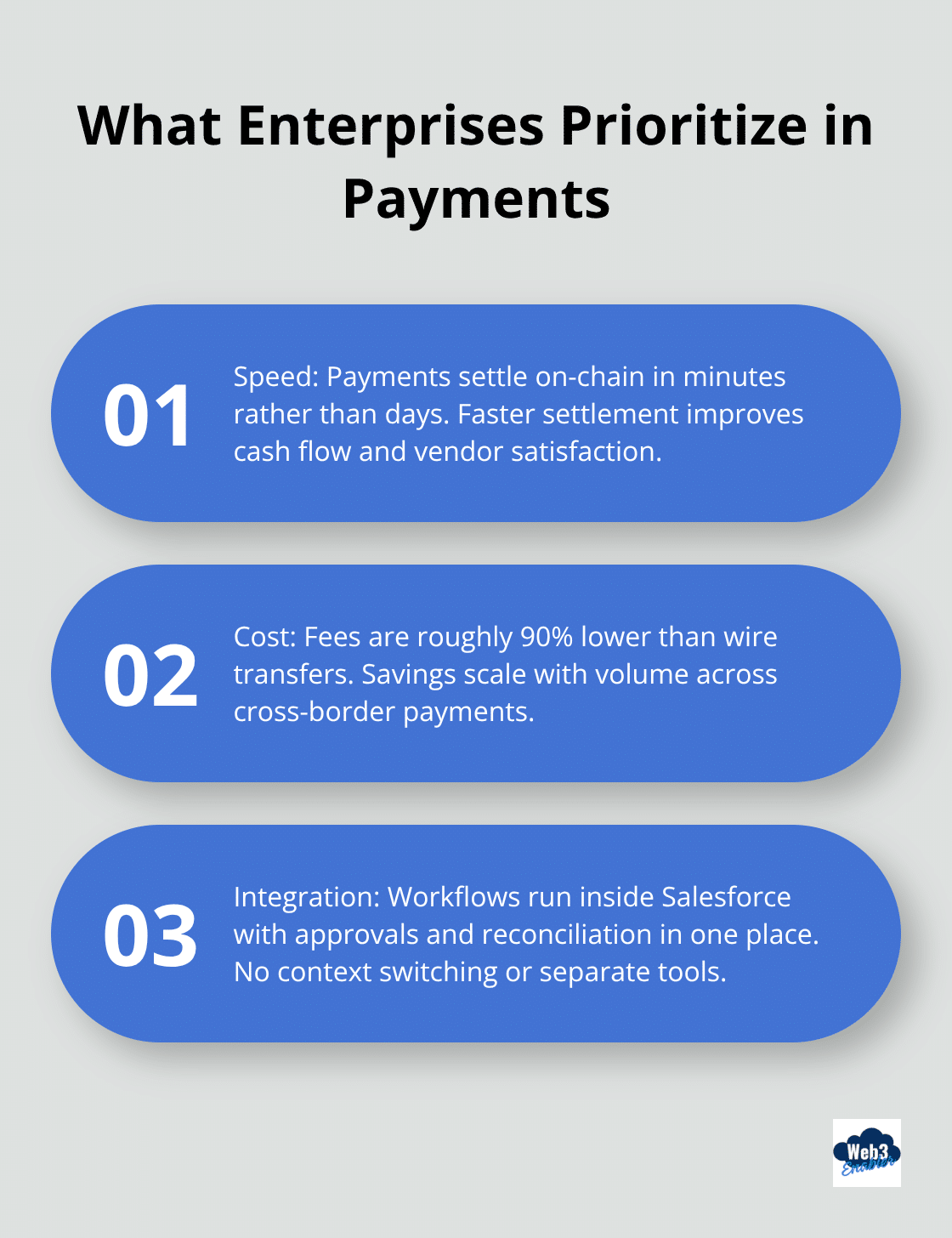
Forward-thinking businesses aren’t waiting for perfect conditions. They use stablecoins for payroll, vendor payments, and client settlements right now. The Beacon Network, which tracks blockchain illicit activity across 60+ law enforcement agencies in 16 countries, shows that stablecoin infrastructure is mature enough for serious compliance work. That maturity extends to business payments too. Enterprises care about three things: speed, cost, and integration with existing workflows. Stablecoin payments deliver all three. When payments settle on-chain in minutes and your accounting team reconciles transactions through Salesforce without manual entry, the business case becomes obvious.
What This Means for Your Payment Stack
The real advantage isn’t just speed or cost-it’s that stablecoins work within the systems you already own. Your Salesforce instance tracks every customer, every deal, every payment obligation. Adding stablecoin rails to that same platform means your finance team stops context-switching between tools. Approvals happen in Salesforce. Reconciliation happens in Salesforce. Compliance records live in Salesforce. This integration eliminates the friction that makes traditional cross-border payments so painful.
How to Integrate Stablecoin Payments Into Your Salesforce Workflow
Most companies that add crypto to their payment stack use third-party gateways sitting outside their CRM, creating data silos and manual reconciliation nightmares. Your finance team approves a payment in Salesforce, then logs into a separate dashboard to process it, then manually enters the transaction back into your accounting system. That’s friction. Web3 Enabler provides a different approach: stablecoin payments that live natively inside Salesforce, meaning your payment approvals, execution, and reconciliation all happen in one place. No API glue. No separate logins. No copying transaction IDs between systems. When you send a $50,000 payment to a vendor in Poland using USDC through Salesforce, the payment settles on-chain in minutes, the transaction record appears automatically in your sales or accounting module, and your team stays focused on their actual work instead of data entry.
Native Integration Eliminates Implementation Friction
Third-party payment processors typically require 8–12 weeks of setup and ongoing maintenance headaches. Native Salesforce integration cuts that timeline dramatically because the payment rails connect directly to your existing approval workflows, customer records, and accounting modules. Your team doesn’t learn new software or manage separate credentials. They work within the Salesforce interface they already use daily. This native approach means your finance team approves payments, executes transactions, and reconciles records without leaving the platform-a significant advantage over bolted-on solutions that fragment your workflow.
Automating Payment Approvals and Execution
You define who can initiate payments, at what thresholds, and to which vendors or customers. Salesforce’s workflow automation rules then handle the rest: when a deal closes at $100,000 or above, the system automatically flags it for CFO approval; once approved, it triggers the payment execution directly from the record without anyone leaving the platform. Your vendor receives USDC in their wallet within minutes. On the receiving end, they can convert to local currency immediately through platforms like Circle’s USDC on-ramps (which operate in 190+ countries) or hold the stablecoin if they prefer.
Real-Time Reconciliation Transforms Your Close Process
Traditional wire transfers create accounting chaos: you send funds on Monday, the bank processes them Wednesday, and settlement clears Friday, leaving a three-day window where your accounting team can’t close the books. Stablecoin payments settle in minutes, so reconciliation becomes automatic. Your Salesforce instance logs the transaction in real-time, matches it to the original payment request, and updates your revenue or expense records without manual intervention. For companies processing hundreds of cross-border payments monthly, this automation alone saves weeks of accounting work per year and eliminates reconciliation errors that cost time and credibility with auditors.
Multi-Currency Payments Without the Complexity
Your vendors and customers operate across different regions and currencies. Stablecoin payments simplify this complexity because USDC and USDT maintain their 1:1 peg to the US dollar regardless of where the recipient lives. Your finance team approves payments in a single currency within Salesforce. Recipients convert to their local currency on their own timeline through established on-ramps, or they hold stablecoins if local inflation makes that the smarter choice. This flexibility eliminates the currency conversion fees and timing risks that plague traditional international payments.
The next chapter explores how these integrated workflows translate into measurable business outcomes-faster vendor payments, lower processing costs, and the compliance visibility that auditors actually want to see.
Real-World Applications of Stablecoin Payments
Most finance teams think stablecoin payments are theoretical until they watch them work in practice. The reality is messier and more practical than the hype suggests. A mid-market SaaS company with customers across 12 countries doesn’t care about blockchain philosophy-they care that their Paris client sends a $75,000 payment in USDC and watches it settle in a wallet within five minutes instead of waiting for a correspondent bank to process a wire transfer over three days. That’s not speculation. That’s operational efficiency. When you accept USDC directly in Salesforce Commerce Cloud, your accounting team reconciles the transaction in real-time without waiting for bank settlement windows or managing forex conversion delays. The payment arrives, your revenue record updates automatically, and your team closes the books on schedule. This matters most for companies with high transaction volume across multiple regions because even small delays compound into cash flow problems and accounting friction. B2B cross-border payments processed approximately $15 trillion in transaction volume in 2025, rivaling Visa’s annual volume.
Global Payments Without the Banking Theater
Your vendor in Vietnam needs payment for this month’s inventory. Traditional wire transfers require her bank to hold the funds for three to five days while correspondent banks process the transaction, then she converts to Vietnamese Dong at whatever exchange rate her bank offers that day, and finally she absorbs a 2-3% conversion fee. Stablecoin payments eliminate this entire charade. You send USDC from Salesforce, she receives it in her wallet within minutes, and she converts to local currency through established on-ramps like Circle’s USDC Access whenever she chooses. She controls the conversion timing instead of accepting whatever rate her bank quotes. For vendors in regions with weaker banking infrastructure (Pakistan, the Philippines, Indonesia), stablecoin payments open access to faster, more transparent payment options that their traditional banks don’t offer. Your team stops managing currency conversion logistics and starts focusing on actual business relationships.
The Cost Math That Makes Finance Teams Pay Attention
Wire transfers cost $25 to $50 per transaction. Stablecoin transactions cost roughly 90% less. For a company sending 100 payments monthly to vendors across different countries, that’s the difference between $2,500 to $5,000 in monthly fees versus a few hundred dollars. Annually, that’s $24,000 to $60,000 in unnecessary costs that disappear when you move to stablecoin rails.
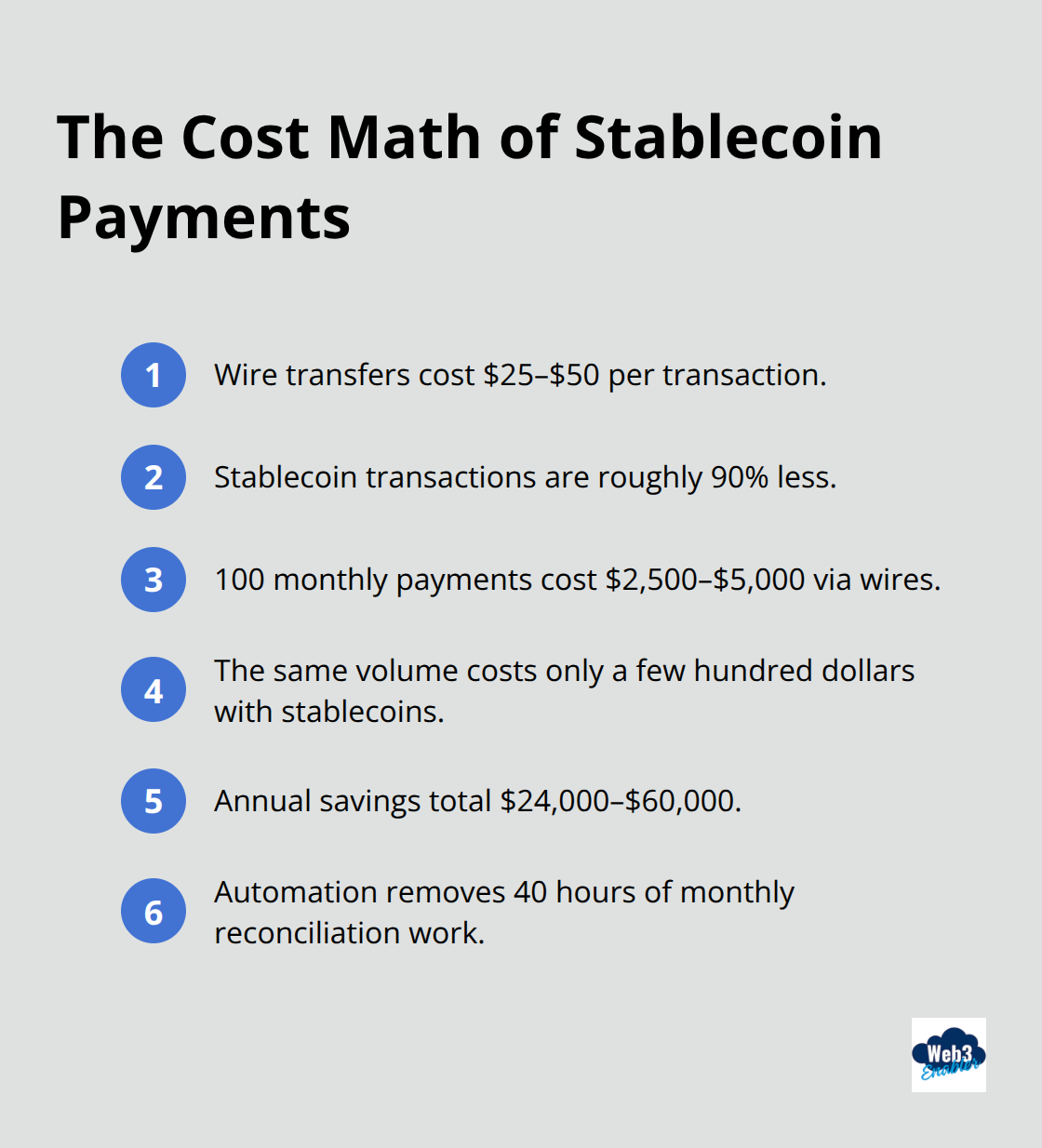
Add in the labor cost of manual reconciliation-your accounting team no longer spends time matching wire confirmations to Salesforce records or tracking FX conversion rates-and the savings accelerate. One mid-market manufacturing company processes roughly 200 vendor payments monthly across 8 countries. Moving to stablecoin payments through native Salesforce integration eliminated manual reconciliation work that previously consumed 40 hours monthly from their accounting team. That’s one full-time employee’s worth of labor redirected to strategic work instead of payment administration.
Vendor Management Becomes Predictable and Transparent
Your vendor in Poland needs to know exactly when payment arrives and at what amount. Stablecoin payments eliminate the uncertainty that plagues traditional banking. You approve the payment in Salesforce at 2 PM on Tuesday. The blockchain confirms it at 2:03 PM. Your vendor receives notification that funds are in their wallet before 2:05 PM. They see the exact amount in USDC without guessing what conversion fees or delays might occur. This predictability matters for cash flow forecasting on both sides of the transaction. Your vendor can plan operational expenses because they know payment arrives on schedule at a fixed amount. You can forecast cash outflows accurately because blockchain settlement is deterministic-there’s no unexpected delay or hidden fee. This transparency extends to compliance too. Blockchain transactions create permanent, auditable records that your finance and legal teams can reference during audits. Traditional wire transfers leave scattered documentation across multiple banks and FX platforms. Stablecoin payments create a single source of truth that regulators and auditors actually want to see.
Final Thoughts
Stablecoin payment workflows in Salesforce aren’t about betting on crypto prices or chasing blockchain hype. They’re about moving money faster, cutting costs, and eliminating the administrative burden that traditional banking imposes on finance teams. Your vendor in Singapore receives payment in minutes instead of days, your accounting team reconciles transactions automatically instead of manually matching wire confirmations, and your company saves thousands monthly on processing fees that disappear when you move to blockchain rails.
The shift from traditional payments to stablecoin-based workflows happens because the math works, not because anyone cares about decentralization philosophy. A company processing 200 vendor payments monthly across multiple countries saves one full-time employee’s worth of reconciliation labor annually. The compliance visibility that blockchain creates-permanent, auditable transaction records that regulators actually want to see-becomes a bonus advantage that your legal and finance teams appreciate during audits.
Streamlining payments directly within Salesforce matters because your finance team already works in that platform every day. They manage customer relationships there, track deals and revenue there, and now they can approve payments and watch them settle on-chain within minutes, with transaction records appearing automatically in your accounting module. Web3 Enabler provides native Salesforce integration that connects stablecoin payment workflows to your existing systems without requiring separate tools or complex setup.