


Enterprise blockchain adoption is accelerating across industries, yet many organizations struggle with where to start. At Web3 Enabler, we’ve seen firsthand that successful implementation requires more than just choosing the right technology-it demands a clear strategy, the right team, and realistic planning.
This guide walks you through the essential steps to move from concept to deployment, addressing the real challenges you’ll face along the way.
What Enterprise Blockchain Actually Solves
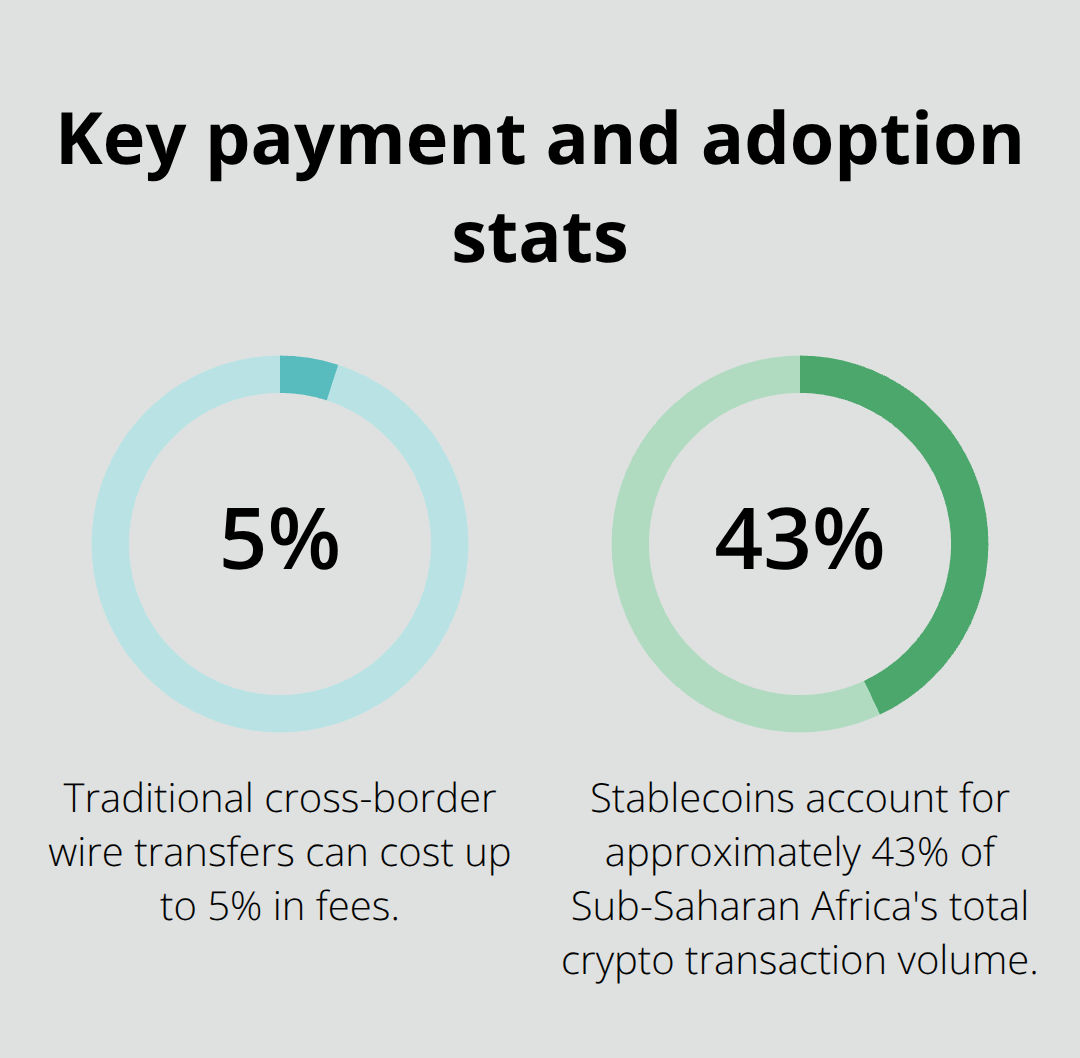
Enterprise blockchain differs fundamentally from public networks in purpose and design. Public blockchains like Bitcoin and Ethereum prioritize decentralization and transparency for anyone to participate, but they lack the efficiency that business operations require-Bitcoin processes roughly seven transactions per second, while Visa handles 24,000. Enterprise blockchains operate on permissioned networks where only authorized participants validate transactions, enabling settlement in seconds rather than days. This distinction matters enormously for cross-border payments. A traditional wire transfer between Nigeria and Europe takes 3-5 business days and costs up to 5% in fees; enterprise blockchain rails settle the same payment in minutes at a fraction of the cost.
Why speed and settlement matter more than decentralization
Most enterprises don’t care about decentralization. They care about settlement risk reduction, eliminating reconciliation delays, and lowering operational costs. When you send $100 via traditional remittance channels, fees consume up to $30 of the value. Stablecoin-based settlement on enterprise blockchains reduces that to under $1 for the same corridor. Nigeria processed over $92 billion in crypto transaction value in the 12 months ending mid-2025, with stablecoins representing approximately 43% of Sub-Saharan Africa’s total crypto transaction volumes. That scale exists because businesses and individuals recognize the practical advantage-faster liquidity, lower friction, better cash flow management.
Enterprise blockchain solutions work best when they integrate directly into your existing infrastructure rather than requiring parallel systems.
Integration with your existing tools
Your finance and operations teams already work within established platforms. Enterprise blockchain solutions that connect to your current systems-rather than forcing you to adopt new ones-accelerate adoption and reduce training costs. This integration cuts implementation time and reduces overhead because your teams use familiar tools alongside blockchain capabilities. The real misconception: blockchain as a magic solution. Organizations often approach enterprise blockchain expecting it to solve problems it wasn’t designed for. Blockchain excels at creating immutable audit trails, enabling programmable settlement through smart contracts, and removing intermediaries from high-friction processes. It fails when applied to situations where traditional databases work fine or where the bottleneck isn’t technical but regulatory.
Custody and compliance: non-negotiable requirements
The misconception that blockchain automatically increases security is particularly dangerous. Custody and key management introduce new risks that traditional banking doesn’t face. If you lose access to your private keys or they’re compromised, your assets are gone-there’s no chargeback mechanism or customer service to contact. Regulated custodians and multisignature wallets aren’t optional extras; they’re essential infrastructure for enterprise deployment. Regulators in Nigeria, South Africa, and across MENA actively shape frameworks for stablecoin settlement and digital asset operations. Nigeria’s Securities and Exchange Commission explicitly states digital assets fall under securities regulation, and the Accelerated Regulatory Incubation Programme aims to integrate platforms into formal oversight. Successful enterprise implementations build compliance directly into architecture rather than treating it as an afterthought.
Moving from theory to practical deployment
Understanding these fundamentals positions your organization to make informed decisions about which use cases actually benefit from blockchain technology. The next step involves assessing whether your specific operations-whether cross-border payments, supplier settlements, or payroll-genuinely require blockchain’s advantages or whether traditional systems already meet your needs efficiently.
Building Your Implementation Roadmap
Identify High-Impact Use Cases First
The most critical decision you’ll make isn’t which blockchain platform to use-it’s identifying which specific business processes actually need blockchain intervention. Organizations that skip this assessment waste months integrating technology into workflows where traditional systems work fine. Start by mapping your current pain points with concrete numbers. If your cross-border payroll takes five days to settle and costs 3-4% in fees, that’s your baseline. If supplier payments require manual reconciliation across three systems, quantify the hours spent. If cash flow gets trapped in transit for 72 hours waiting for wire transfers to clear, calculate the working capital cost.
These metrics become your success criteria later. Speed only matters where delays create real business friction. A domestic payment that already settles next day doesn’t benefit from blockchain; an international payment that takes five days absolutely does. Nigeria’s stablecoin infrastructure now handles over $92 billion in annual transaction volume because businesses recognized concrete advantages-faster liquidity for cross-border commerce, lower settlement costs for diaspora transfers, and immediate fund availability for regional operations.
Your assessment should focus on three specific areas: payment corridors where you operate, transaction volumes that justify infrastructure investment, and regulatory environments where your counterparties operate. A company making 50 international payments monthly to five countries faces different requirements than one making 5,000 daily micro-transactions across 20 currencies.
Evaluate Technology Stack Against Three Core Requirements
Once you’ve identified high-impact use cases, selecting your technology stack requires evaluating three non-negotiable factors. First, regulatory alignment-the platform must support compliance requirements in your jurisdictions. Nigeria’s Securities and Exchange Commission classifies digital assets as securities; any platform you choose must integrate with local regulatory frameworks, not circumvent them.
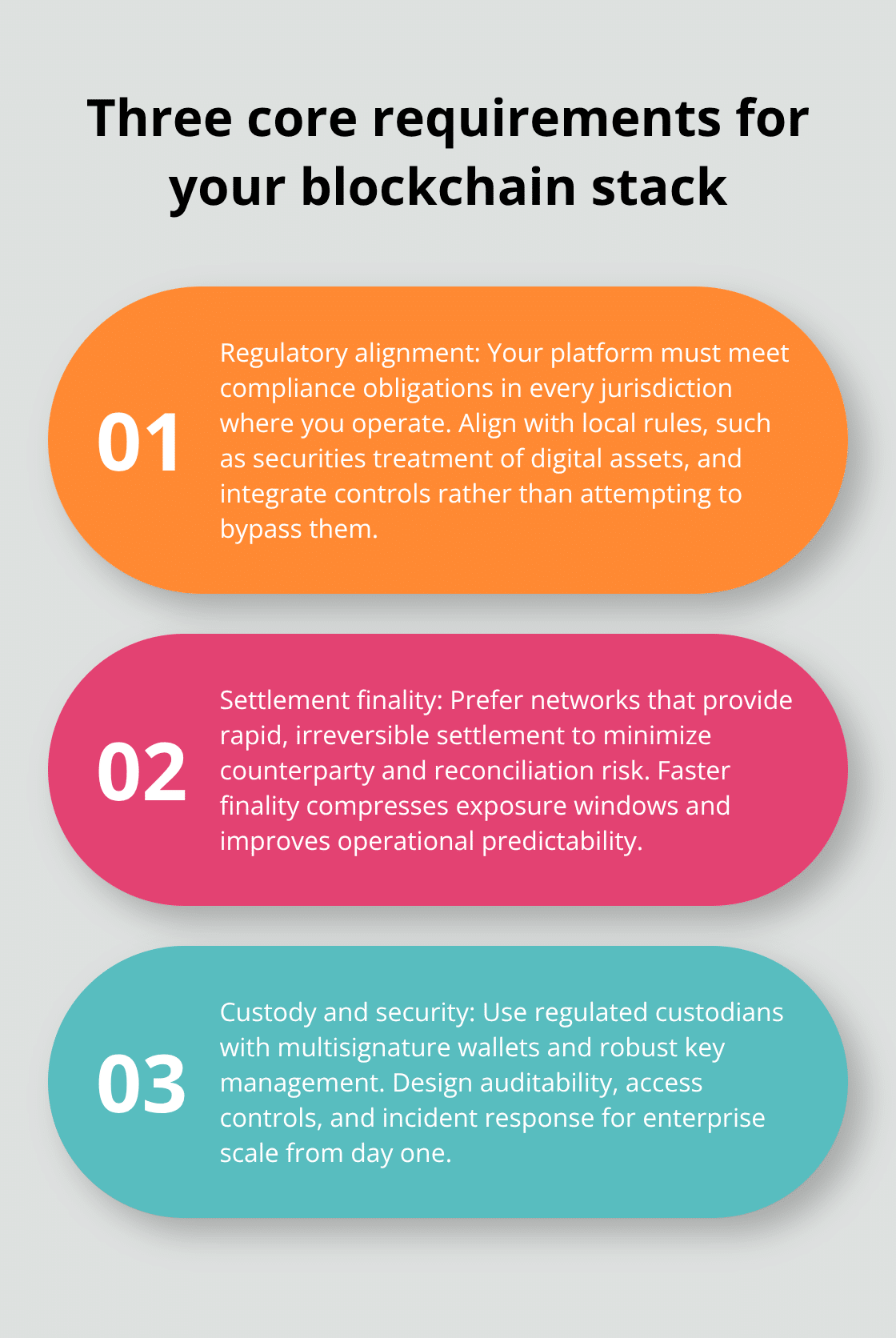
Second, settlement finality determines how quickly transactions become irreversible. Stripe’s Tempo blockchain, announced February 25, 2026, promises sub-second settlement finality compared to traditional rails that exceed 12 hours, and testnet adoption by Visa, Nubank, Shopify, and Klarna demonstrates enterprise-grade readiness. Third, custody and security architecture matters enormously-regulated custodians with multisignature wallets aren’t luxuries but requirements for enterprise deployment.
Build a Team With Three Essential Competencies
Your team structure matters as much as technology selection. Enterprise blockchain implementations fail when organizations hire blockchain specialists without finance operations expertise or assign the project to IT without involving treasury and compliance leadership. You need a core team combining three competencies: technical architects who understand your current systems and blockchain architecture, compliance specialists who navigate regulatory requirements in your operating jurisdictions, and finance operations leaders who understand cash flow, settlement processes, and reconciliation workflows.
Secure Executive Buy-In Through Financial Metrics
Executive buy-in requires presenting implementation in financial terms, not technical terms. Show the cost per transaction reduction, settlement time improvement in hours, and working capital acceleration in dollars or local currency. A company processing $10 million monthly in cross-border payments saves $30,000-$40,000 annually by reducing settlement costs from 3% to 0.1%, and accelerates cash availability by 4-5 days, freeing capital for operations.
With your use cases validated, technology evaluated, and team assembled, the next challenge emerges: integrating blockchain infrastructure into systems that weren’t designed for it, while satisfying regulators who are still writing the rulebook.
Navigating Legacy Systems and Regulatory Complexity
Integrating Blockchain Into Your Existing Infrastructure
Legacy system integration represents the first real obstacle most organizations encounter. Your ERP, CRM, and treasury management systems weren’t built with blockchain in mind, yet your blockchain solution must feed data back into these systems for accounting, compliance reporting, and operational decision-making. The mistake most teams make is treating blockchain as a separate system that operates independently, then manually reconciling data afterward. This approach doubles your operational overhead and introduces reconciliation errors.
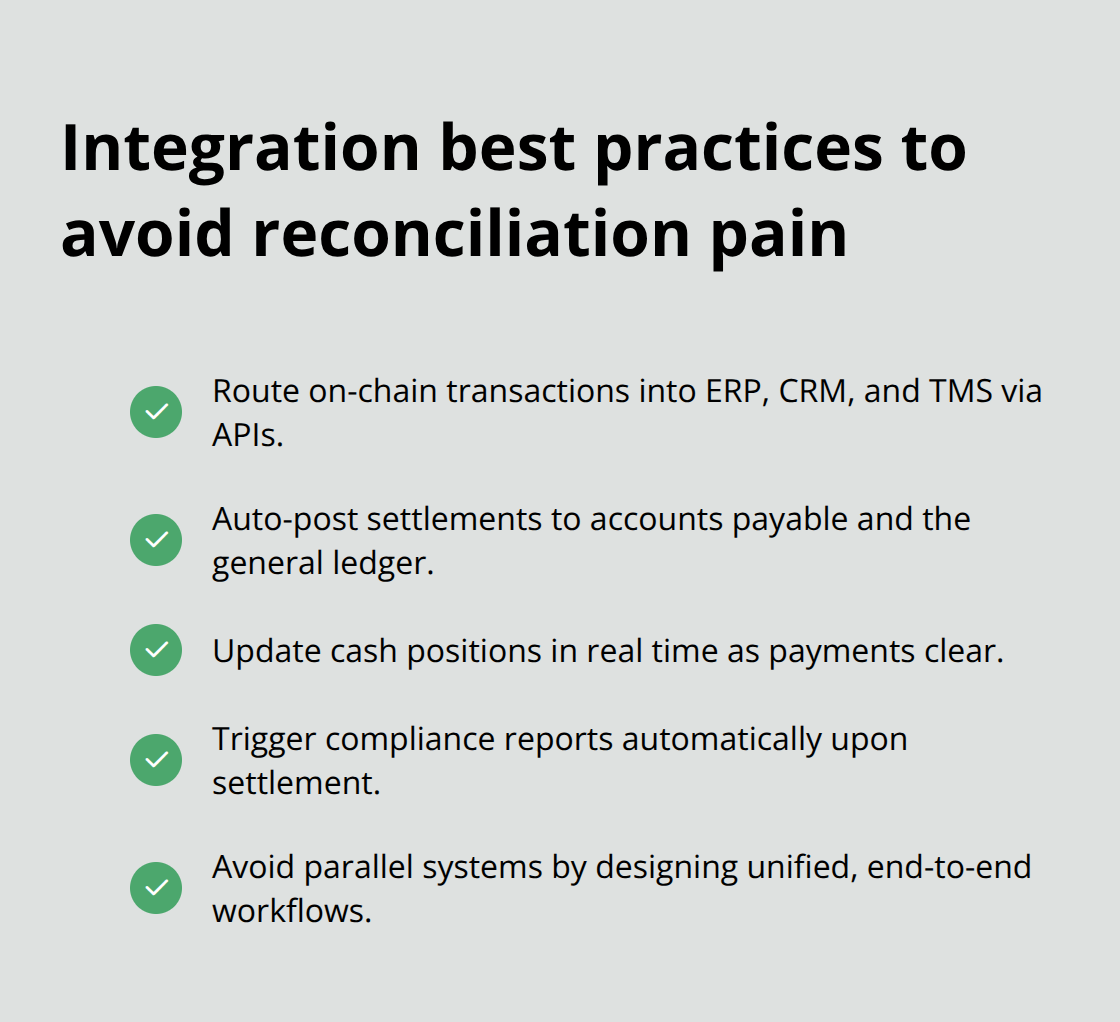
Instead, design your integration architecture so blockchain transactions flow directly into your existing systems through APIs. When a stablecoin payment settles on-chain in seconds, that transaction automatically posts to your accounts payable system, updates your cash position, and triggers any necessary compliance reporting without manual intervention. Blockchain-enabled CRM solutions connect blockchain transactions directly to your Salesforce environment, so your teams work within familiar tools rather than jumping between systems.
Meeting Regulatory Requirements Across Jurisdictions
Your regulatory environment demands equal attention to technical architecture. Nigeria’s Securities and Exchange Commission classifies digital assets as securities under existing frameworks, not as a separate regulatory category. This means your stablecoin payment infrastructure must satisfy the same AML/KYC requirements as traditional financial services, plus additional FATF Travel Rule compliance for cross-border transactions.
South Africa and MENA jurisdictions actively develop digital asset frameworks, with the UAE’s Virtual Assets Regulatory Authority shaping stablecoin settlement governance. Rather than waiting for final regulatory clarity, build compliance directly into your platform architecture from day one. Implement transaction monitoring that screens counterparties against sanctions lists, document transaction chains for audit purposes, and maintain custody records that regulators can verify. Organizations succeed because they integrated compliance controls into their payment rails rather than treating regulation as a constraint imposed afterward.
Scaling Compliance and Custody Operations
For enterprise-scale operations, your settlement infrastructure must support volumes that justify the compliance investment. If you process 50 international payments monthly, investing in dedicated compliance infrastructure doesn’t make economic sense. If you process 5,000 daily transactions across multiple corridors, that infrastructure becomes essential.
Tempo’s sub-second settlement finality and testnet adoption by Visa, Nubank, Shopify, and Klarna demonstrates that enterprise-grade blockchain infrastructure now exists to handle institutional volumes. The scalability question isn’t whether blockchain can technically handle your transaction load, but whether your custody arrangements, compliance monitoring, and liquidity management can scale alongside transaction volume growth.
Regulated custodians with multisignature wallet infrastructure secure assets, but they require operational procedures that scale with your business. Your compliance team needs automated transaction screening that processes thousands of payments daily without creating bottlenecks. Your treasury function needs liquidity planning that anticipates settlement timing across multiple blockchain rails and currency pairs simultaneously.
Final Thoughts
Enterprise blockchain implementation succeeds when organizations focus on solving specific business problems rather than pursuing technology for its own sake. Your cross-border payments take five days and cost 3-4% in fees, your supplier settlements require manual reconciliation across multiple systems, and your international payroll gets trapped in transit for 72 hours. These concrete friction points justify enterprise blockchain investment; abstract efficiency gains do not.
The implementation roadmap we’ve outlined-identifying high-impact use cases, selecting technology that meets regulatory requirements, building teams with the right competencies, and integrating blockchain directly into your existing infrastructure-works because it treats enterprise blockchain as a business transformation tool, not a technical experiment. Organizations across Nigeria, South Africa, and MENA that have moved beyond pilot programs share one characteristic: they built compliance and custody controls into their architecture from day one rather than treating regulation as an obstacle. Your next step depends on where you stand today: if you’re still assessing whether blockchain addresses your specific workflows, start by quantifying your current pain points in financial terms; if you’ve identified high-impact use cases and need to evaluate technology platforms, prioritize solutions that integrate directly with your existing systems rather than requiring parallel infrastructure.
We at Web3 Enabler help organizations connect blockchain transactions directly to their Salesforce environment, enabling faster and cheaper global payments that settle in seconds at a fraction of traditional costs. Visit Web3 Enabler to explore how native Salesforce blockchain integration can accelerate your enterprise blockchain journey.
Frequently Asked Questions
How does enterprise blockchain differ from public networks like Ethereum?
Enterprise blockchains are “permissioned,” meaning only authorized participants validate transactions. While public networks can be slow and congested, enterprise-grade rails—like Stripe’s Tempo—offer sub-second settlement finality and the ability to process over 100,000 transactions per second. This makes them suitable for high-volume corporate payments rather than just speculation.
Why is Nigeria a key market for enterprise blockchain in 2026?
Nigeria has become a global leader in stablecoin adoption, processing over $92 billion in transaction value in the last year. Because the Nigerian Securities and Exchange Commission (SEC) now officially classifies digital assets as securities under the Investments and Securities Act 2025, businesses have a clear regulatory framework to move from “gray market” experiments to formal enterprise deployment.
What are the biggest risks in enterprise blockchain implementation?
The most significant risks are custody and integration. Unlike traditional banking, losing access to private keys means assets are gone forever. Furthermore, many teams fail by creating “data silos” where blockchain transactions don’t talk to their CRM or ERP. Successful firms use native integrations (like Salesforce-native tools) to ensure every transaction automatically updates their existing records.
Does blockchain really lower the cost of cross-border payments?
Yes. In high-friction corridors (such as payments between Europe and Africa), traditional wire fees can reach 3-5%. Using stablecoins on enterprise-grade infrastructure can reduce those costs to under 0.1%. For a company processing $10 million monthly, this translates to roughly $40,000 in annual savings and faster access to working capital.
How do I ensure our blockchain solution is compliant with the “Travel Rule”?
Compliance should be built into the architecture. Modern enterprise solutions include automated transaction monitoring that screens wallet addresses against global sanctions lists in real-time. By documenting every step of the transaction chain for auditors, firms meet both local SEC requirements and international FATF standards.