



Your Salesforce instance handles customer relationships. Your stablecoins handle payments. Right now, they’re strangers in separate rooms.
Stablecoin interoperability in Salesforce changes that. We at Web3 Enabler have seen businesses waste time moving data between wallets, blockchains, and CRM systems-when they could be automating the whole thing natively.
This is how you stop treating crypto payments like a side project and start treating them like business infrastructure.
Why Stablecoin Interoperability Actually Solves Real Business Problems
Multiple Payment Rails Create Hidden Costs
Your business probably runs on multiple payment rails right now. Bank transfers for some vendors, credit cards for others, wire transfers for international deals. Each one carries its own timeline, its own fees, its own friction. Stablecoin interoperability doesn’t add another rail to manage-it collapses the entire system into one that moves money across networks instantly without intermediaries slowing things down.
The numbers tell the story. Stablecoins settled $27.6 trillion in 2024, surpassing Visa and Mastercard combined. That wasn’t hype. Businesses settled payments in minutes instead of days and paid pennies per transaction instead of percentage-based fees. Your Salesforce instance already tracks every customer interaction, every contract, every payment obligation. Interoperable stablecoins let you move money at the same speed your data moves.
Fragmentation Kills Efficiency
Most businesses don’t realize how much they spend on payment friction. Accounting teams manually match wallet transfers to customer records. Teams wait for correspondent banks to clear cross-border payments. Vendor lock-in means switching payment providers requires rebuilding your entire reconciliation process.
Interoperable stablecoins eliminate that friction because the payment happens on-chain with complete transparency, and your Salesforce instance sees it immediately. No more manual reconciliation. No more waiting for bank confirmations while your customer waits for their invoice to be marked paid.
Where Interoperability Changes Everything
A financial advisor tracking client crypto holdings no longer needs a separate dashboard-the data flows directly into customer records. A subscription business no longer waits three days for payment confirmation before delivering service. When you integrate wallet data natively into Salesforce, you stop treating blockchain payments like an experimental side project and start treating them like the business infrastructure they actually are.
That competitive advantage matters most when you move money globally or manage recurring payments. The businesses that connect their wallets to their CRM workflows gain speed, transparency, and control that their competitors still chase through manual processes. Building stablecoin workflows into Salesforce transforms how you actually execute those payments.
How to Wire Stablecoin Payments Into Salesforce
Close the Gap Between Wallets and Your CRM
The technical setup matters less than the business outcome. You need wallet data flowing into customer records, payment confirmations updating automatically, and compliance flags firing without manual intervention. Salesforce sits at the center of your business operations, but blockchain networks sit outside it.
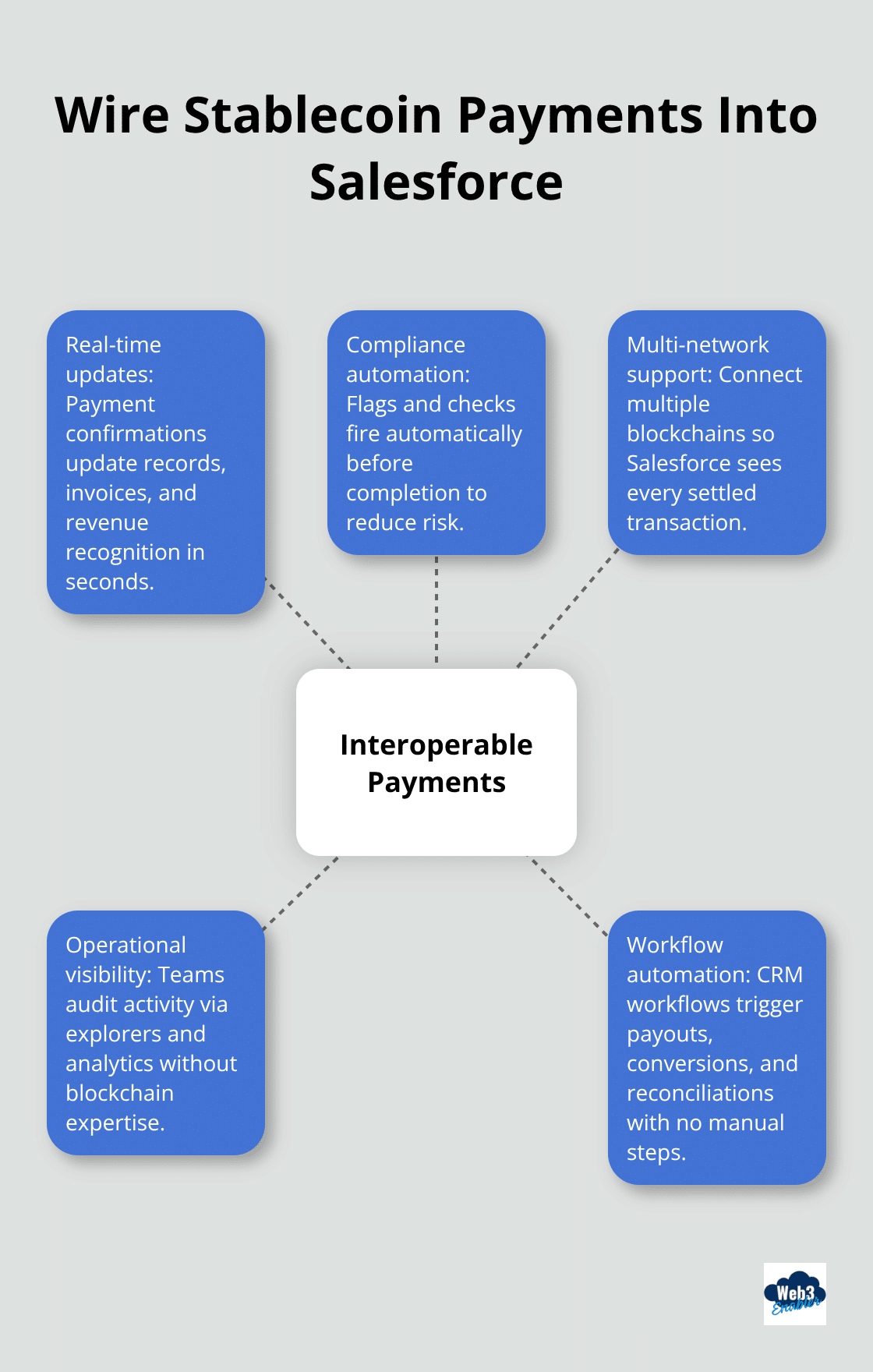
The gap between them is where businesses lose time and money. Bridging that gap means connecting multiple blockchain networks natively so your Salesforce instance sees every transaction the moment it settles.
Real-time data sharing helps businesses optimize their operations and make informed decisions. When a customer pays via stablecoin, your system should update the payment, the customer record, the invoice status, and the revenue recognition all in seconds. Most businesses today wait hours or days because their payment system doesn’t talk to their CRM.
Speed Compounds Into Competitive Advantage
Your Salesforce instance already knows which customer paid, what they owe, and what happens next. Connecting wallet infrastructure directly into that workflow means your business operates at blockchain speed instead of banking speed. The difference compounds quickly.
A subscription business that automates payment reconciliation can deliver service within minutes of settlement instead of waiting for manual confirmation. A B2B business sending cross-border payments no longer needs accounting teams to manually match wallet transfers to vendor records. Financial advisors tracking client crypto holdings stop maintaining separate spreadsheets and see positions updated in real time within customer records. This is where interoperable stablecoins become infrastructure rather than a payment experiment.
Choose Your Stablecoins and Networks First
The practical path forward starts with choosing which stablecoins to support and which networks matter most to your business. USDC, USDT, and USDe together make up about 90% of total stablecoin supply, so most businesses start there rather than supporting every token on every chain. This focused approach reduces complexity while covering the vast majority of transaction volume your customers will actually use.
Next, implement data contracts that define how wallet transactions map into Salesforce records. TRM’s approach to real-time ingestion shows how explicit product-level contracts for freshness, correctness, and reorg handling create stable data integration across chains. Your Salesforce integration needs the same rigor-define exactly how a payment confirms, what triggers reconciliation, and which compliance checks fire before a transaction marks complete.
Automate Everything, Verify Everything
Automation matters here because manual intervention kills the speed advantage. Set up smart contract-level delivery-versus-payment controls that prevent settlement until both sides of the transaction are verified. This reduces human error and fraud risk while keeping your finance team confident the payment actually happened.
Finally, implement on-chain transparency so your team can audit transactions in real time. Public block explorers and on-chain analytics tools support compliance and operational oversight without requiring blockchain expertise from your staff. The goal is simple: your Salesforce instance should know about every stablecoin payment your business sends or receives, automatically reconcile it, and route the data wherever your business logic requires.
With wallet data flowing natively into Salesforce, you’re ready to move beyond single-network payments and tackle the real-world scenarios where interoperability transforms how businesses actually operate.
Real-World Applications of Interoperable Stablecoins
Cross-Border B2B Payments Without the Middleman Tax
Cross-border B2B payments illustrate why interoperability matters in practice. Most international transfers still move through correspondent banking networks that charge 2-4% in fees and take 3-5 days to settle. A manufacturer sends payment to a supplier in Southeast Asia and watches cash sit in transit while the supplier waits to fulfill orders. Stablecoins settle in minutes for pennies per transaction. The real advantage emerges when you automate this in Salesforce: your accounts payable team creates a payment in Salesforce, the system automatically converts to the appropriate stablecoin on the network your supplier prefers, executes the transfer, and updates both the vendor record and your general ledger simultaneously. No manual reconciliation. No waiting for correspondent banks. No hidden fees eating into margins.
Financial Advisors Stop Chasing Spreadsheets
Financial advisors face a different but equally frustrating problem. Clients hold crypto positions across multiple wallets and blockchains, but advisors track these in spreadsheets outside their CRM. This creates blind spots in portfolio visibility and makes it impossible to provide comprehensive financial advice. Integrating wallet data natively into Salesforce means advisor dashboards show real-time positions alongside traditional holdings. When a client’s USDC balance updates on-chain, Salesforce reflects that change immediately. Advisors can now calculate true asset allocation, identify rebalancing opportunities, and provide advice grounded in complete information rather than fragmented data scattered across platforms.
Subscription Businesses Activate Service in Seconds
Subscription and recurring payment businesses benefit most directly from automation at scale. A SaaS platform charges customers in stablecoins and no longer waits three days for payment confirmation before activating service. The payment settles on-chain, Salesforce receives the confirmation, and service activates within seconds. This matters enormously for cash flow and customer experience.
A fitness subscription company charges members monthly in USDC and automates the entire cycle: payment triggers, settlement confirms, membership renews, and failed-payment retries execute through Salesforce workflows without human intervention. When customers want to switch payment currencies or networks, the system routes to their preferred option automatically. This level of automation compounds into operational efficiency that traditional payment processors simply cannot match because they operate outside your CRM.
Choose Your Networks and Stablecoins Strategically
The practical path forward requires choosing which networks and stablecoins your business actually needs rather than supporting everything. USDC, USDT, and USDe together represent the majority of circulating stablecoin supply, so most businesses start there. Then implement the data contracts that map wallet transactions into Salesforce records with explicit rules for freshness, correctness, and blockchain reorg handling. Your Salesforce instance becomes the single source of truth for every payment your business sends, receives, or tracks, regardless of which blockchain it moves across.
FAQ: Stablecoin Interoperability and CRM Integration in 2026
How does stablecoin volume compare to traditional payment networks in 2026?
The landscape of global finance shifted significantly in 2024 when stablecoin transaction volumes officially surpassed those of Visa. By early 2026, this trend has solidified, with stablecoins moving over 27.6 trillion dollars annually. This growth is driven by the fact that stablecoins can settle high-value transactions in minutes for pennies, whereas traditional networks often take days and charge percentage-based fees. For Salesforce users, this volume represents a massive, liquid pool of capital that can now be tapped directly through CRM-native payment rails.
Which stablecoins are most relevant for Salesforce integration today?
While thousands of tokens exist, three primary stablecoins currently command roughly 90% of the circulating supply and transaction volume:
- USDT (Tether): Continues to be the leader in global retail liquidity and cross-border trade, particularly in emerging markets.
- USDC (Circle): The preferred choice for regulated US entities due to its strong adherence to the GENIUS Act standards and transparent reserve reporting.
- USDe (Ethena): A rapidly growing “synthetic dollar” that has gained traction for treasury and DeFi-native applications, though it requires closer monitoring of its unique staking-based peg mechanism. Focusing your Salesforce workflows on these three ensures you cover the vast majority of customer and vendor preferences.
What is the impact of the US GENIUS Act on CRM payments?
Enacted in 2025, the Guiding and Establishing National Innovation for U.S. Stablecoins (GENIUS) Act provides the federal oversight necessary for stablecoins to be treated as legitimate payment instruments. For businesses using Salesforce, this law means that “permitted payment stablecoins” are no longer legally ambiguous. They are regulated by the OCC and Federal Reserve, ensuring full reserve backing and guaranteed redemption rights. This regulatory clarity allows your legal and compliance teams to approve stablecoin automation within your CRM with the same confidence they have in traditional ACH or wire transfers.
How does interoperability prevent “fragmentation” in accounting?
Fragmentation occurs when payment data lives in an external wallet or exchange while the customer record lives in Salesforce. Interoperability solves this by using “data contracts” that automatically map on-chain transaction hashes to Salesforce records in real time. Instead of an accountant manually matching a 50,000 dollar USDC transfer to an open invoice, the system detects the settlement on the blockchain, verifies the amount, and updates the invoice status, customer record, and general ledger simultaneously. This reduces manual reconciliation work by nearly 90%.
Can stablecoins automate subscription services in Salesforce?
Yes. By using smart contract-level “delivery-versus-payment” controls, you can automate service activation. For example, a SaaS company can configure a Salesforce workflow where the moment a USDC payment confirms on-chain, the customer’s “Service Status” field is updated to “Active.” Because this happens in seconds rather than the three to five days required for bank clearing, you eliminate the “waiting period” for customers, improving both cash flow and the user experience.
Final Thoughts
Stablecoin interoperability in Salesforce transforms from experiment into infrastructure the moment your business treats it as essential. You’ve seen how cross-border payments collapse from days to minutes, how subscription businesses activate service instantly, and how financial advisors finally see complete client positions without juggling spreadsheets. Stablecoins settled $27.6 trillion in 2024, and that volume keeps growing because businesses discovered something simple: faster, cheaper, transparent payments actually matter.
The competitive advantage belongs to businesses that move first. Your competitors still wait for correspondent banks while you settle payments in seconds. They manually reconcile wallet transfers while your Salesforce instance handles it automatically. They track crypto holdings in separate systems while your advisors see real-time positions integrated directly into customer records.
Starting this journey doesn’t require ripping out your existing infrastructure. Connect your wallets to your CRM, automate the reconciliation your accounting team currently does by hand, and let your Salesforce instance become the single source of truth for every payment your business sends, receives, or tracks. We at Web3 Enabler have built 100% Salesforce Native blockchain solutions specifically for this, letting businesses accept stablecoin payments, send global payments faster and more securely, and give financial advisors visibility into client crypto holdings without leaving Salesforce.