



Customer support teams handling crypto transactions face a unique problem: traditional payment systems can’t match the speed and transparency that blockchain offers.
Stablecoins in Salesforce Service Cloud change this dynamic by letting support agents settle claims and process refunds instantly, with complete visibility into every transaction. At Web3 Enabler, we’ve seen how this combination eliminates the friction points that slow down dispute resolution and inflate operational costs.
Why Stablecoins Settle Claims Faster Than Traditional Banking
Settlement Speed Eliminates Case Delays
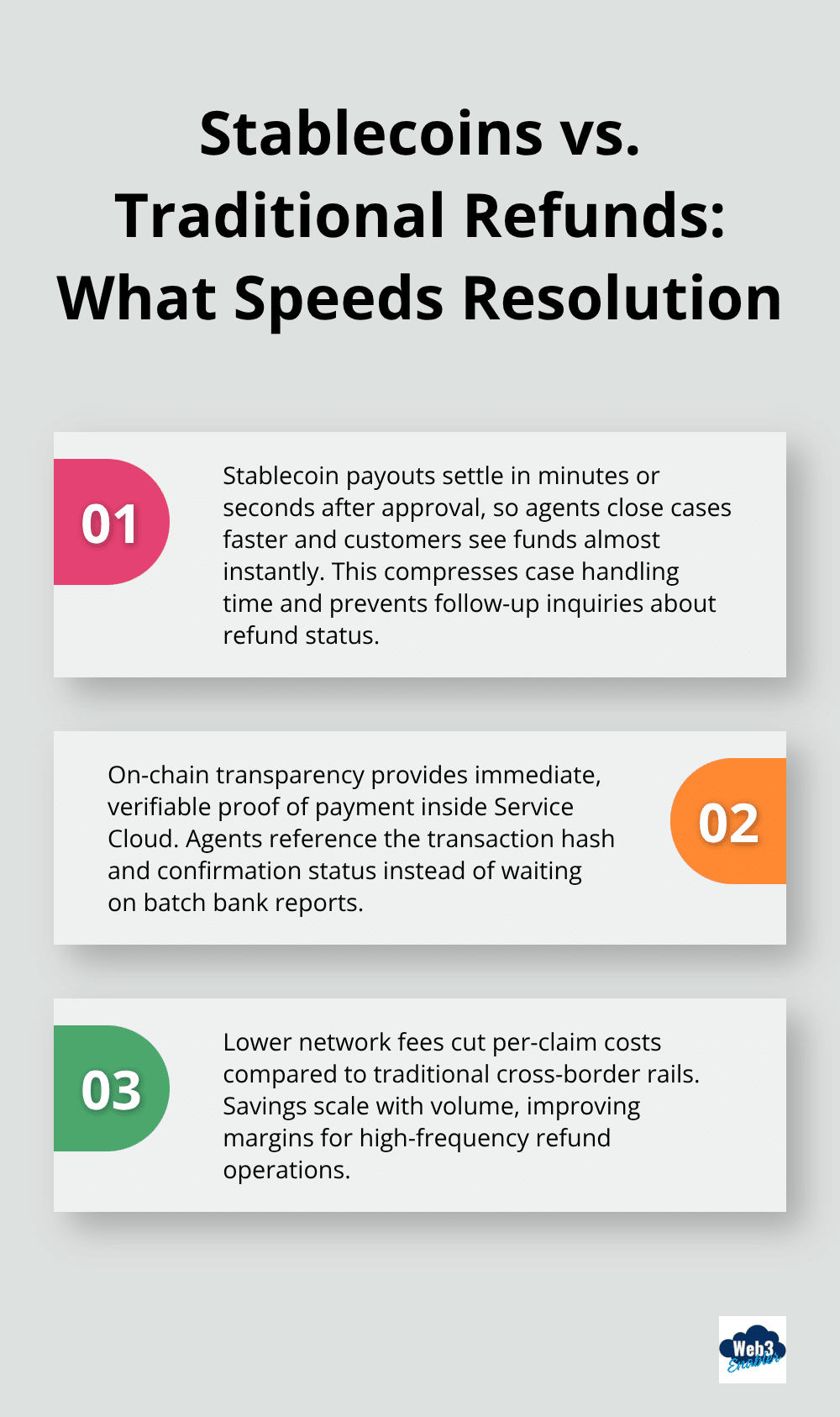
Settlement speed is the first operational win when stablecoins enter your Service Cloud environment. Traditional wire transfers take three to five business days to complete, during which support agents have no real-time visibility into whether a customer’s refund has actually arrived. Stablecoins settle in minutes or seconds after approval, which means your team closes cases immediately and customers see funds in their wallets almost instantly. This speed directly reduces case handling time and eliminates the frustration of customers asking where their money is.
According to Stripe, cross-border remittance costs average above six percent through traditional channels, while stablecoin network fees typically amount to just a few cents. When your support team processes a claim payout in USDC or USDT through Salesforce, the cost difference is dramatic enough to impact your bottom line on high-volume claim operations.
On-Chain Records Transform Dispute Resolution
The transparency advantage matters more than speed alone. On-chain settlement creates an immutable record that both your agents and customers can verify instantly within Service Cloud. When a customer disputes whether a refund was sent, your agent pulls up the transaction hash, wallet address, and confirmation status in real-time-no need to contact a banking partner or wait for batch reports. This eliminates reconciliation disputes entirely because blockchain data is cryptographically verified and cannot be altered.
The operational benefit is concrete: on-chain settlement reduces manual reconciliation because the source of truth is public and permanent. Your agents never leave the CRM to track a payment or verify a transaction status.
Blockchain Transparency Strengthens Fraud Detection
Fraud detection becomes measurably stronger when every transaction leaves a permanent, transparent trace. Traditional payment systems obscure the movement of funds behind banking intermediaries, making it harder to spot patterns of suspicious activity. With stablecoins, your compliance team monitors every claim payout in real-time and flags anomalies automatically.
Blockchain analytics tools integrate into your Service Cloud workflows to screen recipients against sanctions lists, detect unusual velocity patterns, and verify that payouts match claim eligibility criteria. This transparency also protects your customers-they verify that their refund reached the correct wallet address without relying on bank statements or confirmation emails. The audit trail created by on-chain transactions supports regulatory compliance with minimal manual verification, which reduces the risk exposure that comes with high-volume claims operations.
Your support team now has the tools to process claims with confidence, knowing that every transaction leaves a verifiable record. The next challenge is integrating these stablecoin capabilities directly into your customer support workflows so agents can act on this transparency without friction.
Building Stablecoin Refunds Into Your Support Operations
Support agents need tools that match the speed of blockchain settlement. When your team processes a claim in Service Cloud, they move a stablecoin to the customer’s wallet, verify settlement on-chain, and close the case without leaving the CRM. This workflow eliminates the handoff delays that plague traditional refund operations. Stripe supports 125+ payment methods including stablecoins across 195 countries, and when you integrate this capability into Salesforce Service Cloud, your agents gain the ability to process refunds in USDC or USDT directly from the case record. The agent selects the customer’s wallet address from the case data, approves the payout amount, and the transaction settles in minutes. Real-time visibility into the transaction hash and confirmation status appears immediately in Service Cloud, so the agent knows whether the refund succeeded before they close the ticket. This eliminates the common frustration where agents promise a refund but cannot confirm delivery for days.
Verify Disputes With On-Chain Records
Dispute resolution accelerates because on-chain records are immutable and instantly verifiable. When a customer claims they never received a refund, your agent pulls the transaction hash and proves settlement in seconds. Service Cloud can query blockchain records to check whether a claimed transaction actually occurred, retrieve the timestamp and amount, and automatically mark the case as resolved if the on-chain record matches the customer’s claim. If the records conflict, the agent sees a flagged exception with the discrepancy highlighted so they can investigate. This reduces manual review time significantly-agents no longer spend hours digging through bank statements or contacting payment providers.
Automate Triage Based on Blockchain Data
The real operational win comes from automating dispute triage based on on-chain data. Your compliance and operations teams see the same transaction data in real-time, which eliminates reconciliation disputes entirely. The audit trail created by every transaction supports regulatory compliance because blockchain data cannot be altered retroactively. Your support team documents every payout with a permanent, transparent record that satisfies auditors and reduces the operational risk of high-volume claims operations.
Lower Costs Through Native Salesforce Processing
Cost reduction follows naturally when your team stops relying on external payment processors for refund verification. Traditional cross-border claims cost your support operation money at multiple points: the wire transfer fee, the correspondent bank fee, and the time agents spend confirming delivery. Stablecoins incur only network fees of a few cents per transaction, which Stripe typically absorbs or passes through at roughly half the cost of other payment methods. For organizations processing hundreds of claims monthly across multiple countries, this difference compounds into meaningful savings. Automating refund processing within Salesforce further reduces headcount pressure on your support team because agents spend less time on payment verification and more time resolving customer issues. A phased rollout approach works best-start with your highest-volume corridors or customer segments where the cost savings and speed improvements are most obvious, then scale to broader workflows as your team gains confidence with the tools. The next challenge is equipping your support teams with real-time visibility into settlement status so they can handle the most complex disputes without friction.
Support Teams Need Real Visibility Into Blockchain Settlements
Support agents handling crypto-related disputes face a critical gap: they cannot verify blockchain transactions without leaving Salesforce, which means customers wait while agents hunt for transaction data across multiple systems. This operational friction defeats the entire purpose of stablecoin settlement. Your team needs real-time access to on-chain transaction records directly within Service Cloud so they can resolve disputes instantly and close cases without delay.
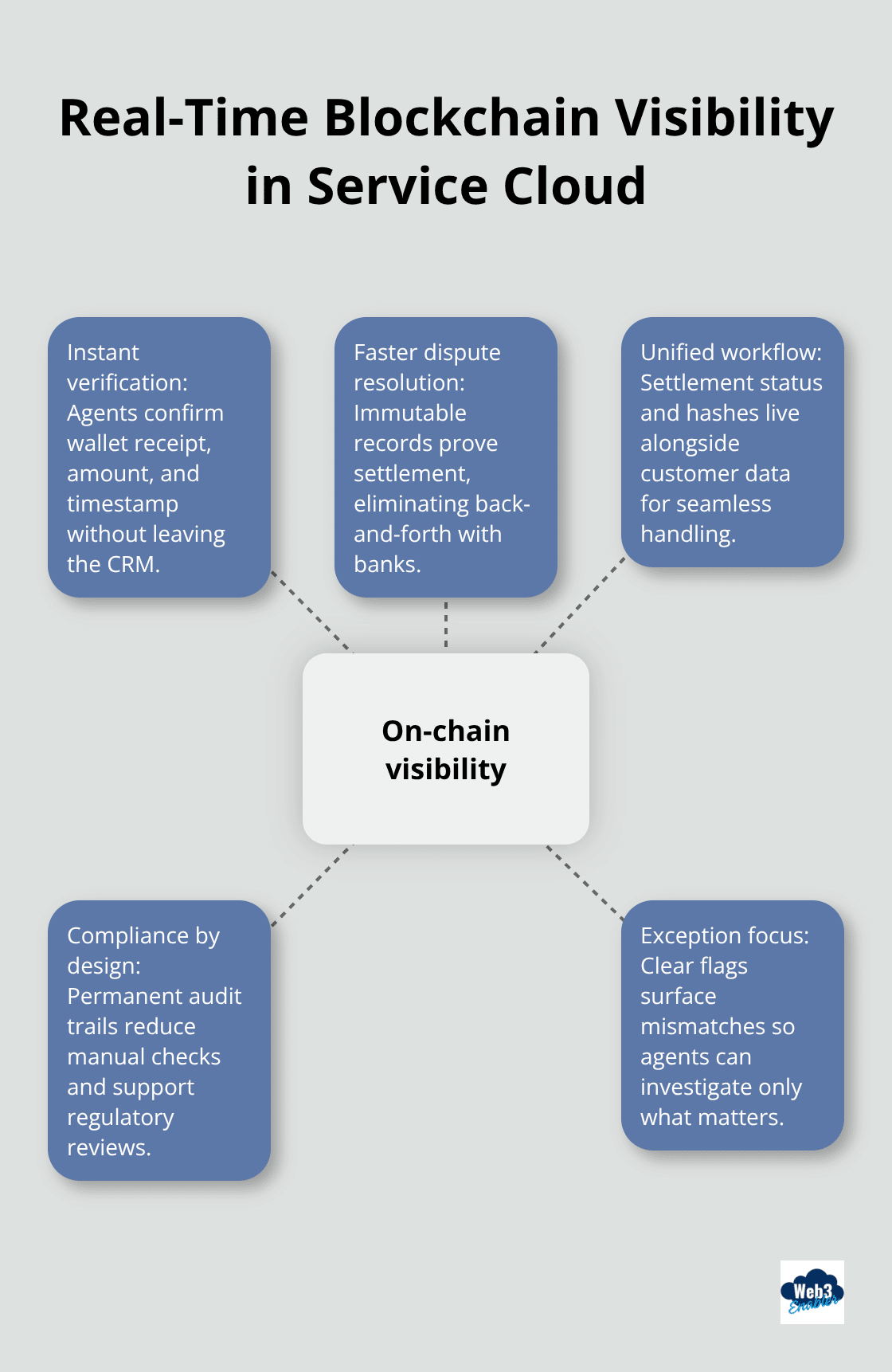
When a customer claims a refund never arrived, your agent pulls up the blockchain record in seconds, verifies the transaction hash, confirms the wallet address received the funds, and provides proof to the customer without contacting external systems. This requires integrating blockchain data queries into your Service Cloud case records so agents see settlement status alongside customer information. When you layer blockchain visibility on top of payment infrastructure, your agents gain the ability to verify stablecoin payouts in real-time.
Disputes Dissolve When Records Cannot Lie
Crypto balance disputes evaporate when both your team and customers reference the same immutable source of truth. Traditional payment systems force agents to rely on bank statements, confirmation emails, and customer reports, which creates room for miscommunication and delays. On-chain records cannot be altered retroactively, which means your agent proves settlement with cryptographic certainty.
When a customer disputes a refund amount, your agent pulls the transaction from the blockchain and shows the exact amount transferred, the timestamp, and the receiving wallet address. If the customer claims they never received funds, the agent queries the blockchain to verify whether the transaction actually reached their wallet. This eliminates reconciliation disputes because blockchain data is verifiable and permanent.
Your compliance team benefits equally because every payout leaves an immutable audit trail that satisfies regulators and auditors without manual verification. Organizations reduce manual reconciliation time significantly by using on-chain data instead of chasing bank confirmations. This means your support team spends less time investigating payment discrepancies and more time resolving actual customer issues.
Automation Handles Routine Disputes Without Agent Involvement
The most valuable optimization comes from automating dispute resolution entirely for straightforward cases. Your Service Cloud instance queries blockchain records automatically when a customer opens a dispute, compares the on-chain transaction data against the case record, and resolves the case instantly if the records match. If settlement occurred at the claimed amount and reached the customer’s wallet, the system marks the dispute resolved without human review.
Agents only handle exceptions where the on-chain record conflicts with the customer’s claim, which typically represents a small percentage of disputes. This automation reduces case handling time dramatically because your team eliminates the manual investigation step for routine disputes. Organizations processing hundreds of claims monthly across multiple countries see the most significant impact because automation scales across all corridors simultaneously.
The cost reduction follows naturally: fewer disputes require agent investigation, which lowers operational expenses and accelerates case closure rates. Your team implements predefined rules that automatically validate disputes against blockchain records, flag mismatches for investigation, and close routine cases without intervention.
Real-Time Settlement Visibility Transforms Agent Workflows
The agent opens the case record and sees the transaction hash automatically populated after settlement. They query the blockchain to confirm the customer’s wallet received the exact amount. If settlement failed, the agent sees the failure reason immediately and can retry or escalate without guessing. This eliminates the common frustration where customers receive conflicting information because agents cannot verify what actually happened on-chain.
Blockchain integration directly within Service Cloud allows your agents to access on-chain transaction records without leaving the CRM. This integration means your team gains real-time visibility into settlement status, transaction hashes, and wallet confirmations as part of your standard case workflow. Your compliance team benefits because every transaction creates an immutable record that satisfies audit requirements and reduces operational risk.
Final Thoughts
Stablecoins in Salesforce Service Cloud eliminate the operational friction that slows down claims and payouts. Your support team settles disputes in minutes instead of days, verifies transactions with cryptographic certainty, and closes cases without leaving the CRM. The speed advantage alone justifies implementation, but the real business impact comes from automation and cost reduction working together.
When your agents process refunds directly in Service Cloud using USDC or USDT, settlement costs drop dramatically compared to traditional wire transfers. Cross-border remittance fees that once exceeded six percent shrink to network fees of a few cents, and for organizations processing hundreds of claims monthly across multiple countries, this difference compounds into measurable savings on every transaction. Your compliance team benefits equally because on-chain records create immutable audit trails that satisfy regulators without manual verification.
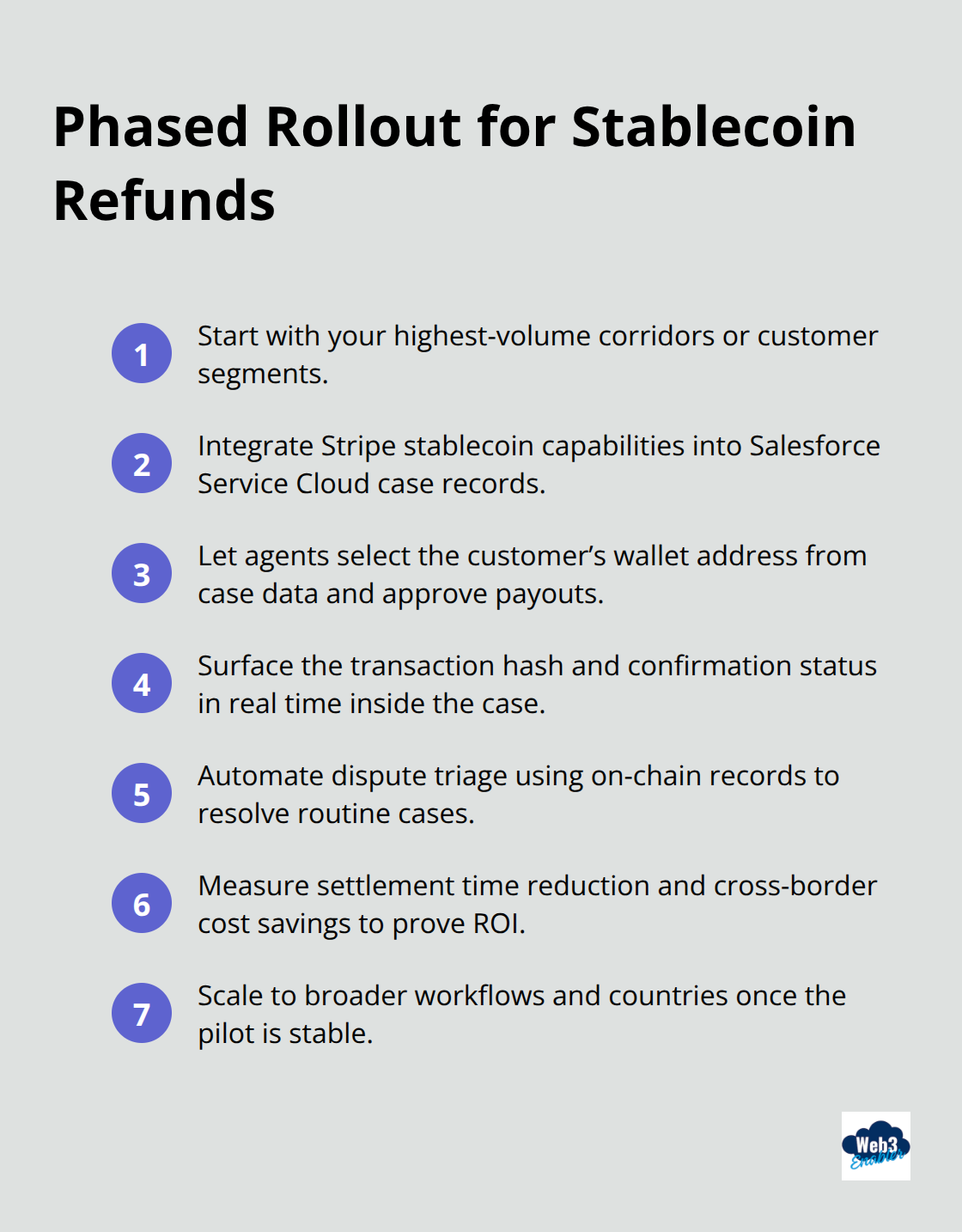
The operational gains extend beyond cost and speed-automating dispute resolution based on on-chain records eliminates the manual investigation step for routine cases. Your agents handle only exceptions where blockchain data conflicts with customer claims, which typically represents a small percentage of disputes. Start with a controlled pilot in your highest-volume claim corridors, measure settlement time reduction and cross-border cost savings to quantify ROI quickly, and most organizations achieve positive ROI within 60 to 90 days post go-live. Web3 Enabler provides the native blockchain platform you need to integrate stablecoin payments directly into Salesforce without external wallets or separate systems.
Frequently Asked Questions About Stablecoins in Salesforce Service Cloud
Stablecoins in Salesforce Service Cloud help support teams process refunds, settle claims, and resolve payment disputes faster with real-time transaction visibility. Below are common questions about how stablecoin settlement, on-chain records, and blockchain-powered support workflows improve speed, transparency, and operational efficiency.
What are stablecoins in Salesforce Service Cloud?
Stablecoins in Salesforce Service Cloud are blockchain-based digital currencies, such as USDC or USDT, that support teams can use to process refunds, settle claims, and manage payouts directly within Service Cloud workflows. Instead of relying on slow banking rails, teams can move funds quickly while keeping transaction details visible inside the CRM.
Why do stablecoins settle claims faster than traditional banking?
Stablecoins settle claims faster because blockchain transactions can confirm in minutes or seconds, while traditional wire transfers often take several business days. This speed helps support teams close cases faster, reduce customer frustration, and avoid repeated follow-up questions about refund status.
How do stablecoins improve refund workflows in Service Cloud?
Stablecoins improve refund workflows by allowing agents to approve a payout, send funds to a customer wallet, and verify settlement from the same case environment. This reduces handoff delays, improves visibility into refund status, and helps agents confirm delivery before closing the case.
Can support agents verify stablecoin refunds inside Salesforce?
Yes. With the right blockchain integration, support agents can verify stablecoin refunds inside Salesforce by viewing transaction hashes, wallet addresses, timestamps, and confirmation status directly in Service Cloud. This gives agents immediate proof that a refund was sent and helps them respond to customer questions with confidence.
How do on-chain records help resolve customer disputes?
On-chain records help resolve disputes because they create a permanent and verifiable record of each transaction. If a customer says they did not receive a refund, the support team can check the blockchain record to confirm whether the payment was sent, when it settled, and which wallet received the funds. This reduces ambiguity and speeds up dispute resolution.
Do stablecoins improve transparency for support teams and customers?
Yes. Stablecoins improve transparency because blockchain transactions create visible and immutable payment records. Support teams can reference the same transaction data that customers can verify independently, which reduces miscommunication and makes payment status easier to confirm during claims and refund conversations.
How do stablecoins help reduce refund and claims processing costs?
Stablecoins can reduce processing costs by replacing expensive traditional payment methods, especially for cross-border claims and refunds. Network fees are often far lower than wire fees, correspondent banking charges, and the administrative cost of manual verification. For organizations handling high claim volume, those savings can become significant over time.
Can blockchain data automate dispute resolution in Service Cloud?
Yes. Blockchain data can support automation by allowing Service Cloud to compare dispute details against on-chain settlement records. If the transaction record matches the case data, a routine dispute can be resolved automatically. Agents then focus only on exceptions where blockchain records and customer claims do not align.
How do stablecoins strengthen fraud detection in customer support operations?
Stablecoins strengthen fraud detection by creating an auditable record of every payout and making transaction behavior easier to monitor. Support and compliance teams can use blockchain data to identify unusual wallet activity, screen recipients, and flag suspicious payout patterns more quickly than with traditional payment systems.
Who should use stablecoins in Salesforce Service Cloud?
Stablecoins in Salesforce Service Cloud are especially useful for organizations that manage frequent refunds, claims, or cross-border customer payouts. They are a strong fit for support teams that need faster settlement, clearer payment visibility, lower transaction costs, and a more efficient way to resolve disputes inside existing Salesforce workflows.