


Your Salesforce instance handles customer data, payments, and partnerships. But what happens when blockchain enters the picture? Suddenly, you’re juggling new rules, compliance headaches, and payment verification across multiple jurisdictions.
At Web3 Enabler, we’ve seen firsthand how Salesforce blockchain governance transforms chaos into control. The good news: you don’t need to rebuild everything from scratch.
Why Governance Matters When Blockchain Meets Salesforce
Blockchain doesn’t play by the old rules, and your Salesforce compliance framework knows it. When you process payments across borders or hold client assets on-chain, regulators care about one thing: can you prove what happened, when it happened, and who authorized it? That’s not optional theater-it’s the price of entry. Without governance baked into your payment workflows, you face sanctions violations, money laundering risks, and the kind of regulatory heat that costs millions. Your Salesforce instance already tracks customer data and payments. Adding blockchain visibility means extending that same rigor on-chain. Cross-chain visibility becomes non-negotiable here. You must monitor assets across major blockchains, bridges, and DeFi protocols to prevent leakage and align activity with your compliance policies. Without it, you fly blind on where client funds actually sit and how they move.
Real Risk Demands Real Controls
Payment governance on blockchain requires you to combine on-chain data with off-chain context like KYC records and sanctions lists so you can attribute activity to actual people and entities. This isn’t theoretical-it directly impacts your risk scoring and approval workflows. Address clustering and entity attribution reduce false positives and improve decision-making when transactions hit your compliance gates. Real-time data processing is the only way to stay ahead here. When a transaction arrives in Salesforce, you need instant access to whether that wallet or counterparty is sanctioned, high-risk, or flagged. Waiting hours for batch reports means you approve payments you shouldn’t have touched.
Embed Controls Into Your Payment Workflows
In Salesforce, embed transaction monitoring and wallet screening directly into your payments policy controls. Use risk scoring to gate or reject transactions before they settle. You document your data sources, scoring logic, and decision rationale so you can defend your choices to regulators (this auditability matters more than most teams realize). Data hygiene matters equally. You normalize and deduplicate your on-chain and off-chain data, maintain standardized attribution, and keep records clean so your governance doesn’t collapse under its own weight.
From Policy to Practice
The real test of governance isn’t what you write in your compliance manual-it’s what actually happens when a payment hits your system. Your Salesforce instance becomes the enforcement point where policy meets reality. Regulators don’t care about your intentions; they care about your audit trail. That’s where the next section comes in: how to actually build these controls into your Salesforce workflows so they work automatically, consistently, and defensibly.
Building Governance Into Your Salesforce Payment Workflows
Your Salesforce instance already tracks every customer interaction, payment, and approval. Blockchain governance works the same way-it’s not about adding complexity, it’s about extending your existing control framework on-chain. The difference is speed and automation. When a stablecoin payment arrives in Salesforce, you have seconds to screen the counterparty against sanctions lists, verify wallet ownership, and approve or reject the transaction. Manual review doesn’t scale. You need your Salesforce workflows to make these decisions in real time, consistently, and with a complete audit trail that regulators can follow.
Map Your Payment Verification Workflow Backwards
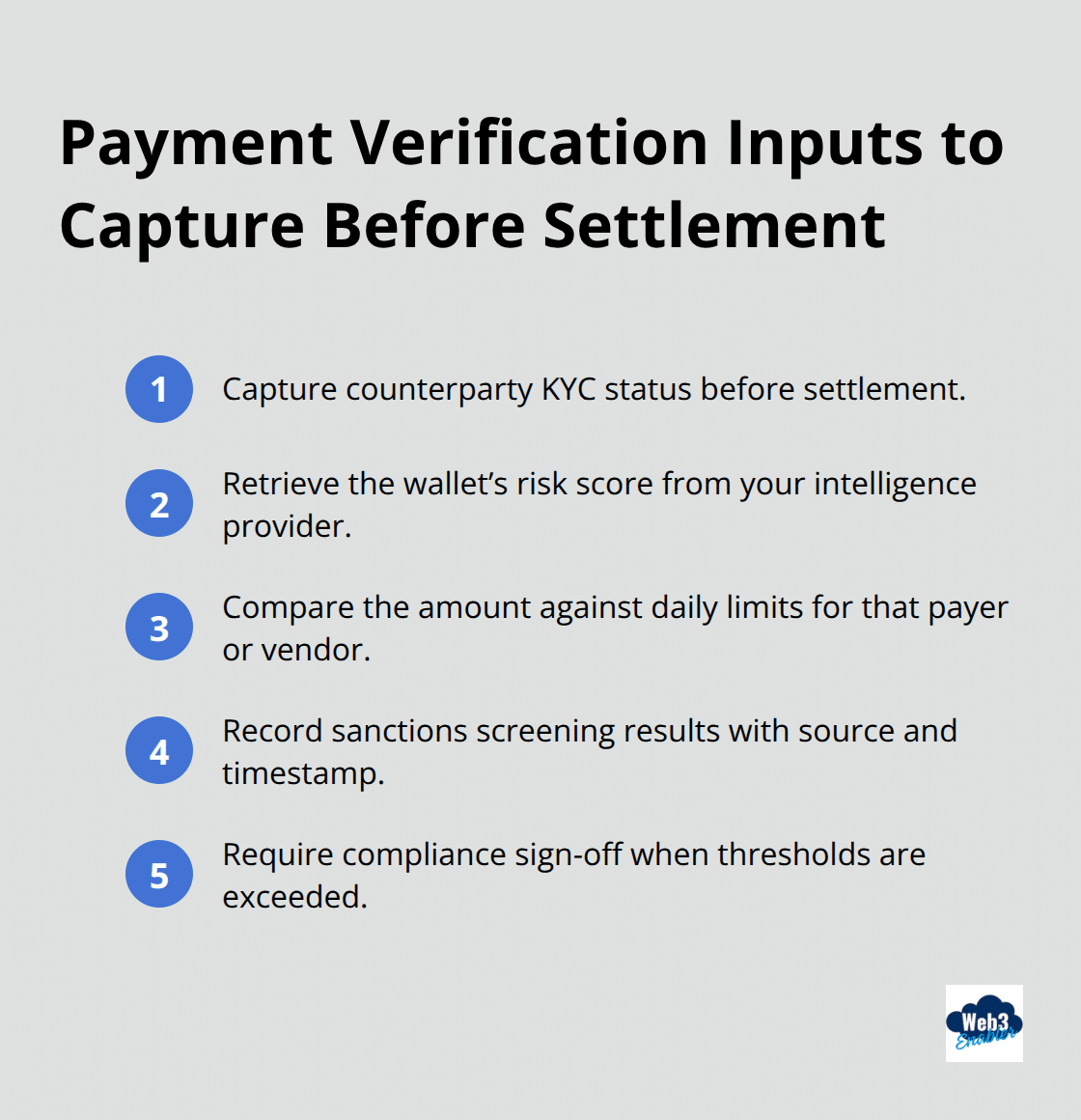
Start by mapping your payment verification workflow backwards from the point of settlement. What data do you need before a transaction moves forward? Counterparty KYC status, wallet risk score, transaction amount against daily limits, sanctions screening results, and compliance sign-off. Each of these inputs should feed into a single Salesforce record that captures the full decision chain. Treat blockchain payments like any other high-stakes Salesforce process: use a single entry point per payment object to avoid fragmented automation, apply record-triggered flows for transaction monitoring and wallet screening, and offload heavy processing asynchronously so you don’t bog down your payment submission.
Process Payments at Scale Without Losing Control
When transaction volume spikes-say, processing 50 stablecoin payments per hour-asynchronous processing keeps your system responsive while compliance checks run in the background. Your Salesforce workflows consume real-time data from your blockchain intelligence provider via APIs, so your payment approval decisions reflect current risk scores and sanctions status. If you’re screening cross-chain transactions, your Salesforce record must reflect which blockchains and bridges the funds moved through. Visibility gaps kill governance-if you can’t see that a payment touched a privacy mixer or a sanctioned exchange, your controls become theater.
Document Every Decision for Regulatory Defense
Document your scoring logic and data sources explicitly in Salesforce custom fields. When regulators ask why you approved a transaction, you don’t say “we thought it looked okay.” You pull the Salesforce record and show them the exact KYC match, the sanctions screening result, the risk score calculation, and the timestamp of approval. This auditability is non-negotiable. Data normalization matters more than teams realize. Standardize how you store wallet addresses, counterparty names, and transaction IDs across Salesforce so your automation doesn’t break when data arrives in different formats.
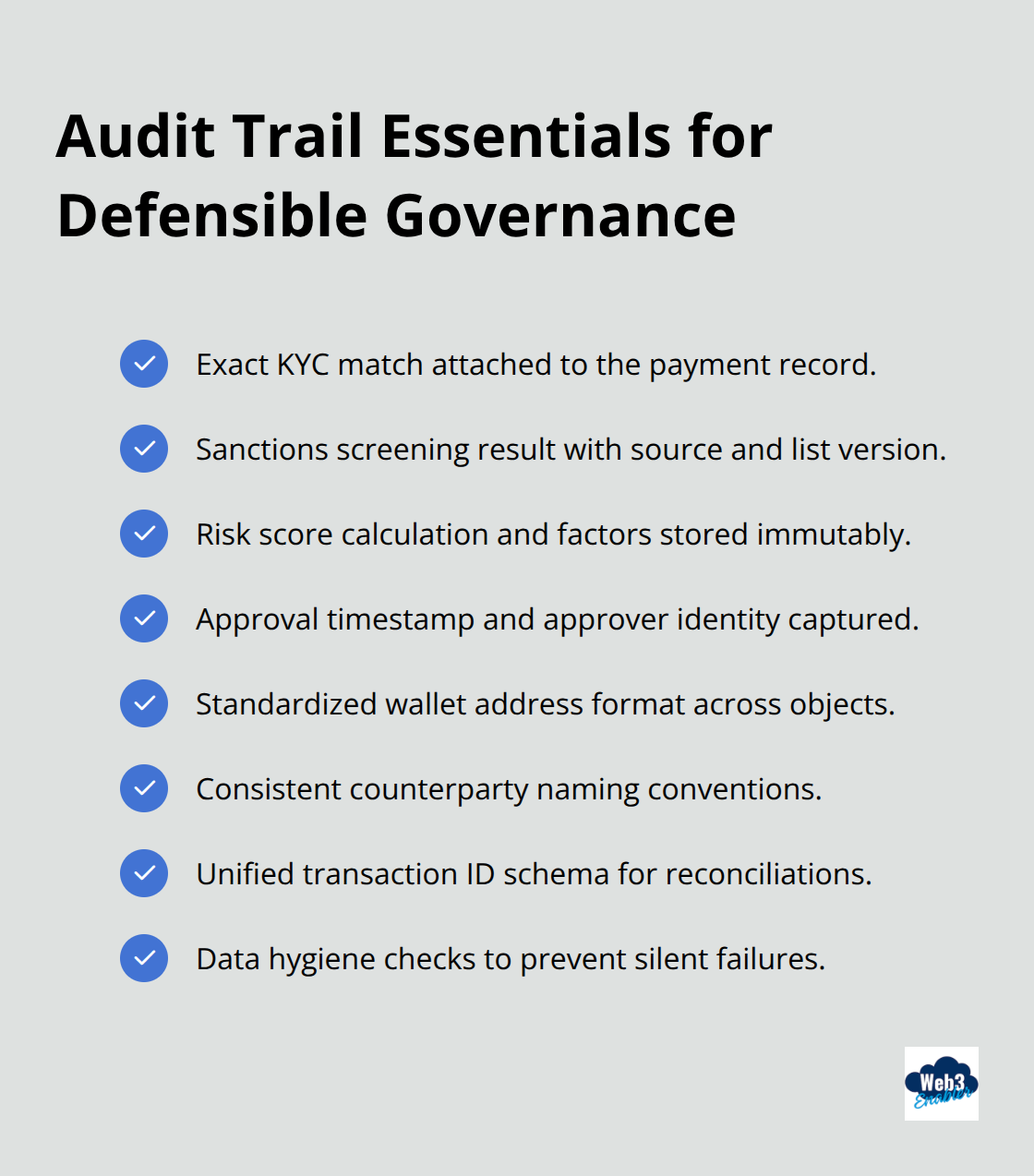
A single typo in a wallet address or a counterparty name mismatch can cause your screening logic to fail silently.
Test and Respond to Real Risks
Test your governance workflows in sandbox with real sanctions data before you go live. When a transaction flags as high-risk or a counterparty appears on a new sanctions list, your Salesforce workflow should trigger an immediate escalation to compliance and create an audit record with timestamp, flagged data, and decision outcome. That record becomes your proof that you acted when you saw the risk.
From Automation to Accountability
Your Salesforce instance becomes the enforcement point where policy meets reality. Regulators don’t care about your intentions; they care about your audit trail. The next section shows you how real-world organizations actually implement these controls and what happens when governance frameworks face their toughest tests.
How Governance Actually Works When Real Money Moves
Wealth Management: Visibility Across Multiple Blockchains
A financial advisor at a mid-sized wealth management firm pulls up a single Salesforce dashboard that displays a client’s Bitcoin holdings alongside their stock portfolio. The same screen shows the client’s current risk classification based on transaction history and whether those holdings passed sanctions screening that morning. That visibility exists because someone built a governance framework that connects blockchain intelligence to Salesforce records in real time. The framework maps wallet addresses to client profiles, runs automated screening against OFAC and other sanctions lists, and flags any transaction that touches a known mixer or privacy coin. When a transaction does flag, Salesforce creates an audit record with timestamp, the specific risk trigger, and the compliance decision. That record lives forever in your org.
Regulators ask questions; you show them the data. No guessing, no reconstructing what happened three months ago from memory. Widespread adoption of blockchain-regulatory tech is accelerating specifically because organizations realized that manual compliance doesn’t scale. When your firm processes 200 client transactions per week across multiple blockchains, you need Salesforce automation to screen every single one. One missed sanctions match can cost your firm millions in fines and reputational damage.
Enterprise Payments: Control at Every Step
Enterprise payments teams face a different but equally serious problem: moving funds across borders without creating compliance nightmares. A company that wants to pay vendors in three countries using stablecoins on different blockchains cannot simply send transactions and hope for the best. Their Salesforce instance becomes the control point where every payment gets verified before settlement. The workflow checks the vendor’s KYC status, confirms the wallet address hasn’t changed since the last payment, screens against sanctions lists, and validates that the transaction amount fits within approved daily limits for that vendor.
If the vendor’s risk score jumped because of recent transaction activity flagged by blockchain intelligence providers, the payment holds and escalates to compliance. This isn’t paranoia; it’s the difference between compliant operations and regulatory violations. Address clustering and entity attribution reduce false positives so your team doesn’t waste time reviewing legitimate transactions. When your blockchain intelligence provider correctly identifies that three wallet addresses belong to the same entity, your Salesforce workflow applies consistent risk rules across all of them instead of treating each wallet independently. That consistency matters when regulators audit your decision-making.
Cross-Border Transactions: Auditable at Every Hop
Cross-border transactions demand even tighter governance because you navigate multiple jurisdictions simultaneously. A payment that travels from your company’s Ethereum wallet through a cross-chain bridge to Polygon and then settles at a vendor’s bank account creates a compliance trail that must be auditable at every hop. Your Salesforce record documents which blockchains the transaction touched, which bridges it crossed, the time spent on each chain, and the final settlement confirmation.
If a regulator later questions that transaction, you don’t say “we think it was fine.” You pull the Salesforce record and show the exact compliance checks that passed, the data sources used, the risk score at the time of approval, and the timestamp of every step. That auditability separates defensible governance from wishful thinking. Your Salesforce instance becomes the enforcement point where policy meets reality, and regulators care about your audit trail far more than your intentions.
FAQ: Salesforce Blockchain Governance & Auditability
What is the most important element of blockchain governance in Salesforce?
In 2026, the gold standard for governance is “Glass Box Attribution.” It is no longer enough for your Salesforce instance to show a simple risk score. Regulators now require a visible evidentiary chain—documented in Salesforce custom fields—that explains why a wallet was flagged or cleared. This includes the specific heuristics used (like common-input analysis), the confidence level of the match, and a timestamped audit trail that connects on-chain data to your internal KYC records.
How do I automate blockchain screening without hitting Salesforce governor limits?
As blockchain transaction volume scales, high-density automation requires a hybrid approach. For 2026, Salesforce architects recommend using Record-Triggered Flows for the initial entry point, but offloading heavy blockchain data processing and API calls to “Invocable Apex” running asynchronously. This ensures your payment UI remains responsive while the system performs deep-dive sanctions screening and address clustering in the background.
Can Salesforce handle “multi-hop” cross-chain visibility?
Yes. Modern governance frameworks in Salesforce are designed to track “hop-by-hop” provenance. A transaction record in your CRM should document not just the final settlement wallet, but every intermediate step—including cross-chain bridges (like LayerZero or Wormhole) and the time spent on each chain. This is a specific requirement under the 2026 implementing rules of the US Treasury and the EU’s EBA to prevent funds from being “washed” through multiple protocols.
What is address clustering, and why should it live in my CRM?
Address clustering is the process of grouping multiple pseudonymous blockchain addresses that are likely controlled by the same entity. By bringing clustering data into Salesforce, your governance rules become entity-based rather than wallet-based. If one wallet in a cluster is sanctioned, your Salesforce workflow can automatically flag every other associated wallet in your database, preventing “risk leakage” across your customer base.
How do I prepare my Salesforce audit trail for a regulatory examination?
The most effective strategy is “Continuous Verification.” Instead of reactive quarterly reports, use Salesforce Shield or Event Monitoring to create a permanent,
Final Thoughts
Salesforce blockchain governance isn’t a future problem you can postpone. Organizations that build it into their payment workflows today avoid the regulatory nightmares that catch unprepared teams off guard tomorrow. The core principle remains simple: extend the same rigor you already apply to customer data and payments into your blockchain operations, which means real-time sanctions screening, documented decision trails, cross-chain visibility, and automation that catches risk before transactions settle.
Your Salesforce instance already tracks every interaction and approval, so blockchain governance works the same way-it’s not about adding complexity, it’s about connecting on-chain activity to your existing control framework. When you embed transaction monitoring, wallet screening, and risk scoring directly into your payment workflows, compliance stops being a manual burden and becomes something your system enforces automatically, consistently, and defensibly. The organizations winning at this aren’t the ones with the most sophisticated blockchain infrastructure; they’re the ones that aligned their Salesforce policies with their blockchain operations and built governance into their payment processes from day one.
We at Web3 Enabler have built 100% Salesforce Native blockchain solutions specifically to make Salesforce blockchain governance easier. Start by mapping your payment verification workflow backwards from settlement, identify the compliance checks that must pass before a transaction moves forward, then build those checks into Salesforce automation so they run consistently, in real time, and with full auditability.