



Your Salesforce CRM is already managing customer relationships. Now it’s time to handle payments the same way-directly in the system you’re already using.
Crypto payments aren’t some distant future thing anymore. Businesses are using stablecoins right now to cut settlement times from days to minutes and eliminate international transfer fees entirely.
We at Web3 Enabler have seen firsthand how Salesforce payments API integration transforms payment workflows. This guide shows you exactly how to connect crypto payments to your CRM and why it matters for your bottom line.
Why Crypto Payments Actually Save Money
Traditional banking locks you into settlement timelines that haven’t budged since the 1980s. Wire transfers consume 3–5 business days domestically and up to 10 days internationally. ACH transfers hit daily limits that strangle cash flow. Your customers wait, and your accounting team manually reconciles transactions days after the money supposedly arrived. Crypto payments on stablecoins like USDC and USDT settle in minutes, not days. Companies processing $50,000 daily in cross-border payments save roughly $15,000 monthly in wire fees alone-that’s $180,000 annually. Add the elimination of currency conversion spreads when you use stablecoins pegged to fiat currencies, and the math improves further. A phased rollout starting with high-friction payment corridors and top-grossing customer segments shows positive ROI within 60–90 days after go-live.
Reconciliation Becomes Automatic
Your accounting staff currently spends about 2 hours per day on reconciliation-that’s 10 hours weekly per person. Blockchain’s immutable on-chain ledger replaces manual reconciliation entirely, cutting those hours dramatically. Real-time payment confirmation means your team sees wallet addresses, amounts received, and settlement status without leaving Salesforce. No more switching between systems. No more waiting for bank confirmations that arrive after business hours.
Settlement Speed Transforms Cash Flow
Cross-border payments that settle in minutes instead of days using blockchain rails directly improve your cash conversion cycle metrics, which investors notice. Faster cash posting means better cash flow forecasting and stronger balance sheet optics. Your treasury team monitors crypto reserves in real time within Salesforce instead of juggling external wallets and spreadsheets (no more spreadsheet chaos). International expansion becomes genuinely frictionless because you no longer fight currency conversion delays and middleman fees.
Geographic Restrictions Disappear
The geographic barriers that traditionally limited payment acceptance vanish-you accept stablecoins from anywhere, instantly. Salesforce-native blockchain solutions available on the AppExchange handle USDC, USDT, and XRP without requiring external wallet management or platform switching. This native integration means your team stays inside the CRM they already know, with no context switching or external tools to manage. The real advantage sits in simplicity: payments flow directly into your existing Salesforce workflows, triggering automations and updating customer records without manual intervention.
How to Connect Crypto Payments to Salesforce
Connecting crypto payments to your Salesforce org requires three practical moves: first, you establish your API credentials and understand the Salesforce REST API structure; second, you connect a stablecoin processor that plays nicely with Salesforce; third, you test everything in a sandbox before touching production. The Salesforce REST API documentation shows that REST is lightweight and JSON-first, making it ideal for modern payment integrations.
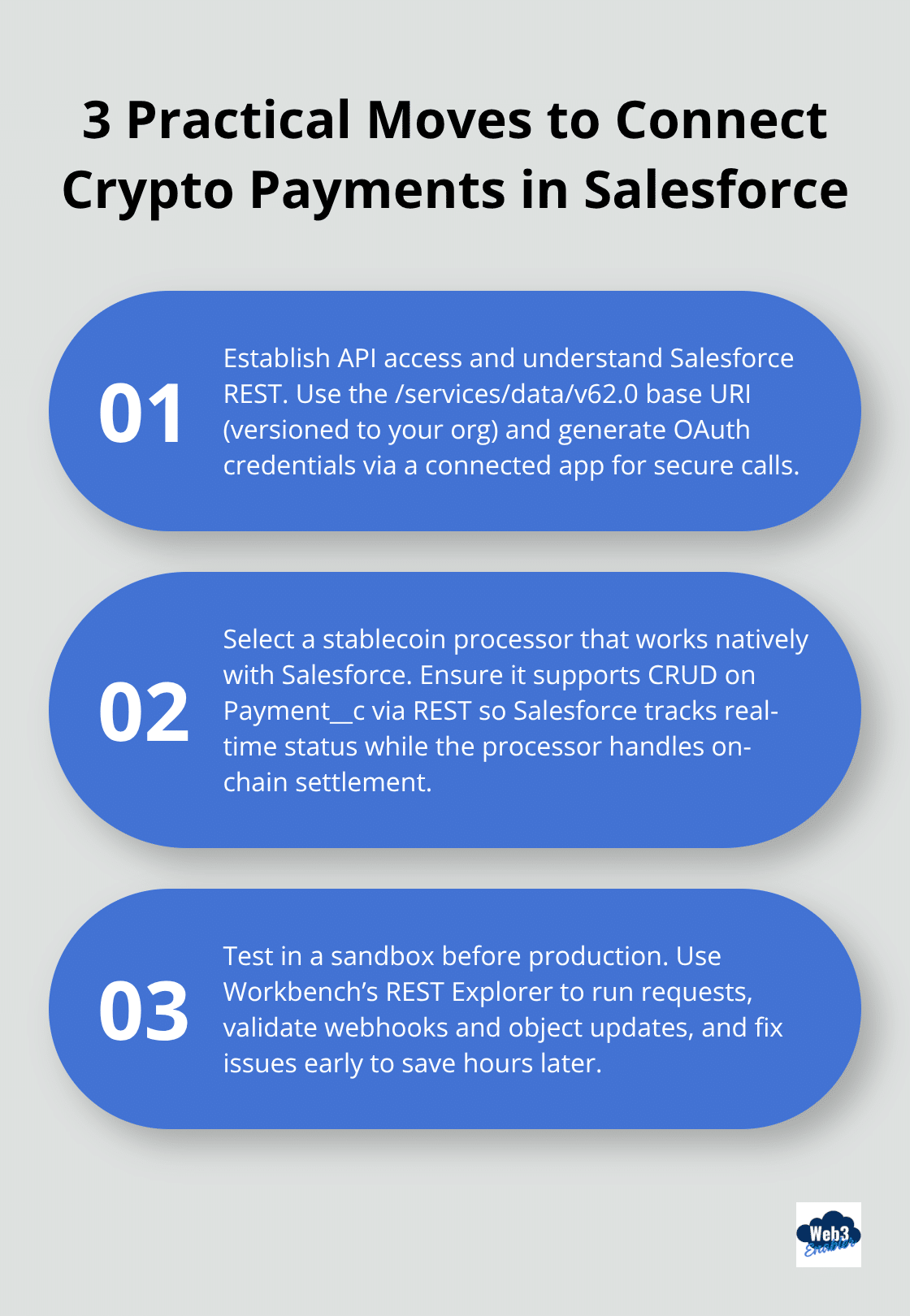
You’ll work with the standard REST data endpoint base URI at /services/data/v62.0 (adjust the version to match your org). Start by creating a connected app in Salesforce to generate OAuth credentials-this is non-negotiable for security. Then use Salesforce Workbench, a free browser-based tool available through your Salesforce org, to test REST endpoints without writing code. Go to Utilities, select REST Explorer, and run a GET request against your payment objects to validate connectivity. This takes 15 minutes and saves hours of debugging later.
Pick Your Stablecoin Processor Wisely
For stablecoin processors, select one that offers native Salesforce integration with no external wallet management required. USDC and USDT are the primary options; XRP works too. The processor you select should support CRUD operations (Create, Read, Update, Delete) directly against your custom Payment object through REST endpoints. When you POST to /services/data/v62.0/sobjects/Payment__c, include the payment amount, wallet address, and customer reference in JSON format. The processor then handles the actual blockchain settlement while Salesforce tracks status in real time. Avoid processors requiring you to manage wallets outside Salesforce-that defeats the entire purpose of native integration.
Real-Time Status Updates Without Manual Work
Set up Change Data Capture streaming from Salesforce to sync your Payment and Invoice objects with sub-second to seconds latency. When a payment settles on-chain, the processor sends a webhook back to Salesforce, triggering a PATCH request that updates the payment status field instantly. Configure automated workflows so that status changes trigger actions: a completed payment automatically sends a receipt email, updates the related invoice, and posts the transaction to your accounting system. Real-Time Data Actions in Salesforce convert payment events into instant CRM actions-no waiting, no manual intervention. Your sales team sees updated customer payment history without refreshing, and your finance team gets immediate visibility into received amounts and wallet addresses. This removes the reconciliation bottleneck entirely because every payment creates an immutable on-chain record that Salesforce references. Idempotent ingestion using idempotency keys prevents duplicate payments if a webhook retries; include a unique transaction ID in each request so Salesforce recognizes and ignores duplicates automatically.
Sandbox Testing Before You Go Live
Test in a Salesforce sandbox environment first-never in production. Create test payment records with small amounts (even $1 transfers work) and simulate success, failure, and refund scenarios. Verify that webhook notifications arrive within seconds and that payment status updates correctly in Salesforce. Check that your automation rules fire as expected: if a payment completes, does the invoice update? Does the revenue recognition trigger? Does the customer record reflect the new payment? Use the REST Explorer in Workbench to manually POST test transactions, inspect the raw API responses, and validate the JSON structure before your team writes any code. Monitor the Trust Layer dashboards (available in Salesforce) to observe ingestion latency, error rates, and data quality issues. A typical implementation timeline shrinks from quarters to weeks when you follow this testing cadence.
Rolling Out Live Transactions Gradually
Go live with a limited set of transactions first-maybe one customer segment or one payment corridor-then expand once you confirm settlement times, reconciliation accuracy, and dashboard reporting work as intended. Track your success metrics from day one: settlement time should drop to 3–5 minutes, reconciliation hours per staff member should fall by roughly 2 hours daily, and cross-border costs should decrease 30–50% depending on your volume and corridors. This phased approach reduces risk and lets you catch integration issues before they affect your entire customer base. Once your first cohort settles smoothly and your team feels confident with the workflow, you’re ready to scale across more payment corridors and customer segments. The next chapter covers real-world examples of how businesses have already implemented these flows and what results they’ve achieved.
How Businesses Are Already Using Crypto Payments
Manufacturing: Cutting Wire Fees and Settlement Time
B2B companies operating across borders discovered that traditional payment rails cost real money and real time. A manufacturing firm processed $50,000 daily in cross-border supplier payments to Southeast Asia and lost $15,000 monthly to wire fees alone. After connecting USDC settlements through their Salesforce org, they cut settlement time from 7 business days to 3 minutes and eliminated currency conversion spreads entirely. Their accounting team moved from 10 hours weekly on manual reconciliation to automated settlement confirmations that posted directly into their general ledger. The finance director tracked DSO improvement of 2.3 days within the first quarter, which translated to an extra $1.2 million in working capital.
E-commerce: Removing Geographic Checkout Barriers
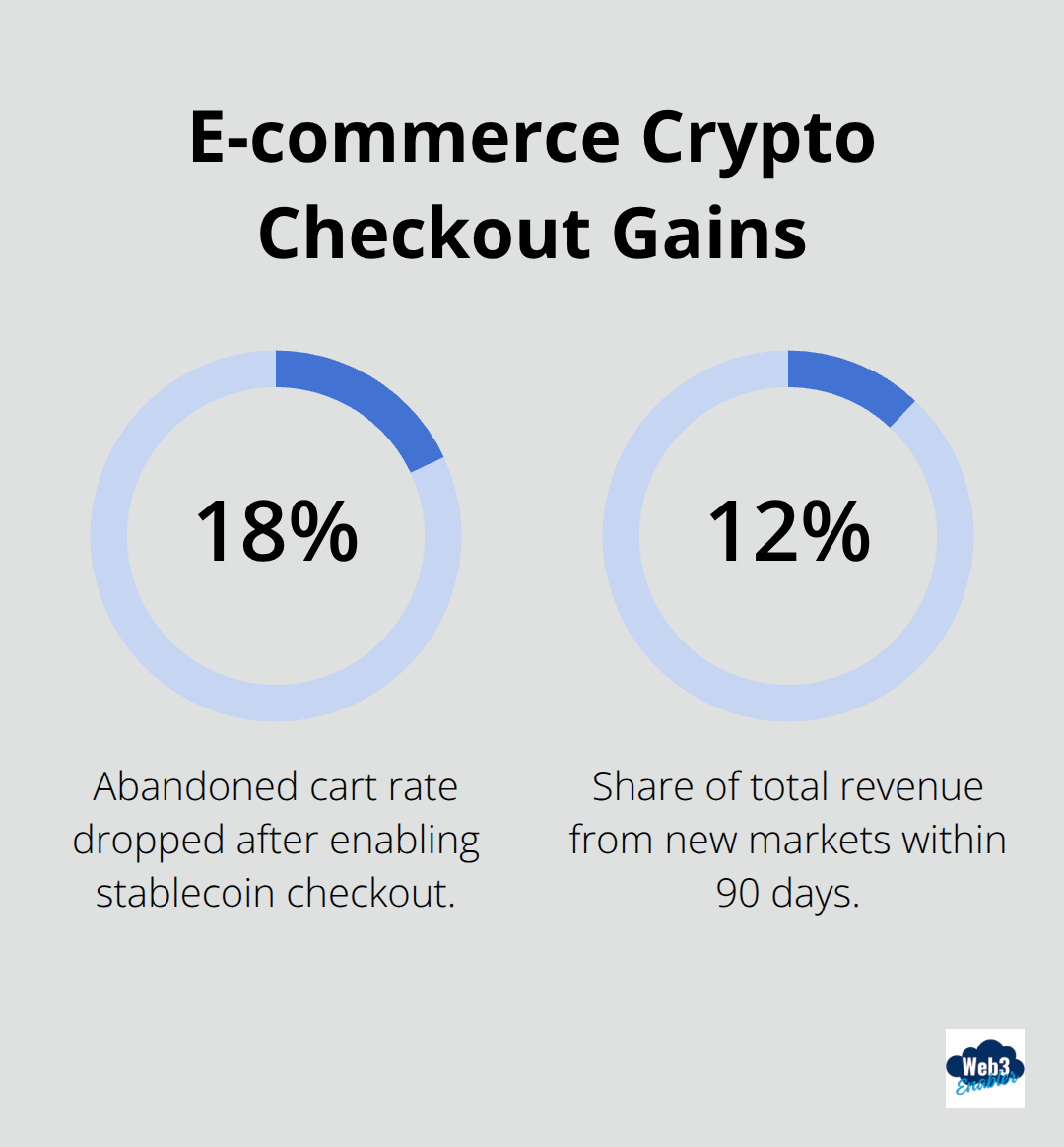
E-commerce businesses faced a different friction point: customer payment failures at checkout due to geographic payment restrictions. One mid-market retailer expanded into 14 new markets using stablecoin checkout options, accepting USDT and USDC from customers in regions where traditional payment processors declined transactions. Their abandoned cart rate dropped 18% because customers completed purchases without geographic barriers. Within 90 days, the new markets accounted for 12% of their total revenue. The operational win came from real-time payment status visibility inside Salesforce: customer service teams saw which transactions completed and which failed instantly, enabling them to follow up within minutes instead of hours.
Financial Services: Accelerating Client Onboarding
Financial services firms took a different angle entirely. Advisory firms managing client assets wanted to offer cryptocurrency exposure without managing separate platforms or requiring clients to move funds outside their existing banking relationships. One wealth management firm integrated stablecoin payment capabilities into their Salesforce Revenue Cloud, allowing clients to fund advisory accounts using USDC directly from their wallets. Settlement happened in minutes, and the advisor saw real-time wallet balances and transaction history without leaving the CRM. This eliminated the manual onboarding friction that previously took 3–5 business days and required paper signatures. Their client onboarding time dropped to 24 hours, and they reported 31% faster account funding across their client base.
The compliance and audit trail advantage proved equally valuable: blockchain payments allow money to move instantly, transparently, and across borders by recording every transaction on a shared, verifiable ledger, reducing compliance review time from 4 hours per account to 30 minutes because auditors verified settlements directly on-chain rather than requesting bank statements.
What Made These Implementations Succeed
These implementations succeeded because they solved real operational problems rather than chasing blockchain hype. The common thread: each business selected native Salesforce integration so their teams stayed inside the CRM they already used daily. No wallet management outside the platform. No context switching. No spreadsheets. Settlement times measured in minutes instead of days directly improved cash flow metrics that matter to CFOs and investors.

The phased rollout approach worked across all three scenarios: start with the highest-friction payment corridors or customer segments, measure settlement time and reconciliation savings, then expand once the team felt confident. ROI appeared within 60–90 days in every case because the operational efficiency gains were immediate and measurable.
Final Thoughts
Native Salesforce payments API integration eliminates the friction that plagued business payments for decades. Your team stays inside the CRM they already use daily, settlement happens in minutes instead of days, and reconciliation shifts from manual drudgery to automatic confirmation. The financial impact appears immediately: companies see positive ROI within 60–90 days through faster cash conversion, reduced wire fees, and eliminated reconciliation hours.
Manufacturing firms cut settlement times from a week to minutes, e-commerce retailers expanded into new markets by removing geographic payment barriers, and financial advisors onboard clients in 24 hours instead of 5 days. These operational realities deliver measurable cash flow improvements that your competitors are already capturing. Stablecoins like USDC and USDT provide the stability businesses need without the volatility that makes crypto payments feel risky.
Start with your highest-friction payment corridor or customer segment, measure settlement time and reconciliation savings, then expand once your team feels confident. We at Web3 Enabler specialize in exactly this-100% Salesforce native blockchain solutions available on the AppExchange that support USDC, USDT, and XRP payments without requiring your team to leave the CRM.
FAQ: Salesforce Payments API Integration
How does Salesforce API v62.0 handle crypto payments in 2026?
The latest Salesforce REST API (v62.0) uses a lightweight, JSON-first structure that allows for sub-second data syncing. By connecting a stablecoin processor to a custom “Payment” object, businesses can trigger automated workflows—such as instant receipt emails or ledger updates—the moment a transaction settles on-chain, typically within 3 minutes.
Can we accept USDC and USDT natively within Salesforce?
Yes. By using Salesforce-native solutions available on the AppExchange, your team can manage USDC, USDT, and XRP payments without ever leaving the CRM. This eliminates “context switching” and the need for external wallet management, keeping all financial data within your existing “Source of Truth.”
How does blockchain integration solve the “Reconciliation Bottleneck”?
In traditional banking, staff often spend 10+ hours weekly manually matching bank statements to Salesforce records. Because blockchain provides an immutable on-chain ledger, reconciliation becomes automatic. Salesforce monitors the wallet address via Webhooks and updates the payment status instantly upon confirmation, reducing manual labor by up to 80%.
What are the cost savings for cross-border B2B payments?
Traditional international wires in 2026 still carry high fees and 1–3% currency conversion spreads. Businesses switching to stablecoin rails through Salesforce often see a 30–50% reduction in transaction costs. For a company processing $50,000 daily, this can result in nearly $180,000 in annual savings on wire fees alone.
Is it safe to test crypto payment APIs in a Salesforce Sandbox?
Absolutely. You should always test your API credentials and OAuth connected apps in a Sandbox environment first. Using tools like Salesforce Workbench, developers can simulate $1 test transfers and verify that status changes correctly trigger your internal automation rules before moving to Production.