



Your financial advisory clients are quietly building crypto portfolios while you’re flying blind. That’s not a judgment-it’s just the reality of 2026.
We at Web3 Enabler know that crypto visibility in Salesforce isn’t a luxury anymore. It’s the difference between managing complete client wealth and managing what you can see.
Why Your Firm Is Operating With Missing Data
Your Clients Hold Crypto Assets You Don’t Know About
Your advisory clients hold crypto assets you don’t know about. This isn’t speculation-it’s documented reality. According to Deloitte’s 2021 Global Blockchain Survey, 73% of enterprises view blockchain adoption as critical, and 76% expect cryptocurrencies to dominate within the next decade. For wealth management specifically, the numbers are sharper: over 81 million blockchain wallets exist globally, and many belong to your clients.

When someone holds Bitcoin, Ethereum, or stablecoins outside your purview, you manage an incomplete picture of their wealth. That gap isn’t just uncomfortable-it’s professionally risky.
Regulators Now Demand Continuous Oversight
Regulators aren’t waiting for the industry to sort itself out. Financial crime controls in crypto-funded programs are tightening fast, and sponsor institutions now face continuous scrutiny. The SEC has made clear that advisors recommending portfolios without full asset visibility expose themselves to suitability violations. Your compliance team needs documented evidence that you’ve assessed all client holdings before offering advice. When a client’s undisclosed crypto position moves against their stated risk tolerance, and you can’t prove you knew about it, regulators will ask hard questions. Firms without crypto visibility build compliance exposure with every client conversation.
Portfolio Gaps Create Real Financial Consequences
An advisor who can’t see crypto holdings can’t properly allocate across a client’s total wealth. If someone carries 15% of their net worth in Bitcoin but you’re only seeing their traditional portfolio, your asset allocation models are fundamentally broken. You might recommend a 60/40 stock-bond split for someone who’s actually sitting on a heavily concentrated crypto position-suddenly your advice creates concentration risk, not mitigation. You also miss tax-loss harvesting opportunities in crypto, rebalancing needs across asset classes, or whether their crypto holdings actually align with their stated investment objectives. These blind spots don’t just hurt your clients; they expose your firm to liability and missed revenue opportunities.
The solution isn’t complex-it’s visibility. Web3 Enabler provides financial advisors with visibility into their client’s crypto holdings directly within Salesforce, so you stop guessing and start seeing the complete picture. This foundation transforms how you approach the next phase: actually implementing crypto visibility into your existing systems.
How Crypto Visibility Integrates Into Your Salesforce Workflow
The magic of crypto visibility isn’t that it requires you to abandon Salesforce and learn new platforms. It’s that crypto data flows directly into the system your team already uses every day. When blockchain data connects natively to Salesforce, your advisors see client crypto holdings in the same interface where they manage accounts, review performance, and document compliance. No tab-switching, no separate logins, no exported spreadsheets that go stale within hours. Web3 Enabler builds 100% Salesforce native solutions on the AppExchange specifically because advisors need this information where they’re already working.
Real-Time Data Syncs Into Your Existing System
Real-time blockchain data syncs into your Salesforce environment continuously, so when a client moves assets between wallets or converts holdings, your dashboards reflect the change instantly. This matters operationally because stale data breeds bad decisions. If your dashboard shows a client held Bitcoin yesterday but doesn’t reflect today’s sale, you’re offering advice based on outdated information. Automated sync mechanisms pull verified blockchain data from trusted sources and update client records without manual intervention, eliminating the lag that makes crypto data unreliable in advisory workflows.
Dashboards That Show What Advisors Actually Need to See
Standard Salesforce dashboards don’t know how to display crypto holdings because they weren’t designed for blockchain assets. Crypto visibility solutions build custom dashboard components that show total crypto exposure, holdings by asset type, wallet addresses tied to client records, and concentration metrics that matter for portfolio construction. An advisor opening a client account sees in seconds whether that client holds stablecoins, major cryptocurrencies, or emerging tokens, and what percentage of total wealth each represents. This visibility surfaces immediately whether an advisor’s recommendations account for existing crypto positions.
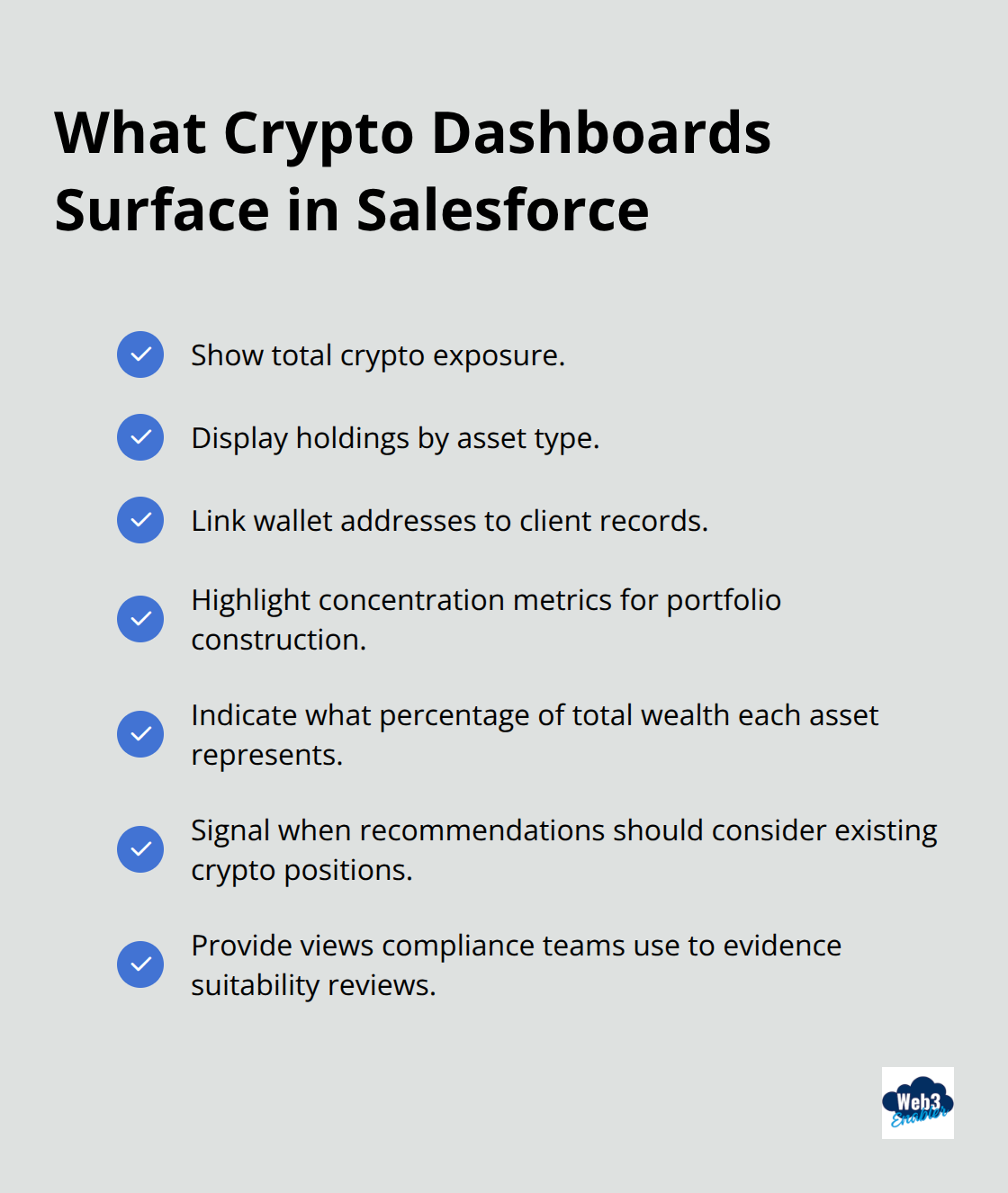
If a client’s profile shows they hold 20% of their net worth in Ethereum, an advisor recommending additional technology stocks receives an immediate signal to reconsider allocation. Compliance teams use these same dashboards to demonstrate to regulators that crypto holdings were documented and considered before suitability determinations were made.
Compliance Becomes Auditable Rather Than Assumed
Crypto-funded financial products now face heightened regulatory scrutiny. Sponsor banks and advisors need documented evidence that they’ve assessed client crypto exposure as part of their compliance framework. Salesforce automation flags when clients report crypto holdings but those holdings haven’t been verified, or when crypto positions exceed concentration thresholds you’ve set for risk management. Workflow rules trigger mandatory compliance reviews before certain client actions receive approval. When regulators ask whether your firm knew about a client’s crypto holdings, you produce audit trails showing exactly when that information entered your system, who reviewed it, and what actions followed. This documentation transforms crypto visibility from a nice-to-have into a control mechanism that protects your firm. Automated compliance tracking also catches inconsistencies: if a client reports owning Bitcoin during onboarding but blockchain verification shows no activity at their disclosed wallet address, that discrepancy triggers investigation before it becomes a compliance problem.
The infrastructure is now in place. What remains is the practical work of actually putting these tools into your advisory firm’s hands-and that starts with understanding what your team needs to succeed.
Practical Implementation for Your Advisory Firm
Start With Your Pilot Group
Your advisory firm already uses Salesforce to manage client relationships, compliance workflows, and portfolio data. Adding crypto visibility doesn’t require ripping out your existing infrastructure or asking advisors to learn entirely new systems. The practical reality is simpler: you integrate blockchain data into Salesforce through native AppExchange solutions that sit on top of your current setup. Web3 Enabler, a Salesforce ISV partner, offers 100% Salesforce native tools specifically designed for this integration, meaning your team works within the platform they already know.
Identify which advisors handle clients with documented or suspected crypto holdings. These advisors become your pilot group. Run them through a two-week onboarding focused entirely on how crypto holdings appear in Salesforce dashboards and what compliance documentation gets triggered when crypto assets appear. Don’t teach them blockchain fundamentals or crypto markets-that’s noise. Teach them exactly where to find crypto holdings on a client record, what the concentration metrics mean for portfolio advice, and which compliance flags require escalation. Most advisors grasp this in 4-6 hours of hands-on training because they’re already comfortable with Salesforce workflows.
Train Your Compliance Team Separately
Your compliance team needs different training than your advisors. They need to understand how automated rules detect inconsistencies between reported crypto holdings and blockchain verification, what audit trails get generated, and how to document their review process for regulators. Schedule compliance training separately and lean heavily on documentation-show them actual screenshots of audit trails, exception reports, and compliance flags so they see exactly what evidence they can produce when regulators ask questions.
This focused approach prevents overwhelming your operations team. Compliance staff learn to spot discrepancies early: if a client reports owning Bitcoin during onboarding but blockchain verification shows no activity at their disclosed wallet address, that inconsistency triggers investigation before it becomes a compliance problem. Your team produces audit trails showing exactly when crypto information entered your system, who reviewed it, and what actions followed.
Build Client Reports That Inspire Confidence
Client-facing dashboards require a different philosophy than internal advisor dashboards. Advisors need comprehensive crypto exposure data; clients need clarity and confidence. Build client reports that show total crypto holdings, breakdown by asset type, and how those holdings fit into overall portfolio allocation. Avoid technical blockchain language-no wallet addresses or transaction hashes in client-facing materials. Instead, present crypto holdings as you would any other asset class: percentage of total wealth, contribution to overall risk profile, and alignment with stated investment objectives.
Many advisory firms make the mistake of either hiding crypto from clients entirely or overwhelming them with technical details. Neither approach builds trust. A clear one-page report showing that a client holds 12% of their portfolio in Bitcoin, 5% in Ethereum, and 3% in stablecoins, with an annotation explaining how these holdings fit the overall asset allocation strategy, gives clients confidence that their advisor understands their complete financial picture. This transparency also protects your firm-clients see documented evidence that you knew about and considered their crypto portfolio management before offering advice.

Measure Results and Expand Gradually
Start with your pilot group’s top 20 clients and generate monthly reports for three months. Measure how many times advisors reference crypto holdings in client meetings, whether clients ask follow-up questions about concentration or rebalancing, and whether compliance flags catch any inconsistencies early. After three months, expand to your full advisory team and all clients. This measured rollout prevents overwhelming your operations team and gives you time to refine reporting formats based on what advisors and clients actually find useful.
FAQ: Financial Advisory & Salesforce Crypto Visibility
Why can’t I just ask my clients to report their crypto holdings annually?
In 2026, snapshot reporting is no longer sufficient for fiduciary duty. According to recent market data, over 64% of wealth management clients now hold digital assets, and their volatility can shift a client’s total risk profile in hours, not months. Relying on annual self-reporting leaves you with stale data exposure. If a client’s Ethereum position triples in value and you continue to recommend aggressive tech stocks, you may be found in violation of SEC suitability requirements for failing to account for their actual concentration risk.
What are the specific SEC expectations for crypto oversight in 2026?
The SEC Division of Examinations 2026 Priorities emphasize transparency and complex product governance. For advisors, this means you are expected to have a documented process for verifying client holdings. If a client funds an investment account using proceeds from a crypto sale, you must be able to prove the source of funds via on-chain provenance. Salesforce-native audit trails provide the continuous oversight regulators look for during examinations to ensure you aren’t flying blind.
How does Salesforce help me identify hidden concentration risk?
By syncing real-time blockchain data into Salesforce Financial Services Cloud, you can create automated alerts for asset allocation drift. For example, if a client’s undisclosed Bitcoin holdings cause their Alternative Assets bucket to exceed 20% of their total net worth, Salesforce can trigger a mandatory Rebalance Consultation task for the advisor. This transforms crypto from a hidden liability into a proactive touchpoint for wealth management.
Does visibility require my firm to take custody of the crypto?
No. Visibility and custody are separate functions. Solutions like Web3 Enabler allow you to view and track client wallet balances within Salesforce—giving you the data needed for holistic advice—without your firm ever touching the private keys or assuming the massive regulatory and insurance burden of asset custody. You remain the advisor, while the client maintains their preferred self-custody or third-party storage.
How do I handle clients who are hesitant to share their wallet addresses?
The most effective approach in 2026 is framing visibility as a Tax and Risk Mitigation service. When clients see that Salesforce integration allows for automated tax-loss harvesting alerts across both their traditional and crypto portfolios, the value proposition becomes clear. Furthermore, showing them Client Confidence Reports that include crypto—without technical jargon like hashes or public keys—demonstrates that you are the only one capable of managing their entire financial legacy.
Final Thoughts
Your advisory firm now has a clear path forward. Crypto visibility in Salesforce transforms how you manage client wealth by eliminating the blind spots that have defined advisory practice for the past five years. When your advisors can see complete client holdings-traditional assets and crypto together-they stop making recommendations based on incomplete information, and your compliance team stops relying on hope and starts producing audit trails that satisfy regulators.
The firms winning in 2026 aren’t the ones pretending crypto doesn’t exist or treating it as a separate conversation. They’re the ones integrating crypto holdings into their standard advisory workflow, the same way they integrated international stocks or alternative investments decades ago. Crypto visibility solutions make this integration straightforward because they work within the platform your team already uses every day.
Identify your pilot group of advisors, run them through focused training on how crypto holdings appear in Salesforce dashboards, and measure what happens when your team actually sees complete client portfolios. Visit Web3 Enabler to explore how crypto visibility works in practice and discuss custom implementations for your firm’s specific needs.