


Marketing teams are sitting on a faster, cheaper way to run campaigns. Stablecoins cut payment processing delays and fees that eat into campaign budgets.
At Web3 Enabler, we’ve seen how tokenized rewards in Salesforce Marketing Cloud shift the economics of loyalty programs. Real-time tracking and instant settlements give you the data and speed traditional systems can’t match.
Why Stablecoins Cut Through Payment Processing Friction
The Hidden Cost of Traditional Payment Networks
Payment processing fees are the hidden tax on marketing budgets. Traditional credit card networks charge 2.2% to 3.5% per transaction, plus fixed per-transaction fees of $0.30. For a $100 reward payout, you lose $2.20 to $3.50 immediately. Stablecoins eliminate this drain entirely. When you issue USDC or other stablecoins directly to customer wallets through Salesforce Marketing Cloud, the transaction cost drops to near zero for on-chain transfers. This shift materially improves campaign ROI because the cost savings compound across thousands of customer interactions.
Speed Creates Immediate Trust and Real-Time Feedback
Settlement speed matters more than most marketing teams realize. Credit card payouts take 3 to 5 business days to clear, which means your customers feel delayed gratification. Stablecoin transfers settle in minutes, creating immediate confirmation and trust. Real-time tracking of redemptions and payouts gives you visibility into campaign performance within hours instead of waiting for bank statements.
You can measure whether a promotion is driving behavior, adjust offers mid-campaign, and prove ROI before the billing cycle closes. This speed advantage transforms how you test loyalty mechanics. Instead of running a 30-day experiment and analyzing results weeks later, you see engagement patterns within days and scale what works.
Where Loyalty Budgets Flow Today
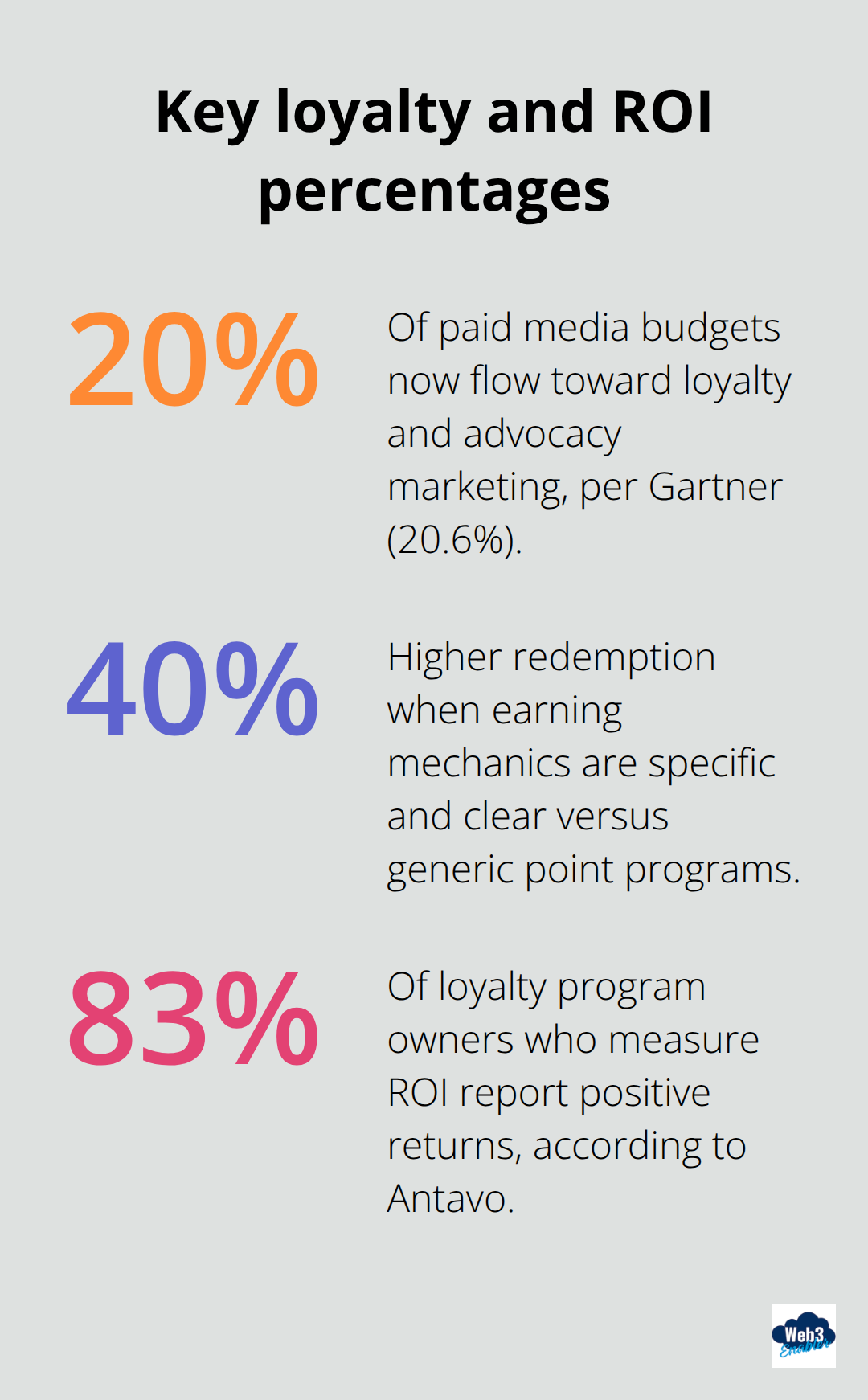
Gartner research shows that 20.6% of paid media budgets now flow toward loyalty and advocacy marketing, and the teams winning in this space capture real-time feedback to optimize spend. Stablecoin-based rewards give you that feedback loop instantly. The ability to track on-chain actions (wallet connections, swaps, trading volume) rather than only clicks aligns your measurement with actual customer behavior. This precision lets you identify which rewards drive repeat purchases and which ones waste budget.
Your next step involves building the actual reward structure that customers will redeem.
Building Stablecoin Rewards Your Customers Will Actually Redeem
The gap between loyalty program design and actual customer behavior is where most programs fail. You can issue stablecoin rewards perfectly, but if redemption rates stay below 20%, you’ve wasted budget on infrastructure instead of driving repeat purchases. The real work starts when you decide what your customers can actually do with those tokens.
Designing Rewards That Customers Redeem
Stablecoins pegged to fiat currencies like USDC give customers stable redemption value, which matters because volatile token rewards create friction. Loyalty members generate 12 to 18% more incremental revenue per year than non-members, but only when redemption feels immediate and valuable. In Salesforce Marketing Cloud, you mint stablecoins directly into customer wallets at the moment they trigger a campaign action, whether that’s a purchase, referral, or engagement milestone.
The key is designing missions that tie token earning to behaviors you actually want repeated. Instead of awarding points for vague engagement, award USDC when a customer completes a specific action: deposits funds, makes a trade, or refers a peer. This specificity drives 40% higher redemption than generic point programs because customers understand exactly what the reward represents.
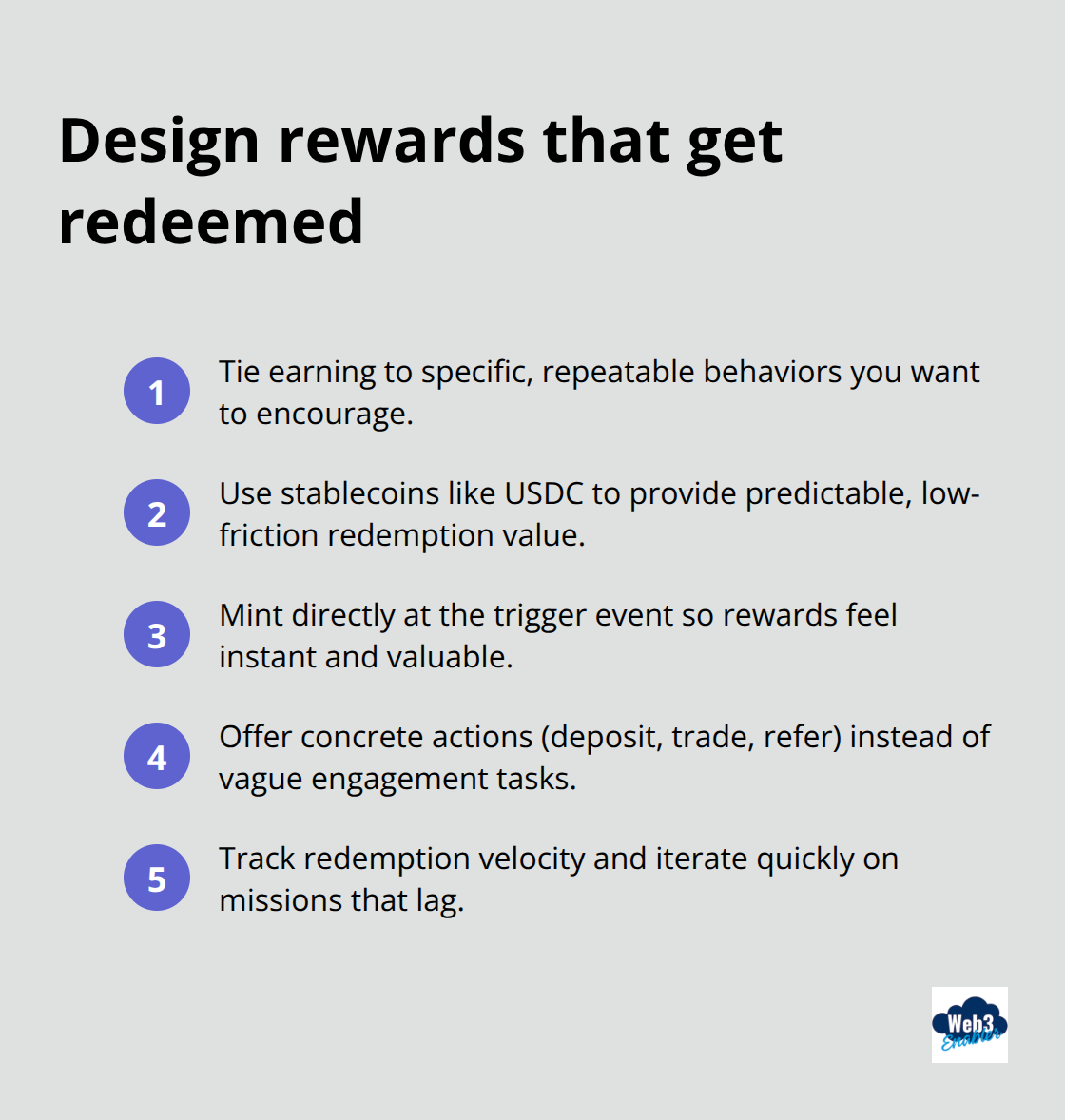
Track redemption velocity obsessively-how many days pass between earning and redemption. If your average customer takes 45 days to redeem, you have a design problem. Industry data shows redemption rates typically range from 15% to 40%, but tokenized programs with clear earning mechanics and instant wallet integration often push toward the upper end. Bain & Company found that improving retention by just 5% lifts profits by 25% to 95%, and redemption behavior is your strongest signal of retention intent. When you see customers redeeming tokens within 7 days of earning them, you know the reward structure is working.
Wallet Integration Transforms Your Measurement Game
Wallet integration transforms loyalty from a black box into a transparent system. Traditional loyalty programs hide redemption status behind a portal; stablecoin rewards live in customer wallets where they’re visible and verifiable. This integration eliminates the 3 to 5 day settlement delay that plagues credit card payouts. When a customer redeems a stablecoin reward through Salesforce Marketing Cloud, the transaction settles in minutes, creating immediate confirmation and reducing support tickets from confused customers waiting for fulfillment.
You measure success through metrics that matter: redemption rate (percentage of issued tokens actually redeemed), time-to-redemption (days between earning and use), and incremental revenue from tokenized campaigns. Antavo reports that 83% of loyalty program owners who measure ROI see positive returns, with top performers delivering about 8x revenue in incremental value. Track which reward types drive the highest redemption velocity. If a $10 USDC reward redeems at 45% within 14 days but a $5 USDC reward redeems at 65% within 7 days, your optimal tier isn’t the largest payout-it’s the one that matches customer behavior. Quarterly ROI reviews catch cost creep early; monitor monthly redemption rates, cost per active member, and whether engagement patterns shift unexpectedly.
Automating Payouts Without Operational Overhead
Manual payout processes kill campaign velocity. Every approval step, every manual wallet address entry, every reconciliation task adds days to settlement. Salesforce Marketing Cloud automation removes this friction entirely. Set up workflow rules that trigger stablecoin minting based on campaign conditions: customer reaches a spending threshold, completes a referral, or hits a loyalty tier milestone. The system mints tokens, routes them to the customer’s wallet address (stored securely in their profile), and logs the transaction for compliance and reporting.
This automation scales to thousands of simultaneous payouts without requiring additional headcount. Industry benchmarks show loyalty program launch marketing costs $2,000 to $10,000 for small businesses, with ongoing promotions running $500 to $5,000 monthly; automation keeps your operational costs flat as volume grows. Vesting controls prevent immediate sell-offs that devalue rewards. If you issue 10,000 USDC tokens to customers all at once without vesting schedules, they’ll dump tokens into the market and crash value. Instead, implement gradual vesting: customers earn tokens over 30 days, or earn tokens in tranches tied to additional behaviors. This approach maintains perceived value and prevents the token glut that kills loyalty economics.
Managing Supply and Integration Risk
Manage wallet integrations through a single integration pattern: Salesforce connects via APIs to mint tokens at campaign launch and burn on redemption while syncing token status with customer profiles in real time. This centralized approach reduces security risk because credentials and wallet addresses live in one audited system instead of scattered across multiple tools. Establish issuance caps during peak campaigns to prevent token devaluation and liquidity stress. If your campaign succeeds beyond projections and you’ve already committed to issuing 50,000 USDC in rewards, you can’t suddenly stop-caps force you to plan realistic supply discipline upfront.
The next challenge involves measuring whether these tokenized rewards actually move the needle on customer lifetime value and campaign ROI.
Measuring ROI on Stablecoin Marketing Initiatives
Calculate Your Payment Processing Savings First
The math on stablecoin rewards is brutally straightforward once you stop measuring vanity metrics. Traditional loyalty programs hide real costs inside opaque fee structures; tokenized campaigns expose every dollar spent and every dollar returned. Credit card networks charge 2.2% to 3.5% per transaction plus $0.30 per transaction. If you issue $100,000 in rewards monthly through traditional payment processors, you lose $2,200 to $3,500 immediately. Stablecoin transfers to customer wallets cost near zero for on-chain settlement. Over a year, that’s $26,400 to $42,000 in pure cost elimination.
This cost savings forms just the floor of your ROI calculation. The real leverage comes from tracking customer lifetime value within tokenized programs, which requires measuring behaviors that traditional loyalty systems cannot see.
Track On-Chain Data to Reveal True Customer Behavior
On-chain transaction data reveals exactly when customers redeem tokens, what they purchase after redemption, and whether they return for repeat purchases. You need monthly dashboards tracking redemption rate, time-to-redemption, cost per active member, and incremental revenue attributed to tokenized campaigns. If your average customer redeems 35% of issued tokens within 14 days, that’s your baseline. If a competitor’s customers redeem 60% within 7 days, you have a design problem worth fixing.
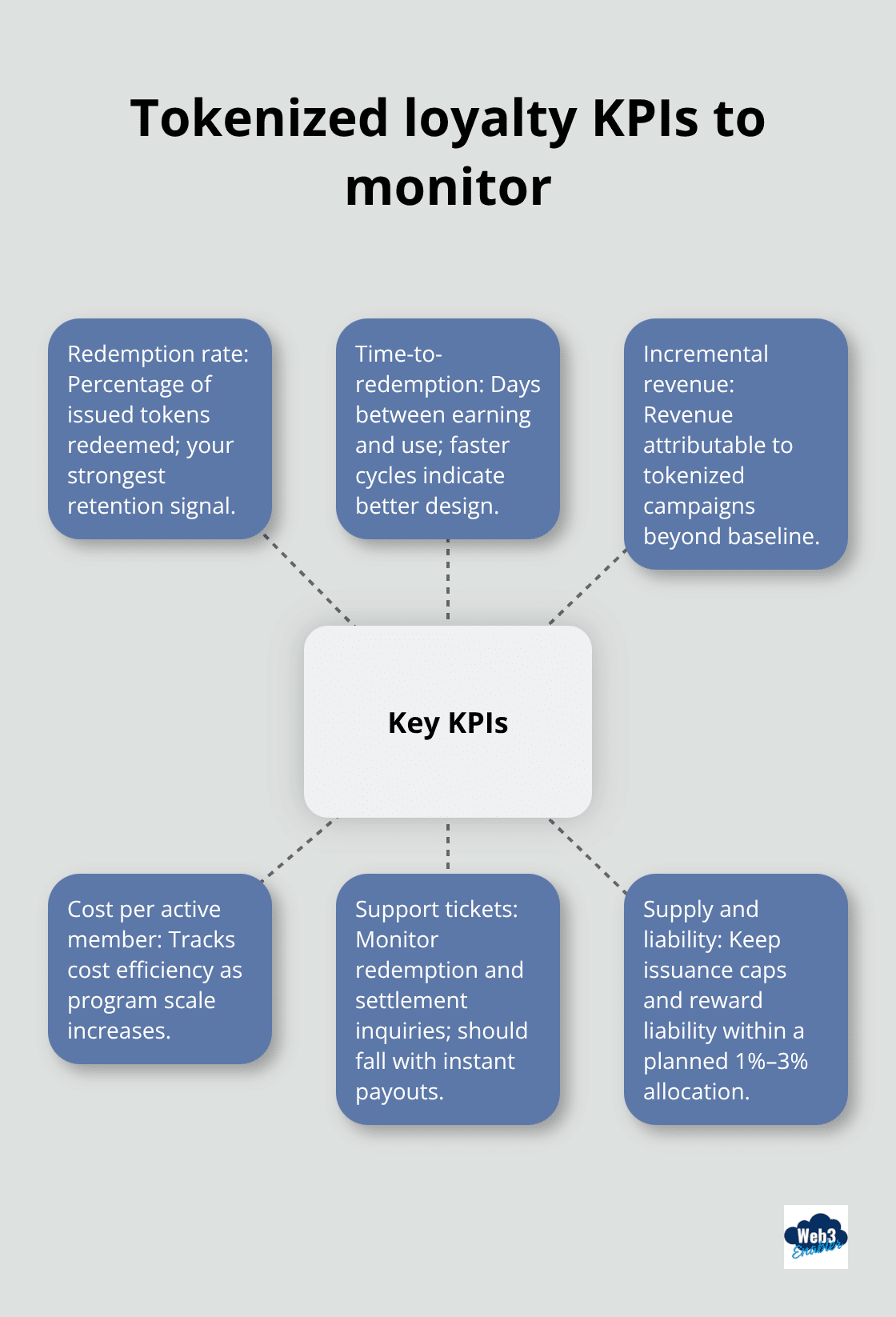
Quarterly ROI reviews catch cost creep immediately; if reward liability or fulfillment costs exceed your planned 1% to 3% of annual revenue allocation, adjust supply caps or earning mechanics before the program becomes unprofitable.
Compare Tokenized Programs Against Traditional Loyalty Structures
Tokenized programs outperform traditional loyalty structures because payment speed matters more than most marketers admit. Traditional programs report 15% to 40% redemption rates; tokenized programs with clear earning mechanics and instant wallet integration push toward the upper end because customers see value confirmed in their wallets within minutes. Improving retention by just 5% lifts profits by 25% to 95%, according to Bain & Company research, and redemption velocity is your strongest retention signal.
Track which customer segments show the highest redemption rates and replicate that earning structure across other tiers. If your top-spending customers redeem USDC rewards within 7 days at 70% redemption, but mid-tier customers redeem at 45% within 21 days, the earning formula for mid-tier customers isn’t working-the reward size, earning path, or redemption options need adjustment. Run A/B tests comparing tokenized promotions to traditional coupons within Salesforce Marketing Cloud; segment your audience and run both simultaneously to quantify the engagement and ROI uplift from stablecoin rewards.
Optimize Reward Amounts Through Testing
Document which reward amounts drive behavior. A $5 USDC reward might redeem faster than a $10 reward because it feels achievable and immediate; larger rewards can feel distant and create redemption friction. Test different token amounts across customer segments to identify the sweet spot where redemption velocity peaks without sacrificing total revenue per campaign.
Measure Operational Cost Reductions
The operational cost structure shifts dramatically with tokenization. Automation through Salesforce removes per-transaction approval overhead, so your costs stay flat as volume scales. Traditional programs require customer support staff to answer questions about pending redemptions, account balances, and fulfillment delays. Stablecoin rewards eliminate this friction entirely because customers see balances and settlement confirmation in real time.
Calculate the cost savings from reduced support tickets, then add that to your payment processing savings and incremental revenue gains. The total ROI compounds because tokenization removes friction at every stage-no payment processing delays, no settlement waiting periods, no redemption confusion. You see the complete customer journey from earning through redemption to repeat purchase within days instead of weeks.
Final Thoughts
Stablecoins in Salesforce Marketing Cloud eliminate the friction that kills traditional loyalty programs. You cut 2.2% to 3.5% payment processing fees, settle rewards in minutes instead of days, and track customer behavior through on-chain data that traditional systems cannot access. We at Web3 Enabler have seen organizations reduce operational costs while improving redemption rates and customer retention through tokenized rewards that customers actually use.
Launch your first tokenized campaign with a controlled pilot targeting a small customer segment, then monitor redemption behavior for 30 days before scaling. Track redemption rate first-if customers redeem below 35% within 14 days, adjust your earning mechanics or reward amounts. Set issuance caps upfront to prevent token devaluation, implement vesting schedules so customers earn tokens gradually, and run quarterly ROI reviews to catch cost creep before it erodes profitability.
Web3 Enabler provides the infrastructure to execute this strategy as a certified Salesforce ISV Partner with the only native blockchain platform on the Salesforce AppExchange. Our platform integrates directly into Financial Services Cloud, Commerce Cloud, and Revenue Cloud, enabling your finance, compliance, and operations teams to collaborate seamlessly without leaving Salesforce. Learn more about implementing stablecoin rewards.
Frequently Asked Questions
How do stablecoins reduce marketing costs in Salesforce?
Stablecoins eliminate traditional payment processing fees, which typically range from 2.2% to 3.5% plus fixed transaction costs. By issuing rewards like USDC directly through Salesforce Marketing Cloud, transaction fees drop to near zero. For a high-volume loyalty program, this can save tens of thousands of dollars in annual budget drain.
Why are stablecoin rewards more effective than traditional points?
Stablecoin rewards offer instant settlement, reaching a customer’s wallet in minutes rather than days. This immediate gratification increases trust and engagement. Data shows that clear earning mechanics and instant integration can drive redemption rates toward 40%, significantly higher than the 15% seen in many legacy point systems.
How does Salesforce Marketing Cloud automate stablecoin payouts?
Salesforce Marketing Cloud uses automated workflow rules to trigger token minting when a customer hits a specific milestone, such as a referral or purchase. The system securely routes the stablecoin to the wallet address stored in the customer’s profile, logging the transaction for compliance and reporting without manual intervention.
Can I track the ROI of stablecoin loyalty programs?
Yes. Unlike traditional “black box” loyalty systems, stablecoins provide on-chain data that allows you to track redemption velocity, time-to-redemption, and incremental revenue in real-time. By comparing this data against the 2.2%–3.5% saved on processing fees, marketers can calculate a precise, transparent ROI for every campaign.
How do you prevent token devaluation in a marketing campaign?
To protect reward value, you should implement issuance caps and gradual vesting schedules. By setting a maximum supply of USDC for a campaign and releasing tokens over time (e.g., a 30-day vesting period), you prevent a sudden market “dump” that could devalue the rewards and harm program economics.