

Global companies lose thousands of dollars annually to invoicing delays and cross-border payment friction. Traditional workflows trapped inside spreadsheets and disconnected systems create bottlenecks that slow cash flow and inflate costs.
Crypto-enabled invoicing inside Salesforce changes this equation. We at Web3 Enabler have built a solution that brings blockchain settlement directly into your CRM, eliminating the manual handoffs and hidden fees that plague international transactions.
What Costs Global Businesses the Most in Cross-Border Invoicing
Manual Workflows Drain Finance Teams
Manual invoicing workflows inside disconnected systems waste enormous amounts of time and money. Finance teams at multinational companies spend weeks chasing approvals across email chains, spreadsheets, and separate accounting platforms. Each handoff introduces delays and errors. Salesforce users often export invoice data into Excel, process it outside their CRM, then manually re-enter results-a cycle that compounds mistakes and extends settlement timelines by days or weeks. For a company processing 500 invoices monthly across multiple regions, this friction alone costs tens of thousands in lost productivity and delayed cash inflow.
Cross-Border Payments Multiply the Damage
Cross-border payments amplify these inefficiencies dramatically. Traditional correspondent banking chains require invoices to move through multiple intermediaries, each adding processing time and fees. A payment from a US buyer to an East African supplier takes 5–7 business days to settle, even though the underlying transaction takes minutes.
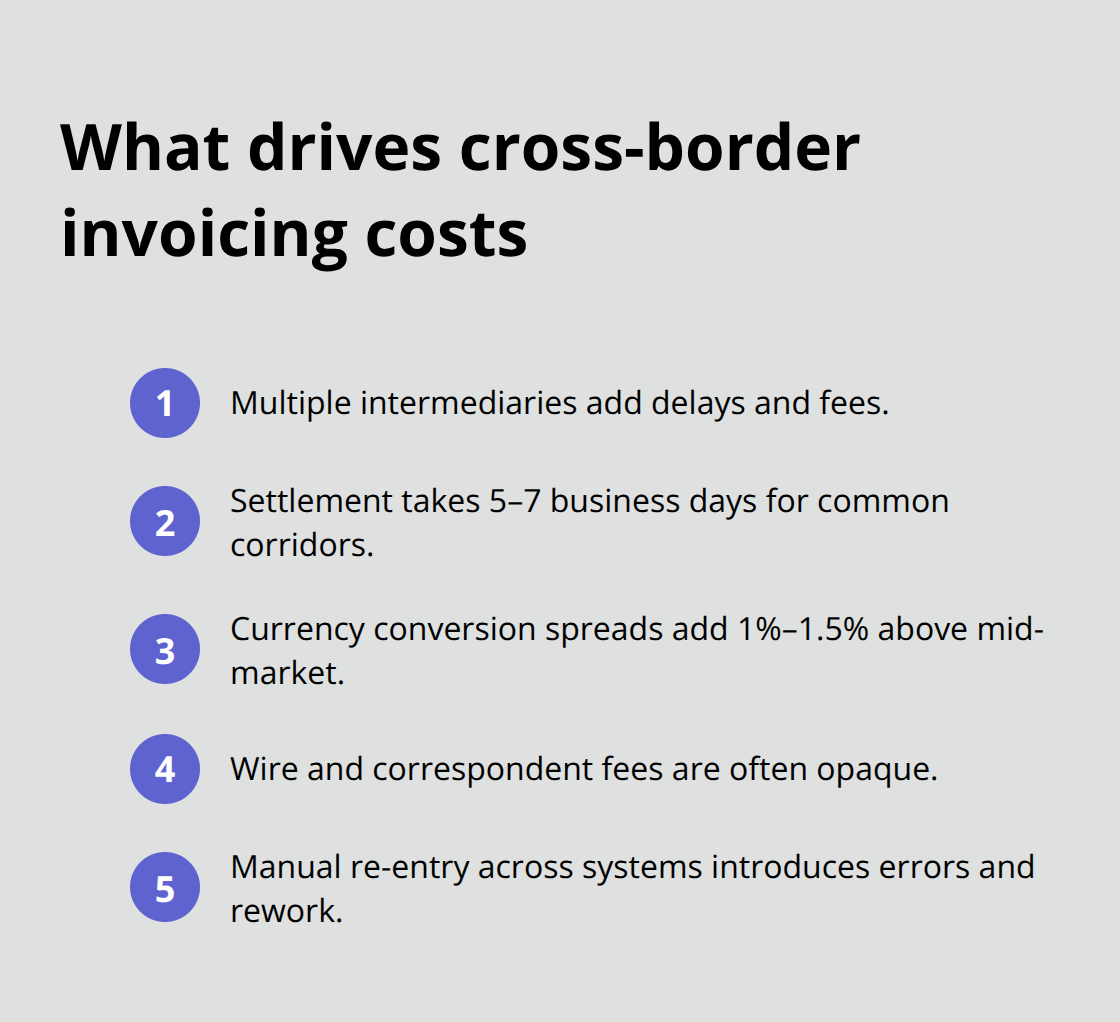
Swift transfers, the backbone of legacy cross-border banking, were designed for batch processing in a world without 24/7 markets.
Hidden fees compound the damage further. Banks charge currency conversion spreads of 1% to 1.5% above the mid-market rate, plus wire fees and correspondent fees that often remain opaque until the money arrives short. A $10,000 invoice to a Kenyan vendor loses hundreds in fees alone, eroding margins that should go to suppliers or reinvest in operations.
Stablecoins Offer Speed and Cost Advantages
Stablecoins settle cross-border payments in minutes at a fraction of the cost. A USDC or USDT transfer moves in seconds with fees under $1, regardless of geography. Yet most Salesforce users have no way to trigger these settlements from inside their CRM, forcing finance teams to manage crypto payments through separate wallets and exchanges. This fragmentation defeats the purpose.
The real cost isn’t just the fees-it’s the operational overhead of managing two separate payment systems, the compliance risks of payments outside your audit trail, and the cash flow damage from delayed settlements. Global companies that invoice across Africa and the Middle East face even sharper penalties. Remittance corridors to Kenya, Nigeria, and Egypt have historically high costs due to limited competition and regulatory friction. Kenya recorded USD 3.3 billion in stablecoin inflows by September 2024, signaling that regional demand exists for faster, cheaper payment rails. Yet without native integration inside Salesforce, teams cannot capitalize on this opportunity-and that’s where a solution that connects your CRM directly to blockchain networks becomes essential.
How Blockchain Settlement Works Inside Your CRM
Native Integration Eliminates Platform Fragmentation
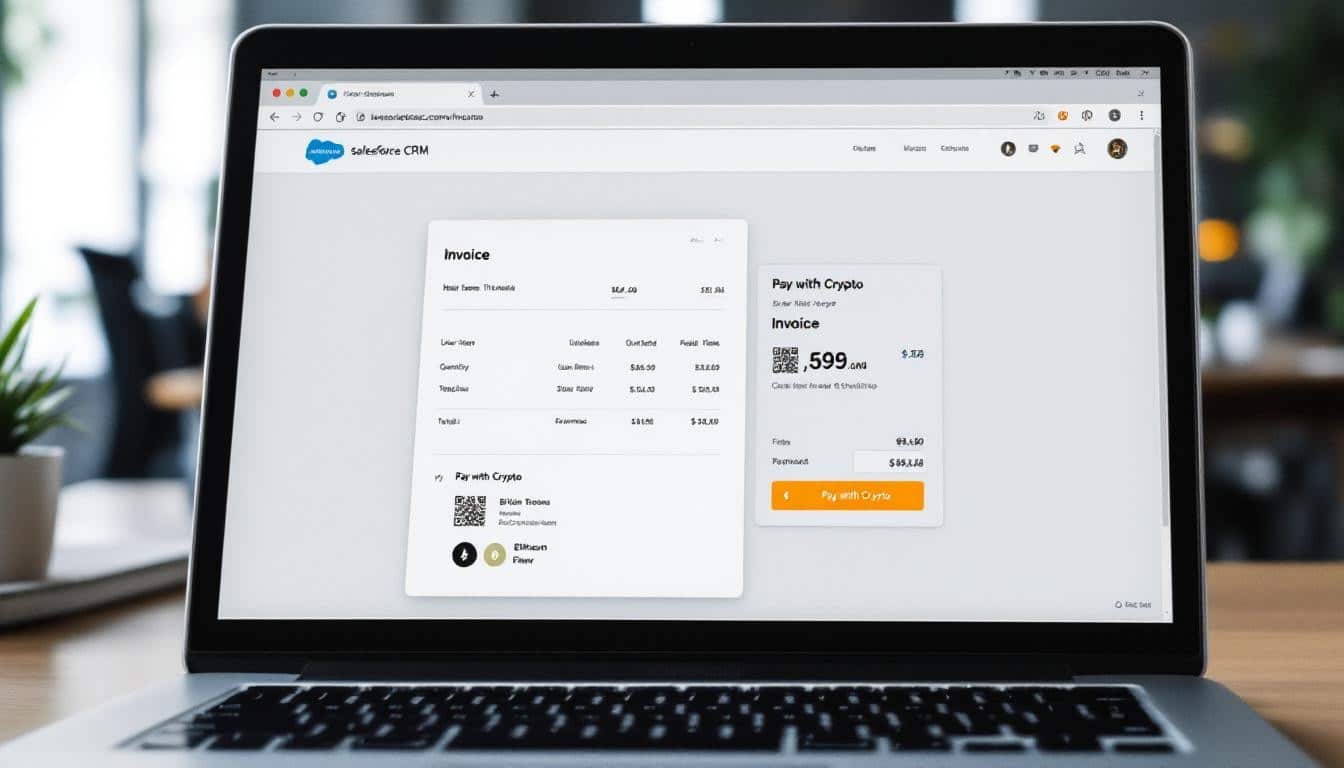
Crypto-enabled invoicing inside Salesforce eliminates the gap between where your transactions live and where your data lives. When an invoice moves through your CRM, it can trigger an on-chain payment in the same workflow. Web3 Enabler provides 100% native Salesforce support for cryptocurrencies and digital assets, meaning you don’t toggle between platforms or manage separate wallets outside your audit trail. The moment a buyer approves an invoice inside Salesforce, a stablecoin payment settles to your supplier’s wallet in seconds. No intermediaries. No batch processing windows. No hidden correspondent fees.
Speed Transforms Cross-Border Corridors
For companies invoicing across Africa and the Middle East, this speed matters enormously. Kenya’s mobile money ecosystem includes 90.4 million accounts as of January 2026, according to the Central Bank of Kenya, yet most recipients still wait 5–7 days for cross-border wire transfers to clear. Stablecoin settlement cuts that to minutes. A $50,000 invoice to a Nairobi vendor that costs $500–$750 in traditional banking fees settles for under $1 via USDC on blockchain rails.
Web3 Enabler connects these blockchain settlement transactions directly to your existing Salesforce infrastructure, so finance teams track payments, approvals, and settlement status without leaving their CRM. Your payment records automatically sync with your invoice records, eliminating manual reconciliation and the errors that come with it.
Real-Time Visibility Prevents Cash Flow Surprises
Real-time visibility across financial operations becomes possible when invoicing and settlement happen inside one system. Traditional setups fragment your data: invoices live in Salesforce, payments move through your bank’s portal, and reconciliation happens in accounting software days later. Stablecoin-enabled invoicing collapses this fragmentation. You see when an invoice is issued, approved, and settled all in one timeline.
For multinational teams managing invoices across time zones, this transparency prevents the cash flow surprises that plague global operations. A finance manager in New York issues an invoice to a supplier in Lagos at 9 AM, the supplier receives and accepts it by 10 AM local time, and the payment settles by 10:15 AM-all visible in Salesforce. This speed unlocks faster working capital cycles. Companies that invoice thousands of times monthly see measurable improvements in days sales outstanding when settlement happens in minutes instead of weeks.
Regional Liquidity and Regulatory Momentum
Stablecoins currently account for 52% of MENA’s crypto volume, with Middle East crypto transactions exceeding $500 billion annually according to The Fintech Times, yet most of this activity happens outside corporate invoicing systems. Blockchain-native invoicing brings that liquidity and speed into your CRM, letting you tap regional payment corridors without sacrificing compliance or audit trails.

The UAE Central Bank approved a dirham-backed stablecoin in February 2026 for high-value settlements and trade finance, signaling institutional confidence in on-chain payments. Businesses that integrate stablecoin invoicing now position themselves to settle in regulated digital currencies as soon as they launch, capturing competitive advantage in markets where speed and cost efficiency determine supplier relationships. This regulatory clarity creates an opening for finance teams to modernize their payment infrastructure before competitors move first.
How Web3 Enabler Connects Your Invoicing to Blockchain Rails
Web3 Enabler provides 100% native Salesforce support for cryptocurrencies and digital assets, meaning your invoice workflows and blockchain settlement operate inside one unified system. When a buyer approves an invoice in Salesforce, the payment instruction flows directly to blockchain rails without manual intervention or platform switching. This seamless interface eliminates the operational friction that forces finance teams to manage crypto payments through separate wallets and exchanges outside their audit trail. Your payment records, invoice statuses, and settlement confirmations all sync automatically within Salesforce, so reconciliation happens in real time rather than days later in a separate accounting system. For companies invoicing across Africa and the Middle East, this integration matters because it lets you tap stablecoin corridors at regional scale without sacrificing compliance visibility.
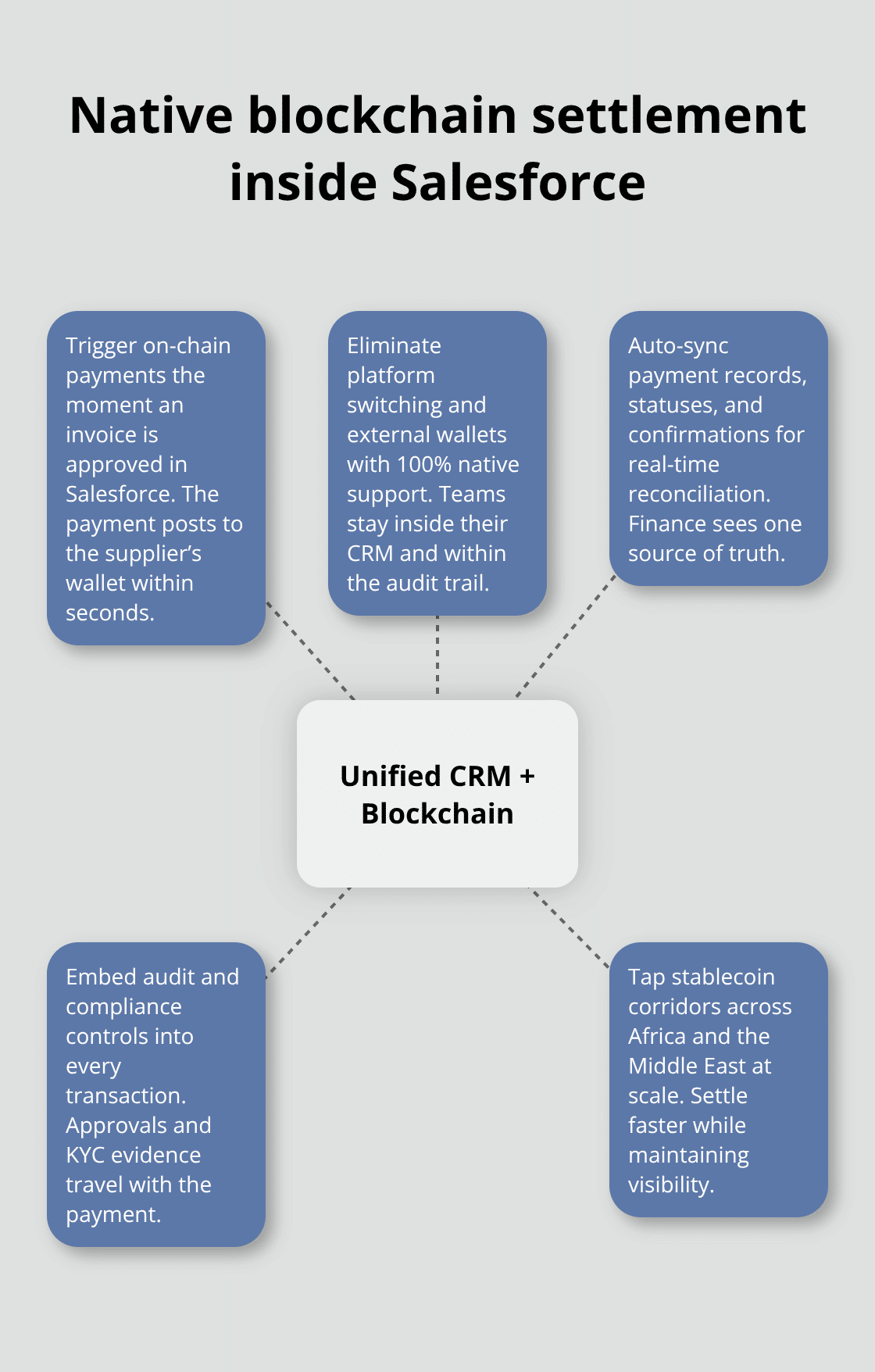
A finance team in Dubai issues invoices to suppliers across Kenya, Nigeria, and Egypt and settles those payments in minutes through regulated stablecoins, with every transaction logged inside their CRM and connected to the original invoice record.
Eliminating Manual Reconciliation Through Automated Tracking
Traditional invoicing requires manual reconciliation between your bank portal, accounting software, and CRM. Stablecoin transactions inside Salesforce eliminate this fragmentation by recording payments directly on the blockchain ledger while simultaneously updating your invoice records. Every USDC or USDT transfer linked to an invoice creates an immutable record that satisfies audit requirements while reducing the administrative burden on finance teams. Automated tracking means a $100,000 invoice to a Lagos-based supplier shows approval status, payment settlement time, and confirmation hash all within the same Salesforce record. Your finance team no longer spends hours matching bank statements to invoices or chasing down missing wire confirmations.
This automation becomes especially valuable for companies processing hundreds of cross-border invoices monthly. According to Vietnam’s Circular No. 15/2026/TT-BTC, which governs crypto asset accounting, service providers must record revenue from crypto-related activities with detail by activity type and track client assets separately from corporate holdings. The system records whether a transaction represents a payment, a custody operation, or an investment activity, then routes that data to your financial reporting infrastructure.
Building Compliance Into Your Payment Workflow
Regulatory frameworks across Africa and the Middle East now require stablecoin transactions to meet specific standards for reserve backing, issuer authorization, and customer fund safeguarding. Kenya’s Virtual Asset Service Providers Act 2025 mandates AML/KYC checks and asset segregation for stablecoin handlers. The UAE’s approval of a dirham-backed stablecoin in February 2026 signals institutional confidence in regulated on-chain payments, but only for firms that maintain proper documentation and audit trails.
Compliance built into your invoicing workflow means KYC data, transaction approvals, and fund movements all generate audit-ready records inside Salesforce. When a supplier receives payment, the transaction includes cryptographic proof of settlement that satisfies both your internal auditors and regulatory authorities. This approach reduces the risk of penalties or transaction reversals that plague firms managing crypto payments through unregulated exchanges or personal wallets. For multinational companies operating across multiple jurisdictions, this simplifies financial reporting by centralizing all stablecoin activity inside one system rather than requiring separate documentation for crypto payments versus traditional wire transfers. Your finance and compliance teams see the same transaction records, eliminating the discrepancies that create audit friction.
FAQ: Salesforce Crypto Invoicing & Cross-Border Settlement
Why is cross-border invoicing faster with stablecoins than traditional SWIFT wires?
Traditional SWIFT transfers rely on correspondent banking, where money hops through multiple intermediary banks across different time zones. In 2026, this still takes 5–7 business days for many African and Middle Eastern corridors. Stablecoins like USDC or the UAE’s dirham-backed stablecoin settle directly on-chain. By triggering these from Salesforce, the payment moves from your wallet to your supplier’s wallet in seconds, bypassing the batch processing windows and delays of legacy banking.
How does Salesforce handle the accounting for stablecoin payments?
In 2026, many jurisdictions have formalized crypto accounting. For example, Vietnam’s Circular No. 15/2026/TT-BTC requires detailed tracking by activity type. Salesforce-native solutions like Web3 Enabler automatically categorize these transactions as payments, custody, or investment activities. The system logs the settlement time, currency value, and transaction hash directly onto the Salesforce Invoice record, ensuring your revenue recognition and client asset tracking meet modern regulatory standards.
Can I settle invoices in local digital currencies like the UAE Dirham stablecoin?
Yes. Following the UAE Central Bank’s approval of a dirham-backed stablecoin in February 2026, businesses can now settle high-value trade finance and invoices in a regulated digital version of the AED. Integrating this into your Salesforce workflow allows you to capture the speed of blockchain while maintaining the stability of a regulated, fiat-pegged currency, which is ideal for regional suppliers who want to avoid the volatility of non-pegged assets.
How much can a business save on fees for a $50,000 international invoice?
Traditional banks often charge 1% to 1.5% in currency conversion spreads plus fixed wire and correspondent fees. For a $50,000 invoice to a vendor in Kenya or Nigeria, this could cost between $500 and $750. On blockchain rails via Salesforce, the network fee is typically under $1. Over hundreds of invoices, this shift can save a multinational company tens of thousands of dollars in pure transaction costs.
How does the system ensure AML/KYC compliance for Kenya or the UAE?
Regulations like Kenya’s Virtual Asset Service Providers Act 2025 mandate strict identity verification. When you invoice through Salesforce, the system can be configured to verify the recipient’s KYC status before the payment is broadcast to the blockchain. Because the record is stored in your CRM, you maintain a permanent, audit-ready link between the customer’s identity and the cryptographic proof of settlement, which satisfies both internal auditors and regional regulators.
Final Thoughts
Global companies lose thousands annually to invoicing delays and cross-border payment friction. Traditional banking infrastructure was built for batch processing in a world without 24/7 markets, leaving finance teams trapped between slow settlements and hidden fees that erode margins. Crypto-enabled invoicing in Salesforce eliminates this friction by settling payments in minutes instead of days, at costs measured in cents rather than hundreds of dollars.
The shift toward stablecoin settlement is already underway. Kenya recorded USD 3.3 billion in stablecoin inflows by September 2024, and the UAE Central Bank approved a dirham-backed stablecoin in February 2026 for high-value settlements and trade finance. Regulatory frameworks across Africa and the Middle East now provide clear pathways for compliant on-chain payments, yet most companies still manage crypto transactions outside their core business systems, creating audit gaps and operational overhead that defeats the purpose of faster settlement.
Web3 Enabler brings blockchain power directly into Salesforce, eliminating the platform fragmentation that forces finance teams to juggle separate wallets and accounting systems. When a buyer approves an invoice, payment settles to your supplier’s wallet in seconds with complete audit visibility, and your team tracks approvals, settlement status, and reconciliation all within Salesforce without manual handoffs or compliance blind spots. For multinational companies invoicing across Africa and the Middle East, this integration transforms working capital cycles-a $50,000 invoice that costs $500 in traditional banking fees settles for under $1 via stablecoin rails in minutes instead of weeks. Start modernizing your payment operations with Web3 Enabler today.