



Your cryptocurrency onboarding KYC process is either a competitive advantage or a customer frustration point-there’s no middle ground.
We at Web3 Enabler know that slow verification kills momentum. When customers wait days for approval, they disappear. When compliance fails, regulators show up.
This post walks you through the real solutions that actually work.
Why Your Current KYC Process Is Costing You Customers
The Speed Problem Nobody Talks About
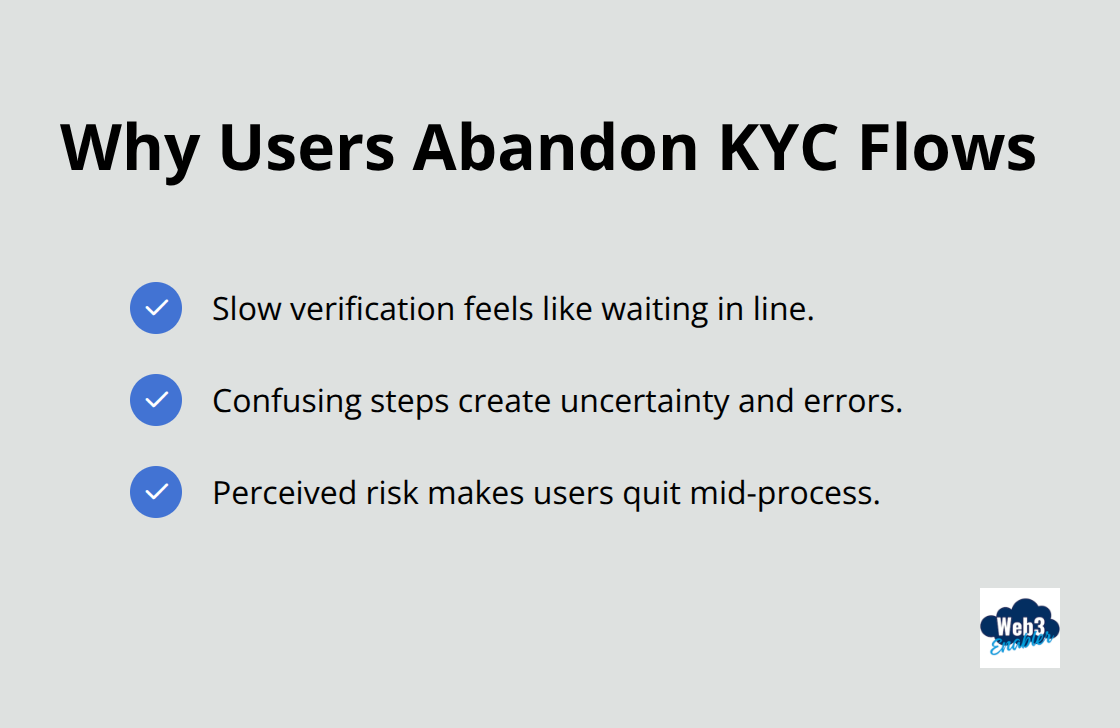
Most crypto platforms and traditional financial institutions remain trapped in a verification nightmare that belongs in 2015. Manual KYC processes stretch across days or weeks, forcing customers to upload documents, wait for human review, and hope nothing vanishes in the shuffle. Stripe reports that potential users abandon identity verification because the flow feels slow, confusing, or risky. That’s not a minor friction point-that’s a customer hemorrhage.
The crypto onboarding problem runs deeper than speed alone. Regulatory requirements shift constantly across jurisdictions, meaning what works for UK customers won’t work for Singapore users. Traditional banks and crypto platforms respond by creating separate compliance workflows for each region, multiplying operational costs and verification timelines. A customer trying to open an account in multiple countries faces repeated identity checks, document re-uploads, and inconsistent approval standards.
The Regulatory Complexity Trap
Stripe reports that onboarding remains unnecessarily complex. The irony cuts deep: the ecosystem that promises frictionless global transactions has built onboarding systems that feel like applying for a mortgage.
Compliance teams struggle with manual document review, data entry errors, and inconsistent risk scoring. These bottlenecks create backlogs that force your staff to work overtime while verification queues grow longer. When verification takes weeks instead of hours, your business loses competitive advantage to faster platforms.
The Hidden Cost of Choosing Wrong
Platforms that prioritize speed without compliance face regulatory penalties. Those that prioritize compliance over speed watch customers migrate to competitors. The winners in crypto adoption will crack both problems simultaneously: instant verification without cutting corners on regulatory standards.
This isn’t a nice-to-have anymore-it’s table stakes for any serious crypto business. The platforms that master fast, compliant onboarding will capture market share while others remain stuck in the old way of doing things. Your next move determines whether you lead or follow in this space.
How Modern KYC Solutions Actually Work
Automated Identity Verification Replaces Manual Review
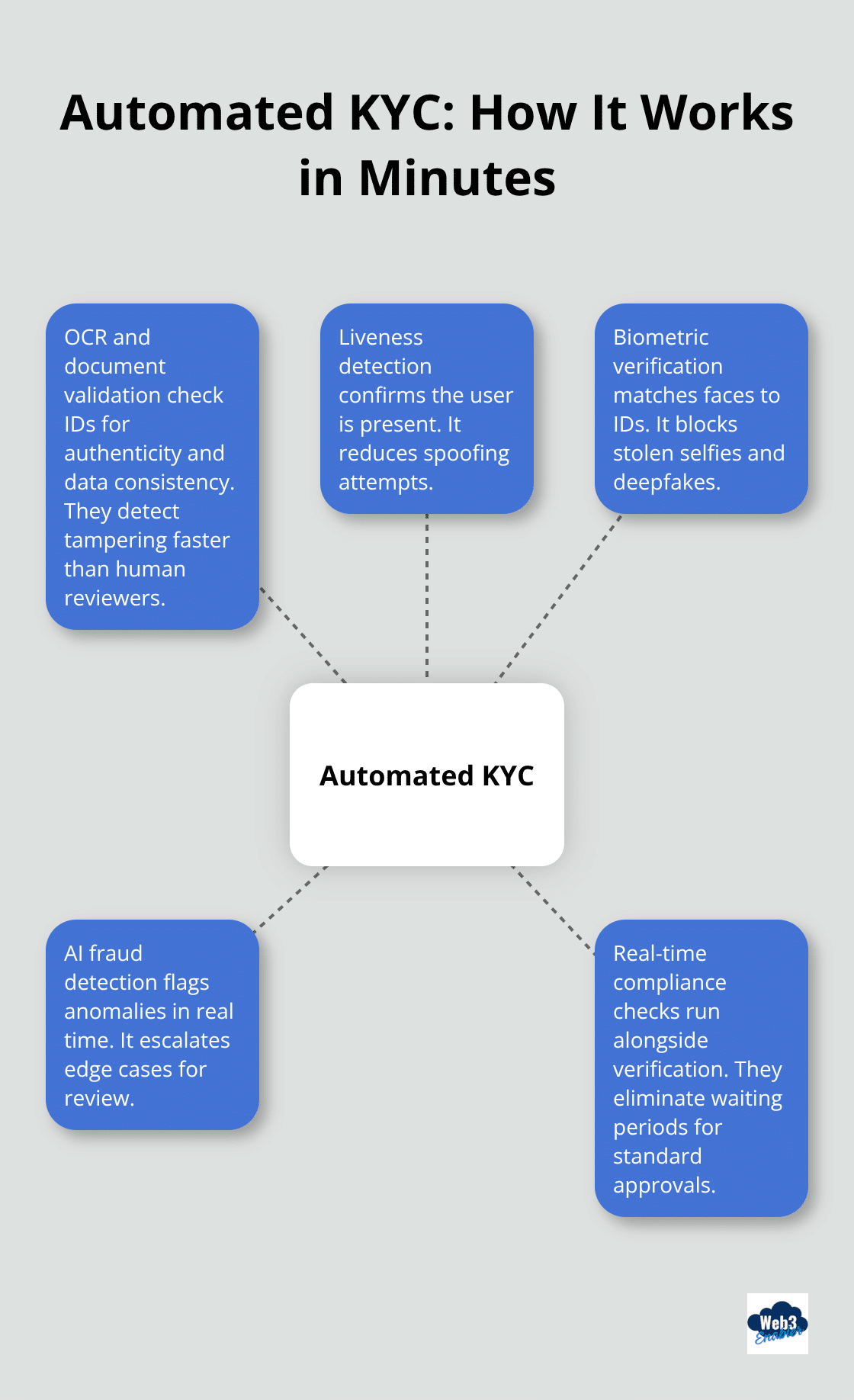
Modern KYC systems flip the old script entirely. Instead of humans manually reviewing documents over days, automated identity verification combined with real-time compliance checks complete verification in minutes. Document validation now happens through optical character recognition and AI-powered fraud detection that spots forged or tampered documents faster than any human reviewer. Persona blocked 75 million deepfakes in June 2025 alone, showing how sophisticated these systems have become.
The process starts the moment a customer uploads their ID. The system extracts data, compares it against liveness detection to confirm the person is actually present, and immediately flags any inconsistencies. Biometric verification and liveness checks prevent deepfakes or stolen selfies from slipping through. This combination of speed and security transforms what once took weeks into a process that completes in minutes.
Real-Time Compliance Checks Eliminate Waiting Periods
Simultaneously, verification runs against regulatory databases for sanctions, PEP lists, and adverse media. Real-time compliance checks mean your team stops waiting for results; instead, risk scores populate instantly, allowing your staff to focus on edge cases rather than routine approvals.
A centralized risk engine combines ID checks, financial activity, and OSINT data to generate risk scores automatically. Continuous monitoring after onboarding tracks changes in sanctions status, ownership, or adverse media in real time, catching problems before they become compliance disasters. Your compliance team gains visibility into risk signals as they emerge, not days later when damage has already occurred.
Risk-Based Segmentation Accelerates Low-Risk Approvals
Integration with your existing systems-your CRM, case management platform, or payment infrastructure-happens through APIs that don’t require rebuilding your backend. A risk-based approach automatically segments customers by their risk profile, fast-tracking low-risk applicants while routing high-risk cases to enhanced due diligence. This tiered verification means a first-time user making a small transaction faces minimal friction, while someone transferring larger amounts or coming from higher-risk jurisdictions gets appropriate scrutiny.
The shift from batch processing to real-time decision-making cuts your verification timelines from weeks to hours while actually improving your risk management. Your business now moves at the speed customers expect, without sacrificing the compliance rigor regulators demand. This foundation of speed and security positions you to scale customer acquisition without multiplying your compliance headcount.
Building Your KYC Stack Without Breaking Existing Systems
Map Your Compliance Burden First
Picking the right KYC provider feels like selecting a business partner, because it is one. The wrong choice locks you into inflexible workflows that fight your infrastructure; the right one slides into your operations like it was always meant to be there. Start by mapping your actual compliance burden. If you operate only in the US, you need different capabilities than a platform serving 50 countries. Stripe serves 195 countries and 135+ currencies, which matters if you scale internationally, but becomes overkill if you remain domestic-only.
Evaluate whether your provider handles the document types your customers actually submit. Shufti Pro covers 10,000+ document types across 230+ countries, which sounds excessive until a customer from Morocco uploads a document you’ve never seen before. The critical metric isn’t breadth alone-it’s whether they support the specific jurisdictions and document formats where your customers live.
Verify Vendor Capabilities With Concrete Metrics
Ask vendors directly: what’s your deepfake detection rate, and can you prove it? Persona’s 75 million blocked deepfakes in June 2025 isn’t marketing fluff; it’s a concrete measure of defensive capability. Check whether their risk engine integrates with your existing screening tools. If your compliance team already uses World-Check or LexisNexis, forcing them to adopt a completely separate system wastes staff time and creates duplicate work. Automation should consolidate your workflows, not multiply them.
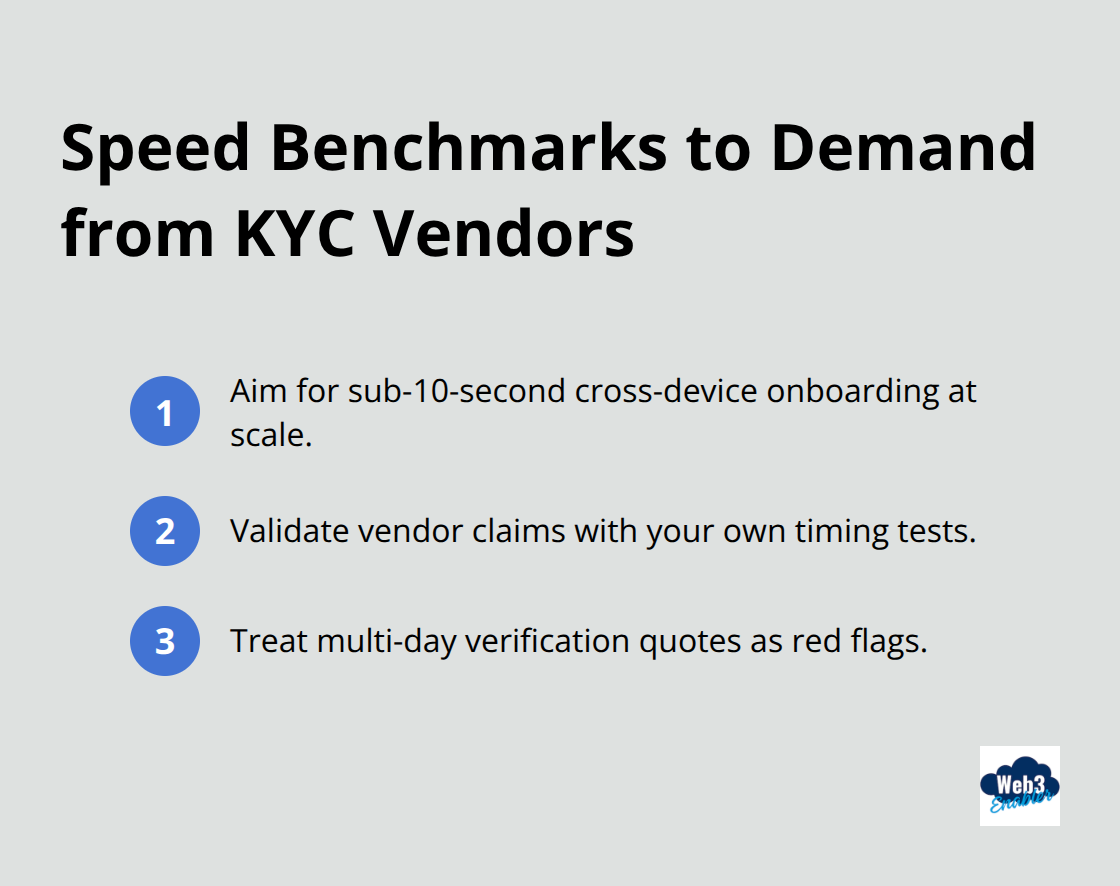
Speed matters too. AU10TIX achieves cross-device onboarding in under 8 seconds, which tells you what’s possible at scale. If a provider quotes you days for verification, they’re selling yesterday’s solution.
Design Integration Into Your Existing Infrastructure
Integration determines whether your new KYC system becomes a workflow accelerator or a compliance bottleneck. API-first architecture lets the provider connect seamlessly with your CRM, payment infrastructure, and case management platform without requiring backend rewrites. If you already run Salesforce for customer data and operations, a Salesforce-native approach eliminates data silos and keeps everything in one source of truth.
Test the integration with a pilot group of 100-200 customers before full deployment. This reveals whether your team can actually use the system without constant support tickets and whether verification times match the vendor’s claims in your actual environment.
Establish Continuous Monitoring and Alert Systems
Real-time monitoring separates platforms that stay compliant from those that create compliance debt. Your chosen provider should flag sanctions changes, adverse media, and ownership shifts automatically after onboarding completes, not require manual quarterly reviews. This continuous monitoring catches problems before regulators do. Set up automated alerts so your compliance team gets notified instantly when risk scores change, not when you discover the issue during an audit.
Update your verification rules quarterly as regulations shift. EU MiCA tightened expectations significantly in 2024, and other jurisdictions follow. A provider locked into static rule sets becomes a liability; one that updates automatically keeps you ahead of compliance drift.
Document Your Implementation Process
Document everything-your choice rationale, integration steps, and ongoing monitoring setup-because regulators want to see that your KYC process is deliberate, not accidental. This paper trail protects you during audits and demonstrates that you made informed decisions about your compliance infrastructure.
Final Thoughts
The crypto industry stands at an inflection point where platforms that master fast, compliant onboarding capture the next wave of mainstream adoption. Those stuck with legacy verification processes watch customers disappear to competitors who respect their time. Cryptocurrency onboarding KYC no longer means choosing between speed and security-modern systems deliver both simultaneously through automated identity verification, real-time compliance checks, and risk-based segmentation that transform weeks into minutes.
The business case speaks for itself: faster verification lifts conversion rates, lowers customer acquisition costs, and cuts operational overhead while continuous monitoring catches problems before regulators arrive. When you combine these elements, you build genuine trust in crypto adoption for mainstream businesses that previously saw the space as too risky or too complicated. The platforms winning right now aren’t the ones with flashiest marketing-they’re the ones that made onboarding boring in the best possible way, where customers sign up, get verified instantly, and move forward without friction.
We at Web3 Enabler help businesses connect blockchain technology with existing corporate infrastructure through Salesforce Native solutions. Whether you’re building stablecoin payment flows or integrating crypto holdings visibility into your operations, the foundation remains the same: onboarding that works at speed without cutting corners on compliance. Your next customer waits for you to get it right.
Frequently Asked Questions
Why is speed critical for cryptocurrency onboarding?
In the digital asset space, slow verification is the leading cause of customer abandonment. Reports show that lengthy or confusing KYC flows cause potential users to drop off before finishing registration. Modern automated systems reduce this timeline from days to minutes, turning compliance into a competitive advantage rather than a friction point.
How does AI-powered document verification improve KYC?
AI-powered systems use optical character recognition (OCR) and fraud detection to validate government IDs instantly. Unlike manual reviews, these tools can spot forged or tampered documents in seconds. In 2026, these systems are essential for blocking sophisticated threats like deepfakes and synthetic identities.
What are real-time compliance checks?
Real-time checks cross-reference applicant data against global sanctions, Politically Exposed Persons (PEP) lists, and adverse media databases the moment a user signs up. This provides an instant risk score, allowing low-risk users to be “fast-tracked” while compliance teams focus only on high-risk edge cases.
How does risk-based segmentation work in onboarding?
Risk-based segmentation tiers the verification process based on a user’s profile and intent. A first-time user making a small transaction might face minimal friction, while an institutional client or someone from a high-risk jurisdiction undergoes Enhanced Due Diligence (EDD). This ensures regulatory rigor without slowing down the majority of users.
Does automated KYC help with regulatory audits?
Yes. Automated systems create a digital, time-stamped audit trail for every verification step, from biometric liveness checks to database screenings. This documentation proves to regulators that your business has “reasonable procedures” in place, which is a critical requirement under frameworks like the EU’s MiCA and the UK’s fraud laws.