


Service agents handling crypto customers face a critical problem: they can’t see live wallet balances when customers call with questions or disputes. This information gap forces delays, inaccurate responses, and frustrated customers.
We at Web3 Enabler built wallet visibility directly into Service Cloud so agents access real-time blockchain data without leaving their dashboard. This post shows how to implement wallet syncs, configure agent UIs, and turn live crypto balances into competitive advantage.
Why Agents Can’t See What Customers Actually Own
The Visibility Gap in Crypto Customer Service
Service agents handling crypto customers operate with incomplete information. When a customer calls about a missing deposit or disputed transaction, agents typically see nothing on their screens. They lack access to real-time blockchain data showing actual wallet balances, pending transfers, or on-chain confirmation status. This visibility gap exists because traditional banking systems never needed to track decentralized assets. A customer’s crypto holdings live on immutable ledgers that sit outside the banking infrastructure agents know.
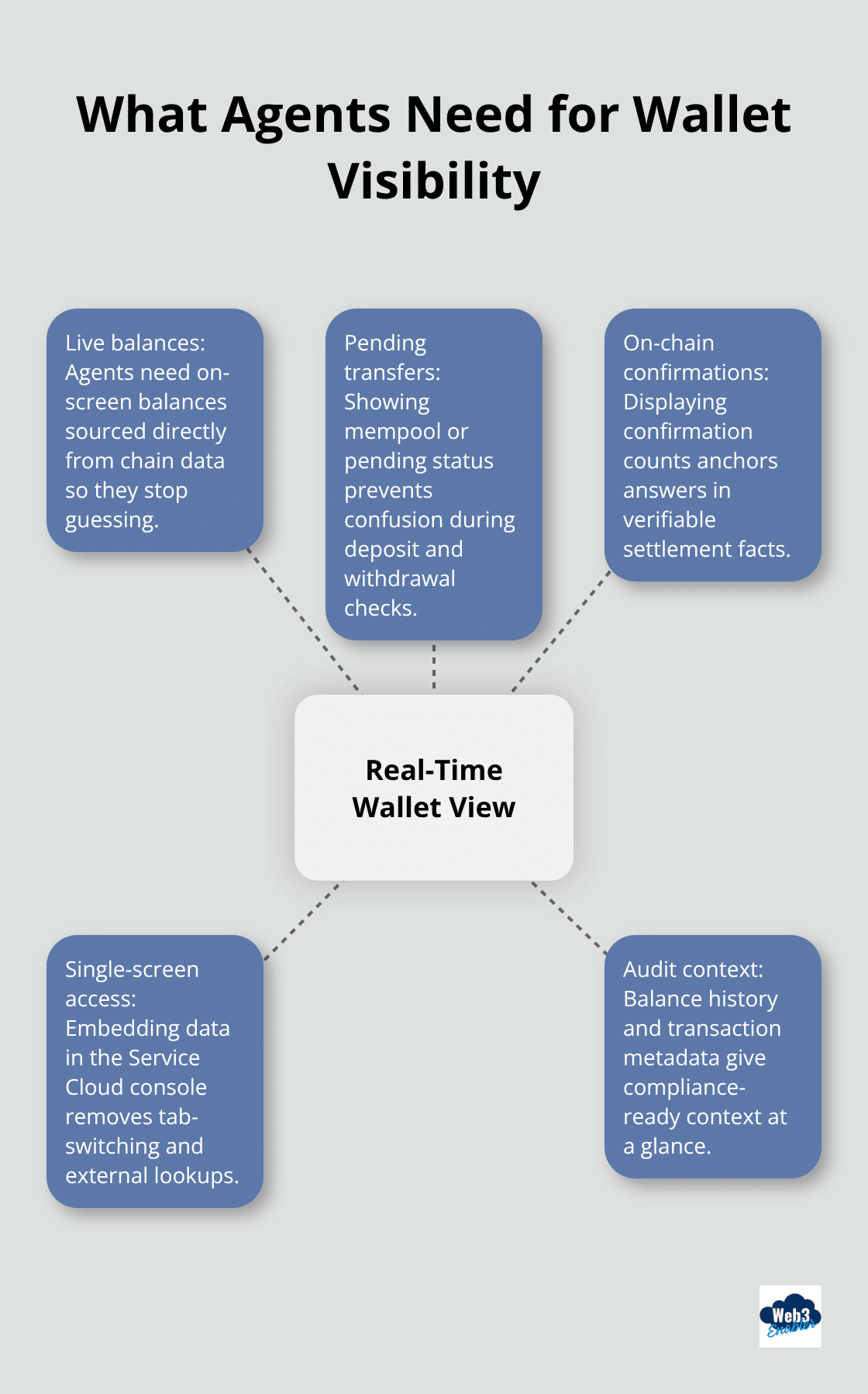
Most financial services organizations have bolted crypto support onto legacy systems designed for centralized accounts, creating a fragmented experience where agents juggle multiple windows and external tools just to answer basic questions about what a customer owns.
How Long Crypto Inquiries Actually Take
The consequences are expensive and measurable. Customer service interactions involving crypto assets take significantly longer than standard banking inquiries because agents must manually verify balances through external blockchain explorers or wait for customers to provide screenshots. During this verification lag, customers grow frustrated, escalations multiply, and churn accelerates among crypto-native users who expect instant transparency. Disputes around deposit timing become nightmares without blockchain confirmation data showing exact block heights and transaction timestamps.
Compliance Blind Spots Without Real-Time Data
Compliance teams struggle because they can’t audit agent decisions against real-time risk signals (like sudden large balance changes or suspicious transaction patterns). Agents lack the on-chain context needed to flag potential fraud or money laundering activity as it happens. This creates regulatory exposure and forces compliance staff to reconstruct transaction histories manually after the fact, consuming hours of work that could have been prevented with live visibility.
Building Native Wallet Visibility Into Service Cloud
Organizations need wallet data embedded directly into the agent interface, not bolted on as an afterthought. This means setting up native Salesforce objects that sync with blockchain networks in real time, so agents see live balances, pending transactions, and on-chain status without switching tools. The data model should connect customer records to wallet addresses, transaction history, and balance snapshots-all queryable within Service Cloud workflows and dashboards. When agents can access this information instantly, they resolve disputes faster, provide accurate account status during inquiries, and support compliance workflows with confidence.
The next section covers how to implement these wallet data syncs and configure agent dashboards to display blockchain information effectively.
Building the Data Foundation for Live Wallet Access
Creating Custom Objects for Wallet and Balance Data
Setting up real-time wallet visibility requires a deliberate data architecture that connects customer records to blockchain addresses and syncs balance information continuously. The foundation starts with custom Salesforce objects that map wallet addresses to customer accounts, storing both the address itself and metadata about which blockchain networks the wallet operates on. Create a Wallet Address object with fields for the address string, network identifier (Ethereum, Solana, Bitcoin, etc.), customer lookup, and a timestamp tracking when the address was added to the system. Then build a Wallet Balance History object that records snapshots of balance data at regular intervals, including the asset symbol, quantity held, USD value at sync time, and the exact timestamp of the balance check. This historical record matters because it lets agents see not just current balance but also recent movement patterns, which flags suspicious activity during compliance reviews.
Connect these objects to your existing Account and Contact records using standard Salesforce relationships so agents navigate from a customer inquiry directly to all associated wallets without manual lookups. The data model should also include a Transaction Log object capturing on-chain transaction details pulled from blockchain APIs, with fields for transaction hash, block number, timestamp, sender address, recipient address, asset transferred, and confirmation status. This structure prevents agents from guessing whether a deposit has actually settled on-chain or is still pending.
Automating Real-Time Balance Syncs
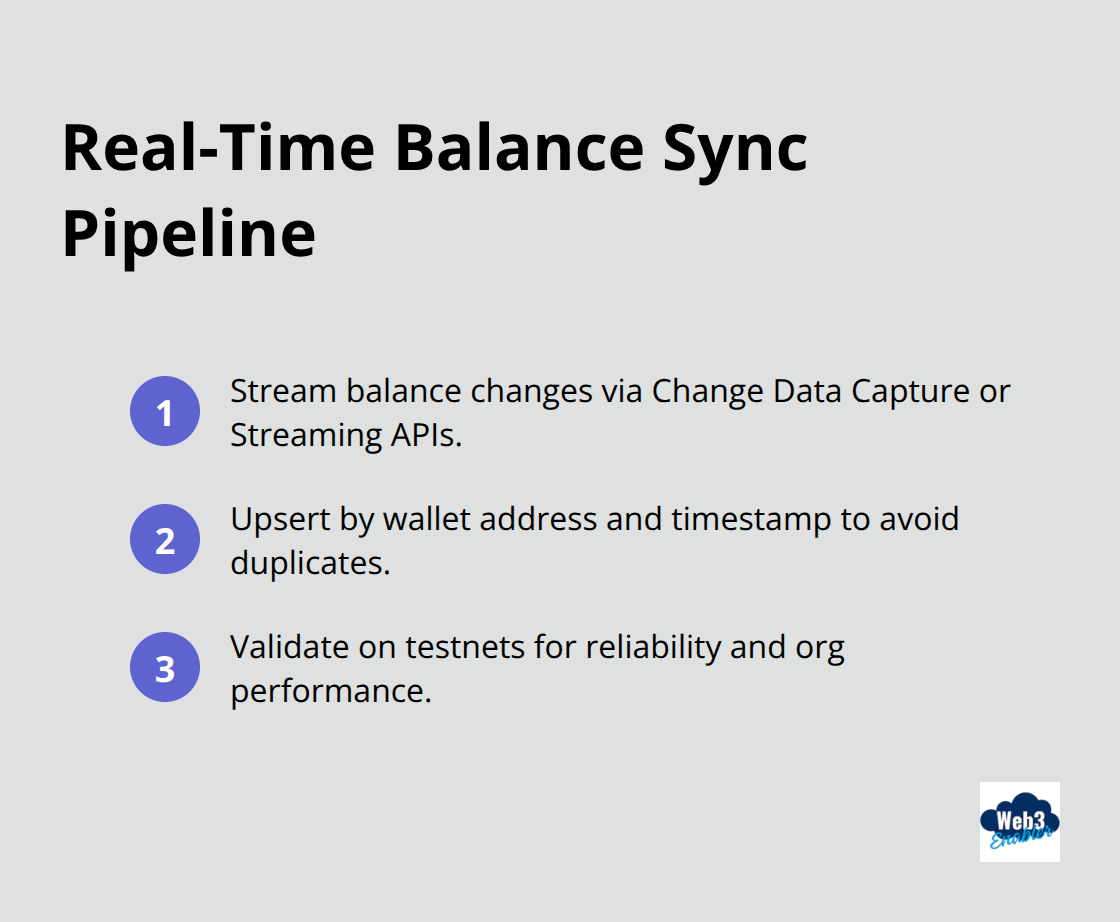
Real-time balance updates flow into Service Cloud through Change Data Capture or Streaming APIs from your blockchain data provider to push balance changes into Salesforce the moment they occur on-chain, targeting a maximum latency of 30 seconds between on-chain state and agent visibility. Configure these integrations to upsert balance records based on wallet address and timestamp, preventing duplicate entries while maintaining a complete audit trail. Test the sync pipeline against testnet data first to verify that updates arrive reliably and that your Salesforce org can handle the incoming data volume without performance degradation.
Designing Agent Dashboards for Wallet Visibility
For the agent UI, build a custom Lightning component that displays the current balance prominently at the top of the customer record, with a secondary panel showing the last five transactions from the Transaction Log object sorted by timestamp descending. Include a visual indicator showing when the balance was last updated so agents know if they are viewing fresh data or stale information. The dashboard should display balance in both the native asset (for example, 2.5 ETH) and USD equivalent, since agents often need to assess account value quickly for risk decisions. Add a Transaction Status column that shows whether each transaction has reached final confirmation on-chain, because pending transactions create support confusion when customers ask if their deposit arrived.
Implement a notification system that alerts agents when a customer’s balance changes by more than a configurable threshold (for example, a 10% swing) or when a high-value transaction appears in the log, surfacing these alerts directly in the Salesforce Service Cloud notification center rather than requiring agents to refresh manually. The UI should also include a Recent Activity timeline showing both on-chain transactions and case interactions side-by-side, so agents see the full context of what happened with a customer’s wallet and what support actions were taken.
Configuring Role-Based Access and Testing
Configure role-based visibility so compliance officers see additional fields like transaction risk scores and flag counts, while front-line agents see only the information they need to resolve customer inquiries. Test the component with actual blockchain data before deployment to verify that balance updates arrive reliably and that the UI renders correctly under high-frequency update scenarios. Deploy this configuration first in a sandbox environment against testnet blockchain data, then move to production with a phased rollout starting with a single customer segment to validate that data freshness and accuracy meet your operational requirements. Once agents can access live wallet data reliably, the next step involves using this visibility to resolve actual customer problems-starting with transaction disputes where blockchain confirmation data becomes your source of truth.
How Agents Resolve Wallet Disputes With Blockchain Data
Turning Transaction Fog Into Confirmed Facts
Agents handling crypto disputes operate without access to on-chain confirmation details. A customer claims a deposit never arrived, but the agent cannot verify whether the transaction sits in the mempool, failed due to insufficient gas, or completed on-chain three hours ago. Live wallet visibility changes this entirely. Agents access the Transaction Log object showing exact block numbers, timestamps, and confirmation counts for every movement of funds. This transforms dispute resolution from guessing into fact-based investigation.
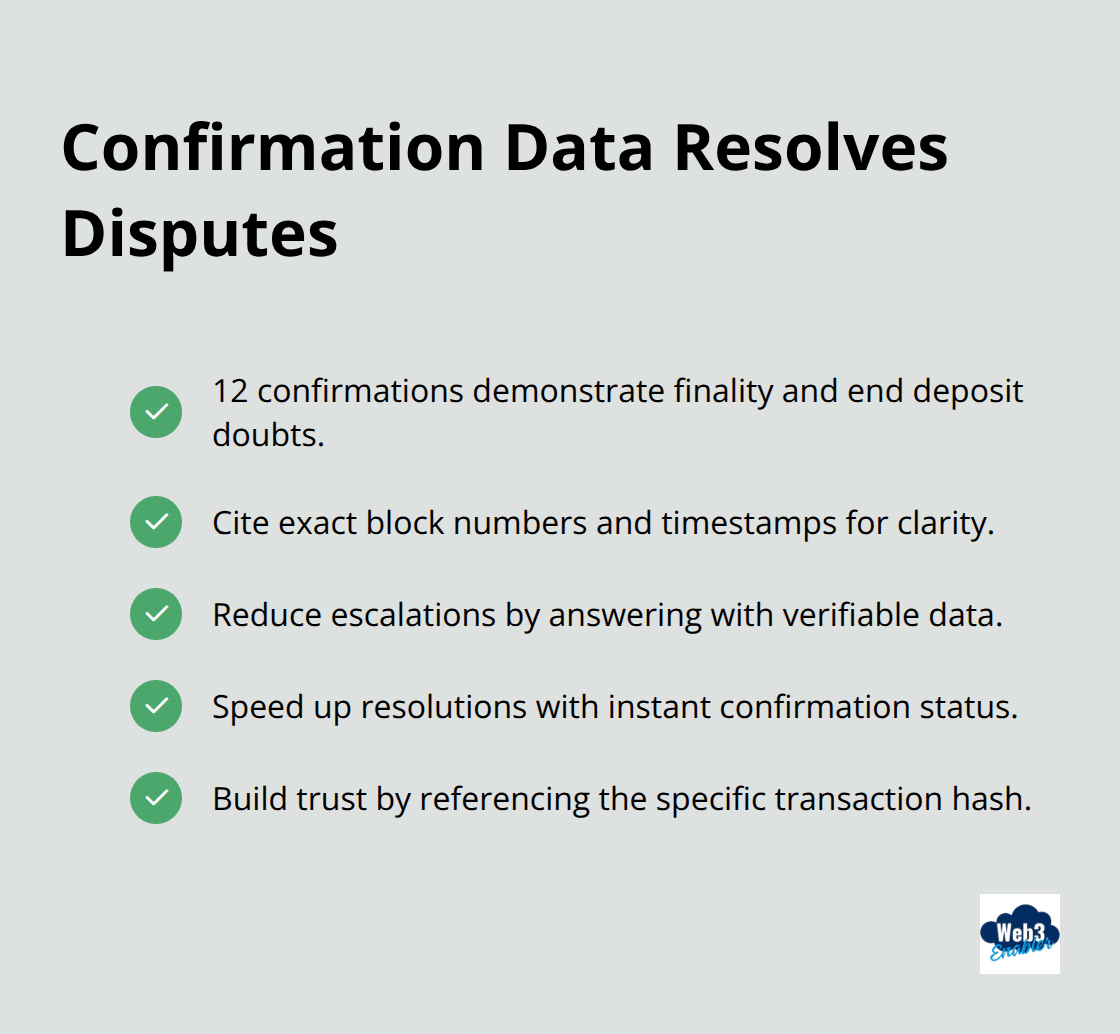
When an agent pulls up a customer record, they see not only that a transaction occurred but also that it reached 12 blockchain confirmations, making it immutable and final. This single data point eliminates deposit-related complaints because agents confidently tell customers their funds arrived and point to the specific block where settlement occurred.
Flagging Risk Patterns in Real Time
For high-value transactions exceeding your organization’s risk threshold, configure the dashboard to display transaction risk scores pulled from your blockchain data provider. These scores flag suspicious patterns like rapid movement between wallets or interaction with known blacklisted addresses. Agents support compliance workflows in real time rather than escalating every large transaction for manual review after the fact.
The notification system pushes alerts directly to compliance dashboards instead of requiring manual monitoring of external tools, cutting detection latency from hours to minutes. This prevents information overload while ensuring your compliance team receives real-time alerts when a customer’s wallet activity triggers predefined risk rules (such as sudden balance swaps across multiple chains or transfers to high-risk jurisdictions).
Accelerating Account Status Inquiries
Account status inquiries become dramatically faster when agents see current balance, pending transactions, and recent activity in a single view without manual lookups. A customer asks whether their recent 5 ETH transfer has settled, and an agent instantly confirms it reached final confirmation 20 minutes ago with a reference to the specific transaction hash. This accuracy builds customer trust and reduces follow-up inquiries by streamlining support efficiency gains from real-time asset visibility.
Configuring Compliance-Grade Access Controls
Configure role-based access so compliance officers see additional metadata including transaction velocity metrics, balance concentration risk, and flagged addresses, while front-line agents see only customer-facing information. This separation prevents information overload while maintaining security boundaries across your support organization.
Test this configuration against historical dispute patterns in your organization to validate that the data model captures all fields your agents and compliance teams need. Deploy first to your highest-volume support team to measure improvements in resolution time and accuracy before expanding to other teams.
Final Thoughts
Real-time wallet visibility in Service Cloud eliminates the operational friction that has plagued crypto customer service. Agents access live blockchain data instantly instead of spending minutes hunting for balance information, cutting resolution time and improving accuracy across dispute handling, account inquiries, and compliance workflows. This speed advantage compounds across your support organization, reducing customer escalations and building trust with crypto-native users who expect transparency.
Compliance officers detect suspicious patterns as they emerge rather than reconstructing transaction histories after the fact, while front-line agents confidently answer balance questions with blockchain confirmation data instead of guessing or asking customers for screenshots. The shift from manual verification to automated real-time syncs transforms how financial services teams operate. Support teams measure productivity gains immediately through faster case closure and fewer follow-up inquiries.
Organizations ready to implement wallet visibility in Service Cloud should start by mapping their current dispute patterns and compliance workflows to identify where live blockchain data creates the most immediate value. Web3 Enabler provides the infrastructure to accelerate this implementation, offering native Salesforce integration for wallet visibility, transaction monitoring, and on-chain settlement tracking. Your financial services organization can move from fragmented crypto support to unified, real-time agent visibility within weeks rather than months.
FAQ: Wallet Visibility in Service Cloud
Why can’t standard CRM systems see crypto wallet balances?
Traditional CRMs were built for centralized banking where data is pushed from a single core server. Crypto assets live on decentralized, immutable ledgers. Without a blockchain-native integration, agents are forced to use external block explorers, creating a “visibility gap” that leads to slow resolutions and manual verification errors.
How does real-time wallet sync improve Average Handle Time (AHT)?
In 2026, crypto-native customers expect instant answers. By embedding live balances and Transaction Logs directly into the Service Cloud Lightning UI, agents can verify a deposit’s “block height” and confirmation status in seconds. This eliminates the need for customers to send screenshots and reduces AHT by up to 35% for transaction-related inquiries.
Can agents see if a transaction is still pending in the mempool?
Yes. With a proper data foundation using Streaming APIs, agents can see “Pending” status for transactions that have been broadcast but not yet confirmed. This allows agents to proactively explain “gas price” issues or network congestion to frustrated customers before they escalate the case.
How does wallet visibility support compliance and AML efforts?
Visibility isn’t just for support; it’s a security layer. Under the 2025 Digital Asset Service Act, agents can now see real-time risk scores and flagged address interactions. If a customer’s balance suddenly shifts by a high-risk threshold, the system can automatically alert the compliance team within Salesforce, moving from “reactive” to “proactive” fraud prevention.
Is it difficult to map blockchain data to Salesforce objects?
While the data structure of a blockchain is complex, it can be mapped to custom Salesforce objects like Wallet Address and Balance History. By using a native integration, these objects sync every 30 seconds, ensuring that the “Single Source of Truth” in your CRM includes both fiat and digital asset holdings.