


Financial advisors managing crypto-exposed clients face a constant challenge: scattered wallet data across multiple blockchains makes it nearly impossible to give timely, informed advice. Client wallet Salesforce visibility changes this dynamic by bringing all digital assets into one place within your existing platform.
We at Web3 Enabler built this capability so advisors can monitor holdings in real time and spot portfolio shifts the moment they happen. That means better conversations with clients and faster, smarter recommendations.
What Changes When Advisors See Crypto Holdings in Real Time
Financial advisors historically operated with a three to five-day lag when tracking client crypto activity. A client might execute a significant trade on Monday, but the advisor wouldn’t see it reflected in their systems until Wednesday or Thursday, if at all. That delay created blind spots that made portfolio recommendations feel reactive rather than strategic.
Web3 Enabler integrates wallet data directly into Financial Services Cloud so advisors access current holdings the moment transactions settle on-chain. This real-time visibility transforms how advisors approach client conversations. Instead of asking clients about their positions, advisors already know them.
A client holding Bitcoin across three separate wallets, Ethereum staking rewards accumulating daily, and stablecoin positions spread across multiple chains becomes visible in a single Salesforce view. Advisors identify portfolio concentration risks immediately, spot tax-loss opportunities before year-end, and recommend rebalancing strategies based on actual positions rather than outdated records. The shift from quarterly reviews to continuous monitoring means advisors catch market movements while they matter.
Real-Time Impact on Portfolio Decisions
When Ethereum rises 15% in a week, an advisor sees that impact on a client’s net worth instantly and can proactively discuss whether the client wants to lock in gains or maintain exposure. Stablecoin holdings become visible alongside traditional assets, allowing advisors to understand how clients position for volatility or prepare for withdrawals.
The moment a client moves funds between blockchains or converts holdings, that activity appears in Salesforce. An advisor might notice a client transferred a significant portion of their portfolio to stablecoin during market uncertainty, signaling concern that wasn’t communicated directly. That insight lets the advisor initiate a conversation grounded in actual behavior rather than speculation.
Tracking Cross-Chain Activity With Precision
Advisors report that cross-chain activity becomes trackable in ways traditional portfolio tracking never allowed. A client might hold Bitcoin on Ethereum as a wrapped asset, stake Ethereum on a third platform, and maintain USDC across four different networks. Without unified visibility, advisors would miss the full picture. With it, they see the complete position instantly.
This detection capability extends to understanding client behavior patterns. If a client typically rebalances quarterly but suddenly starts moving funds weekly, that shift might indicate changing risk tolerance, market anxiety, or simply active trading experimentation. Advisors can respond thoughtfully rather than discovering months later that a client’s strategy had evolved without their input.
Building Recommendations on Accurate Data
Timely advice depends on accurate data. An advisor recommending a client increase their Bitcoin allocation needs to know exactly how much Bitcoin they already hold and across which wallets. An advisor suggesting a client reduce concentration risk needs visibility into all holdings before making that recommendation.
Web3 Enabler delivers that foundation within Salesforce, eliminating the step where advisors ask clients to manually list positions or pull data from multiple exchange accounts. Current holdings inform smarter recommendations. If an advisor sees a client holds 30% of their portfolio in Ethereum and the client expresses interest in diversification, the advisor can suggest specific moves with confidence.
If a client mentions planning to use stablecoins for international payments, the advisor can check their current USDC and USDT positions and recommend consolidation to a single stablecoin to reduce complexity. Real-time data also supports more sophisticated planning. Advisors can model scenarios based on actual positions. What if Bitcoin moves to $80,000? The advisor already knows the exact exposure and can calculate the impact immediately rather than estimating.
What if a client needs $50,000 in liquidity within 30 days? The advisor sees which holdings are most liquid, which are locked in staking, and which might trigger tax events if sold. That precision leads to recommendations clients trust because those recommendations account for the full complexity of their actual situation. With this foundation in place, the next step involves embedding these insights directly into your Salesforce workflows-a process that requires understanding how wallet data flows into Financial Services Cloud and what automation makes that integration seamless.
How Wallet Data Flows Into Salesforce
Integrating blockchain wallet data into Financial Services Cloud requires a direct connection between on-chain activity and your Salesforce records. When a client’s holdings change on-chain, that update flows into Salesforce automatically through native blockchain APIs. The integration captures wallet addresses linked to each client record, monitors those addresses across multiple blockchains, and syncs the data at intervals that match your operational needs. Some advisors need hourly updates during active trading periods, while others prefer daily snapshots.
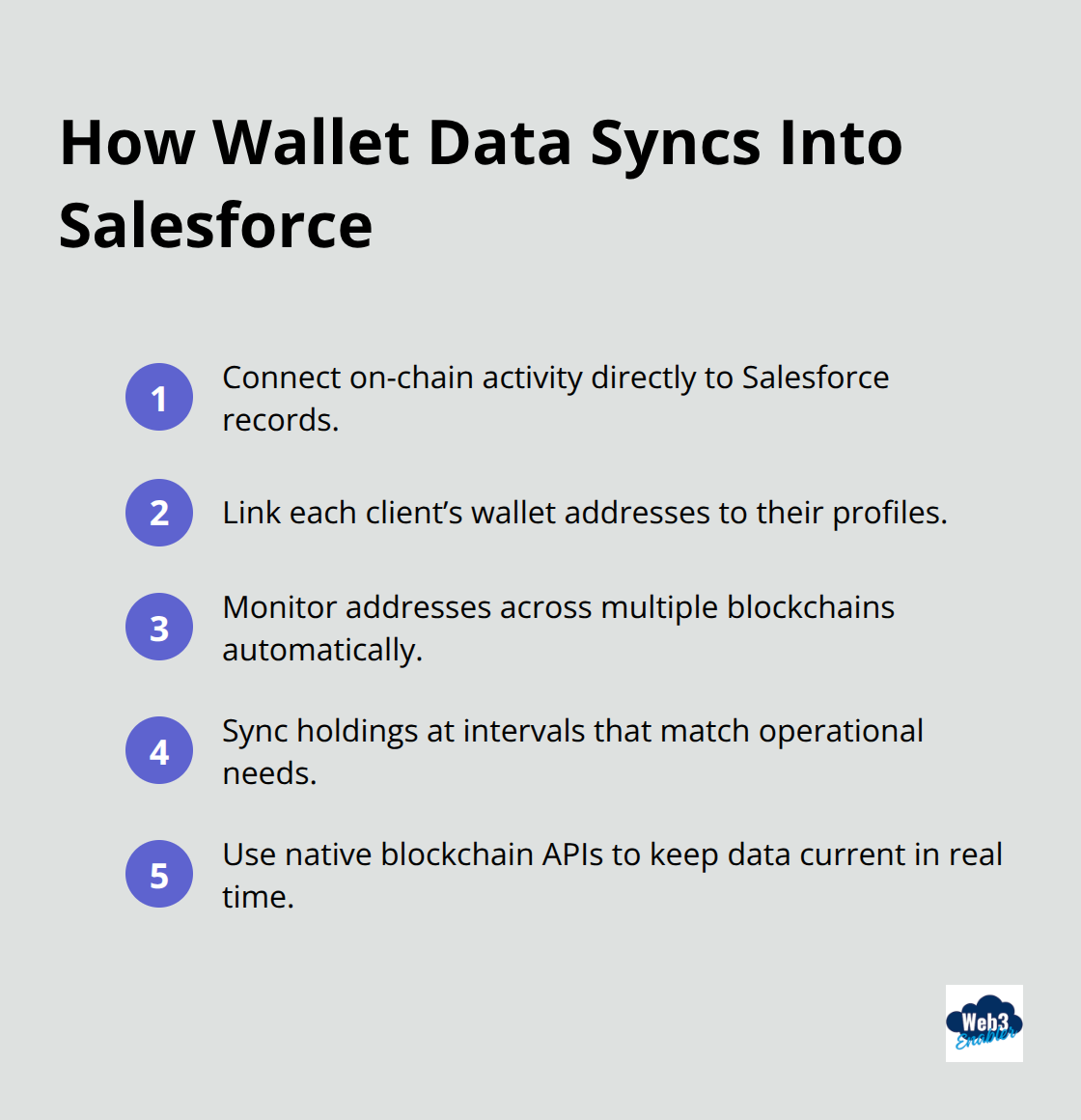
The system adapts to your workflow rather than forcing advisors to check external platforms.
The practical advantage appears immediately in advisor workflows. Instead of asking a client for their current portfolio or logging into multiple exchanges, an advisor opens a client record in Salesforce and sees their complete digital asset position. Bitcoin holdings appear alongside Ethereum staking positions, USDC balances across different chains, and any other tokenized assets the client holds. That visibility eliminates the disconnect between what a client remembers owning and what they actually hold. Advisors frequently discover clients hold positions they forgot about or misremembered the quantity of, which changes the entire portfolio analysis. The data sync also captures transaction timestamps and blockchain confirmation details, creating an audit trail that compliance teams need. When a client disputes whether a transaction occurred or questions timing, advisors can reference the exact on-chain confirmation time rather than relying on memory or exchange records.
Automation Replaces Manual Reconciliation Work
Advisors at firms without native blockchain visibility spend hours each month reconciling client statements with exchange reports and manual notes. That work produces minimal value and introduces errors consistently. Automated wallet data sync eliminates this entirely. The system reconciles holdings continuously rather than monthly, flagging discrepancies the moment they appear. If a client claims to hold one Bitcoin but the wallet shows 0.8 Bitcoin, that gap surfaces immediately in Salesforce. Advisors investigate and resolve the discrepancy while the client remains in the conversation rather than discovering it weeks later during statement review. This approach also catches unauthorized activity faster. If a compromised wallet transfers funds without the client’s knowledge, the advisor sees the balance drop and alerts the client immediately. That speed matters significantly because crypto theft often happens in minutes once a wallet is compromised.
Compliance Becomes Embedded, Not Bolted On
Financial institutions managing crypto-exposed clients face regulatory requirements around reporting, KYC verification, and transaction monitoring. Traditional approaches handle these as separate processes that happen after the fact. Native Salesforce integration embeds compliance into the advisor workflow. Every transaction captured from the blockchain automatically feeds into compliance reports. When regulators require documentation of a client’s holdings on a specific date, that information exists in Salesforce with full audit trails showing when the data was captured and how it was used in recommendations. The system also identifies high-risk activity patterns automatically. If a client suddenly moves significant holdings to a new wallet address or converts to stablecoins in ways that deviate from their historical pattern, the system flags this for review. Advisors assess whether the activity represents legitimate portfolio management or something requiring deeper investigation. This continuous monitoring approach satisfies regulatory expectations around transaction oversight without creating manual work that scales poorly as client bases grow.
Real-Time Data Transforms Advisor Conversations
Compliance teams and advisors access the same wallet visibility, ensuring everyone works from current data rather than conflicting reports generated from different systems. This unified view changes how conversations with clients actually happen. An advisor no longer needs to ask a client about their positions or wait for manual updates. Instead, the advisor opens Salesforce and sees exactly what the client holds across all blockchains and wallets. That foundation shifts the conversation from data gathering to strategic planning. The advisor can ask more sophisticated questions: Should we consolidate these stablecoin positions? Is this Bitcoin allocation still aligned with your risk tolerance? What’s your plan if Ethereum moves another 20%? These questions emerge from actual data rather than assumptions, which means clients trust the guidance more and advisors make recommendations with confidence. The next step involves understanding how advisors actually use this wallet visibility to build better strategies with their clients-and what specific workflows make that process seamless within Salesforce.
Turning Wallet Data Into Actionable Client Strategies
Wallet visibility inside Salesforce stops being valuable the moment advisors finish collecting data. The real work happens when advisors translate what they see into concrete strategies that clients actually execute. An advisor who notices a client holds Bitcoin across three separate wallets, Ethereum staking rewards worth $45,000, and USDC spread across two chains now faces a specific decision: what should this client do with that information?
When an advisor sees a client’s complete digital asset picture in one Salesforce view, the conversation shifts immediately from discovery to strategy. An advisor managing a client with $500,000 in crypto holdings can ask whether consolidating five different wallets into two reduces operational complexity and lowers the risk of lost private keys. The advisor can calculate whether moving staking rewards into a dedicated yield-bearing position generates better returns than leaving them scattered across multiple chains. These aren’t theoretical questions anymore-they’re based on actual positions visible in Salesforce.
Building Strategies Around What Clients Actually Own
Many advisors find that clients misunderstand their own positions fundamentally. A client might believe they hold 2 Bitcoin when Salesforce reveals they actually hold 1.8 Bitcoin, with 0.2 locked in staking arrangements that mature in six months. That discrepancy matters because it changes the entire strategy conversation. The advisor can now discuss whether the client should let the staking arrangement mature or exit early, a decision that affects both liquidity and tax positioning.
Similarly, an advisor might notice a client holds $120,000 in stablecoins but has expressed concern about market volatility. The advisor can recommend converting a portion into actual collateral or diversifying into other assets that generate yield. Real-time visibility also reveals opportunities that spreadsheet-based tracking misses entirely. If a client holds Ethereum across three different staking platforms earning different yields (one at 3.2%, another at 2.8%, a third at 2.1%), the advisor can recommend consolidating to the highest-yield platform. That single move might generate an additional $1,200 annually on a $100,000 position-not transformative, but meaningful enough to justify the conversation and execution.
Identifying Concentration Risk Across Chains
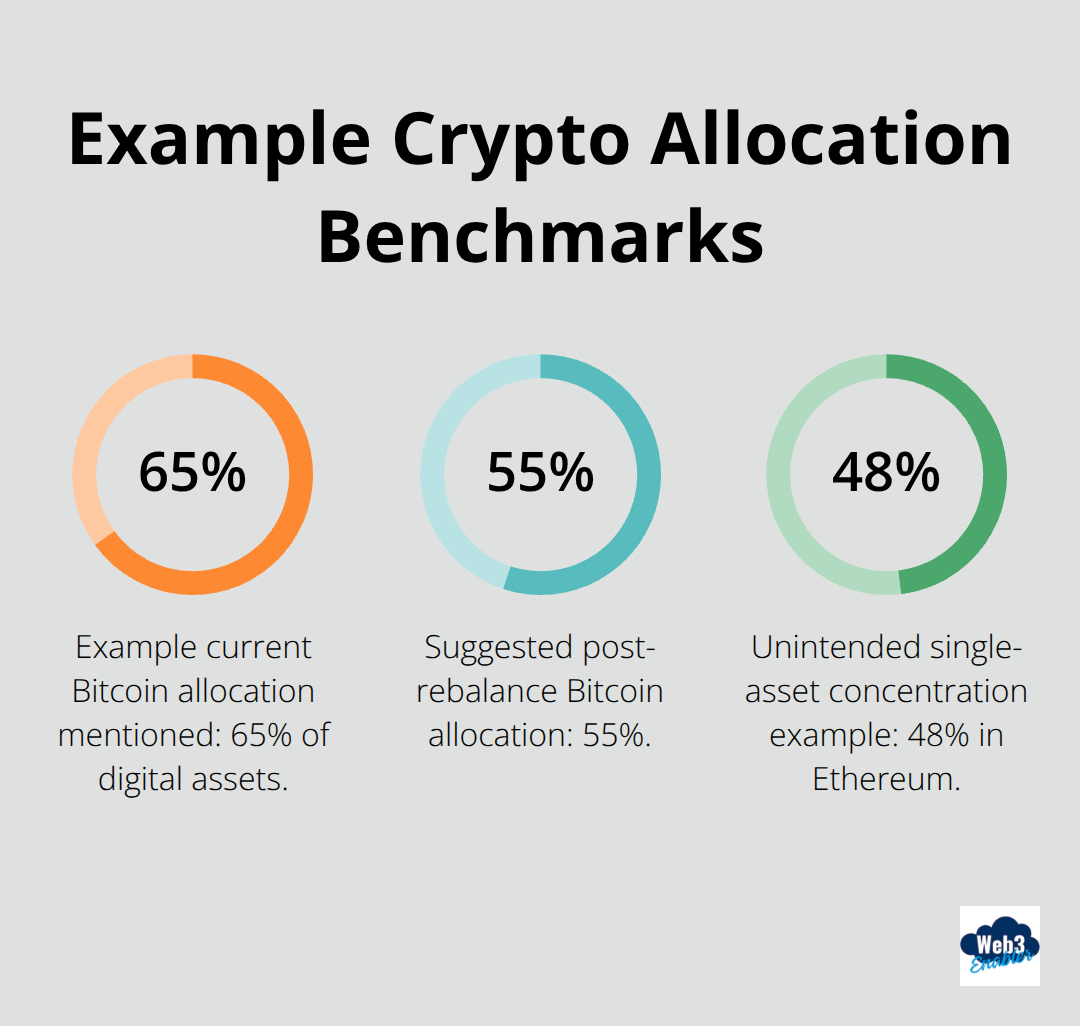
Portfolio concentration remains one of the most critical conversations advisors have with crypto-exposed clients, and wallet visibility makes that conversation far more productive. An advisor might see that a client holds 65% of their digital assets in Bitcoin, with the remainder spread across five altcoins. Without real-time visibility, the advisor might estimate these percentages based on memory or outdated exchange records. With Salesforce showing exact positions, the advisor knows precisely that the client holds $325,000 in Bitcoin out of $500,000 total-not an estimate, but a fact.
That precision allows the advisor to make a specific recommendation: reduce Bitcoin to 55% by selling $50,000 and deploying it into Ethereum or stablecoins. The advisor can show the client exactly what that rebalancing accomplishes and when it should happen.
Cross-chain holdings complicate this analysis significantly. A client might hold wrapped Bitcoin on Ethereum, native Bitcoin on the Bitcoin network, and Bitcoin futures exposure through a different platform. Salesforce consolidates all of this into a single view, showing the advisor that the client’s actual Bitcoin exposure is far higher than they realize. This discovery often prompts immediate rebalancing conversations because the concentration risk becomes undeniable once it’s visible in one place.
Advisors also use wallet visibility to identify clients who’ve accidentally created unintended concentration. A client who received Ethereum as a bonus from their employer might not realize that combined with their existing holdings, they now have 48% of their portfolio in a single asset. Real-time visibility surfaces this immediately, allowing the advisor to recommend reducing that exposure before market movements make the problem worse.
Eliminating Hours of Manual Work Per Client
Financial advisors managing crypto-exposed clients historically spend 8 to 12 hours monthly per client to gather wallet data, verify holdings across exchanges, and reconcile discrepancies. A firm managing 50 crypto-exposed clients dedicates roughly 400 to 600 hours monthly just to data collection-the equivalent of two full-time employees doing nothing but pulling information from different sources.
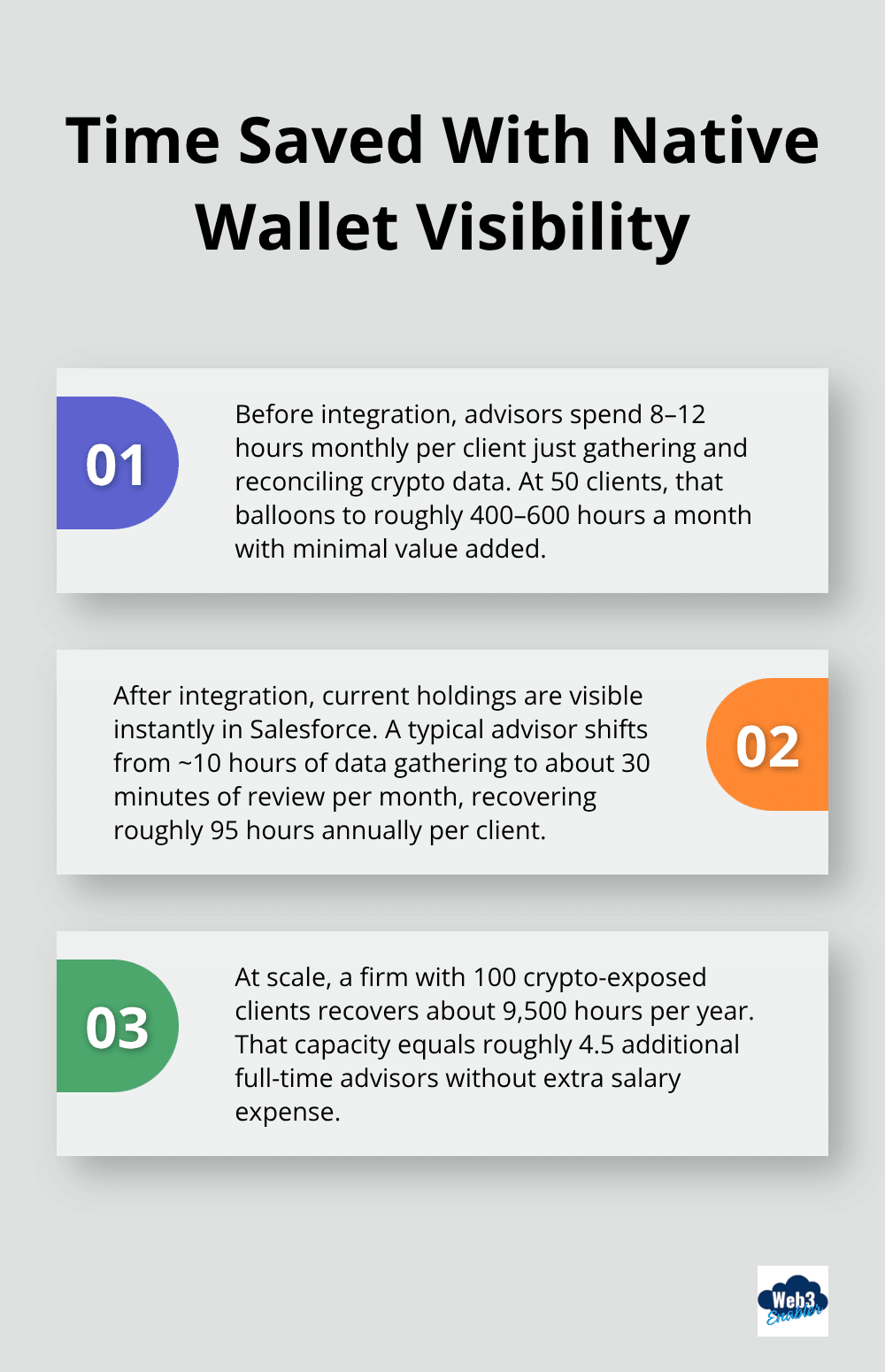
Salesforce integration eliminates this work entirely. Advisors access current holdings the moment they open a client record, with no manual verification needed. That freed time translates directly into advisor capacity. Instead of spending 10 hours monthly to gather data, an advisor spends 30 minutes reviewing the data that’s already current in Salesforce. Over a year, that’s roughly 95 hours recovered per client-time that goes toward actual strategy conversations, tax planning, and relationship deepening rather than administrative work.
The math becomes compelling quickly. A firm with 100 crypto-exposed clients recovers approximately 9,500 hours annually, equivalent to hiring 4.5 additional full-time advisors without any additional salary expense. That capacity lets the firm serve more clients at higher margins or invest existing advisors’ time into more sophisticated advisory services that command premium fees.
Final Thoughts
Client wallet Salesforce visibility fundamentally changes how financial advisors compete in crypto-exposed markets. Advisors who see real-time holdings across multiple blockchains make faster, smarter recommendations while advisors without this visibility operate with incomplete information and outdated data. That gap compounds over time as clients increasingly expect their advisors to understand their complete financial picture before conversations even start.
We at Web3 Enabler built our platform specifically to close this gap by bringing wallet data directly into Financial Services Cloud without manual work or external platforms. Advisors access current holdings, transaction history, and cross-chain positions without leaving Salesforce, while compliance teams get the audit trails and transaction monitoring they need. Firms that deploy client wallet Salesforce visibility serve crypto-exposed clients more effectively, retain those clients longer, and free advisor capacity for higher-value conversations.
Start with a specific client segment or use case rather than attempting firm-wide deployment immediately. Web3 Enabler provides the infrastructure to make that transition seamless, with native Salesforce integration that requires no external workarounds. The advisors who move first gain the advantage of deeper client relationships built on accurate, current information.
Frequently Asked Questions About Client Wallet Salesforce Visibility
Client wallet Salesforce visibility helps financial advisors see crypto holdings, wallet activity, and cross-chain positions inside Financial Services Cloud. Below are common questions about how real-time wallet data supports better portfolio monitoring, stronger client conversations, and more efficient advisory workflows.
What is client wallet Salesforce visibility?
Client wallet Salesforce visibility is the ability to see a client’s crypto wallets, token balances, and blockchain activity directly inside Salesforce. Instead of relying on separate exchanges, spreadsheets, or manual updates, advisors can review digital asset holdings within the same platform they already use to manage client relationships and financial planning workflows.
Why does real-time wallet visibility matter for financial advisors?
Real-time wallet visibility matters because crypto positions can change quickly across multiple blockchains and wallets. When advisors can see those changes as they happen, they can respond faster to portfolio shifts, identify concentration risk sooner, and have more informed conversations with clients based on current holdings rather than outdated records.
Can Salesforce show crypto holdings across multiple wallets and blockchains?
Yes. With the right integration, Salesforce can display crypto holdings across multiple wallets and blockchains in one unified client view. This helps advisors understand total exposure to assets like Bitcoin, Ethereum, stablecoins, and other tokens without piecing together information from several disconnected sources.
How does wallet data flow into Financial Services Cloud?
Wallet data flows into Financial Services Cloud through blockchain integrations that connect wallet addresses to client records. Once connected, on-chain activity such as balance changes, transfers, and transaction history can sync into Salesforce automatically. This gives advisors a current view of client digital assets without requiring manual reconciliation.
How does wallet visibility improve portfolio recommendations?
Wallet visibility improves portfolio recommendations by giving advisors accurate information about what a client actually owns. That makes it easier to discuss rebalancing, diversification, liquidity planning, tax considerations, and stablecoin positioning. Advisors can make recommendations based on complete portfolio exposure instead of estimates or incomplete client-reported data.
Can advisors track cross-chain crypto activity inside Salesforce?
Yes. Cross-chain activity can be tracked inside Salesforce when the integration supports multiple blockchains and wallet types. This allows advisors to see how a client’s digital assets are distributed across networks, identify overlapping exposure, and understand whether a client is consolidating, transferring, staking, or changing strategy across different chains.
How does client wallet Salesforce visibility reduce manual work?
Client wallet Salesforce visibility reduces manual work by replacing spreadsheet tracking, exchange logins, and statement reconciliation with automated data sync. Advisors no longer need to ask clients for repeated wallet updates or pull information from multiple sources. That saves time and allows more focus on planning, relationship management, and strategy.
Does wallet visibility help with compliance and audit trails?
Yes. Wallet visibility can support compliance by creating clearer records of holdings, transaction timing, and account activity inside Salesforce. This helps firms maintain audit trails, respond to reporting requirements, and monitor unusual activity more effectively. When compliance data is embedded into advisor workflows, oversight becomes more consistent and less dependent on manual follow-up.
What types of client strategies become easier with real-time crypto visibility?
Real-time crypto visibility makes it easier to build strategies around portfolio concentration, liquidity planning, stablecoin allocation, staking exposure, and cross-chain diversification. Advisors can also identify when a client’s behavior changes, such as frequent transfers or sudden moves into stablecoins, and use that data to guide more timely and relevant recommendations.
Who should use client wallet Salesforce visibility?
Client wallet Salesforce visibility is most useful for financial advisors, wealth managers, and firms serving clients with meaningful crypto exposure. It is especially valuable for teams that want to monitor digital assets alongside traditional financial records, improve advisory speed and accuracy, and support growing demand for crypto-aware financial guidance within existing Salesforce workflows.