



Treasury teams face a choice: stick with settlement delays that cost millions annually, or modernize with stablecoins. We at Web3 Enabler see treasury management stablecoins transforming how businesses move money across borders in minutes instead of days.
Traditional banking infrastructure wasn’t built for speed. Stablecoins change that equation entirely, cutting settlement times and fees while giving your team real-time visibility into every transaction.
Why Treasury Teams Are Turning to Stablecoins
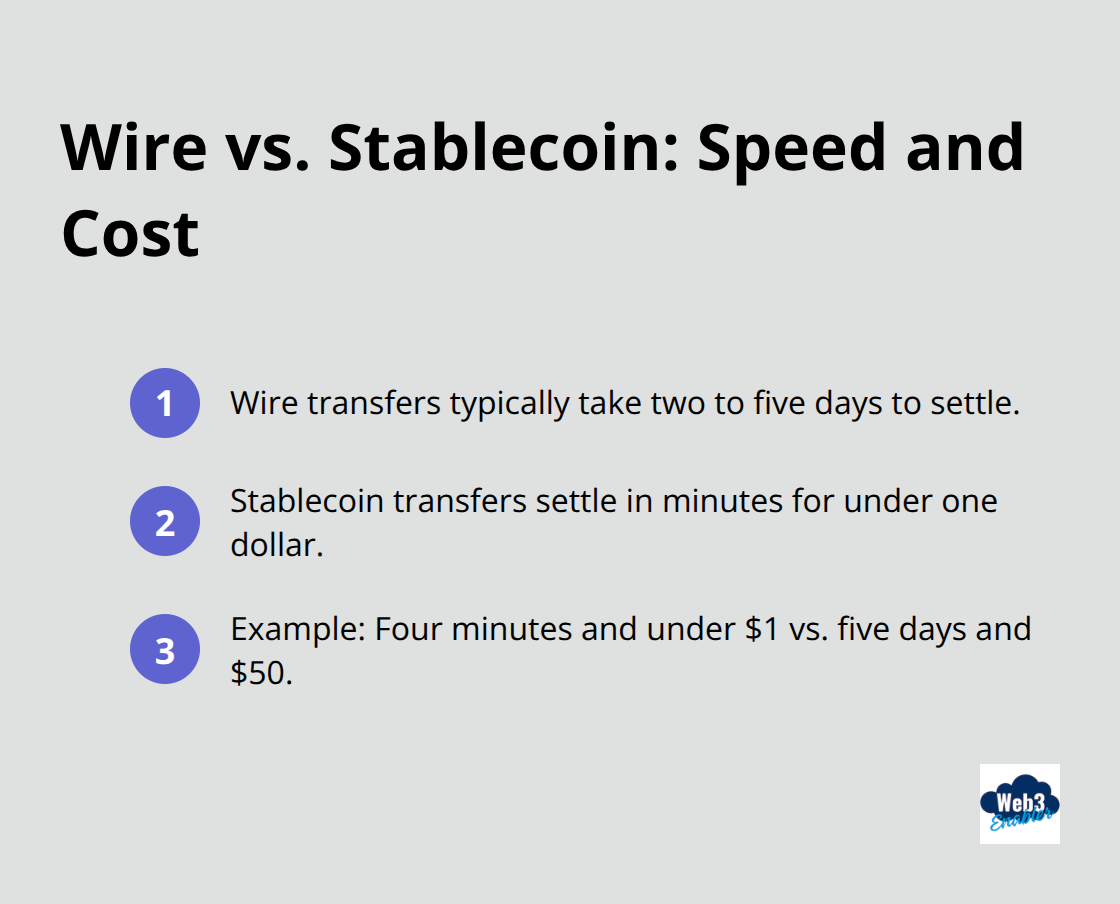
Cross-border payments move at the speed of bureaucracy, not technology. A wire transfer between continents takes two to five days minimum, sometimes longer during market volatility or holidays. During that waiting period, your cash sits frozen in correspondent banking networks, earning nothing while your business loses optionality. The cost compounds quickly: a treasury team managing payments across ten currencies might spend hundreds of thousands annually on wire fees alone, plus the hidden cost of working capital tied up in transit. Stablecoins eliminate this friction entirely. Settlement happens in minutes on public blockchains, and transaction fees measure in cents rather than dollars. According to research from the Journal of International Economic Law, stablecoin-based payments have surged from $100 million in monthly volumes in 2023 to significantly higher levels, demonstrating that institutions have already moved past skepticism into active deployment. The largest USD stablecoins, USDT and USDC, now back their reserves with US Treasury holdings, giving them the same safety anchor as traditional money markets. When your treasury team can move supplier payments across borders in four minutes for under a dollar instead of waiting five days and paying fifty dollars, the decision becomes obvious.
Legacy banking infrastructure creates artificial delays
Your traditional banking system relies on correspondent relationships that were built in an era of physical money movement. Today those relationships create artificial delays and opacity. A payment from your US account to a contractor in Mexico routes through multiple intermediary banks, each taking a cut and adding processing time. Nobody on your team sees where the money sits at any given moment. Stablecoins operate on transparent blockchains where settlement is final and immediate, and your accounting team gains real-time visibility into every transaction. The GENIUS Act, signed in July 2025, established a federal framework that permits banks to offer stablecoin capabilities to corporate clients, removing regulatory uncertainty that previously blocked institutional adoption. This regulatory clarity means your treasury operations can now integrate stablecoins without building custom workarounds.
Real-time liquidity transforms working capital management
When settlement time collapses from days to minutes, your working capital management transforms fundamentally. Treasury teams at companies like Siemens now use programmable stablecoins to automate internal transfers across entities and geographies, consolidating cash positions without waiting for bank cutoffs. This real-time liquidity management reduces the excess cash buffers that traditionally sit idle on balance sheets. EY research projects that five to ten percent of cross-border payments will move via stablecoins by 2030, representing roughly 2.1 to 4.2 trillion dollars in annual volume.

That shift accelerates for early movers who build stablecoin-native treasury workflows today. Your team gains a measurable competitive advantage in cash efficiency and settlement predictability that compounds across every payment corridor your business operates. The next section explores how to integrate stablecoins directly into your treasury operations and gain the real-time visibility your finance team needs to manage global liquidity effectively.
How Stablecoins Transform Your Treasury Dashboard
Unified visibility across cash and on-chain assets
Integrating stablecoins into your treasury operations consolidates fragmented data across banking portals and blockchain explorers into a single view. Your finance team gains immediate visibility into cash positions, on-chain assets, and settlement status without switching between systems. Financial Services Cloud displays USDC balances, pending transfers, and completed transactions using native Salesforce objects that automatically feed your reconciliation workflows. This consolidated visibility eliminates manual spreadsheet reconciliation that currently consumes hours weekly. When a stablecoin transfer settles in ninety seconds instead of five days, your treasury team receives immediate confirmation that the payment landed in the recipient’s wallet-not an email from a correspondent bank three days later. Real-time transaction status integrates directly into your existing Salesforce environment, allowing your team to act on current information rather than assumptions about cash position.
Dramatic cost reduction across payment corridors
The fee structure shift from traditional wire transfers to stablecoins transforms multi-currency operations fundamentally. A standard wire transfer costs between thirty and fifty dollars per transaction and involves currency conversion spreads that compound across geographies. Stablecoin transfers on Ethereum, BASE, or the XRP Ledger cost under one dollar per transaction regardless of amount or destination. A treasury moving five million dollars monthly across five countries spends roughly three thousand dollars monthly on wire fees alone. Stablecoin settlement enables faster cross-border settlement without correspondent banking chains and lower FX and wire costs for international payments. USDC, which Circle backs with cash and US Treasuries, maintains consistent pricing and regulatory clarity following the GENIUS Act framework signed in July 2025. This regulatory environment allows your compliance team to confidently integrate USDC as a settlement rail without building custom legal frameworks.
Real-time liquidity management and working capital efficiency
Your CFO sees immediate cost reduction on the P&L, and your treasury team gains operational flexibility to move capital across entities and currencies on demand rather than during banking hours. A treasury managing ten million dollars in monthly cross-border payments reduces reconciliation time from two days to two hours, freeing your team to focus on liquidity optimization instead of chasing settlement confirmations. Supplier payments, intercompany transfers, and customer refunds all process faster and cheaper, compounding efficiency gains across your entire payment infrastructure. The ability to move money instantly across borders means your working capital sits in productive positions rather than frozen in correspondent networks. Your team responds to market opportunities and supplier needs in real time instead of waiting for banking windows to close and reopen. This operational agility becomes a competitive advantage as your business scales across new geographies and payment corridors. The next section explores how to maintain full control and auditability of these transactions while your compliance team manages regulatory requirements with confidence.
Control and Compliance Without the Friction
Your treasury team moves stablecoins across borders in minutes, but your compliance team still needs the same audit trails, transaction controls, and regulatory reporting that traditional banking provides. Stablecoins deliver this through transparency rather than opacity. Every transaction settles on a public blockchain with an immutable record that your finance team can verify in real time without waiting for bank statements or correspondent confirmations.
Immutable records replace manual audit trails
On-chain transparency creates permanent settlement records that your compliance team accesses instantly. Traditional wire transfers require manual KYC and sanctions screening at multiple points in the correspondent chain, creating delays and audit gaps. Stablecoin transfers embed compliance checks directly into the transaction workflow through integrations with providers like Bridge, automatically screening counterparties against sanctions lists and regulatory databases before settlement executes. Your audit team gains immediate visibility into every stablecoin transfer without building custom data pipelines or relying on third-party reporting tools.

When regulatory frameworks took effect, they established attestations and audits as the regulatory standard for stablecoin issuers. This means the assets backing USDC and other compliant stablecoins receive the same scrutiny as traditional reserves. Your legal team no longer faces guesswork when evaluating whether stablecoins meet governance standards.
Native Salesforce objects capture transaction details automatically
Financial Services Cloud integrates on-chain transparency directly into your existing workflows through native Salesforce objects that automatically capture transaction details, settlement status, and asset positions. Your compliance team gains immediate visibility into every stablecoin transfer without switching between systems or waiting for external reporting. Settlement confirmation arrives in your Salesforce environment within minutes of on-chain execution, eliminating the three-to-five-day lag that characterizes traditional correspondent banking.
Regulated custody protects digital assets
Your treasury operations maintain enterprise-grade security through multi-signature custody. BitGo operates as a federally chartered national trust bank and qualified custodian regulated by the OCC, offering insurance coverage when BitGo holds all three signature keys. This custody architecture means your digital assets receive the same regulatory protection as traditional cash holdings, removing concerns that blockchain assets require lower security standards.
Your CFO and audit team gain confidence that stablecoin treasury operations meet or exceed the control standards applied to traditional banking relationships. The combination of immutable settlement records, automated compliance screening, and regulated custody transforms stablecoin treasury management from a technical experiment into a governance-compliant operation that your board and external auditors can confidently approve.
Final Thoughts
Treasury management stablecoins transform how your finance team operates across borders. The regulatory framework now exists, institutional adoption accelerates, and your competitive advantage belongs to teams that act today rather than waiting for others to move first. A treasury moving five million dollars monthly across multiple currencies saves thousands in wire fees alone, plus your team responds to market conditions in real time instead of waiting for banking windows to open and close.
Your Salesforce environment already contains your financial data, compliance controls, and reporting infrastructure-integrating stablecoins directly into that system eliminates the friction of managing payments across disconnected platforms. Web3 Enabler brings native blockchain capability to Financial Services Cloud, enabling your treasury team to send and receive stablecoin payments, track on-chain assets, and maintain full auditability without leaving Salesforce. Start with a single payment corridor where friction runs highest, measure the settlement speed and cost reduction, then scale to production as your team builds confidence.
Forward-looking treasury teams have already built contained pilots with stablecoin suppliers and measured the results. The technology platforms, institutional infrastructure, and regulatory clarity now exist to make this transition straightforward for your organization.