



Stablecoins regulation is shifting faster than a crypto market crash, and businesses are scrambling to keep up. New rules pop up monthly across different jurisdictions, each with their own quirky requirements.
We at Web3 Enabler see companies getting blindsided by compliance changes that could’ve been managed with the right approach. Smart businesses aren’t just reacting-they’re building systems that bend without breaking when regulators decide to shake things up.
Current Stablecoin Regulatory Landscape
Who Sets the Rules for Stablecoins
The regulatory circus has three main acts right now. The U.S. Treasury Department leads with the GENIUS Act, which requires stablecoin issuers to back every token with cash or government securities at a perfect 1:1 ratio. Circle and Tether control 85% of the market with their USDC and USDT tokens respectively, and both already meet these standards. The European Union takes a different approach through MiCA regulations, which demand detailed risk disclosures and operational resilience tests.

Meanwhile, the Financial Stability Board pushes for global coordination and warns that inconsistent rules create regulatory arbitrage opportunities where companies shop for the most lenient jurisdiction.
Compliance Costs Rise Fast
Recent data shows compliance expenses jumped 40% for stablecoin businesses in 2025 as new requirements kicked in. Companies must now file quarterly reserve attestations, implement real-time transaction systems, and maintain separate compliance teams for different jurisdictions. The GENIUS Act specifically prohibits interest offers on stablecoin accounts (forcing issuers to restructure their business models entirely). Anti-money laws under the Bank Secrecy Act add another layer, with fines that reach millions for violations. Smart businesses budget at least 15% of their operational costs for compliance infrastructure.
Regional Fragmentation Creates Operational Headaches
The patchwork of rules across markets forces businesses into complex operational structures. European banks that launch their Euro-backed stablecoin in 2026 must navigate both EU and U.S. regulations if they want American customers. Western Union announced plans in October 2025 to introduce a USDPT stablecoin built on Solana, facing different compliance requirements in each of the 200+ countries where it operates. Cross-border payment companies report they spend twice as much on legal fees compared to traditional financial services. The FSB’s August 2025 review highlighted significant gaps between jurisdictions and made global compliance a target that changes monthly.
These regulatory complexities directly impact how businesses structure their payment processes and transaction flows, which creates new operational challenges that require strategic responses.
Impact of Regulation Changes on Business Operations
Payment Systems Face Immediate Overhauls
Stablecoin regulation changes hit your payment infrastructure first and hardest. Companies that process over $1 million monthly in stablecoin transactions now face mandatory real-time reports to FinCEN, which forces system upgrades that cost between $50,000 and $200,000 according to compliance vendors. Your transaction flows need complete restructures when new rules demand separate channels for different stablecoin types.

Visa reported a 300% increase in stablecoin-linked card transactions in their latest earnings, but each jurisdiction requires different settlement mechanisms. Payment processors must now maintain separate liquidity pools for USDC and USDT to meet reserve requirements (doubling operational complexity overnight).
Documentation Explodes Into Full-Time Operations
The paperwork explosion from regulatory changes creates massive operational overhead that most businesses underestimate. Quarterly attestations under the GENIUS Act require detailed breakdowns of every transaction above $10,000, with penalties that reach $1 million for incomplete reports. Companies report they spend 25-30 hours weekly on compliance documentation that didn’t exist six months ago. European MiCA requirements demand risk disclosure updates within 48 hours of any material change, which forces legal teams to monitor markets continuously. Your audit trail must now include blockchain transaction hashes, wallet addresses, and counterparty verification for every payment (tripling storage requirements and creating new cybersecurity vulnerabilities).
Risk Management Transforms Into Complex Operations
New regulations transform risk management from simple monitoring into complex multi-jurisdictional compliance operations. Mastercard’s planned $1.5 billion acquisition of Zero Hash demonstrates how seriously payment giants take stablecoin infrastructure risks. Companies must now stress-test their stablecoin exposure monthly, with scenarios that include sudden regulatory bans and liquidity crises. The FSB’s research shows the global regulatory framework for crypto-asset activities continues evolving across jurisdictions. Your compliance team needs specialized training that costs $15,000 per person annually, and most businesses require at least three dedicated compliance officers for stablecoin operations. Insurance premiums for stablecoin businesses jumped 60% in 2025 as underwriters price in regulatory uncertainty.
Smart businesses don’t just react to these operational challenges – they build systems that adapt quickly when new compliance requirements emerge.
Best Practices for Staying Compliant
Track Every Regulatory Change Like Your Business Depends on It
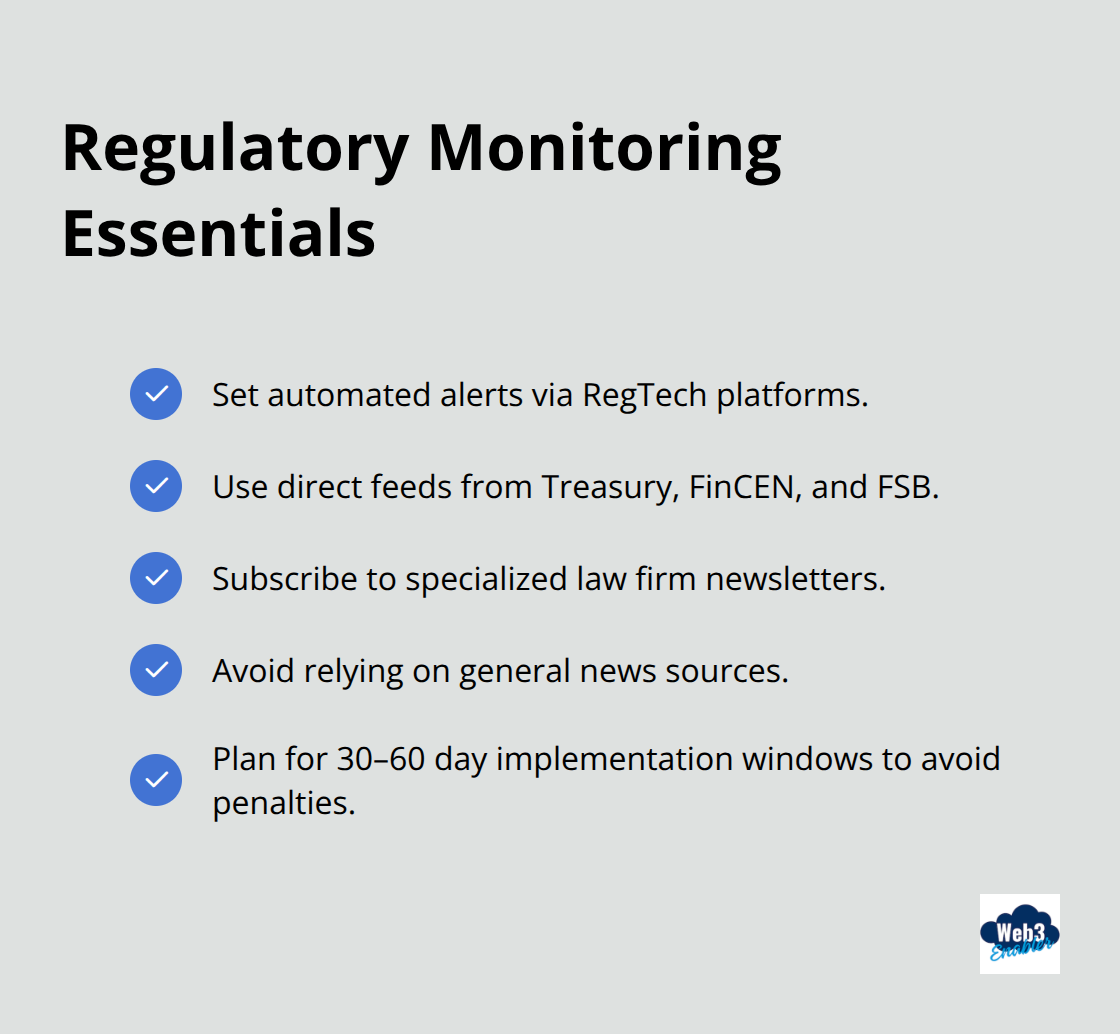
The regulatory landscape shifts so fast that manual monitoring will destroy your compliance efforts. With advanced anomaly detection and adaptive regulatory tracking, AI ensures stronger, faster, and more accurate compliance processes. Set up automated alerts through RegTech platforms like Compliance.ai or Thomson Reuters Regulatory Intelligence, which cost between $3,000 and $8,000 monthly but catch 95% of relevant updates within 24 hours.
Your compliance team needs direct feeds from the Treasury Department, FinCEN, and FSB announcements, plus subscriptions to specialized newsletters from law firms like Sullivan & Cromwell or Cleary Gottlieb that focus on digital assets. Most businesses miss critical deadlines because they rely on general news sources instead of regulatory-specific channels. The GENIUS Act implementation timeline shows new requirements drop with just 30-60 days notice, which makes reactive compliance a recipe for million-dollar penalties.
Build Systems That Adapt Without Breaking Your Operations
Your compliance infrastructure needs modular architecture that handles new requirements without complete overhauls. Companies that hard-code compliance rules into their payment systems face $100,000+ rebuilds every time regulations change. Use API-driven compliance platforms like Chainalysis KYT or Elliptic Navigator that update rules automatically and integrate with existing payment flows through webhooks.
Your transaction monitoring must separate data collection from rule enforcement, which allows you to add new reporting requirements without touching core payment logic. Successful stablecoin businesses maintain separate compliance databases that mirror transaction data but apply different retention and reporting rules based on jurisdiction.
Choose Service Providers That Handle Compliance Automatically
The key insight that most companies miss: compliance flexibility costs 40% more upfront but saves 300% on regulatory change management over two years. Work with service providers like Circle or Coinbase Commerce that handle multi-jurisdictional compliance automatically and absorb regulatory changes into their platform updates rather than pass compliance burdens to your team.
These providers maintain relationships with regulators across multiple jurisdictions and update their systems when new rules take effect. Your business benefits from their scale and expertise without maintaining separate compliance teams for each market you operate in. Simplifying crypto compliance becomes achievable when you leverage the right tools and partnerships, which saves both time and money while reducing regulatory risk.
Final Thoughts
Stablecoins regulation will continue to evolve rapidly, but businesses that prepare now gain significant competitive advantages. The companies that thrive in this environment treat compliance as a strategic asset rather than a cost center. They invest in flexible infrastructure, maintain direct regulatory feeds, and partner with providers who absorb compliance complexity automatically.
The regulatory fragmentation across jurisdictions creates operational challenges, but it also rewards businesses that master multi-jurisdictional compliance early. Your competitors who wait for regulatory clarity will face higher implementation costs and rushed compliance projects when new rules drop with 30-day notice periods (which happens more frequently than most businesses expect). Smart companies position themselves ahead of these changes rather than react to them.
Proactive compliance delivers measurable returns beyond risk mitigation. Companies with robust compliance infrastructure close enterprise deals faster, access better banking relationships, and attract institutional customers who demand regulatory certainty. Web3 Enabler helps businesses navigate these regulatory complexities with blockchain solutions that handle compliance automatically while enabling stablecoin payments and global transfers within existing corporate infrastructure.