


 Ripple has transformed from a startup into a major player in global payments, processing billions in cross-border transactions monthly. The company’s partnerships with over 300 financial institutions worldwide position it for massive growth.
We at Web3 Enabler see Ripple in 10 years as potentially dominating international money transfers. The question isn’t whether Ripple will succeed, but how dramatically it will reshape global finance.
How Strong Is Ripple’s Market Position Today?
Ripple’s partnership network spans 300+ financial institutions across 40+ countries and processes over $15 billion in cross-border transactions monthly (according to company reports). Major banks like Santander, Standard Chartered, and SBI Holdings actively use RippleNet for international payments, which reduces settlement times from days to seconds. The company’s on-demand liquidity product gained traction with MoneyGram and Bitso, which demonstrates real-world XRP utility beyond speculation.
Regulatory Wins Create Market Confidence
The SEC ended its case against Ripple Labs, leaving a $125 million penalty. The court ruled that XRP sales to retail investors don’t constitute securities transactions. This legal clarity triggered institutional interest, with Standard Chartered’s Geoffrey Kendrick predicting XRP could reach $12.50 by 2028 – a 325% increase from current levels. Multiple spot XRP ETF applications await SEC approval, which follows Bitcoin’s successful ETF launch that drove 165% price gains in 2024.
XRP Performance Shows Mixed Signals
XRP trades at $2.97 as of October 2025 and reflects 87% annual growth over three years despite declining monthly transaction volumes. The token’s utility remains limited, with most Ripple customers preferring stablecoins over XRP for actual payments. However, Ripple’s December 2024 launch of RLUSD stablecoin could generate XRP demand through transaction fees.
Strategic Acquisitions Signal Expansion
Ripple’s $1 billion GTreasury acquisition signals expansion into traditional finance infrastructure. This move positions the company to bridge cryptocurrency solutions with conventional corporate treasury management. The acquisition demonstrates Ripple’s commitment to building comprehensive financial tools that extend beyond simple payment rails.
These market foundations set the stage for Ripple’s technological evolution, where infrastructure improvements and innovation will determine the company’s competitive advantage in the next decade.
What Tech Advances Will Power Ripple’s Growth?
Ripple’s infrastructure improvements focus on settlement times that drop from the current 3-4 seconds to under one second through upgraded consensus mechanisms. The company’s XRP Ledger blockchain is used by banks for cross-border payments, compared to Bitcoin’s 7 transactions per second and Ethereum’s 15. Central bank partnerships accelerate this timeline, with the Bank of England and European Central Bank testing RippleNet for digital pound and euro settlements. These partnerships position Ripple as the backbone for government-issued digital currencies across 15+ countries that currently explore CBDCs.
Network Speed Creates the Competitive Edge
Transaction costs drop to $0.0002 per transfer on RippleNet, which makes micro-payments viable for businesses that send frequent small amounts globally. Traditional SWIFT transfers cost $25-50 per transaction with 3-5 day settlement periods. Ripple’s technical upgrades include sidechains that handle 100,000 transactions per second for enterprise clients like banks that process millions of daily transfers.
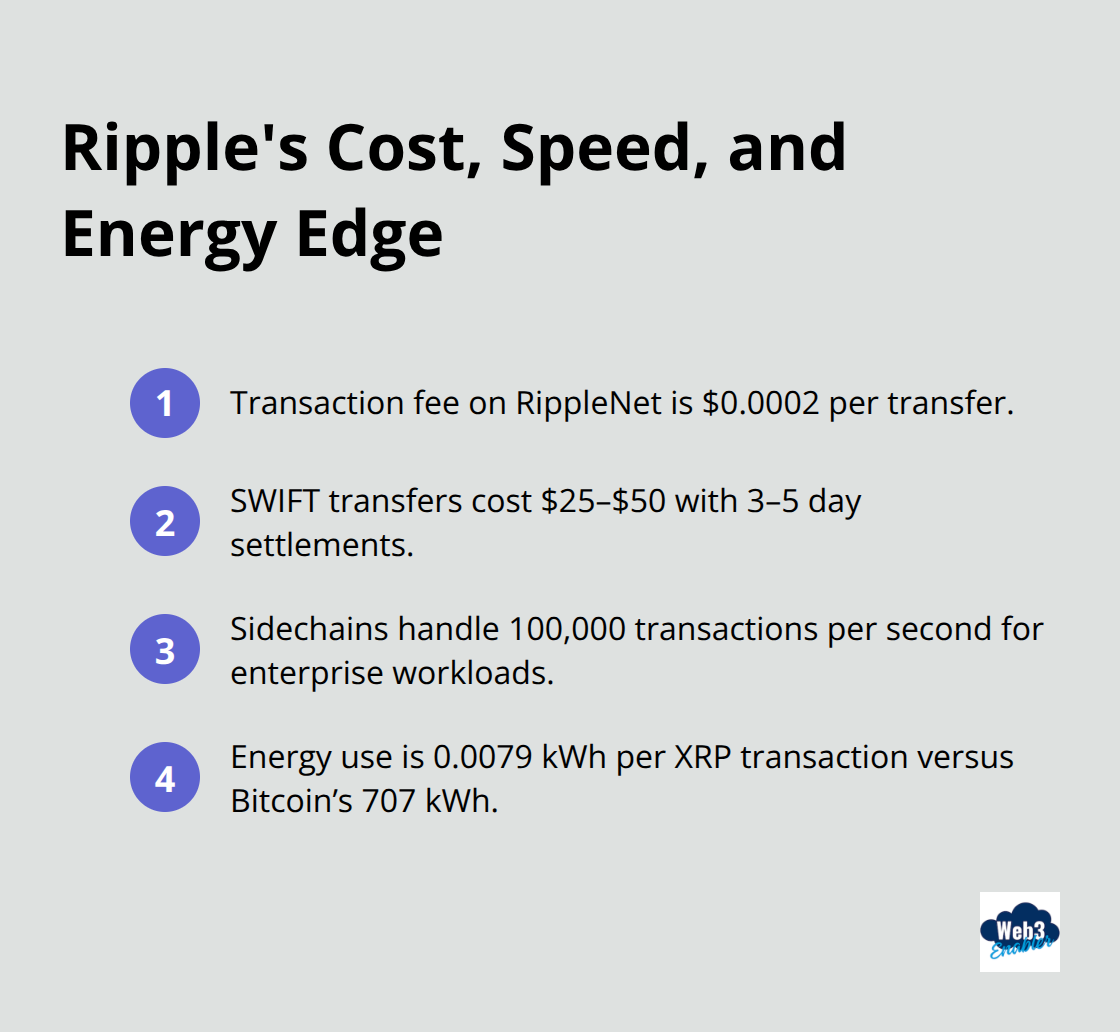
The XRP Ledger Carbon Neutral Initiative reduces energy consumption to 0.0079 kWh per transaction versus Bitcoin’s 707 kWh (attracting ESG-focused institutions).
Enterprise Integration Drives Real Usage
Smart contract functionality launches in 2026 and enables automated payments for supply chain finance and trade settlements. Companies save 40-60% on cross-border payment costs while they receive funds in minutes instead of days. Ripple’s federated sidechains allow banks to create private networks while they maintain interoperability with the public XRP Ledger.
Technical Capabilities Transform Business Operations
These technical capabilities transform how businesses handle international vendor payments and client collections. Companies that adopt blockchain payment solutions experience faster settlement times and reduced costs compared to traditional banking systems. The infrastructure improvements create opportunities for businesses to streamline compliance and their global payment processes.
Market expansion opportunities emerge from these technological foundations, as Ripple positions itself to capture new geographic regions and industry sectors that demand faster, cheaper international payment solutions.
Where Will Ripple Expand Next?
Ripple targets Asia and Africa as primary growth regions, with significant unbanked populations concentrated in these markets. The company signed partnerships with SBI Holdings in Japan, which processes $50 billion annually, and established corridors through the Philippines Central Bank for remittances that serve 10 million overseas Filipino workers.
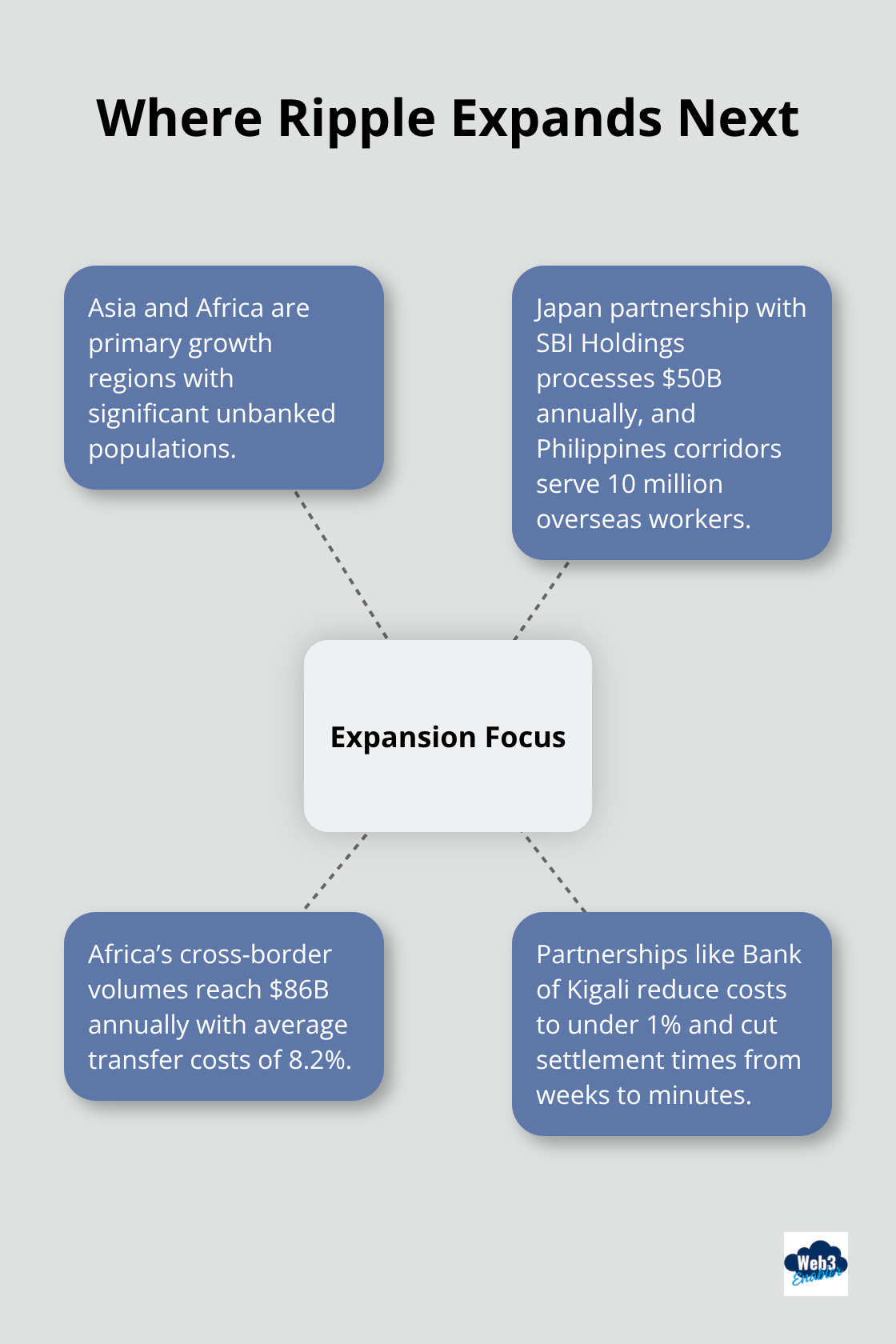
Africa presents massive opportunities, with cross-border payment volumes that reach $86 billion annually and traditional transfer costs that average 8.2% per transaction. Ripple’s partnerships with African banks like Bank of Kigali reduce these costs to under 1% while settlement times drop from weeks to minutes.
Traditional Banks Accelerate Adoption
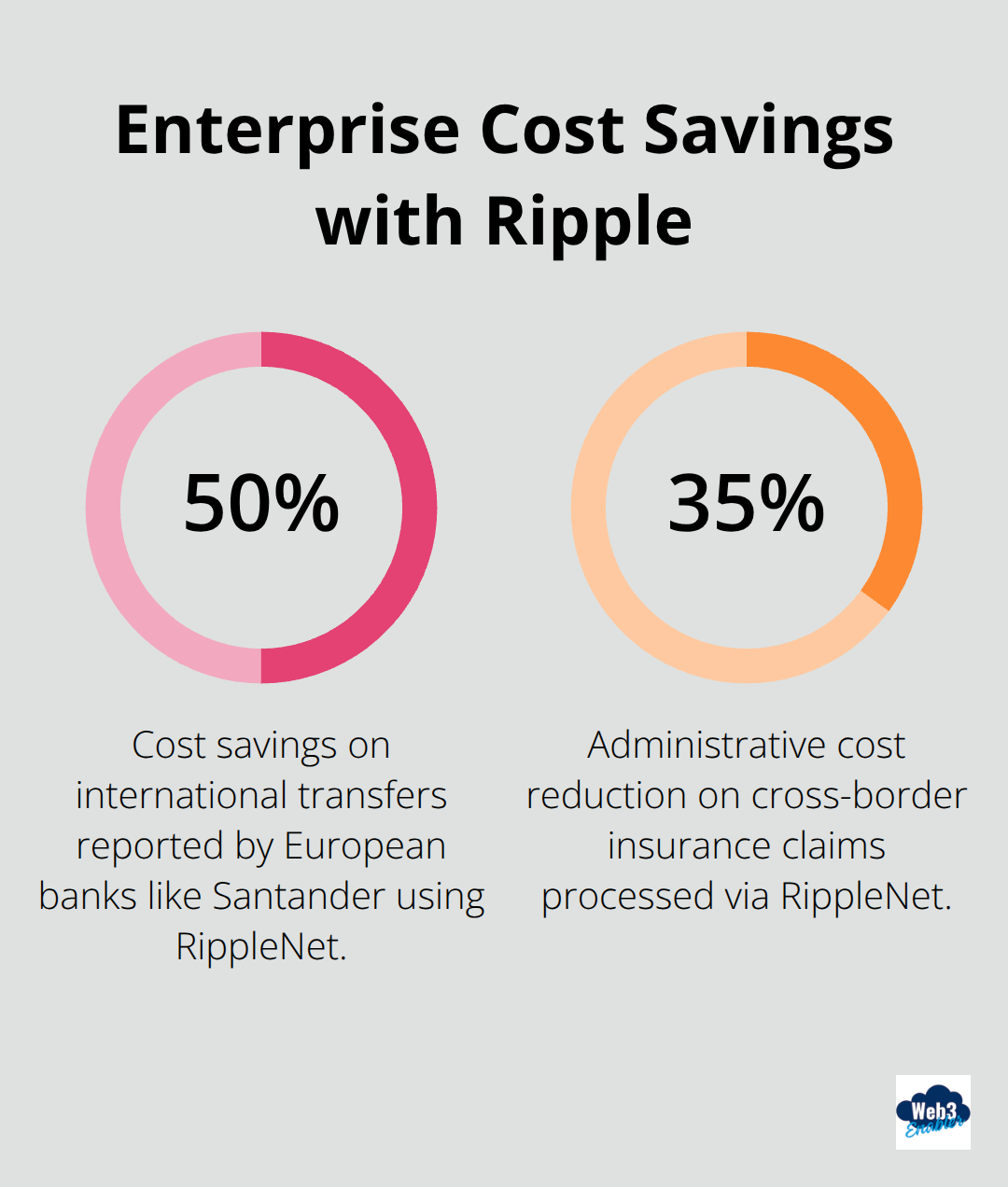
Major financial institutions integrate RippleNet into core systems, with JPMorgan Chase that tests interoperability between its JPM Coin and XRP for institutional clients. European banks like Santander report 50% cost savings on international transfers through RippleNet compared to SWIFT networks. The Federal Reserve explores partnerships with Ripple for real-time gross settlement systems, which could process the $4 trillion daily volume that currently moves through Fedwire. Corporate treasury departments adopt Ripple’s solutions for supply chain finance, where companies like Walmart reduce payment times from 30 days to 3 days for international suppliers.
Enterprise Applications Transform Business Operations
Ripple expands beyond payments into trade finance, insurance settlements, and real estate transactions. The platform processes $2.3 billion in trade finance deals monthly through partnerships with HSBC and Standard Chartered, where letters of credit that traditionally take 7-10 days now settle in 4 hours. Insurance companies use RippleNet for cross-border claims that reduce settlement periods from 45 days to 2 days while they cut administrative costs by 35%.
Real estate transactions benefit from instant international property purchases, where buyers transfer funds across borders in minutes rather than weeks through traditional channels.
Emerging Market Infrastructure Development
Central banks in developing nations partner with Ripple to modernize payment infrastructure. Nigeria’s Central Bank Digital Currency project uses RippleNet technology to facilitate instant domestic and international transfers for 200 million citizens. India’s Unified Payments Interface explores integration with RippleNet to connect domestic instant payments with global corridors. These partnerships position Ripple as the bridge between traditional financial systems and modern digital payment networks across emerging economies.
Final Thoughts
Ripple in 10 years will control 25-30% of the global cross-border payment market and process over $2 trillion annually through partnerships with central banks and major financial institutions. The company’s expansion into Asia and Africa, combined with CBDC partnerships across 15+ countries, positions it as the dominant infrastructure provider for international money transfers. Regulatory clarity attracts institutional adoption while technological superiority delivers sub-second settlements at $0.0002 per transaction.
XRP’s utility grows through enterprise applications in trade finance and supply chain payments, where companies reduce settlement times from weeks to hours. Strategic partnerships with traditional banks that process $4 trillion daily create the foundation for massive scale. Market risks include competition from stablecoins, regulatory changes in key markets, and potential technical challenges as transaction volumes scale (though economic downturns could slow institutional adoption).
Businesses must prepare for this transformation and explore blockchain payment solutions that integrate with existing systems. We at Web3 Enabler help companies leverage these technologies through our Salesforce-native platform, which enables faster vendor payments and client collections. Companies that adopt these solutions position themselves for the digital payment future that Ripple will help create.