



Stablecoins are reshaping how merchants handle payments in Salesforce Commerce Cloud. At Web3 Enabler, we’ve seen firsthand how crypto payments eliminate friction from checkout experiences while cutting cross-border costs dramatically.
This guide walks you through the complete setup-from payment rail configuration to refund handling and compliance across regions. You’ll learn exactly how to integrate stablecoins into your Commerce Cloud instance and scale globally.
Setting Up Stablecoin Checkout in Salesforce Commerce Cloud
Connecting Your Payment Processor and Choosing Stablecoins
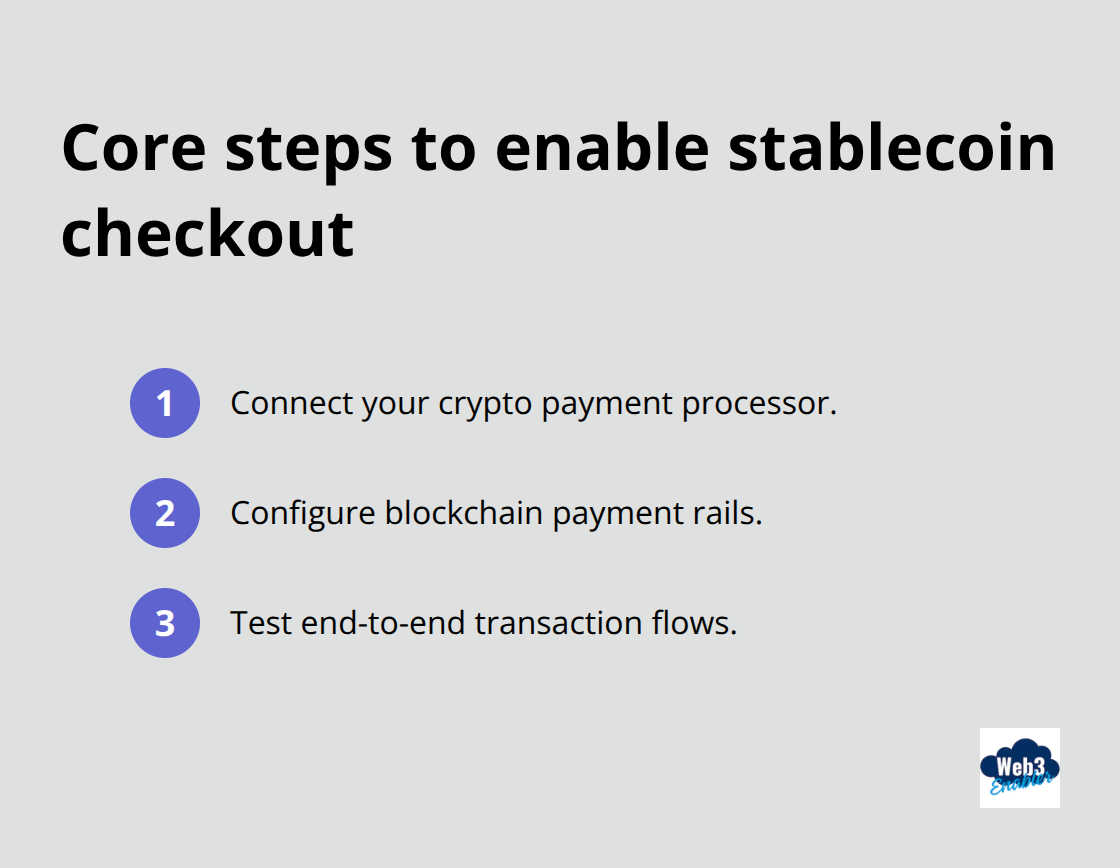
Integrating stablecoins into your Commerce Cloud checkout requires three foundational steps: you connect your payment processor, configure your payment rails, and test transaction flows before going live. Start by selecting which stablecoins you’ll accept-USDC and USDT dominate global commerce because they’re 1:1 backed by fiat reserves under regulatory frameworks like the Genius Act 2025, which explicitly requires reserve requirements and bankruptcy priority for stablecoin holders. Your payment processor must route transactions through the appropriate blockchain rails; for most merchants, this means Ethereum mainnet for high-value transactions or Polygon Layer 2 for smaller orders where fees matter more than settlement speed. Polygon reduces transaction costs compared to traditional cross-border payment fees that average around 5% according to industry analysis of global B2B SaaS payments.
Configuring Payment Methods and Setting Transaction Limits
Once you’ve chosen your stablecoins and rails, configure your Commerce Cloud payment method by mapping stablecoin wallets to your customer accounts and setting transaction limits based on your risk tolerance. Test with small amounts first-$10 to $50 test transactions reveal configuration problems before they affect real customers. Your checkout UX stays visually unchanged; the blockchain infrastructure runs behind the scenes through middleware that connects Commerce Cloud data to on-chain settlement without requiring customers to manage wallets directly.
Monitoring On-Chain Confirmations and Order Status
Real-time transaction processing in Commerce Cloud demands that you monitor both on-chain confirmations and your order management system simultaneously. When a customer initiates payment, the transaction enters a pending state until blockchain validators confirm it-this typically takes 15 seconds on Polygon or 12 minutes on Ethereum mainnet. Configure your Commerce Cloud order status workflow to automatically advance from pending to confirmed once the blockchain returns a transaction hash with sufficient confirmations (usually one block for Polygon and three blocks for Ethereum).
Automating Reconciliation and Handling Payment Failures
Your reconciliation system must match on-chain payment records with Commerce Cloud orders; The Graph provides indexed blockchain data that eliminates manual lookups and reduces reconciliation time from hours to minutes. Set up automated alerts if a transaction remains pending after 30 minutes, which signals either a network congestion issue or a failed transaction that requires customer intervention. Most payment failures stem from insufficient gas fees or wallet balance errors rather than system problems, so your customer support team should know how to diagnose these quickly.
Optimizing Costs Through Multi-Rail Routing
For merchants processing high transaction volumes, implement a multi-rail orchestration system that automatically routes USDC payments through whichever blockchain offers the lowest fees at that moment-Polygon for orders under $500, Ethereum for larger transactions where security matters more than cost. This approach cuts payment processing costs while maintaining customer experience because routing decisions happen invisibly at checkout. Once your stablecoin checkout operates smoothly, you’ll face the reality that refunds and chargebacks demand their own strategy-especially when blockchain transactions are immutable and customer disputes arise across multiple regions.
Managing Refunds and Chargebacks on Blockchain
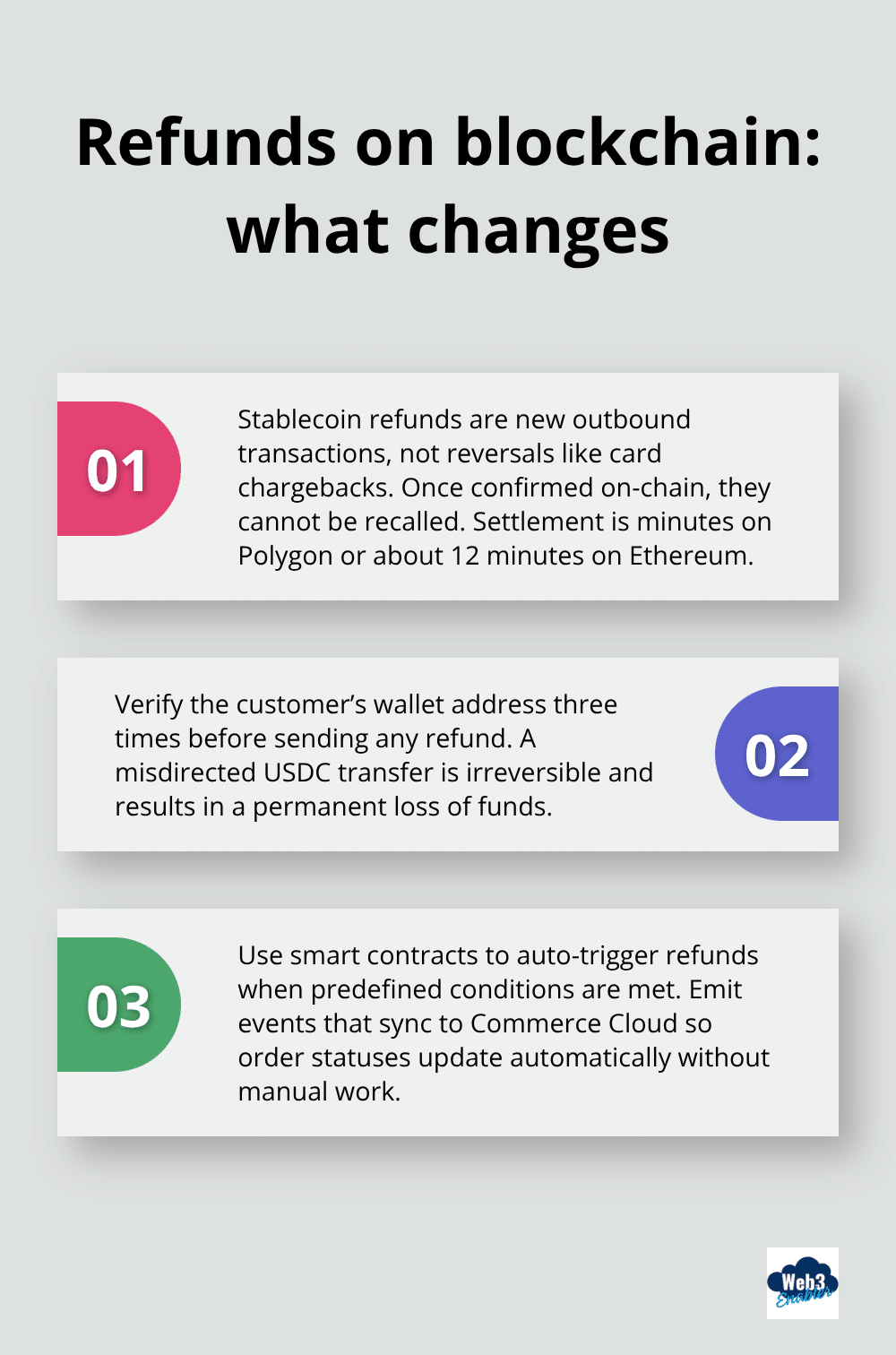
Stablecoin refunds operate differently than traditional card reversals because blockchain transactions cannot be forged or altered after the fact-once confirmed, they cannot be recalled or disputed through payment networks. Your refund strategy must shift from relying on chargeback protection to building refund logic directly into your Commerce Cloud workflow and smart contracts. When a customer requests a refund in your storefront, you initiate a new outbound transaction from your merchant wallet back to their wallet address, which settles in minutes on Polygon or 12 minutes on Ethereum mainnet. The transaction becomes irreversible once confirmed, so your refund policies must be crystal clear at checkout: customers need to understand that stablecoin refunds process to their wallet address and cannot be reversed if sent incorrectly.
Configuring Refund Workflows in Commerce Cloud
Configure your Commerce Cloud order management system to track refund requests separately from chargebacks, since blockchain doesn’t recognize chargebacks as a concept-instead, you handle disputes through your own customer service process and then execute the refund manually. Your support team must verify the customer’s wallet address three times before processing any refund, because sending USDC to the wrong address results in permanent loss of funds with no recovery mechanism. This verification step prevents costly errors that traditional payment processors would reverse automatically.
Automating Refunds Through Smart Contracts
Smart contracts automate refunds based on predefined conditions, eliminating manual intervention for common scenarios. If an order fails to ship within 30 days, your smart contract automatically triggers a refund to the customer’s wallet without requiring manual approval-this reduces refund processing time from days to minutes and eliminates arguments about whether a refund qualifies. Your smart contract emits events that sync back to Commerce Cloud through middleware, so your order status updates automatically when the blockchain confirms the refund transaction. Customers see their refund reflected in their Commerce Cloud account history and their wallet balance simultaneously, creating transparency that reduces support inquiries.
For subscription services, implement logic that pauses access immediately if a refund is issued, preventing customers from using your service while receiving their money back. This protects your margins and eliminates disputes about service usage post-refund. Test your smart contract refund logic extensively on Polygon testnet before deploying to mainnet, because a bug that sends refunds to the wrong address cannot be recovered.
Building Proof-of-Delivery Records on Blockchain
Chargebacks don’t exist on blockchain, but customers still dispute transactions by claiming they never authorized the purchase or received the product. Your defense against these disputes is verifiable on-chain proof that the customer initiated the transaction and received the goods. Record the customer’s wallet address, transaction hash, timestamp, and order details on-chain using IPFS for immutable storage-this creates an auditable trail that proves the customer authorized the payment because only their private key could have signed the transaction.
When a customer disputes an order, retrieve these records and present them to your payment processor or the customer directly, demonstrating that the blockchain proves they initiated the transaction. This evidence is stronger than traditional chargeback documentation because blockchain transactions cannot be forged or altered after the fact. For physical goods, require customers to sign a delivery confirmation on-chain or through your Commerce Cloud portal that links to their wallet address, creating a second proof point that they received the product.
Leveraging Usage Data to Prevent False Disputes
For digital goods like SaaS access, log usage data on-chain through The Graph indexing service, proving that the customer actually used the service they claim they never received. This on-chain fingerprinting approach transforms how you defend against disputes; instead of relying on your word against the customer’s, you present cryptographic proof that the transaction occurred and the service was consumed. As your stablecoin payment volume grows and disputes become more frequent, you’ll need a systematic approach to handling these cases across multiple regions-each with different regulatory expectations and customer protection laws.
Scaling Globally While Cutting Payment Costs
Why Stablecoins Transform Cross-Border Commerce
Stablecoin payments convert cross-border commerce from an expensive, slow process into a competitive advantage. Traditional wire transfers cost merchants approximately 5% in fees and take 1–5 business days because money travels through correspondent banks, multiple currency conversions, and high-value settlement systems. USDC on Polygon settles in 15 seconds with fees under 0.1%, fundamentally changing how you expand internationally. When you accept stablecoins from customers in Southeast Asia, Europe, or Latin America, funds arrive in your merchant wallet instantly without intermediary banks extracting fees at each step. This speed matters operationally: faster settlement means you access capital sooner, reduce working capital tied up in payment processing, and can reinvest revenue into inventory or growth immediately. For SaaS companies billing globally, crypto transactions can make B2B payments faster, cheaper, and simpler-one documented case showed this margin improvement alone justifies stablecoin adoption through eliminated processing fees and instant settlement.
Building a Multi-Rail Payment Strategy
Your expansion strategy should treat stablecoins as a multi-rail payment method, not a replacement for traditional payments. Most customers still pay with cards, bank transfers, or local wallets like Alipay or WeChat Pay, so you need infrastructure that routes each transaction through the optimal rail for that customer’s geography and payment preference. Virtual account providers offering local bank account numbers in 40+ markets let you collect payments locally through ACH, SEPA, or other domestic rails while settling globally through stablecoins when it makes financial sense. This hybrid approach means a customer in Hong Kong sends you HKD through local rails, your system converts to USDC on Polygon for settlement, then you can pay suppliers in Europe via SEPA Instant in EUR-all orchestrated invisibly behind your checkout.
Navigating Regional Compliance Requirements
Regulatory compliance varies dramatically by region, which is where most merchants stumble. The European Union treats stablecoins under MiCA regulations, requiring you to work with licensed stablecoin issuers and maintain customer identification records. The United States passed the Genius Act 2025, which established explicit reserve requirements and bankruptcy priority for stablecoin holders, creating a clearer regulatory framework than existed before. Asia-Pacific regions remain fragmented: Singapore recognizes stablecoins under payment service regulations, while other markets maintain stricter restrictions.
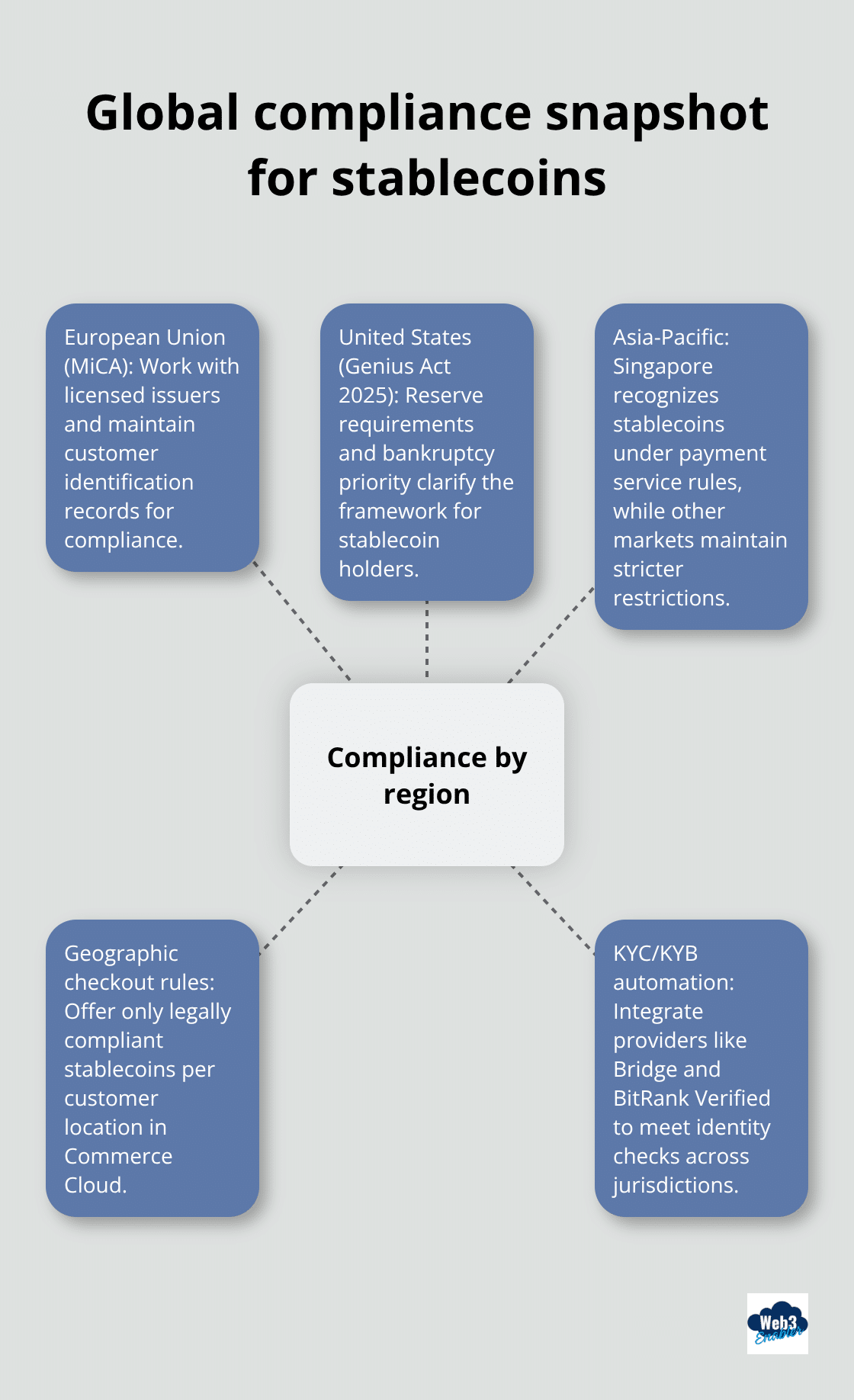
You cannot simply accept USDC everywhere and hope compliance follows-instead, you must map your customer base by geography, determine which stablecoins are legally accepted in each region, and configure your Commerce Cloud checkout to offer only compliant payment methods per location.
Automating Compliance Across Jurisdictions
KYC/KYB verification through partners like Bridge and BitRank Verified integrates directly into Commerce Cloud, automating customer identity checks that satisfy regulatory requirements across multiple jurisdictions without slowing your checkout. This native integration means your team doesn’t juggle separate compliance tools or manual verification workflows-everything happens within Salesforce. When you expand to a new geography, compliance infrastructure should be configured before your first transaction, not retrofitted after a regulator questions your practices.
Final Thoughts
Stablecoins in Salesforce Commerce Cloud transform your payment infrastructure from a cost center into a competitive advantage that drives immediate results. Cross-border fees drop from 5% to under 0.1%, settlement accelerates from days to minutes, and your working capital improves because funds arrive faster. Your customers experience frictionless checkout without currency conversion delays or hidden intermediary fees, which reduces cart abandonment and increases repeat purchases.
The implementation path moves quickly when you start with stablecoin selection and blockchain rail configuration, then test thoroughly on testnet before processing real transactions. Build your refund and dispute handling workflows around blockchain immutability rather than fighting it, and expand regionally by mapping compliance requirements per geography. Most merchants complete this entire process within weeks because Salesforce-native integration eliminates the complexity of bolting external payment processors onto your existing stack.
Long-term growth comes from treating stablecoins as part of a multi-rail strategy that intelligently routes each transaction through whichever payment method optimizes for that customer’s location and your cost structure. Web3 Enabler provides the native Salesforce platform that makes this integration seamless, letting you accept stablecoins directly in Commerce Cloud checkout and automate refunds through smart contracts. You stay within Salesforce throughout the entire process-no external tools, no wallet management friction, no compliance gaps.