



Your online store is leaving money on the table if you’re not accepting stablecoins. B2B Customers worldwide want faster, cheaper payment options, and Commerce Cloud payments powered by stablecoins deliver exactly that. With the Commerce Cloud Add-On, your B2B or D2C Commerce Cloud store can automatically accept stablecoin payments with virtually zero extra work on your behalf. You can operate on chain for free, or automatically off-ramp and your merchant fees are cut to a miniscule off-ramping fee.
At Web3 Enabler, we’ve built the infrastructure to make this simple. In this post, we’ll show you how to set up stablecoin payments, cut your processing costs, and reach global customers who prefer digital currencies.
Why Stablecoins Cut Your Payment Costs and Speed Up Global Sales
The Economics of Blockchain Payments
Stablecoin payments reshape e-commerce economics in ways traditional processors simply cannot match. According to Stripe data, blockchain-based payments cost roughly 90% less and settle 95% faster than traditional cross-border methods. A standard SWIFT transfer charges around $25 per side plus 1% in fees and currency spreads, while a stablecoin transaction on networks like Ethereum or Solana settles in minutes for a fraction of that cost. For online stores processing high volumes across borders, this difference compounds quickly. Businesses handling over $1 million in monthly cross-border payments are 92% more likely to adopt stablecoins than smaller competitors, and that adoption rate reflects hard financial reality.

Scale and Momentum in Stablecoin Adoption
In 2025, stablecoins processed roughly $9 trillion in global payment volume, with B2B flows hitting around $3 billion monthly-a 30x increase over two years. Your competitors are already capturing this efficiency gain. When you accept stablecoins through Web3 Enabler integrated into Commerce Cloud, settlement happens directly to your wallet with full transparency into your Salesforce records, eliminating reconciliation delays and hidden fees that drain margins on every transaction.
Eliminating Chargebacks and Fraud
Chargebacks and fraud represent another massive cost center that stablecoins eliminate entirely. Blockchain transactions are irreversible and transparent, removing the $15 to $100 chargeback fee per dispute that processors charge and the operational overhead of managing claims. Customers paying with stablecoins like USDC or USDT complete purchases at higher rates-Stripe found that stablecoin payments make buyers twice as likely to be new customers compared to other payment methods, suggesting a demographic that values digital efficiency and cost savings.
Reaching Global Markets Without Geographic Friction
This matters especially for global markets where traditional payment infrastructure is fragmented or expensive. Accepting stablecoins opens your store to 7+ million customers worldwide already holding digital assets, expanding your addressable market without geographic friction. The regulatory landscape also solidifies in your favor. The U.S. GENIUS Act and Europe’s MiCA framework establish clear reserve and compliance requirements, making stablecoin issuers like Circle increasingly trusted by institutional buyers and enterprises. That trust translates directly to customer confidence at checkout, and it’s what makes setting up stablecoin payments in Commerce Cloud the logical next step for your business.
How to Launch Stablecoin Checkout in Commerce Cloud
Getting stablecoin payments live in Commerce Cloud requires a structured approach that avoids common pitfalls. Web3 Enabler integrates natively into your Salesforce environment, meaning your payment setup lives alongside your order data, customer records, and inventory in one place. You install Web3 Enabler through the AppExchange in minutes without custom code. Once installed, stablecoin payment options appear in your payment method configuration panel.
Configure Your Stablecoin and Network Settings
You’ll configure which stablecoins you want to accept-USDC and USDT are the standard choices because they’re widely held, have transparent reserves, and settle on multiple networks including Ethereum and Solana. Decide whether you want to accept multiple stablecoins or stick with one; accepting both USDC and USDT broadens your customer base since 40.9% of merchants accepting crypto prefer settlement flexibility. You should set your default settlement currency-most stores choose USDC since it has institutional backing from Visa and strong regulatory alignment. Your configuration also specifies which blockchain networks you’ll accept on; Ethereum and Solana are mature choices with proven transaction throughput, while BASE offers lower fees for smaller transactions. You link your settlement wallet address directly in the configuration so funds route automatically after payment confirmation, eliminating manual transfer steps that create reconciliation friction.
Run Comprehensive Payment Tests
You’ll run your test payments on each network and stablecoin combination you plan to support, not just once but across different transaction sizes. A $100 test tells you nothing about how your system handles a $10,000 order. You test with real wallets, not just testnet, because testnet transactions don’t reveal actual network congestion or real-world confirmation times. You monitor your first 50 test transactions for settlement speed-stablecoin transactions typically confirm within 30 seconds on Solana and 2–5 minutes on Ethereum, though network conditions vary. You verify that your Salesforce order records update immediately when payment confirms, because customers expect instant confirmation and your fulfillment team needs accurate data.
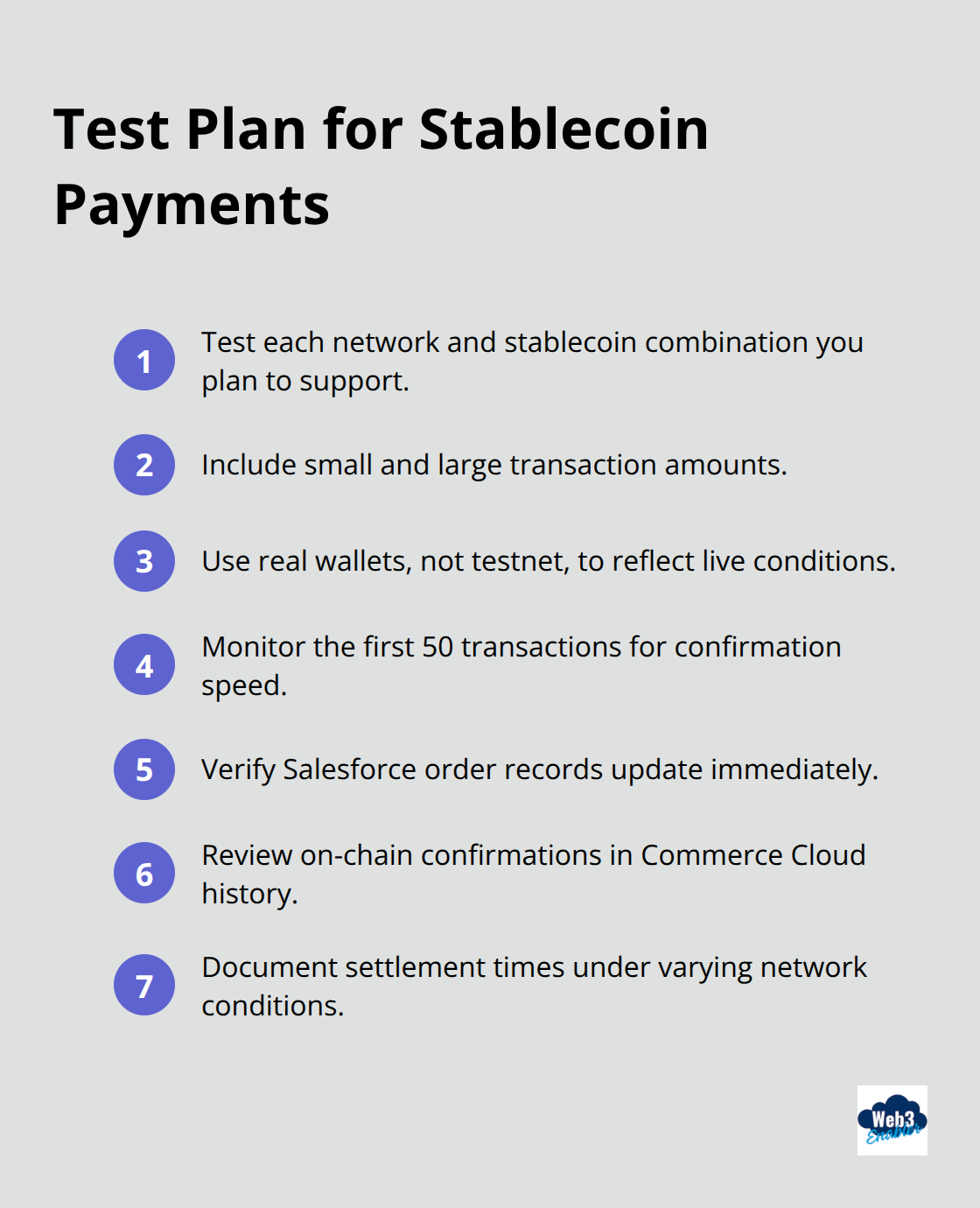
Web3 Enabler logs all blockchain confirmations directly in your Commerce Cloud transaction history, so you have an immutable audit trail for compliance.
Launch with Limited Scope First
Once testing shows consistent settlement and accurate order syncing, you move to a limited live launch with one stablecoin on one network, accepting payments from a small customer segment for 48 hours. This reveals real-world issues without exposing your entire customer base to potential friction. You expand to additional stablecoins or networks only after 100+ successful live transactions across different order values. Your chargeback rate drops to zero immediately-blockchain transactions cannot be reversed-so your payment operations team will notice the difference in day-to-day workload within the first week. This foundation positions you to scale stablecoin acceptance across your store while maintaining operational control and customer confidence.
What Your Store Gains When You Accept Stablecoins
Expanding Your Customer Base Globally
Accepting stablecoins transforms your addressable market immediately. Stripe data shows that stablecoin payments make buyers twice as likely to be new customers compared to traditional payment methods, and those new customers tend to operate globally. You tap into a demographic that already holds digital assets and actively seeks merchants accepting them. In 2024, stablecoins processed $23 trillion in global payment volume, meaning your potential customers already have the infrastructure in place. When you add stablecoin checkout to Commerce Cloud, you meet customers where they already operate rather than asking them to adopt new technology. This proves especially powerful for cross-border sales where traditional payment rails fail. A customer in Southeast Asia holding USDC completes checkout in seconds without the $25-per-transaction fees and 3–5 day settlement windows that traditional processors impose.
Accelerating Your Cash Flow
Stablecoin transactions settle within minutes, not days. Your settlement funds arrive in your wallet immediately after blockchain confirmation, giving you access to revenue faster than any traditional payment processor offers. This matters enormously for stores with tight operating margins or seasonal cash flow challenges. Instead of waiting 2–3 business days for a wire transfer, you control your funds instantly. Web3 Enabler integrates settlement directly into your Salesforce records, so your accounting team sees the payment confirmed in your system at the exact moment it hits your wallet on-chain. No reconciliation delays, no hidden holds, no surprise chargebacks eating into margins weeks later.
Building Customer Confidence Through Transparency
Customer trust strengthens because blockchain transactions are transparent and irreversible. Customers see their payment confirmed on-chain in real time, eliminating the anxiety of traditional checkout where confirmation takes hours or days.
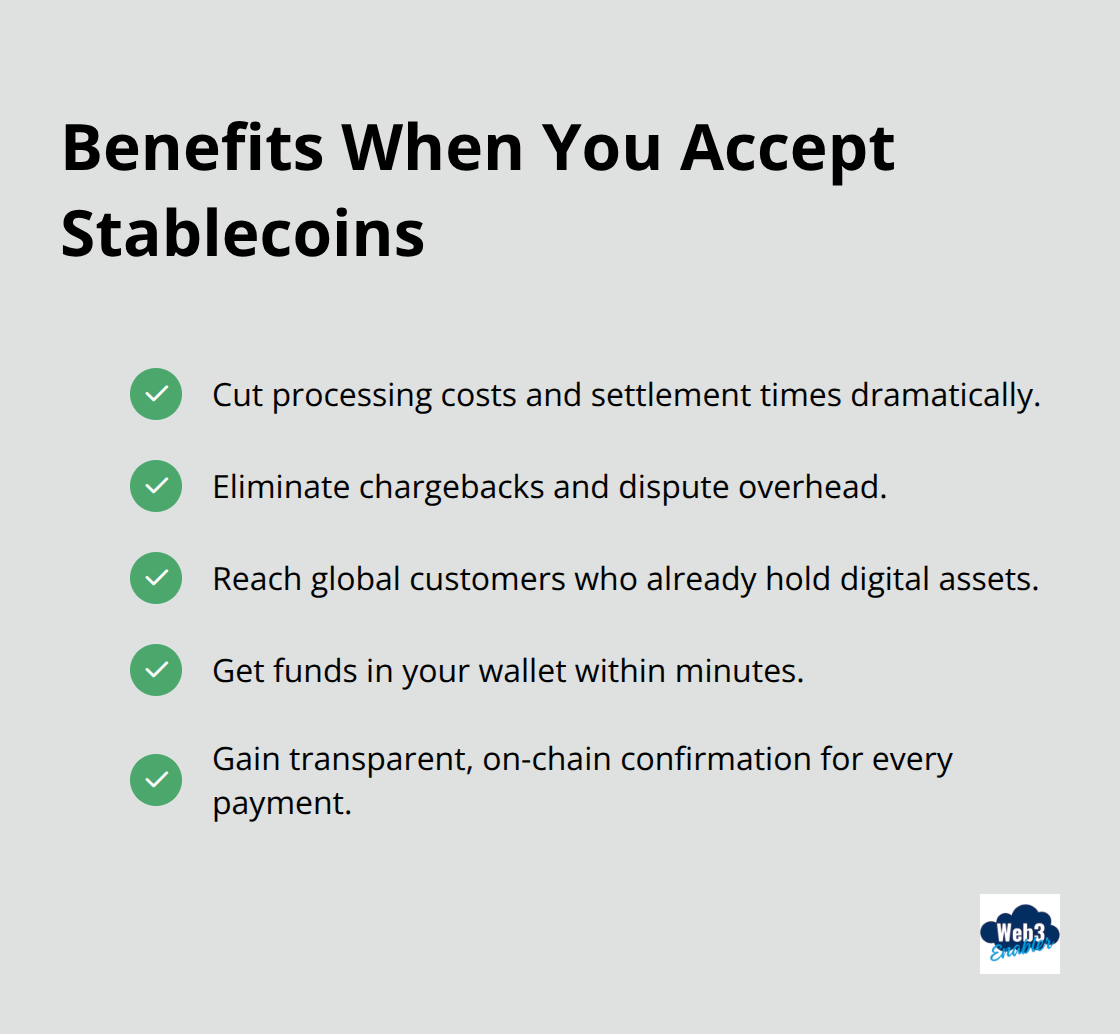
That transparency also eliminates chargeback fraud entirely-blockchain transactions cannot reverse, so your payment operations team stops managing dispute claims. For stores processing high volumes internationally, this single factor saves hundreds of thousands annually in chargeback fees and administrative overhead.
Final Thoughts
Accepting stablecoins in Commerce Cloud payments transforms your online store from a regional operation into a global one. You cut payment processing costs by 90%, eliminate chargebacks entirely, and settle funds in minutes instead of days. Your customers gain access to a checkout experience that’s faster, cheaper, and more transparent than traditional payment methods.
Stablecoin adoption in retail accelerates every quarter-Shopify, Travala, and luxury brands including Gucci and Balenciaga already accept digital currencies. Regulatory frameworks like the GENIUS Act and MiCA provide the clarity enterprises need to move forward confidently. The stores that move first capture market share from competitors still waiting for traditional processors to catch up.
Web3 Enabler makes this transition seamless as the only native blockchain platform on the Salesforce AppExchange. Install Web3 Enabler from the AppExchange, configure USDC or USDT as your primary stablecoin, and run test transactions across Ethereum and Solana to verify settlement speed and order synchronization. Visit Web3 Enabler to see how your store can start accepting stablecoins today and position yourself ahead of the shift toward digital currency in retail.
Commerce Cloud Stablecoin Payments FAQ
These FAQs answer common questions about enabling Commerce Cloud payments with stablecoins, including setup, settlement, fees, refunds, and how Web3 Enabler fits into Salesforce.
What are Commerce Cloud stablecoin payments?
Commerce Cloud stablecoin payments let your B2B or D2C storefront accept payments in stablecoins (like USDC or USDT) at checkout, with on-chain confirmation recorded alongside your Salesforce order and customer data.
Why would an online store accept stablecoins?
Stablecoins can reduce cross-border payment friction by settling faster than many traditional methods, lowering fee drag for international orders, and providing clearer settlement visibility for finance teams.
Which stablecoins should I accept in Commerce Cloud?
Most merchants start with USDC and or USDT because they are widely used for payments. The best choice depends on where your customers are, which networks you support, and how you want to manage treasury operations.
Which blockchain networks can stablecoin checkout use?
Stablecoin checkout can run on multiple networks depending on your configuration (commonly Ethereum and other high-usage networks). Network choice typically balances fee levels, confirmation speed, and customer preferences.
How does settlement work, do I receive funds in crypto or fiat?
You can keep settlement on-chain to a wallet you control, or use an automatic off-ramp workflow so proceeds convert and land in your bank flow. Many merchants start with off-ramping for simpler accounting and treasury handling.
How do stablecoin payments reduce chargebacks?
Blockchain transactions are generally irreversible once confirmed, so the traditional card chargeback loop is reduced. Your policy should still cover customer service issues (returns, delivery problems), but disputes are handled operationally rather than via card-network reversals.
How are refunds handled for stablecoin purchases?
Refunds are typically issued as a new payment back to the customer’s wallet (often in the same stablecoin). Your refund process should include verification steps to confirm the correct destination address and tie the refund to the original order record.
What does the customer experience look like at checkout?
Customers see a stablecoin payment option, complete the transfer from their wallet, and receive confirmation once the transaction confirms on-chain. The order can update automatically in Salesforce when confirmation is received.
Do I need a crypto wallet to accept stablecoins in Commerce Cloud?
Yes, you’ll need a destination wallet for settlement if you keep funds on-chain. If you prefer a bank-first flow, you can configure automatic off-ramping so you still accept stablecoins while operationally receiving fiat proceeds.
How do stablecoin payments show up in Salesforce for reconciliation?
Stablecoin payment confirmations can be logged as transaction records tied to Commerce Cloud orders, enabling faster matching between payment status and fulfillment stages. This reduces manual “did we get paid” checking across tools.
Is accepting stablecoins compliant for B2B commerce?
Compliance depends on your policies, customer base, and jurisdictions. Common requirements include customer identity controls where applicable, sanctions screening and monitoring practices, and audit-ready records that connect payments to orders and counterparties.
How long does it take to launch stablecoin checkout in Commerce Cloud?
A practical approach is to start with one stablecoin on one network, run real-world transaction tests across small and larger order sizes, then expand coverage after consistent successful confirmations and clean order sync.