



Your stablecoin payment data is sitting there, full of insights you’re probably missing. At Web3 Enabler, we’ve seen businesses leave money on the table simply because they weren’t reading their own transaction signals.
The good news? Stablecoin payments analytics transforms raw blockchain data into decisions that actually move the needle on your bottom line.
Why Your Stablecoin Payment Data Actually Matters
The Transparency Advantage You’re Probably Ignoring
The moment a stablecoin transaction hits the blockchain, you’ve got a permanent record. No bank delays, no waiting until tomorrow to see what happened. That transparency is powerful, but only if you’re actually looking at it. Most businesses treat their stablecoin payment data like a black box-transactions go in, money comes out, and nobody asks what the data is screaming about. That’s a missed opportunity.
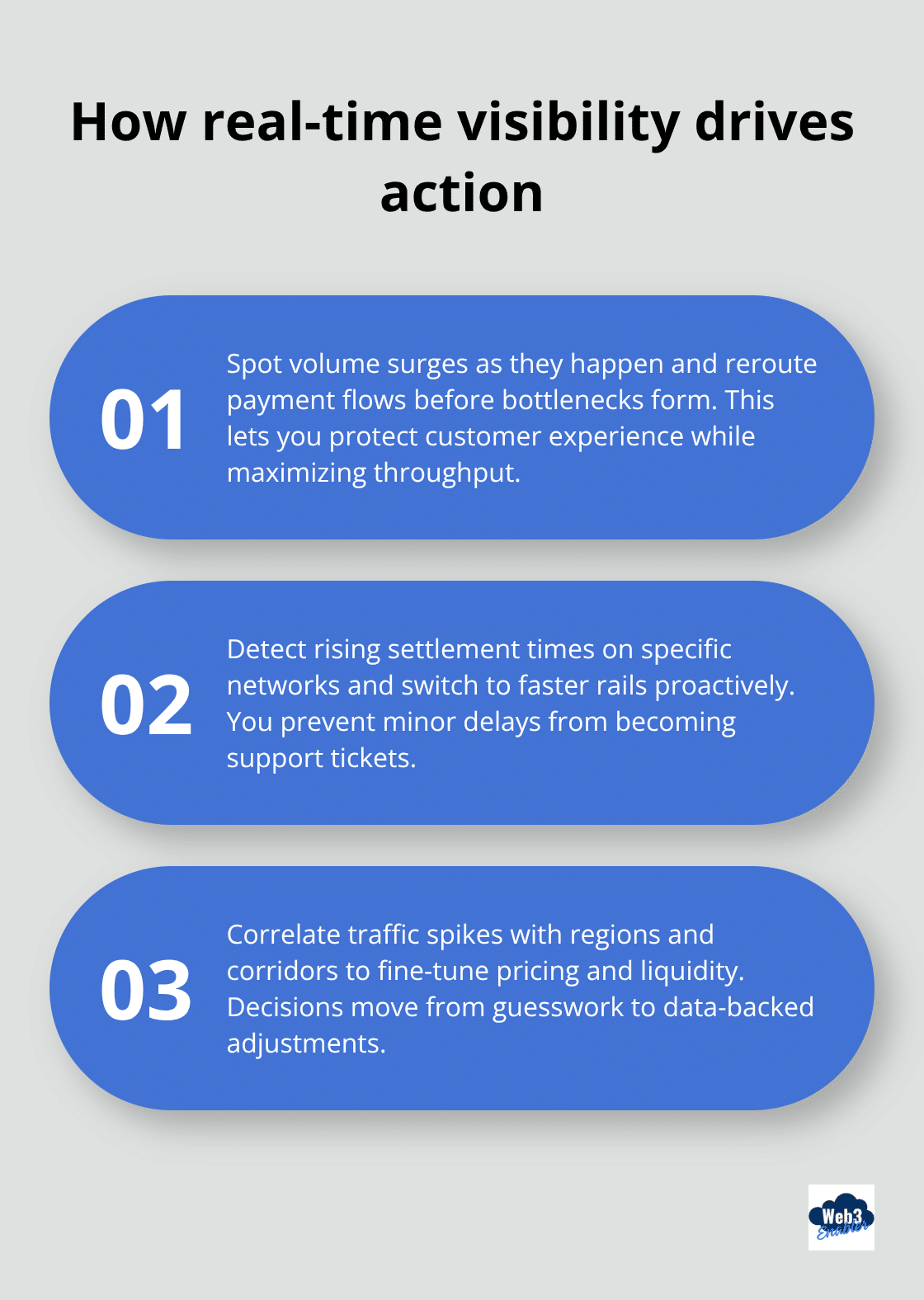
Real-time visibility into your global payment flows lets you spot patterns instantly. If a corridor suddenly spikes in volume, you see it today, not next quarter. If settlement times are creeping up on a particular network, you catch it before it becomes a customer problem.
Stablecoin transaction volumes reached about $33 trillion in 2025, up from $19.7 trillion a year earlier. That growth isn’t slowing down.
Where the Real Money Hides
The businesses winning here aren’t just accepting stablecoins-they’re mining their transaction data for competitive advantage. You can track exactly which customers prefer stablecoin payments, which regions generate the fastest settlements, and where your processing costs actually sit lowest.
The cost argument alone justifies paying attention. Traditional cross-border payments average around 6.5% in fees per transaction, while stablecoin transfers typically cost just pennies in network fees. But that savings only matters if you measure it. Build dashboards that show settlement speed, average transaction cost per network, and cross-border cost savings compared to your old payment rails. Stripe’s research found that stablecoins can cost roughly half as much as other payment methods. Track these metrics rigorously: adoption rate, settlement time, fees per transaction, and revenue uplift from faster payouts.
Compliance That Actually Works
On the compliance side, every stablecoin transaction creates an auditable trail with verifiable timestamps. That’s not a nice-to-have-that’s regulatory gold. Address screening, transaction monitoring, and KYC requirements are non-negotiable, but blockchain analytics platforms give you the tools to automate these workflows at scale.
Real-time blocklists deliver near-instant protection from sanctioned addresses. Risk scores map to FATF, OFAC, EU, and FCA expectations with defensible narratives for regulatory reviews. One-click evidence packs with immutable logs and cryptographic hashes make audit-ready explanations trivial. You’re not just compliant; you’re audit-proof.
This foundation of real-time visibility, cost clarity, and regulatory confidence sets the stage for something bigger: knowing which metrics actually matter to your business.
What Metrics Actually Move Your Business Forward
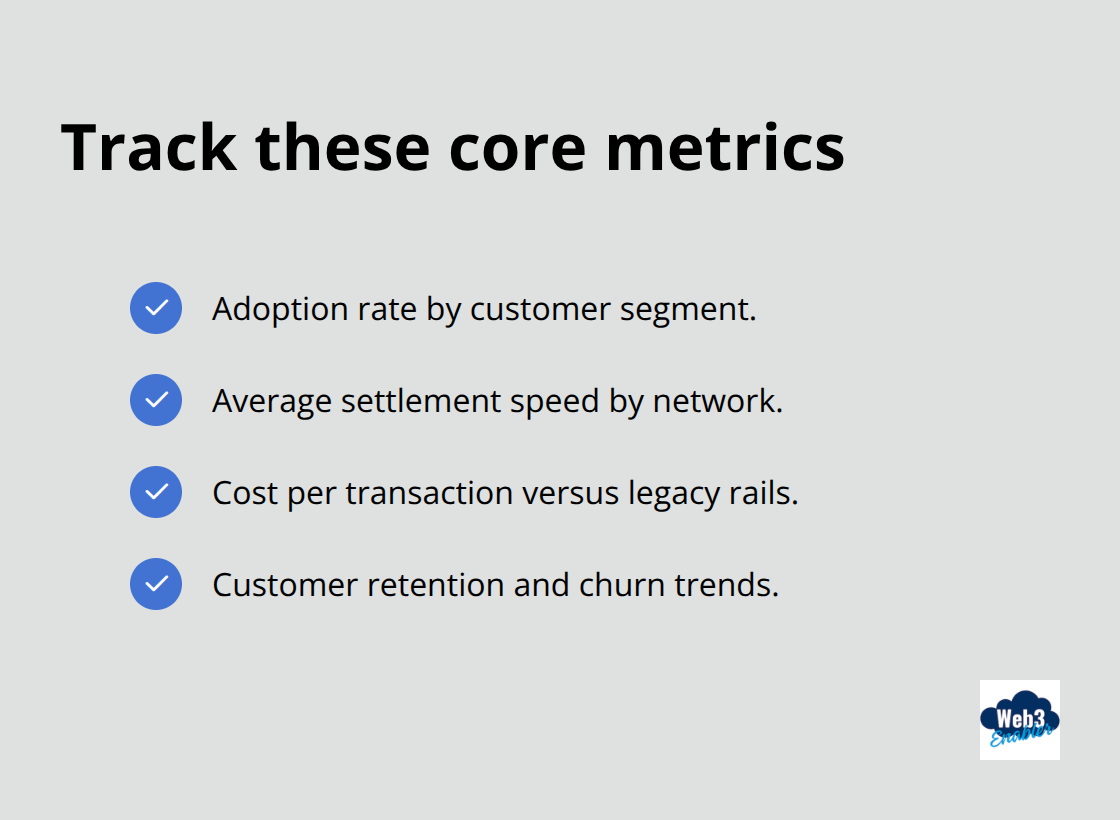
The trap most businesses fall into is measuring everything and understanding nothing. You’ll have access to massive datasets-transaction counts, network fees, settlement times-but without the right framework, you’re just staring at numbers. The metrics that matter depend on what you’re trying to optimize: cost reduction, customer retention, or operational efficiency. Start with your business outcome first, then work backward to the metrics that prove you’re winning. If you’re serious about stablecoin payments, track adoption rate by customer segment, average settlement time broken down by network, and cost per transaction compared to your previous payment rails.
Stablecoin transaction volumes have reached trillions, but that raw figure hides the real story-most of that activity isn’t tied to real-world payments, involving exchange movement and liquidity shuffling instead. Your job is to isolate the signal from the noise. Set up dashboards that show settlement speed, average transaction cost per network, cross-border cost savings, refund rates, and revenue uplift from faster payouts. These aren’t vanity metrics; they’re the levers that drive decisions about which networks to support, which customer segments to prioritize, and where to invest in infrastructure.
The Network Economics Nobody Talks About
Different blockchains cost different amounts and settle at different speeds, but most businesses treat all networks as interchangeable. They’re not. Solana experienced significant growth in stablecoin activity, largely because transaction costs measure in fractions of a cent and settlement happens near-instantly. Ethereum still commands a substantial share of overall stablecoin market activity, but that dominance comes with higher gas fees and network congestion during peak hours.
Track which networks your customers actually use, measure the cost difference between them, and calculate the true cost of supporting multiple chains versus the customer friction of limiting to one. Your analytics platform should flag when settlement times creep above your target threshold on any network-that’s your signal to either optimize your smart contract interaction or shift volume to faster alternatives. Monitor regional preferences too; if your customers concentrate in specific geographies, your network strategy should reflect that.
Customer Adoption Tells You What Actually Works
Track which customers use stablecoin payments and how frequently, then segment that data by industry, region, and transaction size. This is where you find your champions-the customers who adopted stablecoins because they solve a real problem, not because you offered a discount. These segments are your proof points for scaling. Measure adoption rate as a percentage of total transaction volume, but also measure velocity-how quickly adoption grows month over month.
If adoption stays flat, your integration might be too friction-heavy or your value proposition isn’t clear to customers. Look at refund rates and recall activity too; blockchain transactions are irreversible, so high refund rates suggest either customer confusion or a mismatch between your payment experience and customer expectations. Research shows that adding stablecoin payment options can drive meaningful adoption, which tells you that success isn’t automatic-it requires clear communication and a frictionless experience.
Building Your Competitive Edge Through Cohort Analysis
Build cohorts of early adopters and track their lifetime value against customers using traditional payment methods. That comparison is where you find the true business case for stablecoin expansion. Compare settlement speed improvements, cost reductions, and customer retention rates between your stablecoin cohorts and your traditional payment users. The data will reveal whether stablecoins attract higher-value customers, reduce churn, or unlock new revenue streams that your legacy payment rails never could.
This is where your analytics infrastructure becomes your competitive advantage. The businesses that win aren’t the ones with the most data-they’re the ones that act on it fastest.
From Data to Decisions
Your stablecoin payment data won’t organize itself into business wins. You’ve got transaction records, settlement timestamps, network costs, and customer behavior spread across blockchains and wallets-but raw numbers don’t drive strategy. The move from observation to action requires discipline: isolate which customers generate the most value, ruthlessly optimize the workflows that waste time and money, and catch problems before they hit your bottom line.
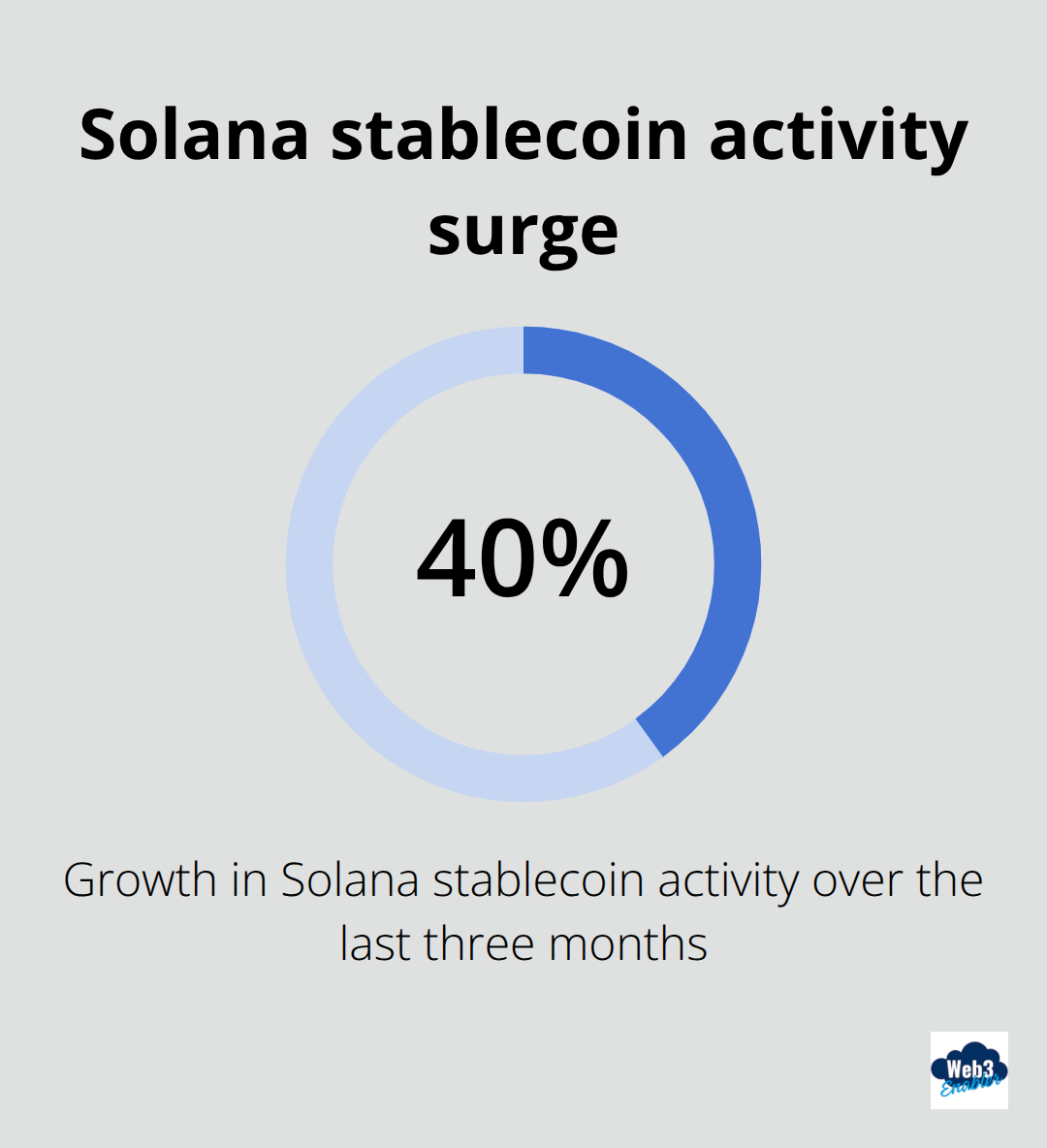
Start with your transaction history from the last three months and tag every payment by customer segment, network, and outcome. If you accept stablecoins across Ethereum, Solana, and Polygon, you’ll immediately see which networks your high-value customers prefer and which ones cost you the most per transaction. Solana’s stablecoin activity grew 40 percent in the last three months, partly because transaction fees sit below one cent-but that advantage disappears if your biggest customers cluster on Ethereum.
Build a simple matrix: customer lifetime value on the Y-axis, average settlement time on the X-axis, colored by network. That visualization tells you everything about where to invest next.
The High-Value Customer Signal Nobody Measures
Your early stablecoin adopters are screaming data at you. Measure which customers transact in stablecoins at least once monthly, calculate their average transaction size, and compare their retention rate to customers using traditional payments. That cohort analysis becomes your proof point. If stablecoin adopters spend 15 percent more per year and churn at half the rate of your traditional payment users, that’s your mandate to expand. Track adoption velocity too-how many new customers tried stablecoin payments last month versus three months ago. Flat adoption signals friction; rising adoption validates that your value proposition resonates.
Segment further by industry and geography. If your B2B customers in Southeast Asia show 3x higher stablecoin adoption than your North American customers, that tells you something about regional payment preferences and liquidity needs. Use that insight to tailor your go-to-market strategy and network selection for each region.
Workflow Optimization Through Cost Transparency
Most businesses have no idea what their actual payment processing costs are because legacy systems hide fees across multiple line items. Stablecoin infrastructure exposes everything: network fees, custody costs, on-ramp fees, off-ramp spreads. Pull your transaction costs for the last 90 days and break them down by network and customer segment. If you pay $0.50 per transaction on Ethereum but $0.01 per transaction on Solana, and your customer base splits evenly between both networks, you’re burning money on unnecessary settlement costs.
The fix isn’t always to migrate everything to the cheapest network-some customers need Ethereum’s liquidity or your compliance infrastructure sits on Ethereum. Instead, route intelligently based on transaction size: small payments under $100 go to Solana, larger payments stay on Ethereum where liquidity runs deeper. Track settlement time alongside cost; if Ethereum settlements average 45 seconds and Solana settlements average 8 seconds, but your customers only care about same-day settlement, Solana’s speed advantage doesn’t justify the operational complexity. Monitor refund rates too. High refunds on a particular network might indicate customer confusion about irreversible transactions-that’s a signal to improve your payment interface or pre-transaction confirmation flow, not a reason to abandon the network.
Real-Time Anomaly Detection Stops Problems Before They Spread
Fraud in stablecoin payments looks different than traditional fraud. You watch for transaction patterns that deviate from baseline behavior: a customer who normally sends $5,000 payments suddenly sends $500,000, or a region that typically processes 20 transactions daily spikes to 200. Set up automated alerts on your analytics platform that flag transactions exceeding three standard deviations from your customer’s historical pattern. When an alert fires, your compliance team reviews it in minutes, not days.
Cross-reference flagged transactions against blockchain risk intelligence platforms that track sanctioned addresses and high-risk wallet behavior. Most platforms deliver near-instant screening with sub-second latency, which means you catch problems in real time rather than discovering them during monthly reconciliation. Build a secondary layer: monitor transaction velocity by customer and by network. If a single customer suddenly moves $2 million across five different wallets in 30 minutes, that’s not normal business behavior-it might be a compromised account or a test run before something worse. Your analytics dashboard should surface these patterns automatically and trigger a manual review process that takes less than 10 minutes to complete. Document every alert and resolution; those logs become your audit trail and your defense if regulators ever question your risk controls.
Final Thoughts
Stablecoin payments analytics transforms how you understand your payment flows, optimize costs, and stay ahead of compliance requirements. The businesses winning right now read their data and act on it faster than their competitors, not because they have the most sophisticated blockchain infrastructure. Your competitive advantage sits in three places: you see transaction patterns in real time instead of waiting for monthly bank statements, you measure actual costs instead of guessing at hidden fees, and you build an audit trail that regulators respect because it’s immutable and transparent.
Native blockchain integration collapses the gap between your payment infrastructure and your business systems. When stablecoin data flows directly into your existing tools-your ERP, your analytics platform, your compliance workflows-you stop treating crypto payments as a separate experiment and start treating them as a core business capability. That integration is where the real efficiency gains happen, and it’s where you prove that blockchain payments work for business, not just for speculation.
Start small with one region or one customer segment and run a controlled pilot. Track the metrics that matter: adoption rate, settlement speed, cost per transaction, and customer retention.
At Web3 Enabler, we help businesses connect blockchain technology with their existing corporate infrastructure through Salesforce Native solutions, handling the complexity of stablecoin payments and compliance so you focus on what the data tells you.
Frequently Asked Questions About Stablecoin Payments Analytics
Stablecoin payments analytics helps businesses turn blockchain transaction data into clearer decisions about settlement speed, payment costs, customer behavior, and compliance risk. Below are common questions about how stablecoin analytics works and which metrics matter most for improving payment operations and business performance.
What is stablecoin payments analytics?
Stablecoin payments analytics is the process of collecting and analyzing blockchain payment data to understand how stablecoin transactions affect your business. This can include settlement times, transaction costs, customer adoption trends, network performance, refund activity, and compliance signals. The goal is to turn raw transaction records into insights that improve operations, customer experience, and financial performance.
Why does stablecoin payment data matter for businesses?
Stablecoin payment data matters because every blockchain transaction creates a visible and timestamped record. That gives businesses a level of real-time transparency that traditional payment systems often do not provide. When used well, this data helps teams identify cost-saving opportunities, improve settlement workflows, monitor customer payment behavior, and respond faster to issues that affect revenue or operations.
What metrics should businesses track for stablecoin payments?
Businesses should track metrics such as adoption rate, average settlement time, transaction cost by network, refund rate, payment volume by region, and customer retention by payment type. These metrics help teams understand which payment flows are performing well, where costs are lowest, and whether stablecoin adoption is creating measurable business value.
How do stablecoin payments analytics improve cost visibility?
Stablecoin payments analytics improves cost visibility by showing the full transaction picture across networks, payment routes, and customer segments. Instead of relying on blended or hidden payment costs, businesses can see where fees are lowest, which networks are most efficient, and how stablecoin settlement compares with legacy payment rails. This makes it easier to reduce unnecessary payment expenses.
Can stablecoin analytics help businesses choose the right blockchain network?
Yes. Stablecoin analytics can help businesses compare networks based on factors such as settlement speed, transaction cost, customer usage, and operational reliability. This allows teams to make better decisions about which networks to support, where to route specific payment types, and how to balance customer demand with cost efficiency.
How can businesses use stablecoin analytics to understand customer behavior?
Businesses can use stablecoin analytics to identify which customers prefer stablecoin payments, how often they use them, which regions adopt them most quickly, and whether they tend to have different transaction sizes or retention patterns than customers using traditional payment methods. This makes it easier to find high-value customer segments and build stronger payment strategies around actual user behavior.
How do stablecoin payments analytics support compliance?
Stablecoin payments analytics supports compliance by creating a clearer view of transaction history, wallet activity, settlement timing, and abnormal behavior patterns. Businesses can combine this data with screening, monitoring, and audit workflows to support KYC, sanctions checks, and regulatory reporting. Because blockchain transactions create permanent records, they also help teams prepare stronger audit trails.
Can stablecoin analytics help detect fraud or unusual activity?
Yes. Stablecoin analytics can help detect unusual activity by flagging transaction patterns that fall outside normal customer or network behavior. Examples include sudden spikes in volume, changes in transfer frequency, unexpected wallet behavior, or unusual geographic patterns. Real-time alerts make it easier for operations and compliance teams to review exceptions before problems spread.
What is cohort analysis in stablecoin payments?
Cohort analysis in stablecoin payments means grouping customers based on shared behavior, such as first-time stablecoin users, repeat users, or high-value adopters, and comparing how those groups perform over time. This helps businesses understand whether stablecoin users spend more, stay longer, settle faster, or create lower processing costs than customers using traditional payment methods.
How should a business start using stablecoin payments analytics?
The best way to start is by focusing on one payment segment, region, or customer group and tracking a small set of meaningful metrics. Many businesses begin with settlement speed, cost per transaction, adoption rate, and customer retention. A focused pilot makes it easier to prove value, identify useful patterns, and expand analytics into broader payment, finance, and compliance workflows over time.