


 Enterprise finance teams face mounting pressure as digital asset transactions multiply across their organizations. Traditional accounting systems struggle with crypto’s unique complexities, from volatile valuations to intricate tax requirements.
We at Web3 Enabler see companies spending countless hours on manual crypto accounting processes that should be automated. Salesforce offers powerful native capabilities that transform how businesses track, value, and report their digital assets.
What Makes Crypto Accounting So Complex
Tax Compliance Creates Operational Chaos
Finance teams battle crypto tax requirements that shift quarterly across jurisdictions. The IRS treats each cryptocurrency transaction as a taxable event and demands detailed cost basis calculations for every trade, payment, or conversion. Companies that hold significant crypto positions face constant volatility that makes traditional budgeting impossible, and must track acquisition dates, fair market values, and disposal methods for thousands of transactions annually.
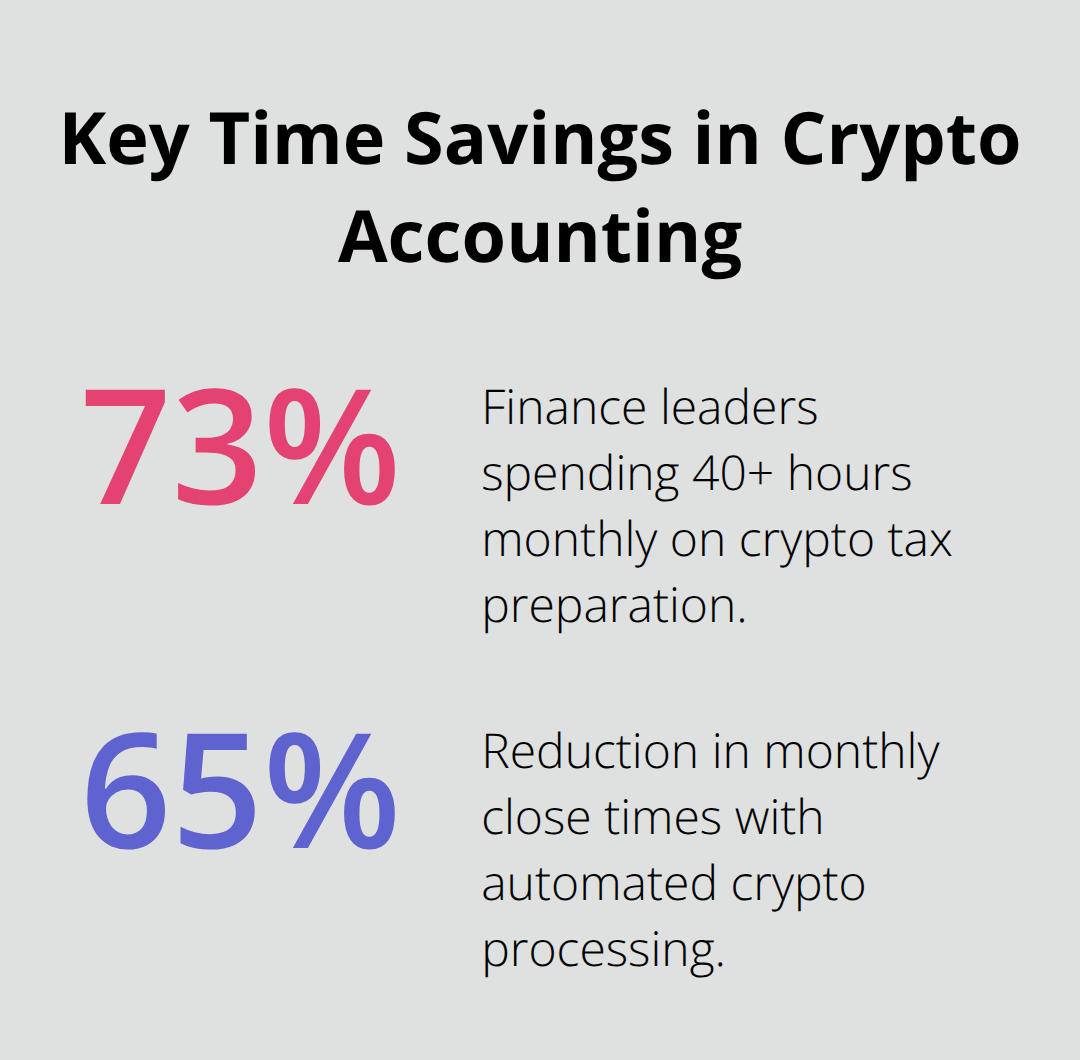
Ernst & Young reports that 73% of finance leaders spend over 40 hours monthly on crypto tax preparation alone. International operations multiply this complexity, with different countries that classify digital assets as property, currency, or securities. Each jurisdiction applies unique rules that force teams to maintain separate records and calculations.
Manual Processes Consume Critical Resources
Accounting teams export transaction data from multiple crypto exchanges manually, then spend days to reconcile wallet addresses with corporate records. A single Bitcoin payment requires teams to track across blockchain explorers, match timestamps, convert values to reporting currencies, and update multiple ledgers.
PwC found that companies that process 100+ crypto transactions monthly dedicate two full-time employees just to data entry and reconciliation. Traditional accounting software lacks native blockchain integration and forces teams to build error-prone spreadsheet solutions.
Classification Challenges Multiply Workload
Without automated transaction classification, every digital asset movement demands manual review to determine if it represents income, expense, investment, or operational activity. Teams must analyze each transaction’s business purpose (whether it’s a vendor payment, investment purchase, or operational expense) before they can record it properly, considering that cryptocurrencies are classified as intangible assets or investment instruments with specific implications for financial reporting.
These inefficient workflows create bottlenecks that delay monthly closes and increase audit risks. Finance leaders need solutions that can handle crypto’s unique requirements while maintaining the accuracy and control that enterprise accounting demands.
How Salesforce Handles Digital Asset Management
Salesforce transforms crypto accounting through its comprehensive digital asset management framework that eliminates manual processes and connects directly with blockchain networks. The platform’s native capabilities handle complex cryptocurrency workflows that previously required multiple third-party tools and extensive manual intervention.
Automated Transaction Processing Powers Real-Time Updates
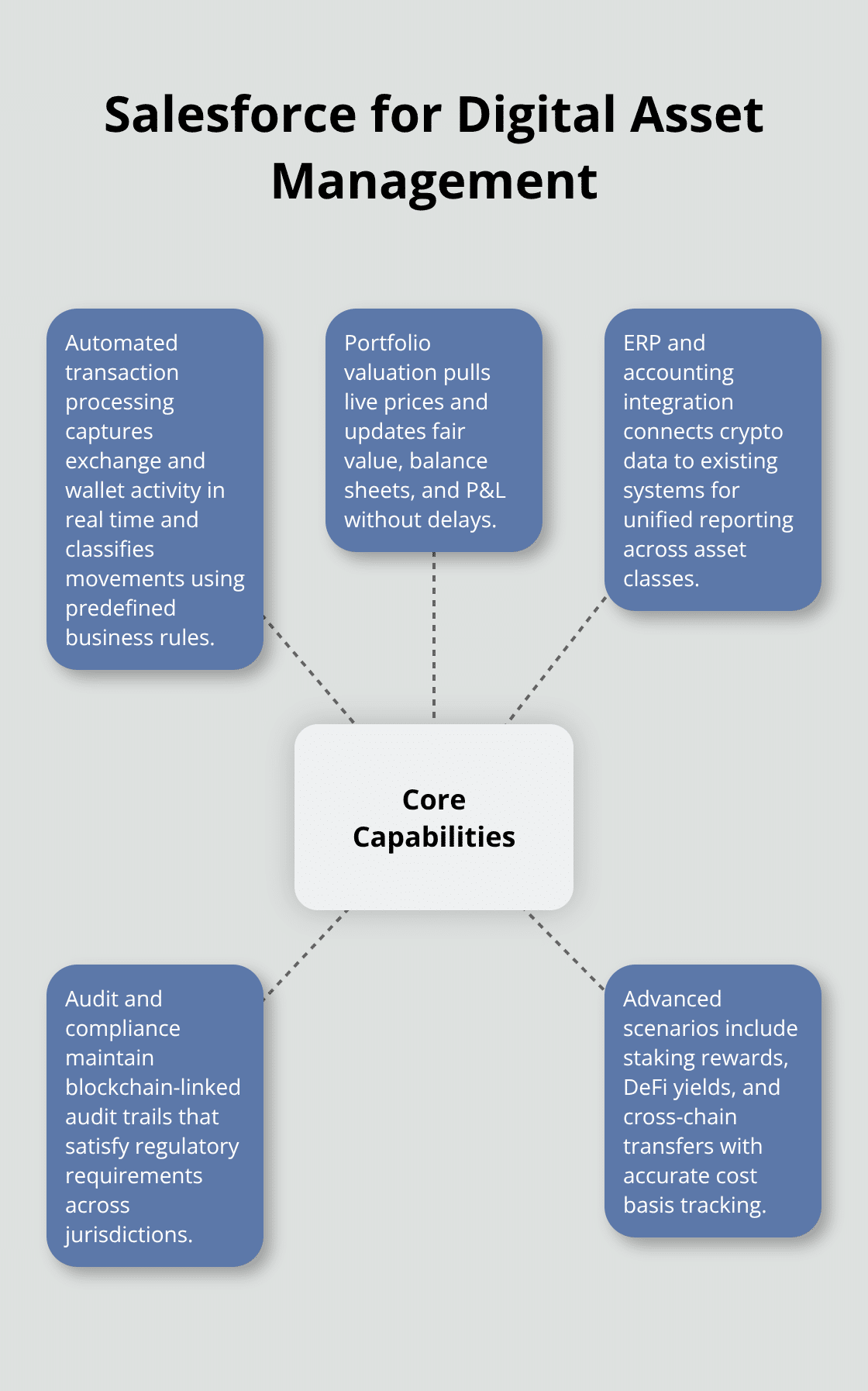
Salesforce automatically captures crypto transactions from major exchanges and wallets, then classifies each movement based on predefined business rules. The system enhances customer relations and operational efficiency through blockchain integration, enabling automated workflows that assign proper accounting categories (such as trading gains, operational expenses, or investment activities) without human review.
Finance teams set up automated workflows that trigger journal entries, update portfolio valuations, and generate compliance reports the moment transactions hit the blockchain. Deloitte research shows companies that use automated crypto processing reduce monthly close times by 65% while they eliminate the reconciliation errors that plague manual systems.
The platform maintains complete audit trails that link every accounting entry back to its source transaction on the blockchain, which satisfies regulatory requirements across multiple jurisdictions.
Portfolio Valuation Delivers Instant Financial Visibility
Real-time portfolio valuation capabilities provide finance teams with up-to-the-minute asset positions and performance metrics across all digital holdings. Salesforce pulls live pricing data from multiple exchanges and calculates fair value adjustments automatically, which updates balance sheets and P&L statements without delays.
Companies can track unrealized gains and losses instantly, monitor exposure limits, and generate executive dashboards that show crypto performance alongside traditional investments. The system handles complex scenarios like staking rewards, DeFi yield farming, and cross-chain asset transfers while it maintains accurate cost basis calculations for tax reporting.
Integration Capabilities Bridge Traditional and Digital Finance
Salesforce connects digital asset data with existing ERP systems and traditional accounting workflows through native APIs and pre-built connectors. Finance teams can consolidate crypto transactions with conventional financial data in unified reports that provide complete visibility across all asset classes.
These integration capabilities set the foundation for implementing structured workflows that can handle the specific requirements of enterprise blockchain solutions and crypto accounting operations.
How Should You Structure Crypto Assets in Salesforce
Chart of Accounts Architecture for Digital Assets
Finance teams must create dedicated account structures that separate digital assets from traditional holdings while they maintain compatibility with existing reporting frameworks. Establish parent accounts for each cryptocurrency type (Bitcoin, Ethereum, stablecoins) with child accounts that track acquisition methods, holding purposes, and geographic locations. Companies with structured digital asset charts reduce audit preparation time compared to those that mix crypto with traditional asset categories.
Create separate accounts for trading gains versus operational crypto usage, since tax treatment differs significantly between investment activities and business operations. Set up liability accounts for crypto-denominated obligations and establish clearing accounts that handle the timing differences between blockchain confirmations and accounting recognition. This structure prevents the classification errors that trigger regulatory scrutiny and audit findings.
Automated Transaction Classification Reduces Manual Errors
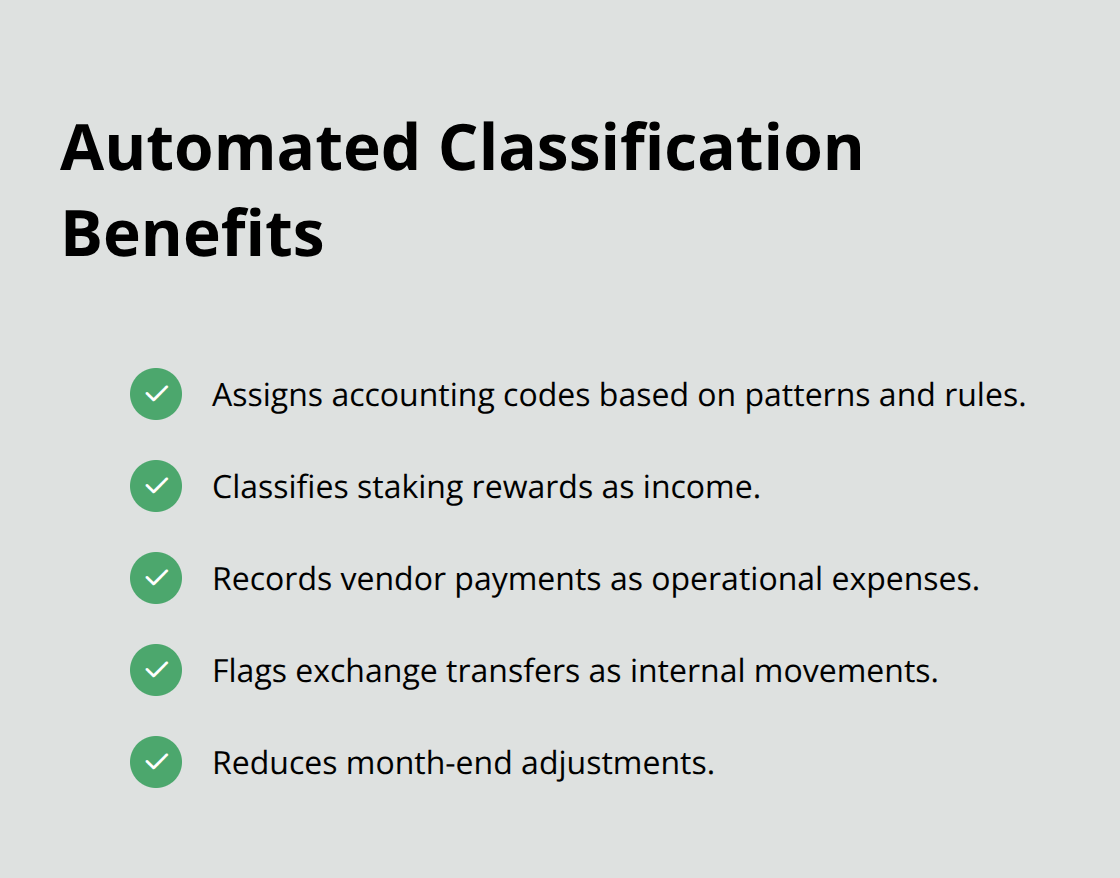
Configure Salesforce workflows that automatically assign accounting codes based on transaction patterns, wallet addresses, and business rules established during implementation. Set triggers that classify staking rewards as income, vendor payments as operational expenses, and exchange transfers as internal movements without accounting impact. Companies that use automated classification report fewer month-end adjustments.
Establish validation rules that prevent transactions from posting without proper business purpose documentation and approval workflows. Create automated journal entry templates that populate based on transaction type, which ensures consistent accounting treatment across all digital asset activities while they maintain the audit trails that regulators demand for compliance verification.
Compliance Controls Protect Against Regulatory Risk
Implement role-based access controls that restrict crypto transaction capabilities to authorized personnel while they maintain segregation of duties between transaction initiation and approval. Configure automated compliance reports that track regulatory thresholds, flag suspicious activities, and generate the documentation required for tax filings across multiple jurisdictions. Set up automated alerts when transactions exceed predetermined limits or when unusual patterns emerge that require management review.
These controls create the foundation for secure crypto operations that meet enterprise standards while they reduce the manual oversight burden on finance teams. The custom digital wallet report provides advisors with structured portfolio views that enhance client management capabilities.
Final Thoughts
Crypto accounting transforms from a manual burden into an automated advantage when finance teams leverage Salesforce’s native digital asset capabilities. Companies that implement structured workflows reduce monthly close times by 65% while they eliminate the reconciliation errors that create audit risks and regulatory scrutiny. The future of enterprise digital asset management centers on platforms that integrate blockchain data with traditional financial systems seamlessly.
Organizations that adopt comprehensive crypto accounting solutions today position themselves ahead of competitors who still struggle with spreadsheet-based processes and manual transaction tracking. Finance leaders ready to modernize their digital asset operations should start with a pilot implementation that focuses on their highest-volume crypto activities. Web3 Enabler provides the interface between Salesforce and blockchain networks that enterprises need.
The transition from manual crypto accounting to automated digital asset management represents a competitive advantage that grows stronger as digital currencies become standard business tools. Companies that master these capabilities now will lead their industries as blockchain adoption accelerates across all business functions. Smart finance teams act today rather than wait for competitors to gain the operational advantages that automated crypto accounting delivers.