


Stablecoin payments through Salesforce are transforming how businesses settle transactions on-chain. Yet most finance teams still reconcile these settlements manually, wasting hours each week on spreadsheets and status checks.
At Web3 Enabler, we’ve seen firsthand how Salesforce stablecoin reconciliation automation eliminates this friction. When your on-chain and off-chain records match instantly, your team stops chasing discrepancies and starts focusing on growth.
The Real Cost of Spreadsheet-Based Settlement Tracking
Finance teams handling stablecoin payments on-chain face a brutal reality: manual reconciliation destroys productivity and introduces risk at scale. When your Salesforce system processes a stablecoin payment to a customer or supplier, that transaction exists in two worlds simultaneously-on the blockchain and in your accounting records. Your team must cross-reference wallet addresses, transaction hashes, and settlement timestamps against general ledger entries by hand. Manual processes introduce human error at every step-typos in transaction IDs, missed entries, timing mismatches between on-chain confirmation and off-chain posting. When an auditor or compliance officer flags a discrepancy, your team must backtrack through weeks of spreadsheets to find the mistake, often discovering the issue only after settlement delays have already cost you cash flow advantages.
Where Blockchain Speed Gets Lost in Manual Workflows
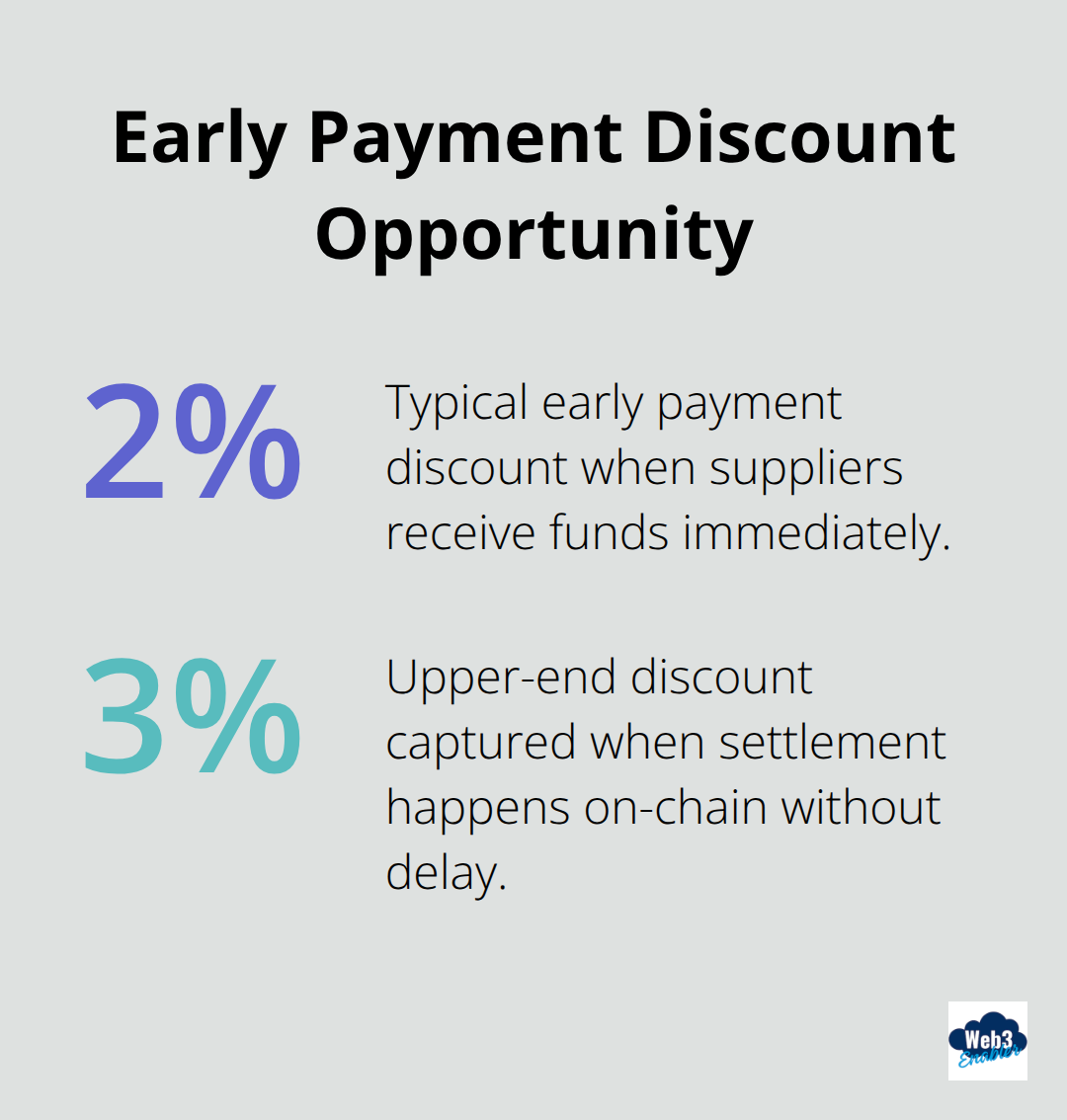
Stablecoin settlements on-chain complete in minutes, but your finance operation treats them like traditional SWIFT payments that take three to five business days. This disconnect creates operational friction that bleeds money. A customer or supplier receives confirmation that payment has settled on-chain, yet your Salesforce system still shows the transaction as pending because your team hasn’t manually verified and posted it yet. This delay prevents you from capturing early payment discounts-typically 2 to 3 percent savings when suppliers receive funds immediately-and it keeps your cash flow reporting inaccurate until reconciliation catches up.
Real-time visibility into on-chain settlements directly within Salesforce eliminates this lag entirely. Your general ledger updates instantly as transactions confirm on-chain, your cash position reflects true liquidity, and your team can act on accurate data immediately rather than waiting for weekend reconciliation sessions.
Why Your Compliance Team Struggles with On-Chain Records
Regulatory requirements demand that you maintain complete audit trails for every transaction, including stablecoin settlements. Manual reconciliation creates gaps in this documentation. Your team posts entries to the general ledger days after on-chain confirmation occurs, leaving a window where your records don’t match blockchain reality. Auditors question these timing differences, and your compliance team must explain why settlement records exist in multiple systems with no clear connection between them. Automated reconciliation within Salesforce solves this problem by linking on-chain transactions directly to your accounting records in real time. Each stablecoin settlement automatically maps to the corresponding general ledger entry, creating an immutable audit trail that satisfies regulatory scrutiny without manual intervention.
The Hidden Cost of Delayed Cash Flow Visibility
Finance leaders rely on accurate cash position data to make treasury decisions, but manual reconciliation delays this visibility by days. Your Salesforce dashboard shows pending transactions that have already settled on-chain, making your liquidity picture inaccurate. This forces you to hold excess cash reserves as a safety buffer, tying up capital that could fund operations or growth. Real-time on-chain reconciliation gives your team true visibility into available funds the moment settlements confirm. Your cash flow forecasts become accurate, your treasury team makes better decisions, and you optimize working capital without guesswork.
Moving from Manual Chaos to Automated Clarity
The path forward requires connecting your blockchain transactions directly to Salesforce’s financial data layer. This integration eliminates the manual steps that consume your team’s time and introduce errors. Instead of spreadsheets and status checks, your finance operation gains a unified view of every stablecoin settlement-from initial payment through final posting in your general ledger. The next section explores how this automation actually works within Salesforce and what results organizations achieve when they implement it.
How Automated Reconciliation Closes the On-Chain Gap
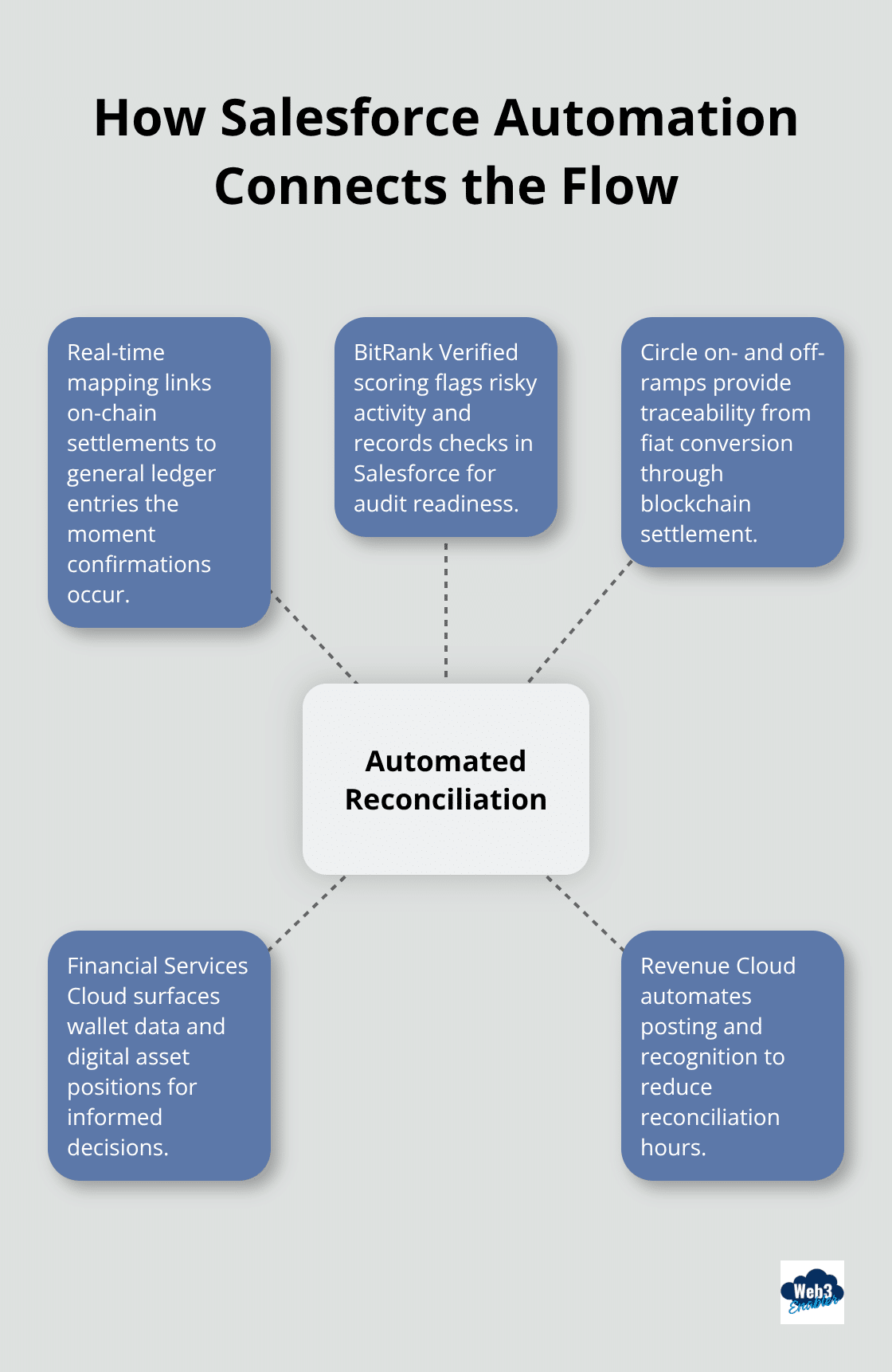
When a stablecoin payment settles on-chain, the transaction completes in minutes with cryptographic certainty. Your Salesforce system, however, operates on a different timeline unless you build the connection that links blockchain reality to your accounting records. Web3 Enabler’s native Salesforce integration maps each on-chain settlement directly to your general ledger, eliminating the manual verification step that delays your records from reflecting true cash position. The platform captures transaction details-wallet address, settlement timestamp, stablecoin amount, and recipient identifier-and automatically matches these against pending entries in Financial Services Cloud or your revenue records. This real-time matching happens without human intervention, which means your finance team stops treating blockchain settlements like traditional bank transfers that arrive days later. Instead, your Salesforce dashboard shows accurate liquidity the moment on-chain confirmation occurs, and your compliance records automatically reflect the blockchain-verified transaction with an immutable audit trail that satisfies regulatory requirements.
Real-Time Matching Prevents Compliance Headaches
Regulatory frameworks demand complete documentation linking on-chain activity to accounting entries, yet manual reconciliation creates days-long windows where your records diverge from blockchain truth. Automated matching closes this gap instantly. Web3 Enabler embeds transaction safety scoring through BitRank Verified, which flags suspicious activity in real time, and integrates Circle’s on-ramp and off-ramp infrastructure so your team can track funds from fiat conversion through blockchain settlement to final posting in your ledger. Each step leaves an auditable record within Salesforce itself-no external spreadsheets, no delayed batch reconciliation, no compliance gaps. When an auditor examines your stablecoin payment history, they see a continuous chain of evidence from order creation through on-chain settlement to accounting entry, all timestamped and immutable. Your compliance team no longer spends hours reconstructing transaction timelines or explaining discrepancies between systems. Instead, they access a unified record that proves settlement occurred exactly when blockchain data confirms it, eliminating the friction that auditors typically encounter with traditional cross-border payments.
Blockchain Settlement Connects to Cash Flow Accuracy
Your treasury team makes working capital decisions based on available liquidity, but manual reconciliation delays this visibility by days. With automated on-chain reconciliation in Salesforce, your cash position updates instantly as settlements confirm. If your organization processes international payments across multiple currencies and corridors, real-time visibility becomes especially valuable-you see which funds have settled in which accounts without waiting for batch reconciliation cycles. This accuracy allows your team to optimize liquidity reserves, capture early payment discounts from suppliers, and forecast cash flow with confidence rather than padding estimates for reconciliation uncertainty. Organizations processing millions in monthly stablecoin volume report that instant settlement visibility reduces the cash buffers they must maintain, effectively freeing capital for operations or growth initiatives.
Integration Within Salesforce’s Native Architecture
The integration works within Salesforce’s native architecture, so your team doesn’t juggle separate systems or reconciliation tools. A stablecoin payment to a customer flows through your sales order, triggers payment settlement on-chain, and simultaneously posts to your general ledger with full transaction lineage intact. Financial Services Cloud captures wallet addresses and digital asset positions in real time, enabling your advisors to deliver informed guidance based on current on-chain data. Revenue Cloud automates settlement posting and revenue recognition without manual intervention, reducing the reconciliation hours your accounting team spends each week.
This unified environment means your finance, compliance, and operations teams collaborate within a single platform rather than coordinating across disconnected systems.
Your organization now possesses the infrastructure to settle payments in minutes while maintaining complete audit trails and accurate cash visibility. The next step involves understanding what results teams achieve when they implement this automation at scale-and how quickly those results translate to measurable operational improvements.
What Teams Actually Save When Reconciliation Runs Automatically
Organizations that implement automated reconciliation within Salesforce report staggering time savings that compound across their finance operations. Teams previously spending 20 to 30 hours weekly on manual stablecoin reconciliation now handle the same volume in under two hours, freeing experienced finance professionals to focus on analysis, forecasting, and strategic treasury work rather than spreadsheet maintenance. The acceleration happens because automated matching eliminates the verification bottleneck entirely.
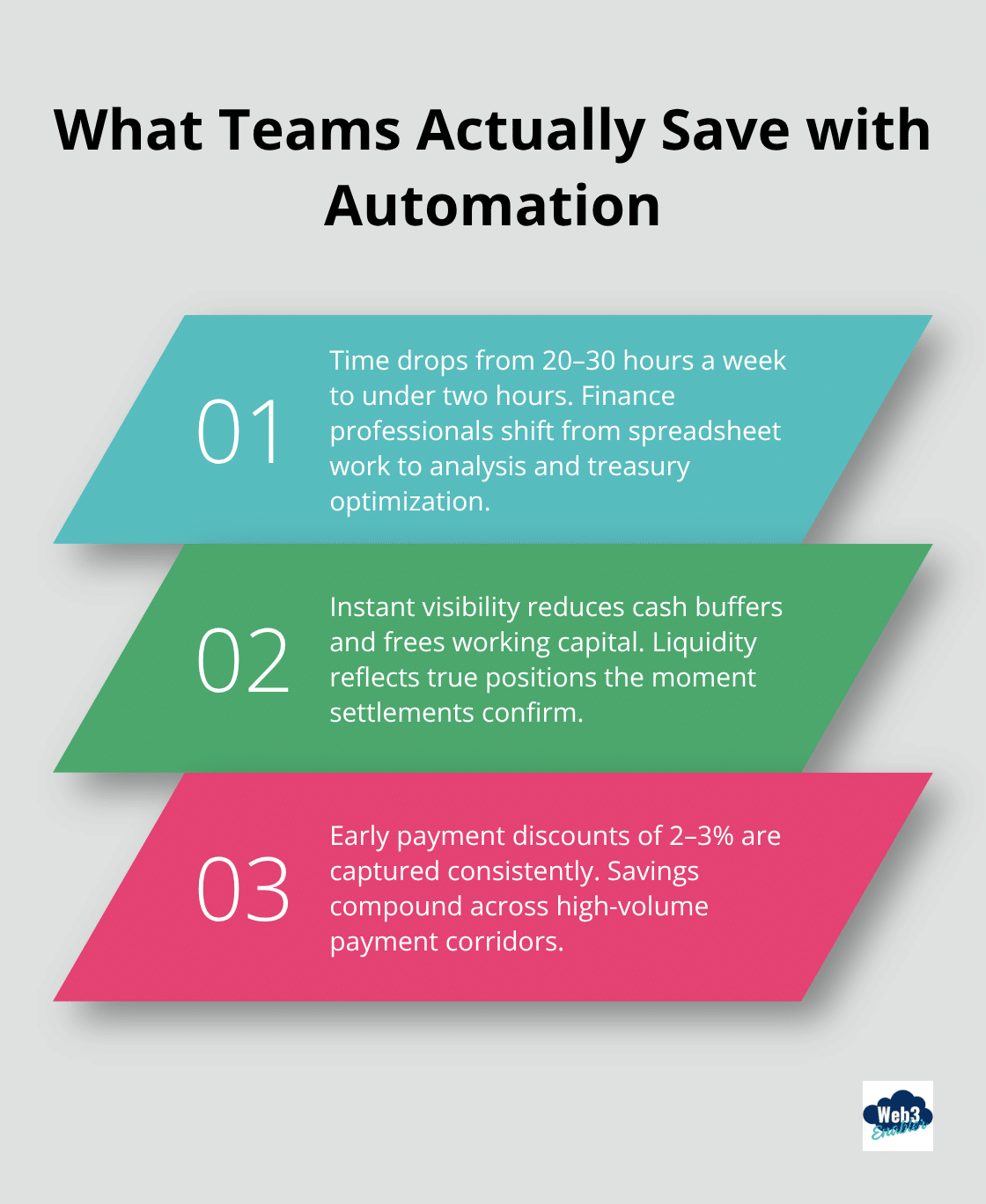
When a stablecoin settlement confirms on-chain, Salesforce captures the transaction details-wallet address, amount, timestamp, recipient identifier-and matches them instantly against pending general ledger entries without human review. This real-time matching means your accounting records reflect true cash position the moment settlement occurs, not days later after batch reconciliation cycles complete. Companies processing $10 million or more in monthly international payments report that instant visibility alone enables them to reduce cash reserves held for reconciliation uncertainty, effectively freeing hundreds of thousands of dollars in working capital that previously sat idle. Beyond capital optimization, finance teams capture early payment discounts from suppliers-typically 2 to 3 percent savings when funds arrive with blockchain certainty rather than traditional payment delays. These discounts compound quickly across high-volume payment corridors.
Compliance becomes auditable rather than explanatory
Regulatory frameworks demand immutable audit trails linking on-chain activity to accounting records, yet manual reconciliation creates documentation gaps that consume compliance resources. Automated reconciliation closes these gaps entirely by maintaining a continuous chain of evidence within Salesforce itself. Each stablecoin settlement automatically creates timestamped records showing the on-chain confirmation, the matched general ledger entry, the settlement currency and amount, and the complete transaction lineage from order through posting. When auditors examine your stablecoin payment history, they access a unified record that proves settlement timing and eliminates the discrepancies that traditionally plague cross-border payment audits. Your compliance team stops explaining delayed posting windows and instead demonstrates real-time synchronization between blockchain settlement and accounting records. This shift from explanation to demonstration reduces audit friction dramatically and accelerates sign-off cycles. Organizations with significant stablecoin volume report that automated reconciliation reduces compliance review time from weeks to days, directly lowering the operational burden on finance and legal teams.
Transaction safety integrates into your audit trail
Real-time compliance monitoring strengthens your audit trail without requiring manual oversight. Programmable payments integrate transaction safety scoring directly into Salesforce, flagging suspicious activity in real time and automatically documenting compliance checks within your audit trail. This embedded compliance layer means your team maintains regulatory readiness without manual compliance monitoring or external tools. Your finance and legal teams spend less time on post-transaction reviews and more time on strategic compliance initiatives.
Operational costs drop measurably when automation replaces headcount allocation
Finance teams currently allocate significant resources to reconciliation work that automation eliminates entirely. A mid-market organization processing stablecoin payments across multiple corridors typically dedicates one to two full-time accounting staff members to manual reconciliation tasks-salary, benefits, and overhead costs that disappear when Salesforce handles matching automatically. These teams can reallocate that capacity toward higher-value work: analyzing payment patterns, optimizing settlement corridors, forecasting liquidity needs, and identifying cost reduction opportunities across their payment infrastructure. Organizations that previously used third-party reconciliation tools or external accounting services to manage stablecoin settlements report that native Salesforce automation eliminates these ongoing service fees entirely. The cost comparison is straightforward: manual reconciliation requires headcount or external service providers, while automated reconciliation runs within your existing Salesforce environment at no incremental per-transaction cost. For organizations processing thousands of monthly stablecoin transactions, this efficiency difference translates to tens of thousands of dollars in annual operational savings.
Final Thoughts
Manual stablecoin reconciliation drains your finance team’s time and introduces compliance risks that grow with transaction volume. Your team spends hours matching on-chain settlements to general ledger entries, delays cash flow visibility by days, and creates audit gaps that regulators scrutinize. These inefficiencies cost real money through missed early payment discounts, excess cash reserves, and headcount allocated to spreadsheet maintenance rather than strategic work.
Automated Salesforce stablecoin reconciliation eliminates this friction entirely. Real-time matching connects blockchain settlements directly to your accounting records the moment transactions confirm on-chain, giving your finance team instant visibility into true liquidity. Your compliance records automatically reflect blockchain-verified transactions with immutable audit trails that satisfy regulatory requirements without manual intervention, and organizations implementing this automation report cutting reconciliation time from days to hours while freeing experienced finance professionals to focus on analysis and treasury optimization.
Web3 Enabler offers native blockchain integration on Salesforce AppExchange, enabling your organization to accept and send stablecoin payments while gaining real-time visibility into on-chain transactions directly within Financial Services Cloud, Commerce Cloud, and Revenue Cloud. The platform automates settlement posting, revenue recognition, and reconciliation without leaving Salesforce, creating a unified environment where finance, compliance, and operations teams collaborate seamlessly. Evaluate whether your current payment infrastructure can deliver the speed and accuracy your business demands, and consider how Salesforce stablecoin reconciliation positions your organization ahead of competitors still managing settlements manually.