


Your payment system is stuck in 2015 while your customers expect 2026 speed and flexibility.
Salesforce Revenue Cloud Payments changes that by letting you accept stablecoin payments directly on the platform you already use. We at Web3 Enabler have seen firsthand how this shifts the game for businesses tired of settlement delays and intermediary fees.
Why Your Customers Already Expect Crypto Payments
The Market Has Already Shifted
Your customers are not waiting for you to catch up. According to a PayPal and National Cryptocurrency Association report, nearly 40% of U.S. merchants now accept crypto payments at checkout. Among larger firms-those generating over $500 million in revenue-that number jumps to 50%. This is not a niche experiment anymore. Square made Bitcoin available to roughly 4 million vendors, and the infrastructure is maturing fast.

Speed Wins Over Friction
Traditional payment rails still impose settlement delays measured in days, currency conversion friction, and intermediary fees that pile up across borders. A stablecoin payment settles in minutes without the volatility drama that made early crypto adopters nervous. Your business can accept USDC, USDT, or XRP and move money to a bank account across borders without waiting for clearing houses to do their thing. The speed advantage is not theoretical-it is operational. Faster settlement means better cash flow, fewer disputes, and the ability to serve customers who prefer paying this way.
Stablecoins Solved the Volatility Problem
Volatility was the original objection to crypto payments, and stablecoins solved it years ago. A stablecoin pegged to the U.S. dollar or another fiat currency eliminates the risk that your revenue shrinks overnight because Bitcoin crashed. Merchants can accept payment in stablecoins and convert to local currency immediately if they want, or hold the stablecoins for customers in regions where traditional banking is slow or expensive. For B2B transactions, the advantage is sharper: a software company selling to a client in the Middle East, EU, or UK can settle payment in hours instead of weeks, without the fees that wire transfers demand.
Why Revenue Cloud Keeps It Simple
Adoption patterns show that larger firms embrace this faster than smaller ones, but that gap exists because the infrastructure is still newer. The real advantage emerges when you keep everything inside your Revenue Cloud ecosystem-no new dashboards, no separate wallets, no manual reconciliation. The payment system your team already knows gains a new capability without adding complexity. This is where Salesforce Revenue Cloud Payments changes the equation for businesses ready to move forward.
How Revenue Cloud Payments Actually Works
Everything stays inside Salesforce, which is the whole point. When a customer pays you in USDC or USDT, the transaction flows directly into Revenue Cloud without requiring separate wallets, external dashboards, or manual reconciliation spreadsheets. Your finance team sees the payment hit your account in real time, the system automatically records it against the correct invoice, and compliance checks run in the background without slowing anything down. No more toggling between three different platforms to confirm a payment cleared. The stablecoin arrives, Revenue Cloud recognizes it, your bank account gets funded, and your revenue recognition stays accurate. This native integration matters because it eliminates the operational friction that kills adoption. According to Salesforce’s own State of Sales research, businesses using the platform see sales productivity increases of 34% and revenue growth up to 29%, largely because teams stop wasting time on manual data entry and tool switching. Add crypto payments to that equation and your team gains even more efficiency.
Compliance Checks Happen Before Settlement, Not After
The biggest fear most finance teams have about crypto is regulatory exposure. Revenue Cloud Payments runs AML and KYC checks before the payment settles, not after you’ve already accepted it and created a compliance nightmare. The system verifies customer identity, screens against sanctions lists, and flags suspicious transaction patterns in real time. Your compliance team receives alerts if something looks off, but most payments clear without drama because the infrastructure catches problems early. This matters operationally because your sales team can accept payment immediately without your legal department having a heart attack. The alternative-accepting crypto and then scrambling to verify compliance-creates delays that defeat the whole purpose of faster settlement. Revenue Cloud Payments bakes governance into the payment flow itself, not as an afterthought.
Your Bank Account Receives Funds Without the Manual Work
Once the payment lands in your stablecoin wallet, you can move it to your bank account whenever you want. Some businesses convert immediately to local currency; others hold stablecoins if they have expenses in multiple regions. Either way, Revenue Cloud tracks the transaction from customer payment through bank deposit, so your accounting records stay clean without anyone manually matching invoices to deposits. Your cash flow reporting becomes more accurate because the system knows exactly when money moved and where it went. This automation saves your finance team hours every month that they currently spend reconciling payments across different systems.
The Real Advantage: Everything Stays Connected
What separates Revenue Cloud Payments from bolting crypto onto your existing infrastructure is that nothing lives in isolation. Your customer record, the invoice, the payment, the compliance check, and the bank deposit all exist in one system. Your team doesn’t context-switch between platforms or wait for data to sync across disconnected tools. When your CFO wants to know revenue by region or payment method, the data is already there.
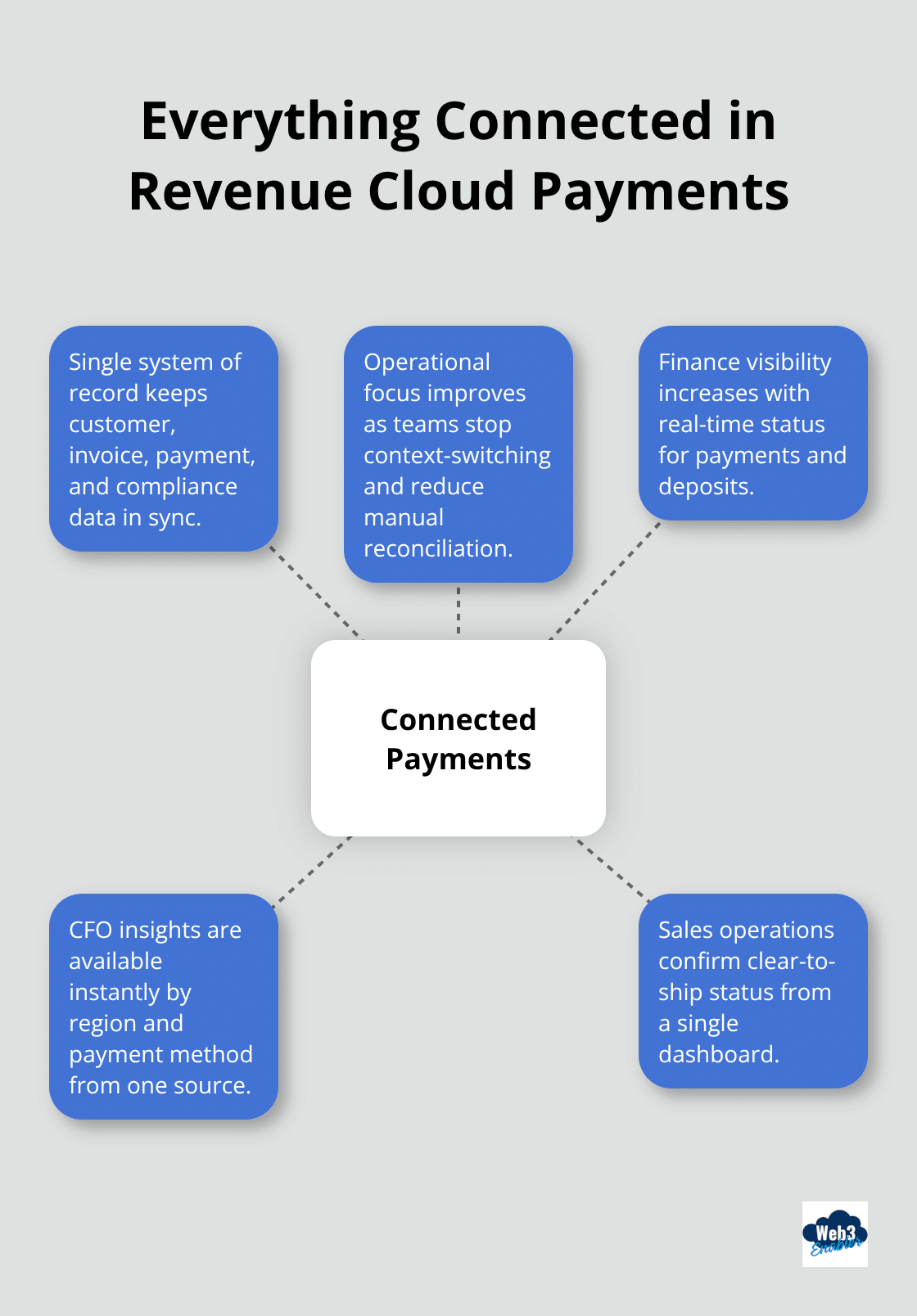
When your sales team needs to confirm a payment cleared before shipping, they check one dashboard instead of three. This connectivity is what transforms crypto payments from a technical novelty into an operational advantage that actually moves the needle on efficiency and cash flow. The next section shows how this plays out across different industries and business models.
Where Crypto Payments Actually Move the Needle
E-Commerce: Cash Flow Wins in Days, Not Weeks
E-commerce businesses face a brutal reality: payment processing delays cost them money every single day. When a customer buys from you on Monday, traditional payment processors don’t settle funds until Wednesday or Thursday. For high-volume sellers processing thousands of transactions daily, that float adds up fast. Stablecoin payments settle in minutes, which means a seller processing $100,000 in daily volume accesses cash flow 2-3 days faster than competitors still relying on ACH transfers. That’s not a minor convenience-it’s operational capital that funds inventory, payroll, and growth without requiring external financing.
E-commerce teams also benefit from the compliance automation Revenue Cloud provides. A seller in the UK shipping to customers across the EU, US, and Asia accepts payments in USDC without manually verifying each transaction against sanctions lists or AML requirements. The system handles that work in the background, which is critical because regulatory requirements differ by region and manual tracking creates liability. One more advantage for e-commerce: chargebacks disappear. Stablecoin transactions are final, which eliminates the fraud protection overhead that traditional credit card processing demands. Your operations team spends less time investigating disputed charges and more time scaling the business.
Financial Services: Real-Time Visibility Into Client Crypto Holdings
Financial services firms operating in wealth management and advisory face a different problem: their clients increasingly hold crypto assets, but traditional CRM systems have no way to track or report on those holdings. A financial advisor managing a $2 million portfolio for a client who holds $300,000 in Bitcoin or Ethereum has incomplete visibility into total asset allocation, tax implications, and rebalancing strategies. Revenue Cloud Payments, combined with Digital Asset Wallet capabilities within the Salesforce ecosystem, gives advisors real-time visibility into client crypto holdings directly within the platform they already use for managing accounts and generating reports.
This matters operationally because advisors provide comprehensive portfolio guidance without asking clients to share login credentials or maintain separate tracking systems. The advisor sees the full picture-traditional stocks, bonds, and crypto assets-all in one place. That integrated view transforms how advisors approach client conversations and portfolio recommendations. Understanding crypto compliance requirements becomes simpler when your platform automates the verification and reporting layers.
B2B Enterprises: Speed and Simplicity Across Borders
A software company selling to a client in Singapore traditionally waits 5-7 business days for wire transfer settlement, incurs $50-150 in wire fees per transaction, and deals with currency conversion spreads that chip away at margin. The same transaction in stablecoins settles in 30 minutes with negligible fees and no currency conversion friction.
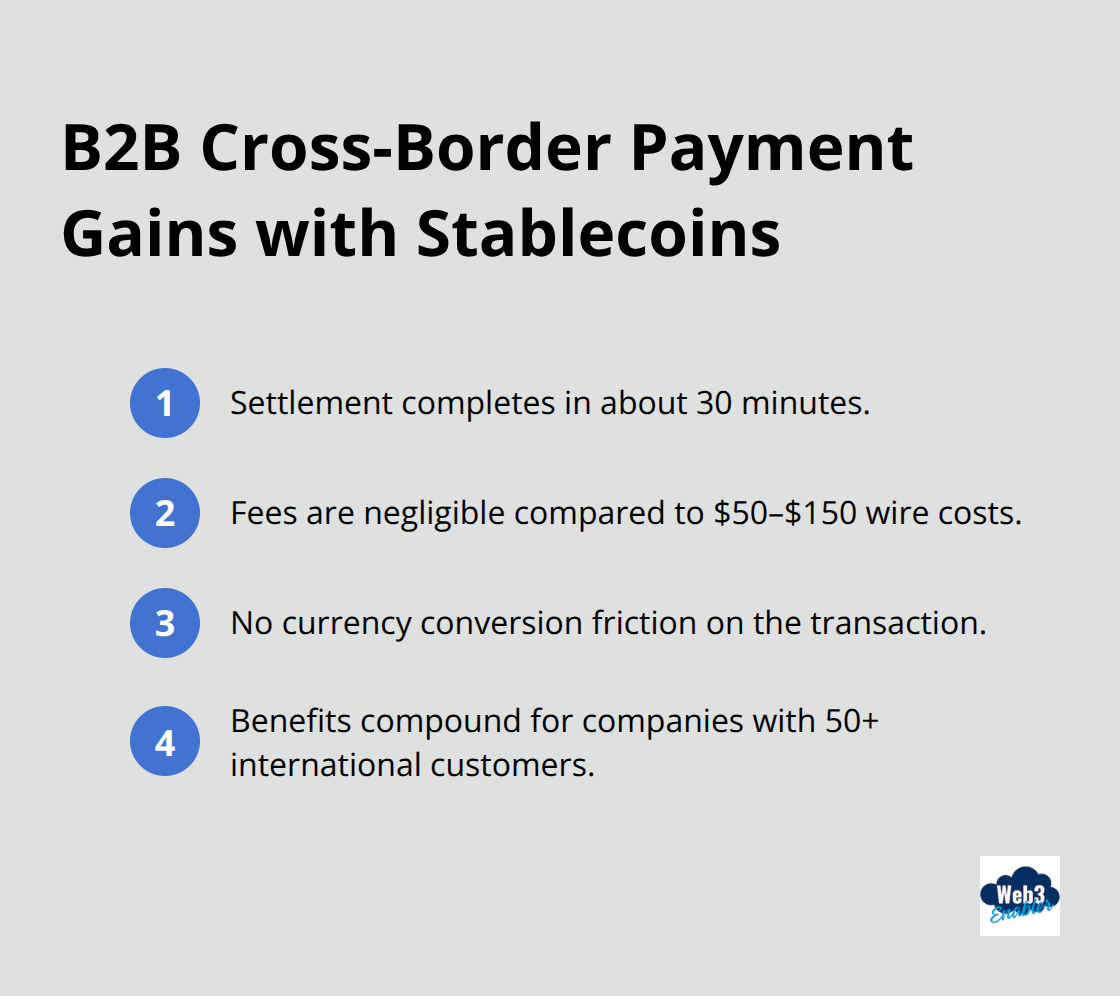
Blockchain technology enables this speed advantage for companies with 50+ international customers, where the difference compounds into meaningful working capital improvement and simplified financial reporting.
B2B teams also eliminate the manual reconciliation nightmare that comes with international payments. When a customer in Germany pays in USDC and your Revenue Cloud system automatically converts it to EUR and deposits it to your German bank account, your accounting team doesn’t need to manually match the payment to the invoice or investigate why the amounts don’t align due to conversion spreads. The transaction records itself accurately, which reduces accounting overhead and accelerates month-end close.
Final Thoughts
Crypto payments stopped being experimental the moment 40% of U.S. merchants started accepting them. Your competitors are already moving, and the ones generating over $500 million in revenue are moving faster. Salesforce Revenue Cloud Payments solves the problem by keeping everything inside the platform your team already knows, without dismantling your entire payment infrastructure.
E-commerce sellers access cash flow 2-3 days faster, which compounds into working capital that funds growth. Financial advisors see client crypto holdings inside their CRM and provide better guidance. B2B companies settle international payments in 30 minutes instead of a week and compete differently. These measurable improvements show up in your cash flow statement and your team’s productivity metrics (not just in theory).
Your payment infrastructure doesn’t need replacement-it needs evolution. Web3 Enabler specializes in connecting blockchain technology with your existing Salesforce infrastructure to handle payments, compliance, and automation so you can focus on growing revenue and serving customers faster.