



Traditional payment systems weren’t built for the speed and efficiency that global businesses need today. X Payments for crypto transactions offers a direct path to faster settlements, lower costs, and real-time transparency across borders.
At Web3 Enabler, we’ve seen firsthand how companies transform their operations by moving treasury, payroll, and vendor payments onto blockchain networks. This guide walks you through the practical steps to implement crypto payments in your business.
Building Your Blockchain Payment Stack
Connecting your payment infrastructure to blockchain networks requires you to choose the right stablecoin networks and ensure your systems communicate with them reliably. Most businesses start with Ethereum, Tron, or Solana because these networks handle the majority of stablecoin transactions globally. Ethereum offers the strongest security and widest merchant support, though transaction costs rise higher during peak periods. Tron provides faster settlements and lower fees, making it ideal for high-volume payroll or vendor payments across Africa and Southeast Asia. Solana delivers the fastest confirmation times, useful for time-sensitive treasury operations.
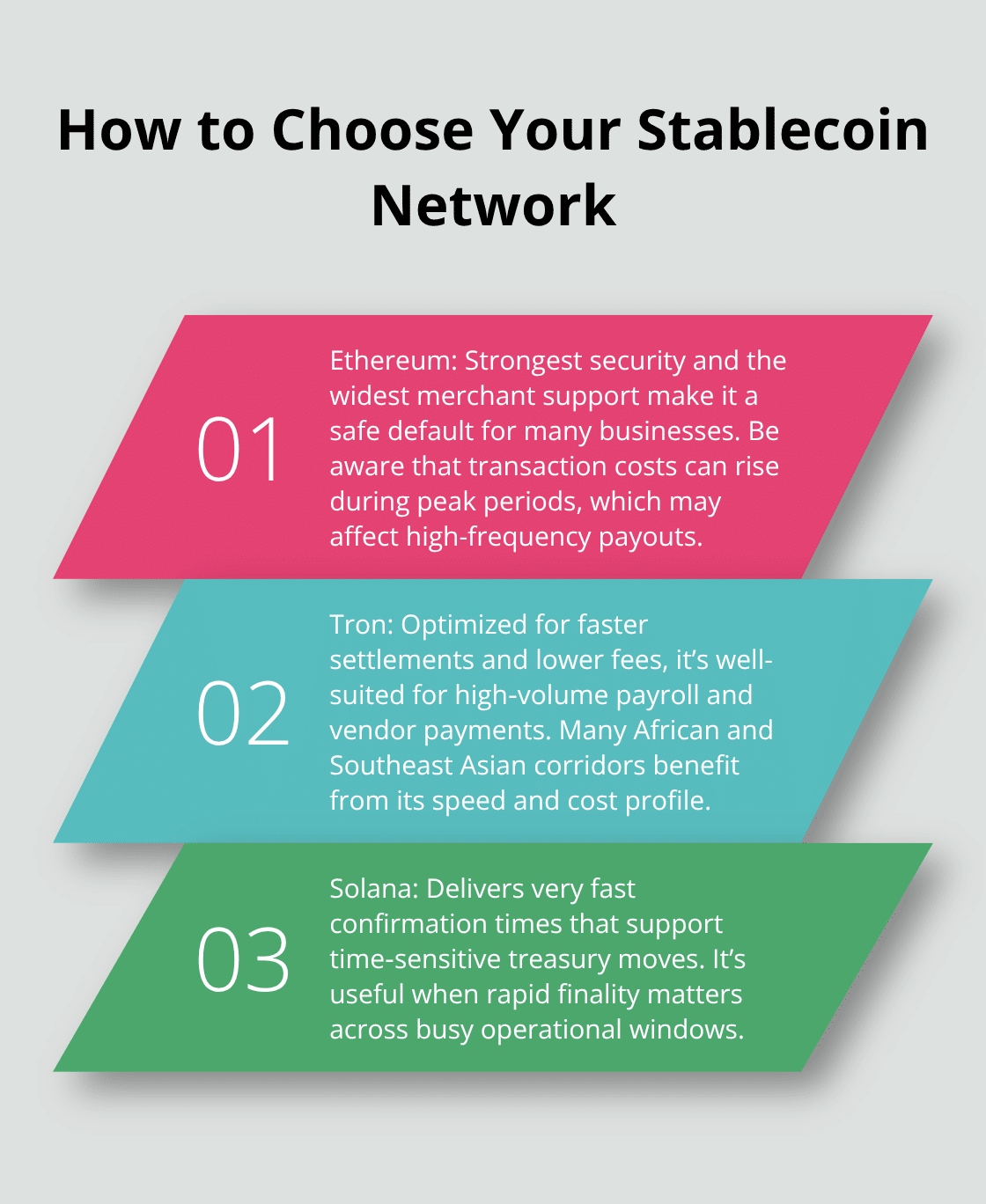
Your transaction volume and geographic focus determine which network works best. If you send payments across Nigeria or South Africa, Tron-based USDT often proves more cost-effective than Ethereum alternatives. Configure your infrastructure to support multiple networks simultaneously so you can route transactions to whichever network offers the best speed and cost at any given moment. This flexibility prevents you from locking into a single network when conditions change.
Selecting and securing your digital wallets
Dollar-pegged stablecoins like USDC and USDT dominate cross-border payments because they eliminate currency volatility that complicates international transactions. For your wallet infrastructure, implement custodial solutions if you manage funds on behalf of clients or employees-this approach centralizes security and simplifies regulatory reporting under frameworks like South Africa’s CARF requirements, which took effect on March 1, 2026. Non-custodial wallets work better when individual contractors or vendors manage their own funds. Your security setup should include multi-signature authorization for any transaction above a threshold you set (typically $10,000 or higher), cold storage for reserves you don’t move regularly, and transaction monitoring that flags unusual patterns immediately. Real-time webhooks notify your accounting team the moment a payment settles, eliminating reconciliation delays that plague traditional banking. Automated sweeps convert stablecoins to local currency within hours of receipt-this prevents you from holding volatile crypto exposure longer than necessary and simplifies tax reporting under local regulations.
Automating currency conversion and reporting
Multi-currency support means your system handles conversion from stablecoins into local fiat automatically at the point of settlement. When you pay contractors in Kenya with USDC, your system converts that USDC to Kenyan Shillings and deposits directly into their bank account without manual intervention. Services like Breet, which focus specifically on African markets, handle this conversion with zero setup fees and settlement in under two hours, with pricing around 0.5%. This automation reduces your finance team’s workload and accelerates cash flow for your vendors. Compliance tooling within your infrastructure captures customer identification details, wallet counts per user, and transaction categories required under emerging frameworks like CARF. This data collection happens automatically during onboarding and payment processing rather than as a separate compliance burden. Treasury automation tools help you rebalance stablecoin holdings across wallets and networks based on upcoming payment schedules, ensuring you maintain sufficient liquidity without over-concentrating funds in any single location. Your reporting system produces transaction exports in formats your accountant and auditors expect, with blockchain transaction hashes linked to your internal payment records for complete auditability.
With your blockchain payment infrastructure configured and secured, you now need to understand how to process transactions efficiently across borders and manage the real-time settlement that makes crypto payments powerful for global operations.
Processing Crypto Transactions at Scale
Settlement Speed Transforms Your Cash Flow
Stablecoin transactions settle in seconds, not days. When you send USDC across Tron to pay a supplier in Lagos, the payment arrives within minutes and converts to Naira instantly through your configured settlement partner. This speed advantage compounds across your operations. A company processing 50 international vendor payments monthly saves roughly 40 to 50 days of float compared to traditional wire transfers, which typically take 3 to 5 business days per transaction. Your cash accelerates through the payment cycle, improving working capital without additional financing.
The settlement speed varies by network. Tron-based USDT and other stablecoins on networks like Ethereum and Solana offer faster transaction processing for African corridors. Choose your primary network based on your payment frequency and geography rather than treating all networks equally.
Cost Efficiency Across International Corridors
Transaction costs on blockchain networks run 80 to 90 percent lower than traditional banking corridors. Sending $100,000 to Nigeria via traditional wire transfer costs $300 to $500 in bank fees plus hidden FX spreads that often consume another 1 to 2 percent of the total amount. The same transfer via USDT on Tron costs roughly $2 in network fees plus your stablecoin conversion spread, typically 0.5 to 1 percent depending on your provider.
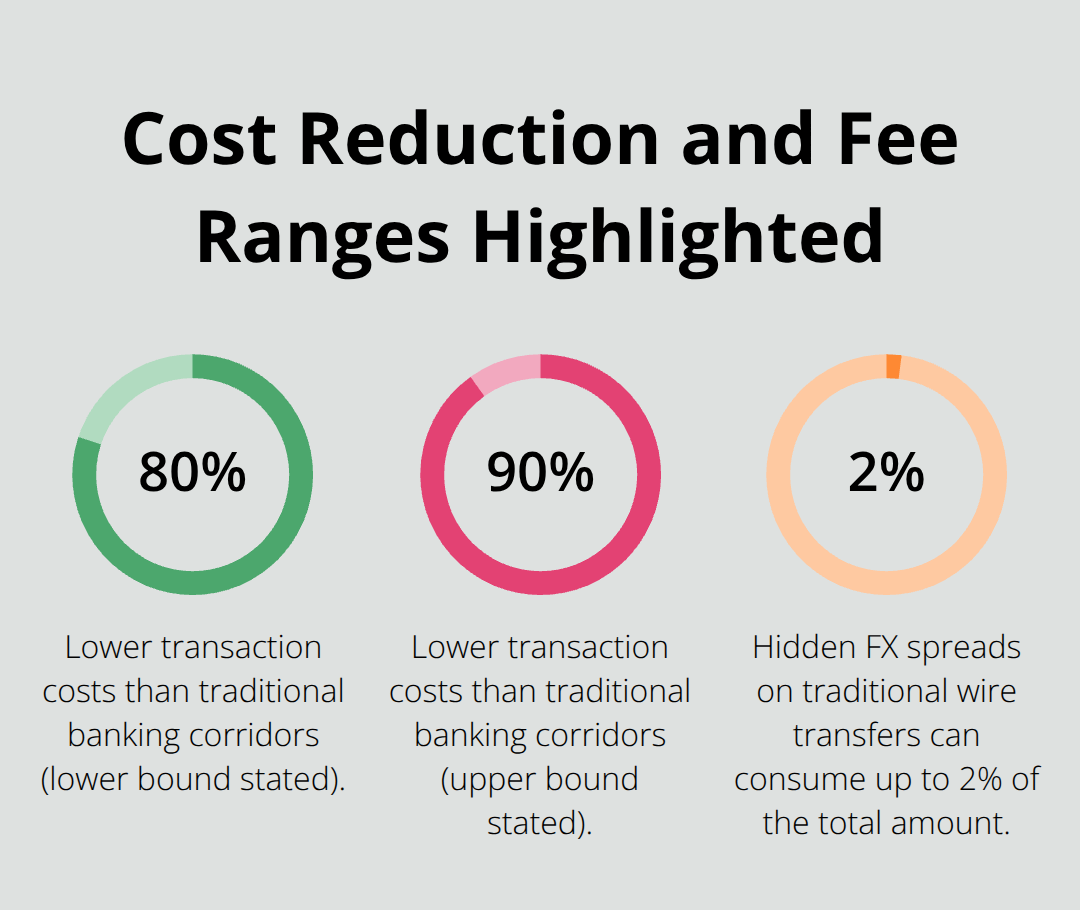
Over a year of regular international payments, this difference funds your entire blockchain infrastructure investment.
For high-volume payroll runs across multiple African countries, Tron’s speed and cost efficiency typically outweigh other considerations. Your finance team redirects resources from payment processing toward strategic work that actually moves your business forward.
Real-Time Visibility and Compliance Automation
Real-time transaction monitoring through webhooks eliminates reconciliation overhead that traditional banking creates. Your accounting system receives instant notification the moment a payment settles on-chain, with the transaction hash permanently recorded. This real-time visibility prevents the 3 to 5 day lag where funds sit in limbo between banks, making your balance sheet accuracy immediate rather than estimated.
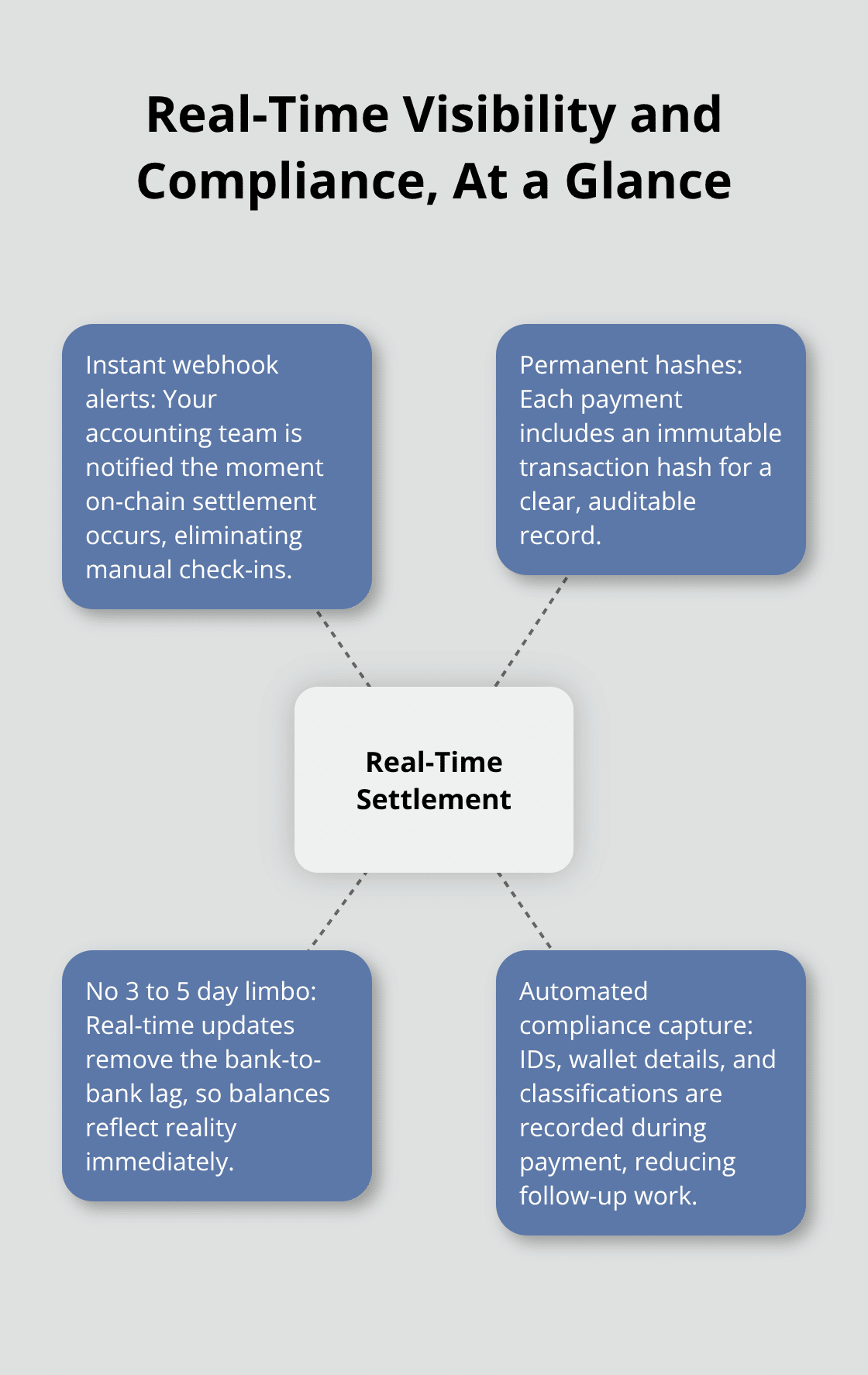
Compliance data collection happens automatically during settlement rather than requiring manual follow-up. When you pay a contractor, your system captures their identification details, wallet information, and transaction classification simultaneously, satisfying CARF reporting requirements that took effect in South Africa on March 1, 2026. This automation removes the compliance friction that typically emerges weeks after transactions occur, when finance teams scramble to locate missing documentation or reconstruct transaction details.
Your real-time settlement infrastructure now handles individual transactions efficiently, but managing these payments across your entire organization-from payroll to vendor management to treasury operations-requires orchestrating multiple payment flows simultaneously.
Deploying Stablecoin Payments Across Your Business Operations
Contractor Payments: Speed and Cost Reduction
Contractor payments expose the inefficiency of traditional banking immediately. When you hire a developer in Kenya or a designer in Nigeria, wiring them their monthly fee takes 3 to 5 days while your bank extracts 1 to 2 percent in hidden FX spreads on top of explicit transfer fees. Stablecoin payments eliminate this friction entirely. You load USDC into your settlement infrastructure, route it through Tron to minimize costs, and your contractor receives Kenyan Shillings or Nigerian Naira in their local bank account within hours. Breet handles this conversion at 0.5 percent with zero setup fees and settlement under two hours, meaning a $5,000 monthly payment costs you roughly $25 in conversion fees instead of $75 to $100 through traditional wires.
For a company paying 20 contractors monthly across African markets, this difference amounts to $12,000 to $18,000 annually. Your finance team stops chasing wire confirmations and starts focusing on strategic vendor relationships instead.
Treasury Operations and Capital Efficiency
Treasury operations shift fundamentally when you manage dollar-denominated reserves as stablecoins rather than holding them in low-yield bank accounts. Companies holding $500,000 or more in operational reserves typically distribute these funds across multiple bank accounts to manage risk, but this fragmentation creates reconciliation overhead and leaves capital sitting idle. Stablecoin treasury automation tools rebalance your reserves across blockchain networks and wallets based on your upcoming payment schedule, ensuring sufficient liquidity for payroll while keeping excess capital available for faster movement.
You maintain real-time visibility into your global cash position across every network and wallet simultaneously, something traditional banking infrastructure cannot provide. When you need to deploy capital quickly for an acquisition or opportunity, stablecoin reserves move in minutes rather than days, eliminating the cash-flow delays that plague traditional international operations.
Payroll Automation Across Multiple Countries
Payroll at scale across multiple countries becomes genuinely practical with stablecoin infrastructure. A regional company with employees in Nigeria, Kenya, Ghana, and South Africa faces nightmarish complexity through traditional banking: each country requires different wire instructions, multiple banks take different processing times, and FX rates fluctuate daily between payment initiation and settlement. Stablecoin payroll automation handles 50 or 500 employees simultaneously with a single transaction.
Your payroll system generates a file listing each employee’s address and USDC amount, your infrastructure converts USDC to each employee’s local currency automatically, and funds settle into bank accounts within hours. The entire process reduces your finance team’s manual work from days to minutes while improving employee satisfaction through faster, more predictable payments. Compliance automation captures all required data during this process, satisfying CARF requirements in South Africa and similar frameworks elsewhere without additional effort. For companies with significant seasonal variations in headcount, this efficiency prevents payroll bottlenecks during busy hiring periods when finance teams typically face maximum pressure.
Final Thoughts
Crypto transactions eliminate the friction that traditional banking creates across your global operations. Stablecoin infrastructure reduces costs by 80 to 90 percent compared to wire transfers, accelerates settlement from days to minutes, and automates compliance reporting that would otherwise consume weeks of manual work. These advantages compound across contractor payments, treasury operations, and payroll processing, freeing your finance team to focus on strategic priorities rather than payment logistics.
Start with a single payment corridor where your volume justifies the setup effort-typically contractor payments to a high-activity market like Nigeria or Kenya. Configure your wallet infrastructure with multi-signature security and automated conversion to local currency, then process your first batch of payments through Tron-based stablecoins to validate the workflow. Your team learns the mechanics, your vendors experience faster payments, and you establish the foundation for expanding across other payment types.
At Web3 Enabler, we built our platform to connect blockchain transactions directly into your existing Salesforce environment, eliminating the integration complexity that typically slows crypto adoption. X Payments for crypto transactions manages digital assets, tracks international contractor payments, and handles settlement-all within the system your team already uses daily. Identify your highest-friction payment corridor, map out the specific workflow you’ll automate, and validate the cost savings against your current banking fees.