



Paying contractors and suppliers across borders has always been slow and expensive. Banks take days to process transfers, charge hefty fees, and exchange rates eat into your margins.
Stablecoins change this. At Web3 Enabler, we’ve seen companies cut payment times from days to minutes while reducing costs by up to 90%. This guide walks you through the practical steps to pay contractors crypto, from wallet setup to tax compliance.
Building Your Stablecoin Payment Stack
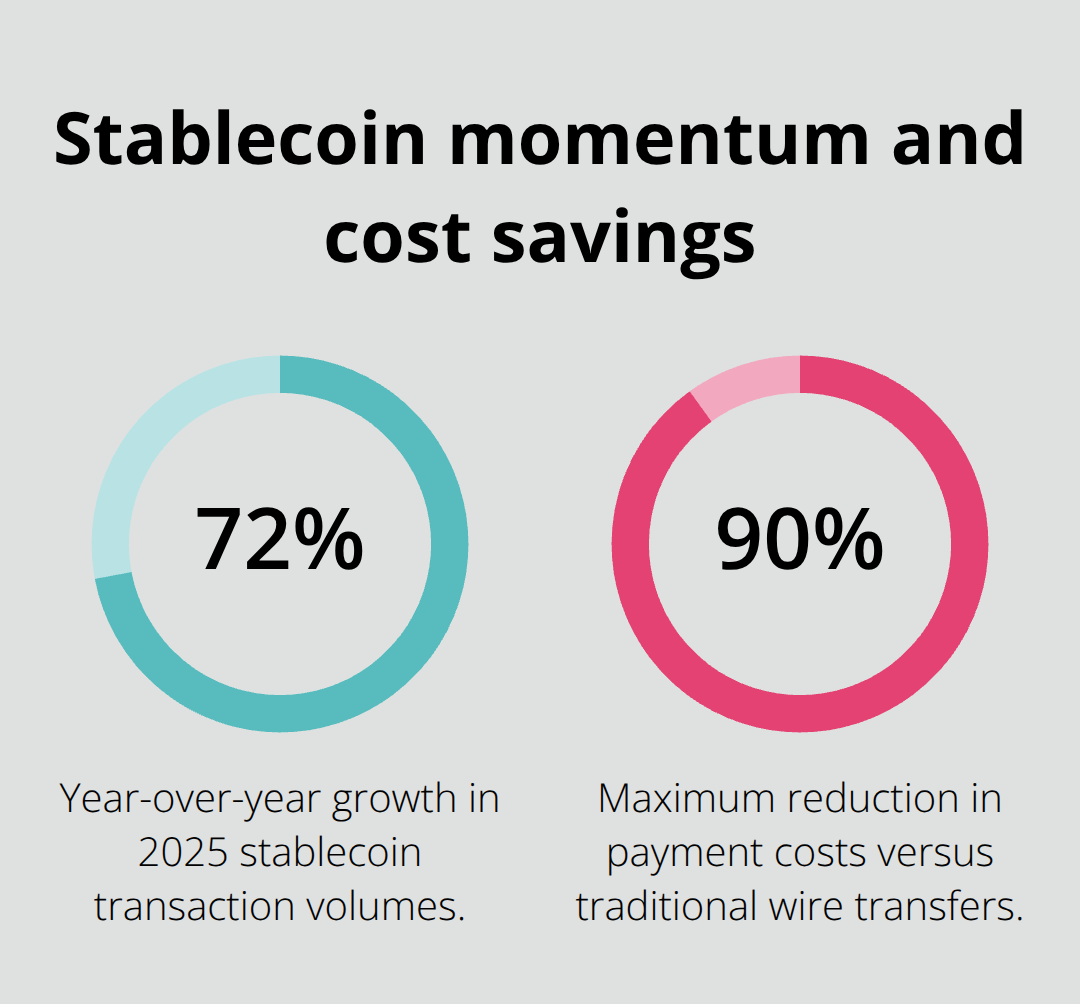
USDC and USDT dominate international contractor payments for good reason. USDC, backed by cash and short-duration U.S. Treasuries with monthly attestations from Circle, offers transparency that matters when moving company funds. USDT holds the largest stablecoin market cap, but USDC’s regulatory clarity makes it the safer choice for businesses handling employee and contractor payroll. In 2025, stablecoin transaction volumes reached approximately $33 trillion, up 72% year-over-year, driven largely by companies moving away from traditional wire transfers. Try USDC as your primary currency. The stability justifies the minor liquidity difference, and your accountants will sleep better knowing funds remain fully reserved.
Securing Your Wallet Infrastructure
Wallet security determines whether stablecoins simplify your payments or create compliance nightmares. Implement multi-signature wallets that require multiple approvals before funds move, cold storage for holdings above $50,000, and two-factor authentication on every access point. MetaMask, Coinbase Wallet, Gnosis Safe, and MEW all support USDC across Ethereum, Polygon, Arbitrum, Optimism, and Avalanche networks. Choose Arbitrum or Polygon for contractor payments-transaction fees run $0.10 to $1 versus $5 to $30 on Ethereum, and settlement happens within minutes. Document every wallet address, private key custody arrangement, and access protocol in writing. When contractors receive payments, they need clear instructions on wallet setup and security. Most international contractors have never held crypto before, so your onboarding must include step-by-step wallet guidance and warnings against phishing attempts.
Connecting Payments to Your CRM
Web3 Enabler integrates directly into Salesforce, eliminating manual payment tracking and reconciliation work that consumes hours from your finance team. Your contractor records, payment amounts, and transaction history live in one system instead of scattered across spreadsheets and bank dashboards. When you initiate a USDC payment through Web3 Enabler’s native Salesforce interface, the blockchain transaction connects automatically to your CRM, creating an immutable audit trail that auditors expect. Salesforce handles contractor data, Web3 Enabler handles the blockchain rails, and your accounting team sees real-time payment status without logging into separate wallets or exchanges. This integration reduces the time spent on international contractor administration from days to hours per month.
Moving Forward to Invoicing and Accounting
Your wallet infrastructure and CRM integration form the foundation for reliable stablecoin payments. The next step involves structuring your invoices, managing foreign exchange considerations, and recording transactions in ways that satisfy both your accountants and tax authorities. These processes transform stablecoin payments from a technical capability into a compliant, auditable payment method that scales across your entire contractor network.
Managing Invoicing and Accounting for Stablecoin Payments
Structuring Invoices for Stablecoin Payments
Your invoices must specify stablecoin payments upfront, not as an afterthought. Include the exact stablecoin (USDC or USDT), the blockchain network (Arbitrum or Polygon for cost efficiency), and the USD equivalent amount converted at a fixed rate on the invoice date. This prevents disputes when contractors receive slightly different token amounts due to network fees or price fluctuations between invoice and payment.
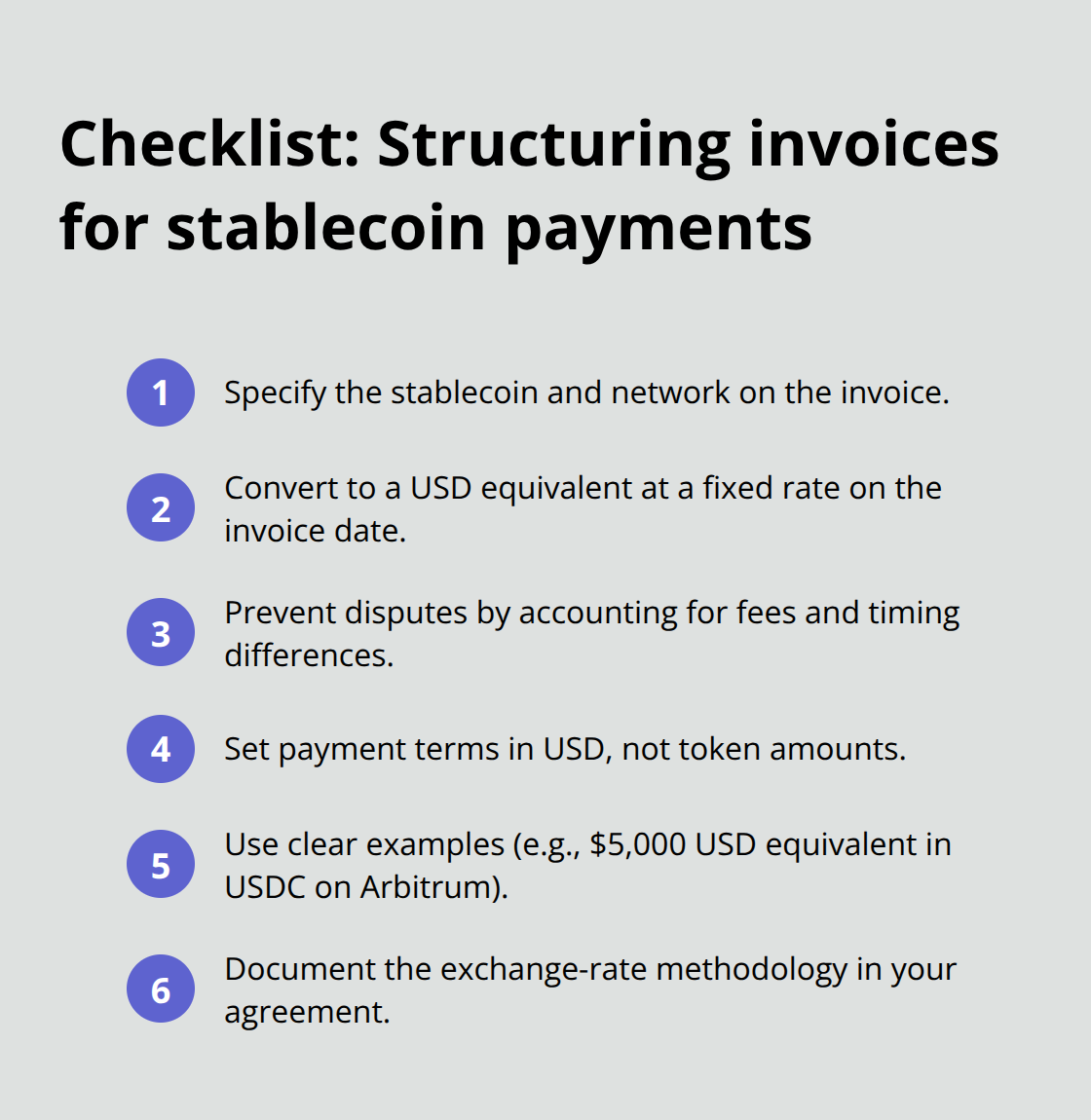
Set payment terms in USD terms, not token amounts. For example, invoice for $5,000 USD equivalent in USDC on Arbitrum, not 5,000 USDT tokens. This protects both parties from volatility and simplifies tax reporting.
Most contractors expect 30-day terms; stablecoin payments let you compress this to weekly or bi-weekly disbursements without the traditional banking delays, so negotiate shorter cycles in exchange for the payment speed advantage. Document the exchange rate methodology in your master service agreement. State whether you lock the rate at invoice date, payment date, or use a third-party reference like CoinGecko’s 24-hour average. When disputes arise about FX treatment, clear contracts eliminate arguments.
Recording Transactions with Proper Documentation
Record the payment at the USD fair market value of USDC or USDT on the payment date, not the token count. If you paid a contractor $5,000 worth of USDC on January 15, record $5,000 as the expense, regardless of network fees or token price movements. Track the blockchain transaction ID, wallet address, payment date, amount in stablecoins, USD conversion rate, and contractor name in a dedicated ledger. This audit trail satisfies tax authorities and auditors who expect to trace every international payment.
In 2025, stablecoin transaction volumes hit $33 trillion, and regulators increasingly scrutinize how companies record these payments. Your accounting system must show that stablecoin payments received the same documentation rigor as wire transfers. Create a monthly reconciliation between your blockchain payments and accounting records. Pull transaction data directly from the blockchain using Etherscan or Polygonscan to verify amounts match your books. This catches discrepancies early and prevents accumulated errors that create audit nightmares.
Managing Foreign Exchange and Contractor Elections
For contractors in high-inflation countries, document their choice to receive stablecoins explicitly. If a contractor in Argentina earning $3,000 monthly chooses USDC instead of pesos, record that decision in writing. This protects you if tax authorities question why you paid in crypto instead of local currency. The contractor’s election shields you from claims you failed to pay in appropriate currency.
Set up separate general ledger accounts for stablecoin payments by contractor type and country. Track contractors separately from suppliers, and group by jurisdiction to simplify tax reconciliation across different filing requirements. This granular tracking costs nothing in modern accounting software but saves hours during tax season. Salesforce integration automatically timestamps each transaction and records the fair market value in USD at payment time, creating the documentation your tax team needs without manual spreadsheet work.
Moving to Tax and Compliance Considerations
Your invoicing structure and accounting records now form a solid foundation for compliant stablecoin payments. The next step involves understanding how tax authorities classify these payments, navigating contractor versus employee distinctions, and selecting custody arrangements that satisfy regulatory requirements across multiple jurisdictions.
Tax Compliance for Stablecoin Contractor Payments
Contractor Classification and Tax Status
Contractor versus employee classification determines whether you file 1099 forms or handle payroll taxes, and stablecoin payments do not change this fundamental distinction. The IRS classifies workers based on control, investment, and profit/loss potential, not payment method. A contractor who sets their own hours, uses their own equipment, and serves multiple clients remains a contractor whether paid in dollars or USDC. Document this classification in writing before the first payment. When tax authorities question why you paid in crypto, your contract showing independent contractor status protects you. Stablecoin payments create an audit trail that actually strengthens your position if classification is ever challenged, since blockchain transactions timestamp every payment and create immutable records of amounts and dates.
The real compliance risk emerges when companies blur the line between contractors and employees to avoid payroll taxes, then use stablecoins as cover. Regulators see through this. Your classification must stand on its own merits, regardless of currency.
Withholding and Tax Obligations Across Jurisdictions
Tax obligations differ drastically by jurisdiction, and stablecoins expose this complexity because international contractors suddenly become easier to pay. A contractor in Mexico owes Mexican income tax on stablecoin payments at the same rate as peso payments. A contractor in Singapore files Singapore tax returns. You must withhold taxes where legally required and file informational returns documenting payments made to contractors in each country.
This is where most companies stumble. They adopt stablecoins for speed and cost savings, then neglect local withholding requirements because stablecoin payments feel less formal than wire transfers. They’re wrong. Your accounting system must flag when contractors operate in jurisdictions requiring withholding. Set up separate payment workflows for jurisdictions with withholding obligations versus those without. Document the withholding rate, the amount withheld, and the tax authority to which funds were remitted. Auditors expect this documentation linked to contractor records and payment dates.
Custody Arrangements and Regulatory Requirements
Custody and regulatory requirements vary by region, and your choice of wallet infrastructure determines compliance burden. Cold storage wallets held by your company create custodial responsibility under emerging regulations. Multi-signature wallets where contractors control one key reduce your custody exposure but complicate your control over funds. Regulated stablecoin providers like Circle, which backs USDC with monthly attestations, shift some custody risk to the issuer. This matters because if USDC’s reserves are questioned, contractors holding it face potential losses. Using fully reserved stablecoins from regulated issuers protects your contractor relationships and reduces your audit risk.
Country-Specific Restrictions and Compliance Verification
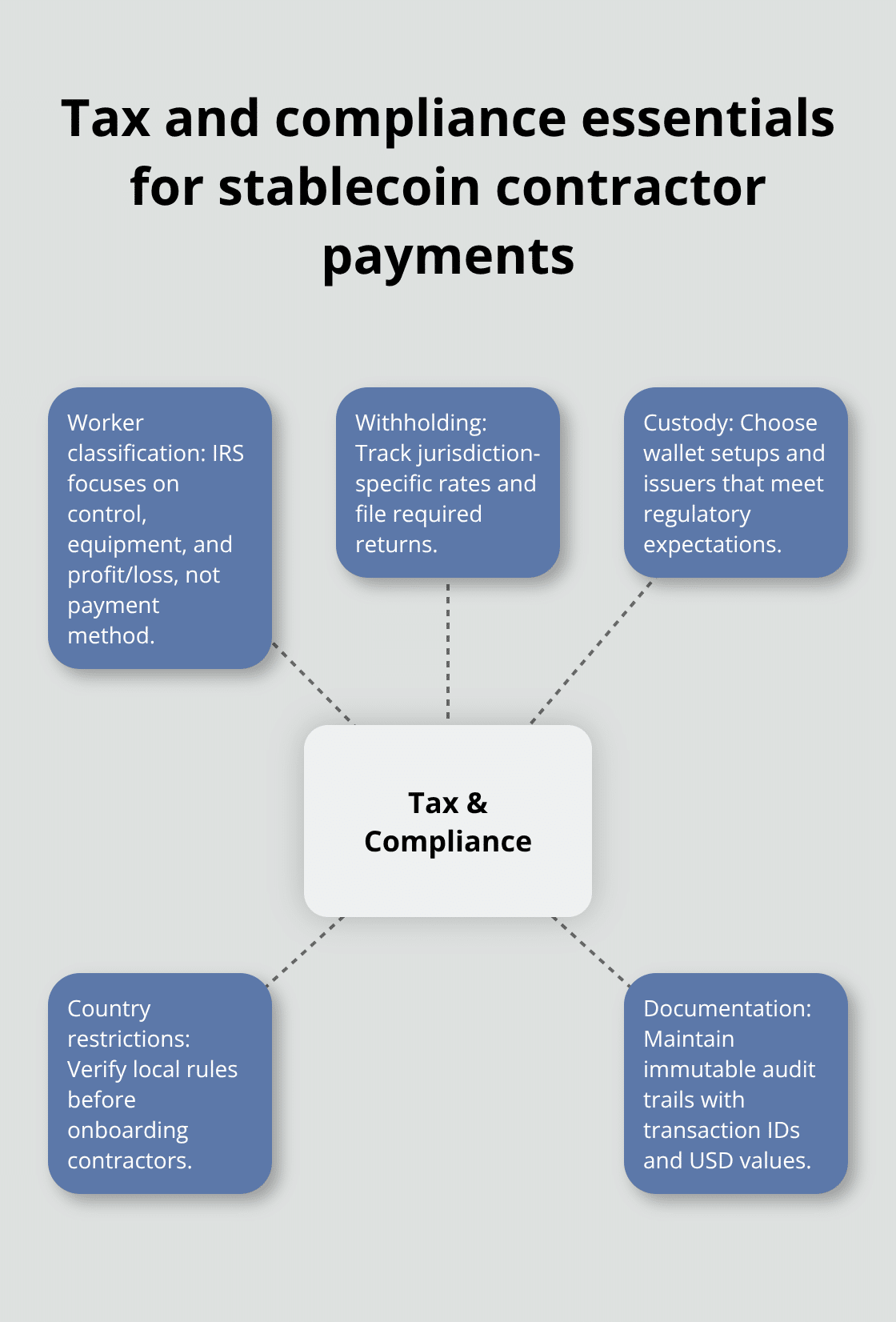
Some countries restrict stablecoin payments entirely. Verify local regulations before sending funds to contractors in unfamiliar jurisdictions. Your manual approach must include a country-by-country regulatory checklist before onboarding any new contractor. The cost of getting compliance wrong-penalties, back taxes, audit fees-far exceeds the cost of spending an hour verifying regulations upfront.
Final Thoughts
Stablecoin payments eliminate the friction that has plagued international contractor payments for decades. You move from multi-day settlement windows to transactions that clear in minutes, cut costs by up to 90% compared to traditional wire transfers (which charge $25 to $50 per transaction plus hidden FX markups), and your contractors in underbanked regions gain access to USD-equivalent stability without relying on local banking infrastructure. These advantages compound across your entire contractor network, turning what was once a compliance headache into a competitive advantage.
Getting started requires three concrete steps. First, choose USDC as your primary stablecoin and set up multi-signature wallets on Arbitrum or Polygon to minimize transaction fees. Second, structure your invoices in USD terms with fixed exchange rates and clear payment terms, then record every transaction at fair market value with blockchain transaction IDs for audit purposes. Third, verify contractor classification, withholding obligations, and country-specific regulations before the first payment goes out.
We at Web3 Enabler built our platform specifically to handle this complexity. When you pay contractors crypto through Web3 Enabler, your CRM automatically timestamps the transaction, records the USD fair market value, and links everything to your accounting records, so you manage international contractor payments from within Salesforce instead of juggling wallets, exchanges, and spreadsheets.
Frequently Asked Questions: Paying International Contractors and Suppliers With Stablecoins
How do you pay international contractors and suppliers using stablecoins?
To pay international contractors with stablecoins, you choose a stablecoin (most businesses use USDC or USDT), select a low-fee network (often Arbitrum or Polygon), collect the contractor’s wallet address, and send the payment on-chain. For accounting and compliance, you also record the USD value at the time of payment and store the transaction hash as proof of settlement.
Is it legal to pay contractors in crypto or stablecoins?
In many jurisdictions, paying contractors in stablecoins is allowed, but legality depends on local laws, contract terms, and compliance requirements. The safest approach is to document contractor consent, verify country-specific restrictions before onboarding, and maintain complete payment records (invoice, agreement, USD equivalent, and transaction ID). Always consult tax and legal advisors for the countries involved.
USDC vs USDT: which stablecoin is better for contractor payments?
USDC is often preferred for business contractor payments because it is designed to be transparent and accounting-friendly, and many companies view it as a lower-risk option for corporate treasury. USDT is widely used and highly liquid, but some businesses choose USDC to align better with internal compliance and reporting expectations. The best choice depends on your risk policy, counterparties, and where funds will be settled.
What blockchain network is best for paying contractors (Arbitrum vs Polygon vs Ethereum)?
For cost-efficient stablecoin payments, many teams use L2 or low-fee networks like Arbitrum or Polygon because transaction fees are typically far lower than Ethereum mainnet. Ethereum can be more expensive during network congestion. The best network is the one your contractor can reliably access while meeting your cost and settlement-time goals.
What wallet setup should a business use to pay contractors safely?
Most businesses use a controlled wallet setup with clear access policies, multi-signature approvals for outbound transfers, and strong security like two-factor authentication. Many teams also separate operational wallets from larger holdings and document custody, access, and approval workflows. A secure setup reduces fraud risk and supports clean audits.
Do contractors need a wallet to receive stablecoin payments?
Yes, the contractor needs a compatible wallet address on the correct network to receive stablecoins. Because many international contractors are new to crypto, onboarding should include simple wallet instructions, how to confirm the network, and basic security tips (like avoiding phishing links and protecting recovery phrases). This reduces failed transfers and support issues.
How should invoices be structured for stablecoin payments?
Invoices should specify the stablecoin (for example, USDC), the blockchain network (for example, Arbitrum), the contractor wallet address, and the USD amount being paid. Many businesses set terms in USD and clarify how the conversion rate is determined (invoice date vs payment date, and the pricing source used). This prevents disputes and simplifies tax reporting.
How do you record stablecoin payments in accounting and bookkeeping?
Stablecoin payments are typically recorded at the USD fair market value on the payment date, not just the token amount. Best practice is to store the transaction hash, wallet address, timestamp, USD value, and any fees as supporting documentation. This creates an audit trail similar to (or stronger than) bank wire documentation.
Do you still issue 1099s or handle withholding when paying contractors in stablecoins?
Yes. Paying in stablecoins does not change worker classification or tax obligations. If a contractor is reportable under your local rules, you still issue the appropriate forms (such as 1099s in the U.S. when applicable) and follow withholding requirements where legally required. The payment method changes settlement speed, not compliance responsibilities.
How does Web3 Enabler help pay contractors crypto through Salesforce?
Web3 Enabler connects stablecoin payments directly into Salesforce so contractor records, payment history, and transaction details live in one system. When a payment is initiated, the on-chain transaction can be linked to CRM records automatically, creating a clear, immutable audit trail. This reduces manual tracking across wallets, exchanges, spreadsheets, and bank dashboards.