


Your business probably still moves money the way it did five years ago. Slow. Expensive. Complicated.
We at Web3 Enabler are watching digital payments trends shift dramatically, and the companies ignoring this change are getting left behind. Stablecoins, blockchain settlement, real-time visibility-these aren’t sci-fi anymore. They’re reshaping how enterprises actually pay each other.
This post breaks down what’s happening and why your finance team should care.
The Rise of Stablecoin Adoption in Business Payments
Stablecoins aren’t the wild west anymore. Enterprises adopt them because they solve real problems that traditional banking created. A stablecoin like USDC pegs its value to the U.S. dollar, which means your finance team stops sweating currency volatility. You get blockchain’s speed without crypto’s mood swings. Stablecoin adoption in enterprise payments is reshaping how companies move money, signaling a shift from experiments to enterprise-grade infrastructure. That’s not hype-that’s momentum. Companies in fintech, marketplaces, trading, and global payroll already move money this way because settlement happens in minutes instead of days. Your working capital doesn’t sit in limbo waiting for correspondent banks to play intermediary. BVNK powers stablecoin payments for Visa Direct, connecting digital asset rails with the Visa network for rapid settlement. That integration matters because it bridges the gap between blockchain speed and existing payment rails your business already trusts.
How Stablecoins Cut Through Cross-Border Friction
Cross-border payments using traditional methods are expensive nightmares. A wire to Europe takes three to five business days, costs $15 to $50 per transaction, and involves multiple correspondent banks each taking a cut. Stablecoins on blockchain settle in seconds with transparent, predictable fees. Direct SEPA access enables 24/7 instant euro payments, shortening European settlement times and expanding euro-wide velocity. Your supplier in Frankfurt gets paid immediately instead of waiting through a weekend. Enterprises gain real-time cross-border visibility and improved liquidity management when they settle on blockchain rails, reducing reliance on intermediary banks. The practical advantage: you know exactly when funds arrive.
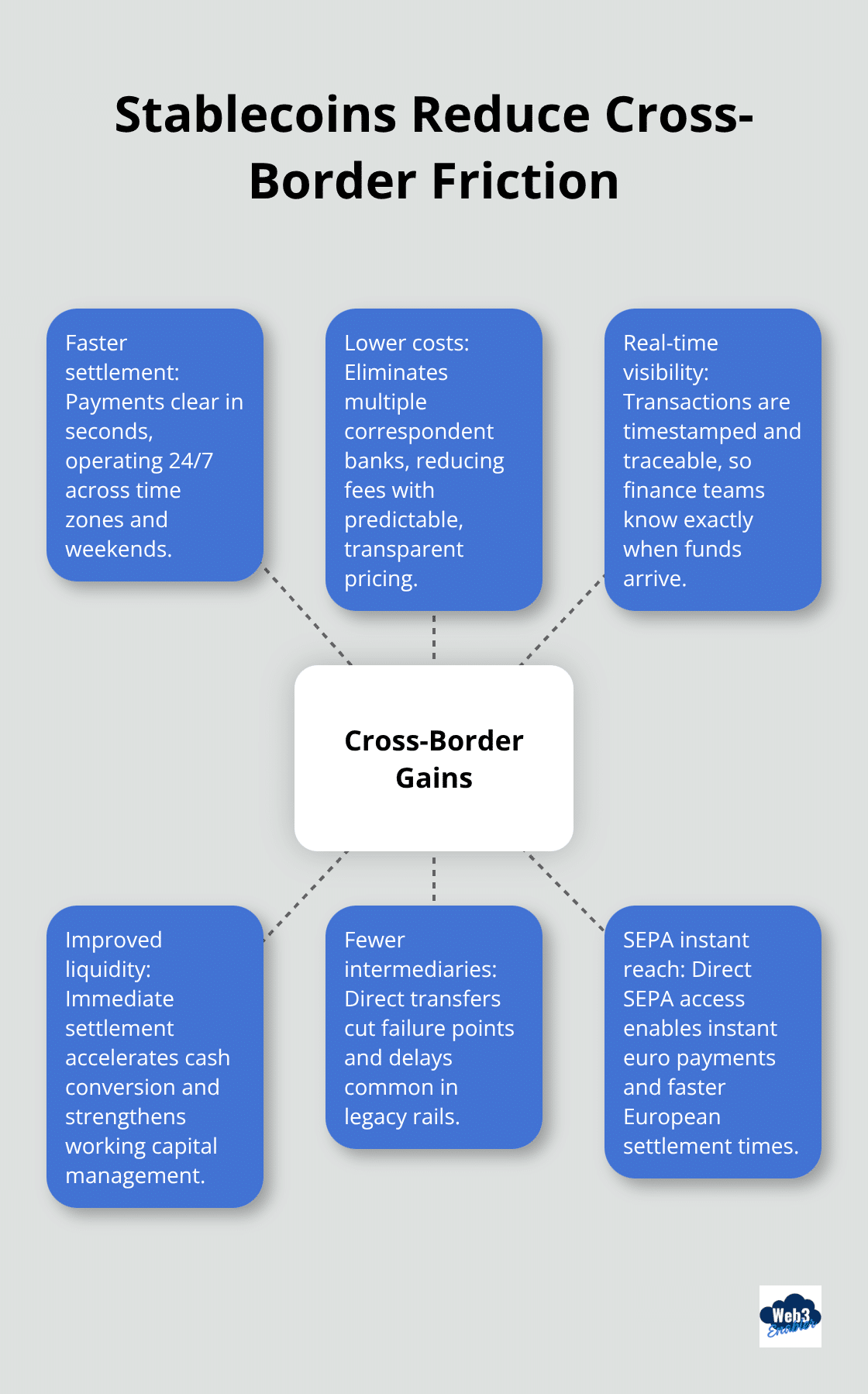
Each blockchain transaction is timestamped, traceable, and final once confirmed, eliminating chargeback risk and reconciliation headaches. High-volume cross-border transfers benefit most because blockchain rails lower costs and friction (cutting out multiple correspondent banks entirely).
Compliance Isn’t the Barrier Anymore
Regulatory concerns used to block stablecoin adoption. That’s changing fast. Licensed providers help meet AML/KYC and sanctions-screening requirements for blockchain payments. Institutional momentum is growing, with BlackRock, Franklin Templeton, and J.P. Morgan exploring tokenization pilots, signaling regulatory maturity and mainstream interest. Your finance team needs platforms with audited smart contracts, strong custody and verification practices, and monitoring of regulatory developments. Web3 Enabler provides Salesforce Native blockchain solutions designed specifically for businesses that need compliance baked in alongside speed. You accept stablecoin payments, send global payments faster and more securely, and maintain the visibility your CFO demands-all within systems your team already uses daily. The infrastructure exists. The regulatory pathways are clear. What matters now is choosing partners who’ve already solved the compliance puzzle instead of building from scratch.
Real-World Use Cases Across Industries
Stablecoins aren’t theoretical anymore-they’re solving actual business problems right now. Fintech platforms use them to move customer funds across borders without the three-to-five-day settlement lag. Marketplaces leverage stablecoins to pay sellers instantly, improving cash flow and seller satisfaction. Trading firms settle positions in minutes rather than waiting for traditional banking hours. Global payroll teams pay contractors in their local currency equivalents without expensive wire fees or currency conversion markups. Each industry sees the same pattern: faster settlement, lower costs, and better cash visibility. The companies moving first gain a competitive edge because they free up working capital and reduce operational friction their competitors still tolerate.
Speed and Security: Why Businesses Are Moving Away From Traditional Methods
Traditional banking infrastructure treats speed like a luxury feature, not a requirement. A standard wire transfer takes three to five business days because money moves through correspondent banks, each one adding delays and fees.
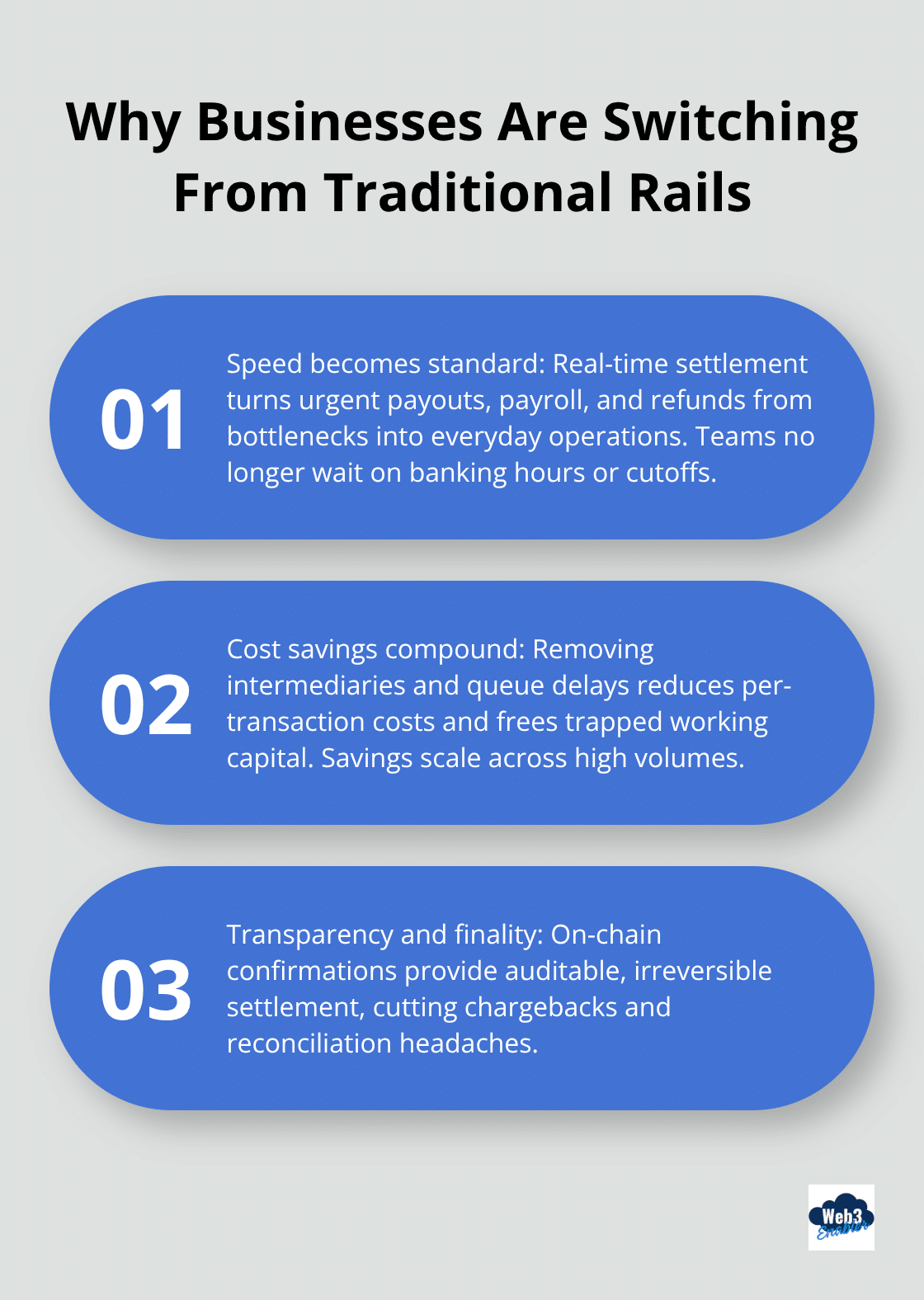
According to J.P. Morgan Strategic Insights, real-time payments settle in seconds, which immediately improves cash flow, treasury visibility, and customer satisfaction. The difference matters operationally: urgent supplier payments, instant payroll runs, and quick refunds become feasible instead of impossible.
When you move $500,000 to a supplier in Singapore using traditional methods, that money sits in transit while your working capital gets trapped. Settlement happens on banking schedules, not business schedules. Blockchain-based settlement removes that friction entirely because transactions finalize in minutes regardless of time zones or banking holidays.
The Cost Advantage Compounds Quickly
Traditional cross-border payments run $15 to $50 per transaction after correspondent bank fees, currency conversion markups, and intermediary charges accumulate. Blockchain rails cost pennies because there’s no middleman extracting value at each step. J.P. Morgan notes that RTP adoption is accelerating in business contexts and may substitute ACH in many transactions, signaling that enterprises recognize the old system’s weakness.
Your finance team stops tolerating delays once they experience real-time settlement because going back feels like moving backwards. The working capital freed up from faster settlement compounds across hundreds of transactions monthly, creating measurable impact on cash flow and operational efficiency.
Transparency Replaces Hidden Intermediaries
Blockchain payments provide security advantages traditional banking obscures. Each transaction gets timestamped, traceable, and final once confirmed, which eliminates chargeback risk and reconciliation headaches that plague wire transfers. When a payment confirms on-chain, it’s genuinely settled-not pending, not reversible, not subject to intermediary disputes.
This finality matters for high-volume operations because chargebacks on traditional payments cost time and administrative overhead. Fraud detection improves because every transaction creates an auditable record visible to authorized participants. Traditional banking hides fraud until statements arrive; blockchain payments show suspicious activity immediately.
Real-Time Visibility Replaces Opacity
J.P. Morgan emphasizes that blockchain and distributed ledger technology reduce fraud and enable secure cross-border payments with real-time fund tracking. Your treasury team gains visibility into exactly where funds are and when they’ll arrive, replacing the opacity of correspondent banking with transparent, verifiable settlement.
AI and machine learning enhance payment security further with real-time fraud detection and adaptive authentication, reducing risk without harming user experience. Licensed providers implement AML/KYC and sanctions-screening requirements natively into blockchain payment platforms, so compliance happens automatically rather than as a separate, sluggish process.
The Security Model Shifts Fundamentally
The security model shifts from hoping intermediaries protect your money to having cryptographic proof that transactions are legitimate and final. This shift matters because it moves control from distant correspondent banks to your organization, where you can monitor and verify every transaction in real time.
Enterprises that integrate blockchain payments into their existing systems gain competitive advantages that compound over time. The next section explores how to actually connect these faster, more secure payment rails with the business systems your team already relies on daily.
The Integration of Digital Payments Into Existing Business Systems
Your ERP system tracks every transaction, every invoice, every payment. Your CRM holds customer data and payment history. These systems talk to each other, but they stop at the bank’s front door. Traditional payment rails exist outside your operational visibility, which means your finance team watches a payment leave the system but cannot track it in real time until a bank statement arrives days later. Blockchain payments change this completely because they integrate directly into your existing infrastructure instead of requiring parallel systems. Salesforce Native blockchain solutions connect your payment operations with the platforms your team already uses daily. Your team accepts stablecoin payments, sends global payments faster and more securely, and maintains complete visibility across payment status and settlement confirmation without switching between applications. When a payment settles on-chain, that transaction data flows directly into your ERP and CRM, eliminating manual reconciliation and the delays that plague traditional banking integrations. This matters operationally because your finance team stops asking where money is and starts knowing exactly where it is at every moment.

Reconciliation Happens Automatically When Transactions Become Transparent
Traditional payments create reconciliation nightmares because bank statements arrive after settlement, forcing your team to manually match transactions against invoices and purchase orders. Blockchain transactions settle in minutes with complete transparency, meaning reconciliation occurs automatically rather than consuming hours of manual work. Each transaction is timestamped, traceable, and final once confirmed, so your ERP system knows with certainty when funds arrived and when settlement completed. This eliminates the common scenario where a payment clears in your bank account but does not match the corresponding invoice in your accounting system for days. Enterprises implementing blockchain payments report immediate improvements in cash flow visibility because working capital moves faster and your team stops managing phantom transactions that exist in limbo between systems. The practical impact compounds across high-volume operations where traditional payments might require dedicated staff just to reconcile discrepancies between banking systems and accounting records. Real-time financial visibility means your CFO accesses accurate cash position data instantly rather than waiting for overnight batch processing from legacy banking systems.
Automation Transforms Manual Payment Workflows Into Frictionless Operations
Most enterprise payment workflows still involve human approval steps that slow operations unnecessarily. A purchase order arrives, someone creates a payment instruction, another person approves it, then someone else initiates the wire transfer. Each step introduces delay and human error. Blockchain integration enables smart contracts that automate these workflows based on predefined rules your team establishes. When an invoice matches a purchase order and payment terms are met, the system initiates payment automatically without requiring manual intervention. This automation works within your existing Salesforce environment, meaning your team does not learn new systems or navigate between platforms. Trading firms settle positions in minutes instead of waiting for traditional banking hours because automated payment execution removes the approval bottlenecks that exist in legacy workflows. Global payroll teams pay contractors instantly because payment automation triggers based on timesheet data in your system rather than requiring manual batch processing and wire transfers. The operational efficiency gains are concrete and measurable: fewer payment processing errors, faster supplier payments that improve vendor relationships, and staff time redirected toward strategic work instead of repetitive transaction management.
Real-Time Data Flow Replaces Batch Processing Delays
Legacy banking systems process payments in batches, which means your finance team waits hours or days to see transaction status reflected in your accounting records. Blockchain payments settle continuously (24/7, across all time zones), so your systems receive settlement confirmation immediately. This real-time data flow eliminates the common frustration where your bank shows a payment as complete but your ERP still marks it as pending. Your treasury team gains visibility into exactly where funds are and when they will arrive, replacing the opacity of correspondent banking with transparent, verifiable settlement. When payment data flows directly into your existing systems, your finance team stops managing spreadsheets and manual status updates. Instead, your ERP becomes the single source of truth for payment status, cash position, and settlement confirmation. This shift matters because it frees your team from administrative overhead and redirects attention toward cash flow optimization and strategic financial planning.
Integration Preserves Your Existing Workflows While Adding Speed
You do not need to rip out your current systems or retrain your team on unfamiliar platforms. Blockchain payment integration works alongside your existing ERP, CRM, and accounting software, adding speed and transparency without disrupting established processes. Your team continues using the tools they know while gaining access to faster settlement, lower costs, and real-time visibility. This approach matters because it reduces implementation risk and adoption friction. Your finance team sees immediate operational benefits without the learning curve that typically accompanies new financial infrastructure. The integration handles the complexity of blockchain settlement behind the scenes, presenting your team with familiar payment screens and reporting dashboards they already understand.
Final Thoughts
Digital payments trends reshape finance faster than most enterprises realize, and the shift from experimental to enterprise-grade infrastructure accelerates every quarter. Stablecoins now power real transactions across fintech, marketplaces, and global payroll operations while blockchain settlement replaces days-long delays with minutes. Your finance team stops tolerating the old way once they experience real-time visibility and faster working capital cycles because going backwards feels impossible.
Regulatory clarity improves as BlackRock, Franklin Templeton, and J.P. Morgan explore tokenization pilots, signaling that enterprise adoption accelerates across industries. Start with a specific use case where blockchain payments deliver immediate value-cross-border supplier payments, instant payroll, or marketplace settlements-rather than attempting enterprise-wide transformation overnight. Licensed providers with audited smart contracts and strong custody practices have already solved compliance puzzles you don’t need to rebuild.
We at Web3 Enabler help businesses connect blockchain technology with existing corporate infrastructure through Salesforce Native solutions that your team already uses daily. Explore how blockchain integration works for your business and start moving money the way modern finance actually operates.
Frequently Asked Questions
Digital Payments Trends Shaping the Future of Finance
What are the biggest digital payments trends impacting businesses today?
The biggest trends include stablecoin adoption, blockchain-based settlement, real-time payment visibility, and tighter integration between payment rails and enterprise systems. These changes reduce settlement times, lower costs, and improve cash flow transparency.
Why are stablecoins being adopted by enterprises?
Enterprises adopt stablecoins because they combine the speed of blockchain with price stability. Stablecoins like USDC are pegged to the U.S. dollar, allowing businesses to avoid volatility while benefiting from faster settlement and lower cross-border costs.
How do stablecoins improve cross-border payments?
Stablecoins settle transactions in minutes instead of days and eliminate many intermediary banks. This reduces fees, improves transparency, and gives finance teams real-time visibility into when funds arrive.
Are stablecoin payments compliant with regulations?
Yes. Regulatory clarity has improved significantly, and licensed providers now support AML, KYC, and sanctions screening for blockchain payments. Enterprises should choose platforms that build compliance directly into payment workflows.
Which industries benefit most from stablecoin payments?
Industries such as fintech, marketplaces, trading firms, and global payroll teams benefit most. Stablecoins enable faster settlement, instant payouts, improved liquidity, and lower operational friction.
Why are businesses moving away from traditional banking methods?
Traditional banking methods are slow, expensive, and opaque. Wire transfers can take days to settle and involve multiple intermediaries. Blockchain-based payments settle quickly, reduce fees, and provide real-time transaction tracking.
How do blockchain payments improve security?
Blockchain payments use cryptographic verification, timestamped transactions, and immutable records. Once a transaction is confirmed, it is final, reducing chargeback risk and simplifying reconciliation.
What does real-time payment visibility mean for finance teams?
Real-time visibility allows finance teams to see exactly where funds are and when they settle. This replaces the uncertainty of traditional banking systems and improves cash flow management and treasury planning.
How do blockchain payments integrate with existing business systems?
Blockchain payments integrate directly with ERP and CRM platforms such as Salesforce. Transaction status and settlement data flow automatically into existing systems, eliminating manual reconciliation and delays.
Does blockchain integration require replacing current financial systems?
No. Blockchain payment solutions work alongside existing ERP, CRM, and accounting systems. Businesses gain speed and transparency without disrupting established workflows or retraining staff.
How does automation improve payment workflows?
Automation enables payments to trigger based on predefined rules, such as invoice approval or payroll completion. This reduces human error, speeds execution, and improves operational efficiency.
Why is now the right time for enterprises to adopt blockchain payments?
Stablecoin infrastructure has matured, regulatory frameworks are becoming clearer, and major institutions are validating blockchain use cases. Early adopters gain faster settlement, better liquidity, and a competitive advantage.
How does Web3 Enabler support modern payment integration?
Web3 Enabler provides Salesforce-native blockchain solutions that connect stablecoin payments, global transfers, and real-time visibility directly into existing enterprise systems with compliance and security built in.