


Your treasury team is probably still using wire transfers that take days and cost a fortune. USDC treasury management changes that equation entirely-moving money across borders in minutes instead of weeks, with fees that won’t make your CFO wince.
We at Web3 Enabler have watched enterprises realize they’ve been overpaying for speed they don’t get. This post shows you exactly how to optimize liquidity, automate payments, and actually keep control of your cash flow.
Why USDC Actually Works for Corporate Treasury
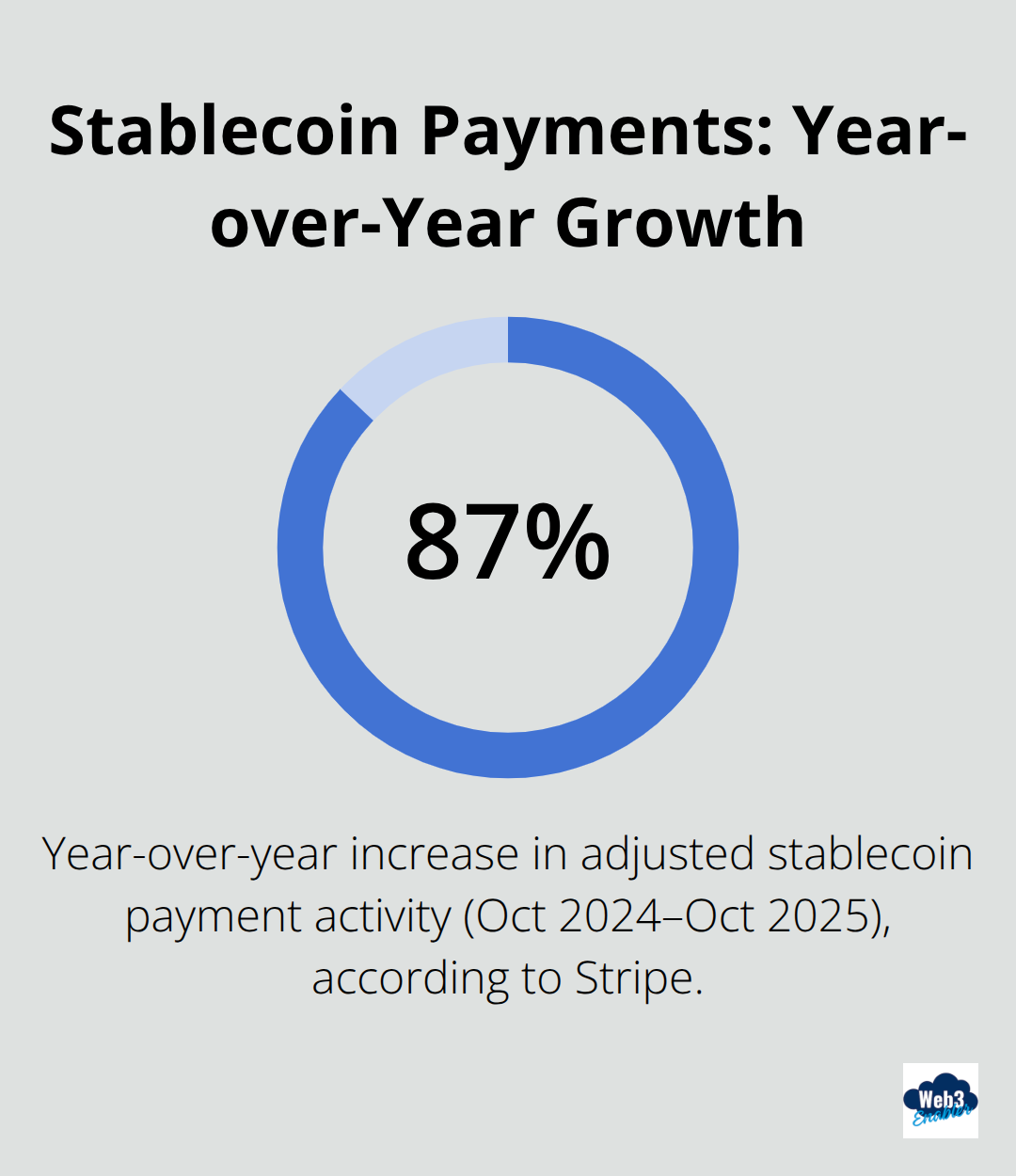
USDC isn’t some speculative token-it’s a regulated stablecoin backed 1:1 by USD reserves and short-duration US Treasuries, which means your money stays stable while moving at blockchain speed. Circle, the issuer, maintains this reserve backing through strict KYC/AML checks, so you’re dealing with compliance-first infrastructure from day one. This matters because stablecoins processed $9 trillion in adjusted payment activity between October 2024 and October 2025 according to Stripe, up 87% year over year. That’s not niche behavior-that’s institutional capital treating USDC as a legitimate settlement layer.
The regulatory clarity is real too: stablecoin issuers like Circle operate under Treasury Department oversight, and discussions around frameworks show governments are building guardrails rather than shutting things down. Your treasury team can actually sleep at night knowing this isn’t some Wild West operation.
Where USDC Beats Wire Transfers Cold
A traditional wire transfer costs you 6% to 8% all-in when you factor in correspondent banking fees, FX markups, and the time value of money sitting in limbo for three to five days. USDC settlements happen in minutes or seconds on-chain, with network fees that typically run pennies. For AI businesses on Stripe, stablecoin payments cost roughly half as much in transaction fees compared with other payment methods. Cross-border payroll, vendor settlements, and customer refunds all compress from days into hours. That’s not marginal improvement-that’s the difference between monthly cash flow forecasting and actual same-day visibility. Your liquidity sits in your account, earning yield through DeFi lending protocols like Aave or Compound if you choose, rather than locked in some bank’s nostro account earning nothing.
Building Liquidity That Actually Works Across Regions
USDC exists natively on Ethereum, Solana, Avalanche, and Polygon, so your treasury isn’t trapped on a single network. This multi-chain presence lets you distribute liquidity strategically: hold reserves where your customers or vendors actually operate, reducing settlement friction and slippage. When large USDC mints happen, that new liquidity flows to exchanges and DeFi protocols, tightening spreads and reducing the cost of moving money across borders. Set up accounts on multiple chains, maintain a maturity ladder of reserves in cash and short-term Treasuries, and monitor mint activity through on-chain analytics tools to anticipate when liquidity conditions improve.
Connecting USDC to Your Existing Systems
The real power emerges when you connect USDC to the infrastructure your team already uses. Salesforce-native solutions let you automate payment flows, track stablecoin movements, and maintain compliance without ripping out your current tech stack. Your finance team stays in familiar territory while gaining access to global, 24/7 settlement rails. This integration approach means you don’t choose between blockchain speed and operational control-you get both, with visibility into every transaction right where your team works. The next section shows you exactly how to set this up.
How to Actually Execute USDC Treasury Management
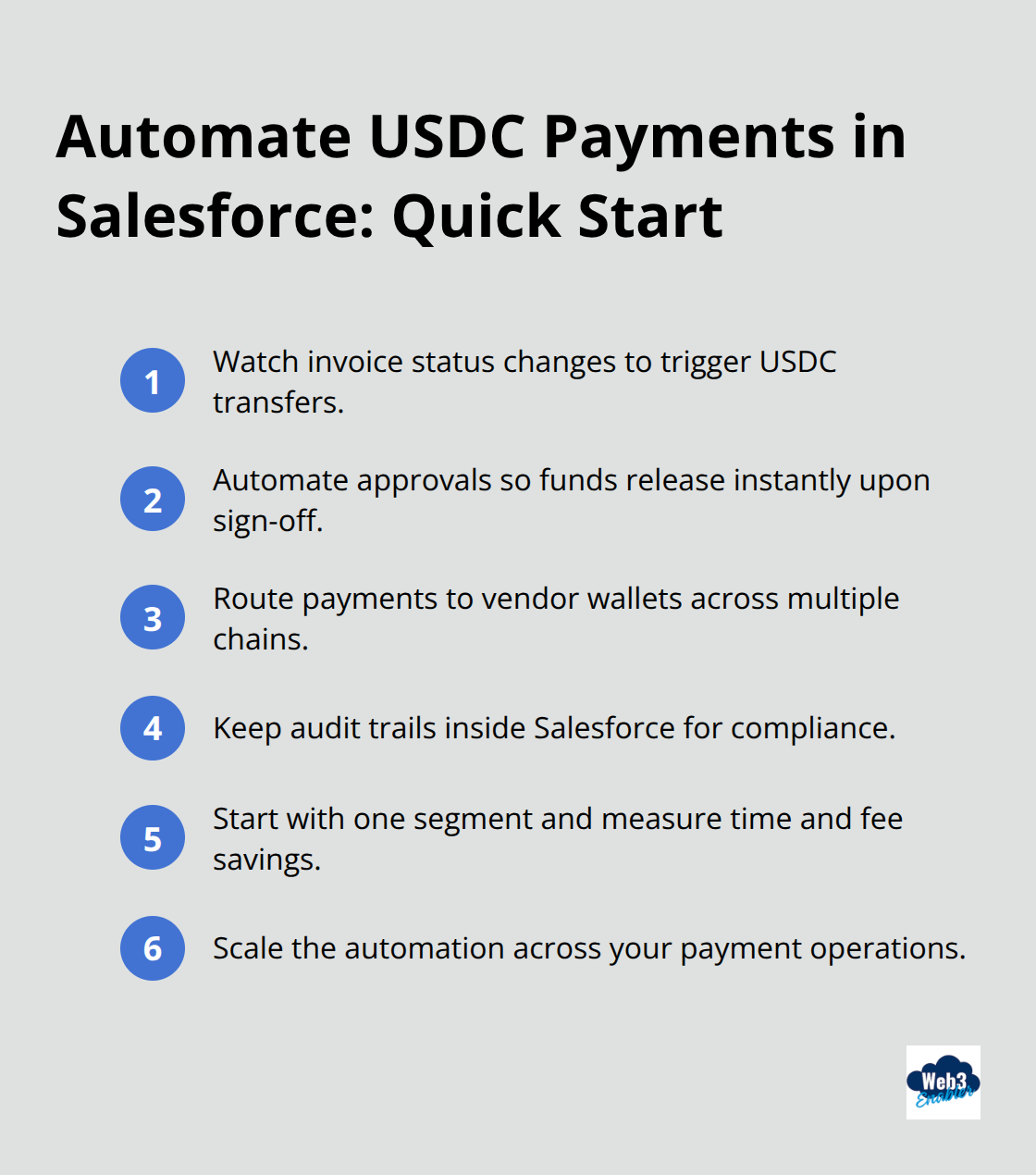
Your Salesforce instance already tracks customer data, vendor relationships, and payment schedules. Connecting USDC directly into that workflow means your finance team stops switching between systems and starts automating settlement in real time. Salesforce-native solutions let you trigger USDC transfers based on invoice milestones, payment approvals, or scheduled dates without leaving your CRM. This matters because stablecoin payments settle in minutes or seconds on-chain, so the moment an approval happens in Salesforce, funds move globally without manual intervention. Set up automation rules that watch for invoice status changes, then automatically initiate USDC transfers to vendor wallets on multiple chains. Your compliance team gets full audit trails within Salesforce itself, eliminating the friction of tracking blockchain transactions in separate tools. Start with one vendor or customer segment, measure the time saved and fee reduction, then expand the automation across your entire payment operation.
Distributing Liquidity Across the Networks Your Business Actually Uses
Holding all your USDC on Ethereum exposes you to single-chain congestion and higher settlement costs during peak hours. Instead, maintain a distributed liquidity strategy across Solana, Polygon, and Avalanche based on where your customers and vendors actually operate. If your Asia-Pacific operations primarily use Solana, allocate 40% of regional reserves there. If your European payroll runs on Polygon, adjust your distribution accordingly. Monitor stablecoin activity to identify where liquidity tightens or spreads widen. Use multisig wallets to control each regional reserve, with approval requirements that match your internal controls.
Securing Control Without Sacrificing Speed
A treasury manager approves transfers in Salesforce, which triggers a multisig request, requiring a second approval from your CFO or controller before funds move. This dual-control structure mirrors your wire transfer authorization process but executes in minutes instead of days. Test your multisig setup with small transfers first, then scale to your full payment volume once your team confirms the workflow. Multisignature wallets eliminate the single point of failure that comes from giving one person custody of all treasury assets. Require at least 2-of-3 approvals for any transfer above a threshold you define, with signers spread across your finance and operations teams. Your Salesforce instance tracks every transaction, every approval, and every recipient wallet, creating an audit trail that satisfies both internal controls and external auditors. For larger organizations, hardware wallet custody combined with multisig adds a physical security layer, so private keys never live on internet-connected servers. Start with a 2-of-2 setup between your treasurer and controller, then add a third signer if your volume justifies the complexity. Test the recovery process immediately, because you need to know how to access funds if one signer becomes unavailable. Document the exact steps your team takes, then practice a dry run with small amounts before moving significant capital through the system. Once your multisig structure is live and your team has confidence in the approval workflow, you’re ready to scale USDC across your entire vendor and customer base-which means the real liquidity optimization begins.
Where USDC Actually Delivers Results
Enterprises adopt USDC because the math works, not because it’s trendy. Between October 2024 and October 2025, stablecoin payment activity hit $9 trillion according to Stripe data, a jump of 87% year over year. That volume reflects real money moving through real businesses, not speculation. Financial services firms moved earliest, with payroll operations, vendor settlements, and cross-border customer refunds shifting to stablecoin rails. Traditional remittance costs run above 6% all-in when you include correspondent banking fees and FX markups, while stablecoin transfers typically cost pennies in network fees. For AI businesses on Stripe specifically, stablecoin payments cost roughly half as much in transaction fees compared with other payment methods. Companies processing high-volume international payroll have seen settlement compress from five business days to minutes, which means cash flow visibility improves dramatically and forecasting becomes actual, not theoretical. Financial services firms report that holding USDC reserves across multiple chains reduces their settlement risk while maintaining the ability to earn yield through DeFi lending protocols.
Settlement Speed Transforms Cash Flow Management
Wire transfers lock your funds in transit for three to five days, trapped in correspondent banking channels where you have zero visibility and zero control. USDC settlements happen in minutes or seconds on-chain, which means your vendor receives payment immediately and your cash position updates in real time. Payroll operations benefit most visibly: companies paying contractors across 30 countries no longer batch payments weekly or monthly. Instead, they settle daily or even on-demand, which improves contractor cash flow and reduces payment disputes. Your finance system tracks every transaction with full audit trails, so compliance teams stop hunting through bank statements and blockchain explorers separately. The time saved compounds-finance teams report reclaiming 15 to 20 hours monthly on reconciliation work alone when they move from wires to USDC.
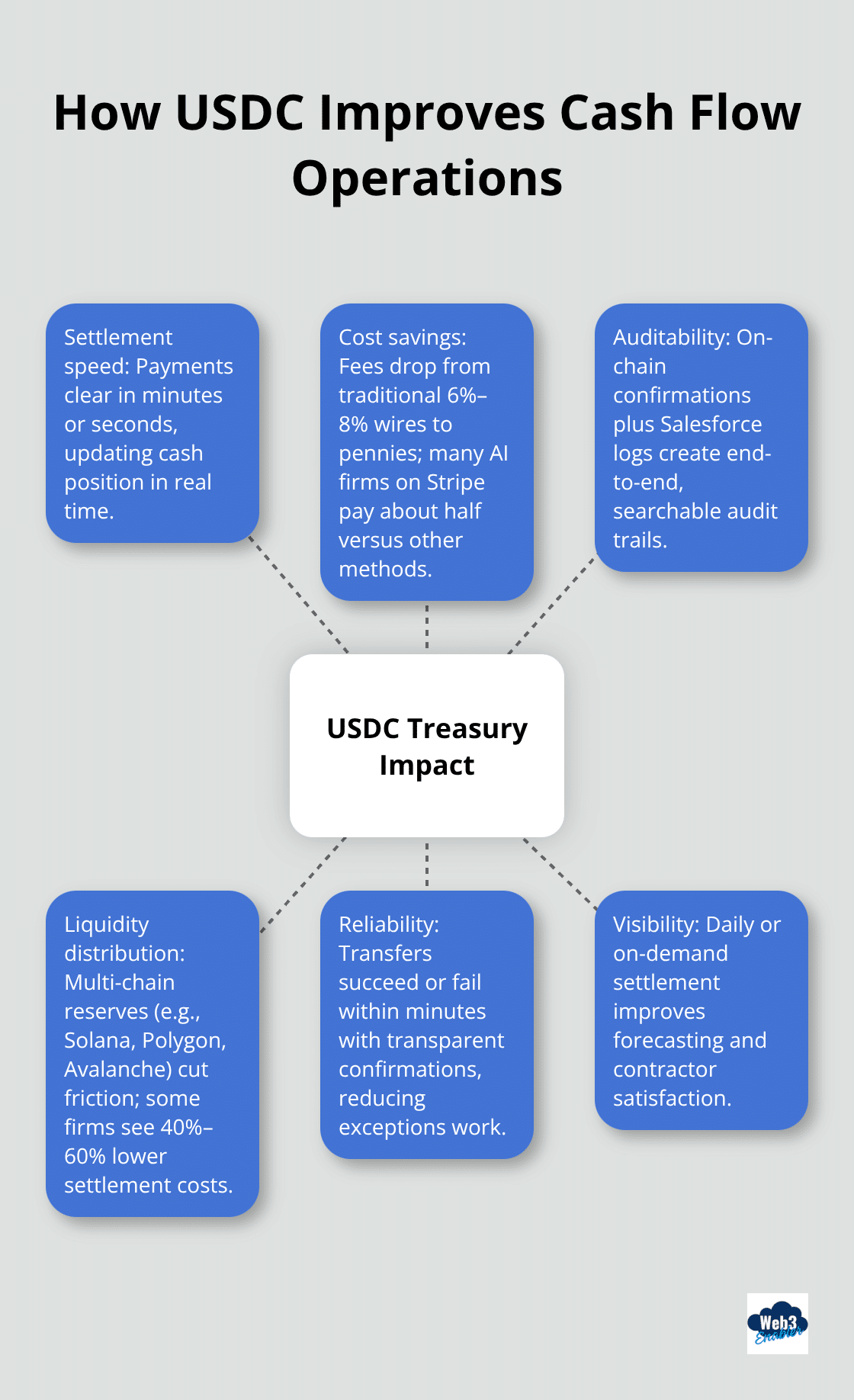
Cost savings stack on top: a company processing $50 million in annual cross-border payments reduces fees from roughly $3 million annually down to under $500,000, freeing capital for actual business operations. Settlement certainty matters too. Wire transfers fail regularly due to incorrect routing information, sanctions screening delays, or correspondent bank rejections. USDC transfers either succeed or fail within minutes, with transparent on-chain confirmation, eliminating the limbo period where finance teams call banks asking whether a payment went through.
Regional Liquidity Distribution Reduces Friction
Enterprises with operations across Asia-Pacific, Europe, and North America face a choice: centralize USDC reserves on one chain and pay high settlement costs during peak hours, or distribute liquidity strategically across Ethereum, Solana, Polygon, and Avalanche based on actual transaction volume. Companies that chose distribution saw settlement costs drop by 40 to 60% compared with single-chain strategies. The reason is straightforward-when your Asia payroll runs on Solana and your European operations use Polygon, you avoid congestion on Ethereum during US trading hours. Monitor where your counterparties actually hold liquidity and position your reserves accordingly. This requires discipline: you’re not chasing yield or speculating on network performance, you’re matching your treasury distribution to your actual business geography. Multisig control structures make this work operationally. Require approvals from regional finance managers for transfers above defined thresholds, with signers distributed across your organization so no single person controls all liquidity. Your finance system enforces these approval workflows automatically, triggering multisig requests the moment a payment hits a certain size or destination. Test the entire structure with small amounts first-actually execute a few thousand dollars in transfers, verify that approvals flow correctly, and confirm that funds arrive in the expected wallets within your expected timeframe. Once your team gains confidence in the process, scale gradually to your full payment volume.
Final Thoughts
USDC treasury management strips away the intermediaries that slow your cash flow without adding value. Your vendor receives payment the moment an approval happens in Salesforce, your payroll team settles daily instead of batching weekly, and your finance team reclaims hours monthly on reconciliation work. The $9 trillion in stablecoin payment activity between October 2024 and October 2025 proves enterprises treat these rails as legitimate settlement infrastructure, not experimental technology.
Start with one payment corridor or vendor segment and run USDC transfers for 30 days to measure the time saved and fees eliminated. Test your multisig setup with small amounts first, verify that your Salesforce automation triggers correctly, and confirm that approvals flow as expected before scaling to your full payment volume. The regulatory framework is real, the reserve backing is auditable, and the compliance trails are built in-you gain both speed and control simultaneously.
Web3 Enabler provides Salesforce-native blockchain solutions that connect directly to your existing infrastructure, so your finance team stays in familiar territory while accessing global settlement rails. The sooner you start, the sooner your treasury stops overpaying for speed it doesn’t get.