



Your finance team is probably drowning in spreadsheets trying to track USDC payments across different systems. What if your revenue data just… lived in Salesforce, updated in real-time, ready to analyze?
At Web3 Enabler, we’ve seen businesses waste hours on manual reconciliation when they could be spotting trends and optimizing cash flow. USDC payments reporting in Salesforce changes that game entirely, turning crypto transactions into clean, actionable business intelligence.
Why Enterprise Companies Are Actually Using USDC
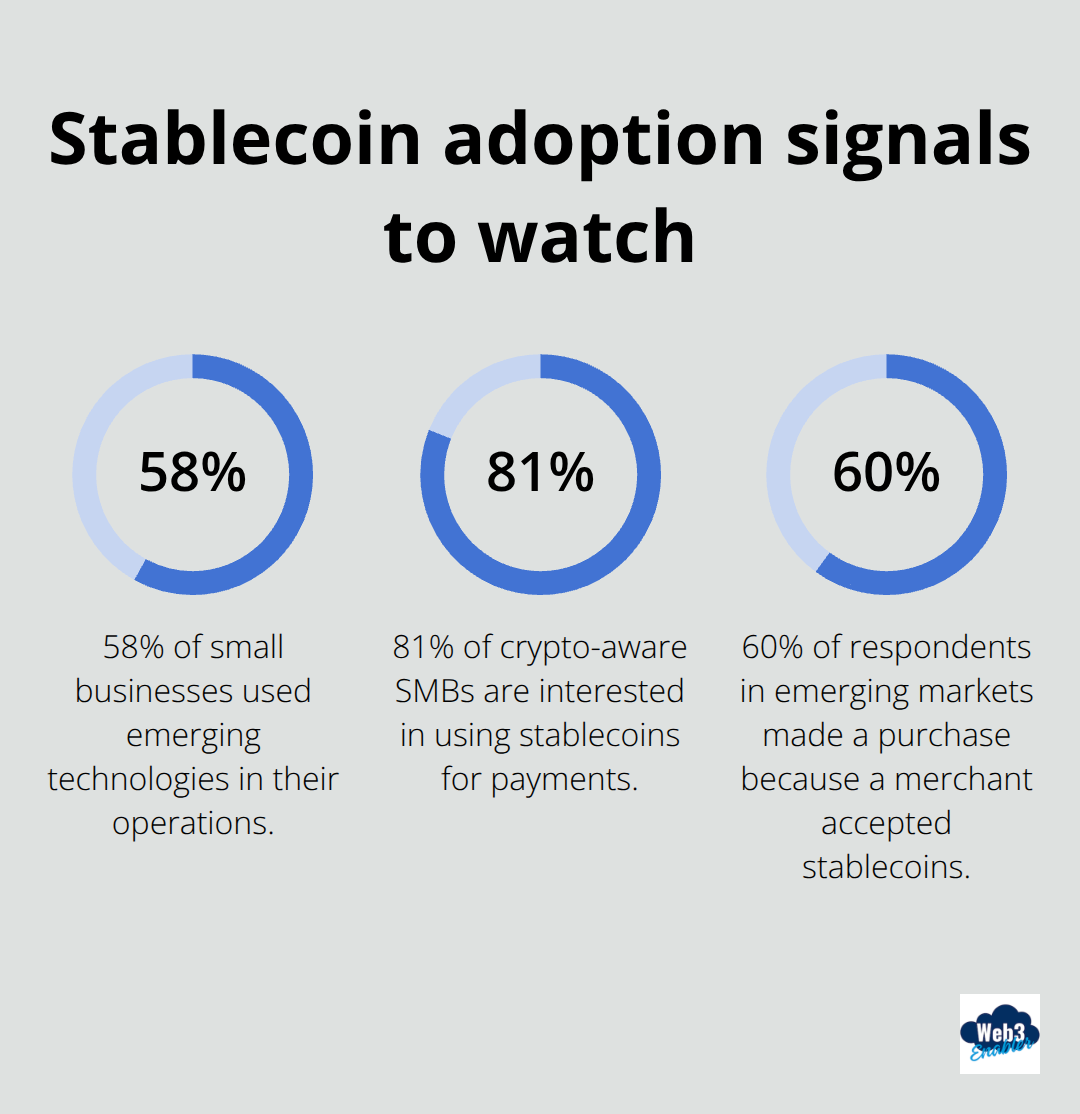
Stablecoin adoption isn’t some fringe experiment anymore. A 2025 report found that 58% of small businesses used emerging technologies in their operations, signaling serious institutional appetite. More tellingly, 81% of crypto-aware small and medium-sized businesses show genuine interest in using stablecoins for actual payments, not speculation. This isn’t theoretical-businesses from SpaceX to forward-thinking fintech companies already convert payments into stablecoins for global treasury management. The shift happened quietly while everyone debated crypto’s future. What changed? Companies realized stablecoins solve real problems that traditional banking simply doesn’t address.
Speed and Cost That Actually Matter
Traditional wire transfers take 1–3 business days and cost $15–50 per transaction. USDC transfers settle in minutes and cost mere cents. For a business sending 50 international payments monthly, that’s the difference between $750 in fees and under $10. Coinbase’s stablecoin revenue grew 48% year-over-year in 2025, with USDC circulation hitting $75 billion and on-chain transaction volumes more than doubling. These numbers reflect real adoption, not hype. The 24/7 settlement capability matters too-your business doesn’t wait for banking hours. A payment at 2 a.m. on Sunday processes instantly, which is critical for global teams and cross-border suppliers who need cash flow predictability. Companies in emerging markets particularly benefit; more than half of surveyed respondents made a purchase specifically because a merchant accepted stablecoin payments, with that share rising to 60% in emerging markets. This isn’t about early adopters anymore-it’s about competitive advantage in regions where traditional banking infrastructure lags.
Compliance and Auditability Built In
The GENIUS Act, passed in late 2025, established formal regulatory frameworks for stablecoins in the US, removing much of the ambiguity that previously held back enterprise adoption. Every USDC transaction lives on the blockchain with a permanent, immutable record-no lost emails, no disputed invoices, no manual reconciliation nightmares. When your finance team audits payments, they see the exact timestamp, parties involved, and settlement confirmation. Circle and Coinbase, the organizations behind USDC, maintain audited reserves and operate under increasingly rigorous compliance standards. This transparency works in your favor when regulators ask questions or when you need to prove payment history to customers or partners. The compliance infrastructure exists; you just need to connect it to your business systems.
Why Salesforce Integration Changes Everything
That’s where Salesforce integration transforms the game from manual spreadsheet tracking to automated, auditable revenue recognition. Your payment data flows directly into the system your team already uses every day. No more context switching between platforms. No more manual data entry that introduces errors. Your finance and sales teams access real-time payment visibility without leaving Salesforce, which means faster insights and smarter decisions about cash flow and customer patterns.
How to Wire USDC Into Salesforce Without Breaking Everything
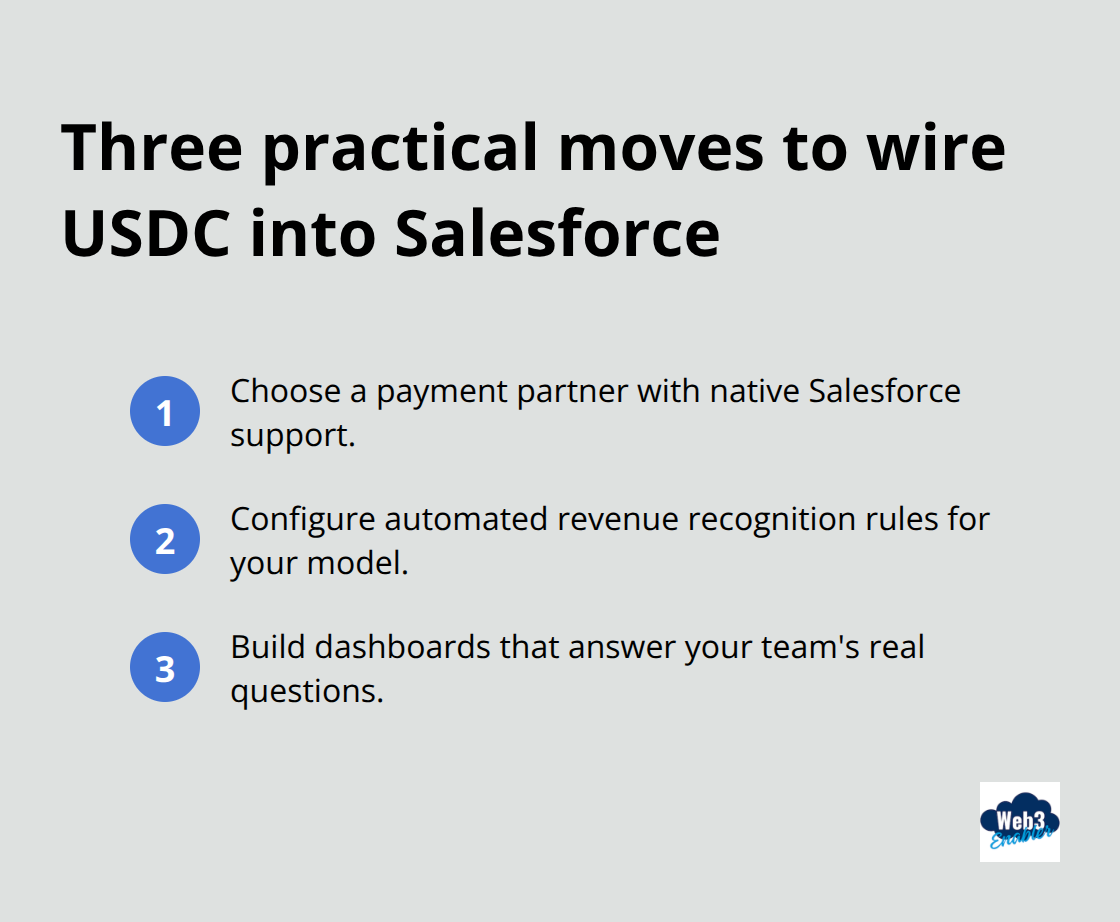
Getting USDC payment data into Salesforce requires three practical moves: first, select a payment infrastructure partner that speaks Salesforce natively, second, set up automated revenue recognition rules that match your business model, and third, build dashboards that actually answer the questions your team asks. Modern Treasury processes over $400 billion in payments across fiat and stablecoins through a single API, which matters because it means your USDC transactions flow through the same ledger as your traditional wire transfers.
When you integrate a payment provider that understands both blockchain rails and Salesforce architecture, your transaction data arrives with full ledger details, timestamps, and counterparty information already structured for revenue recognition. Stripe supports stablecoins across 125+ payment methods in 195 countries, and their data pipeline tools feed reporting directly into Salesforce, which means you capture USDC revenue alongside credit card transactions in one unified system. The key is avoiding integration hell: pick a partner whose API connects natively to Salesforce, not one that requires middleware or custom coding to bridge the gap.
Making Revenue Recognition Automatic
Revenue recognition for stablecoin payments works differently than traditional invoicing because settlement happens instantly, not days later. Set up Salesforce automation rules that trigger the moment USDC hits your wallet, capturing the USD value at settlement time to eliminate volatility concerns. Modern Treasury’s ledger system tracks each payment account with full transaction history and balance visibility, so your accounting team sees exactly when funds arrived and which customer they belong to. Create separate revenue line items in Salesforce for USDC payments versus traditional methods, then track the percentage of total revenue flowing through stablecoins as a KPI. This separation matters because your CFO needs to understand whether stablecoin adoption is growing and where the cost savings actually appear. Link your Salesforce revenue records directly to blockchain transaction hashes, creating an immutable audit trail that auditors genuinely appreciate instead of dreading.
Building Dashboards That Drive Decisions
Your Salesforce dashboard should answer three specific questions: what percentage of revenue comes from USDC, which regions or customer segments drive stablecoin adoption fastest, and how much you’re saving on payment fees versus traditional rails. Create a regional breakdown because emerging markets show higher stablecoin purchase intent than developed markets, which means your Asia and Latin America teams might see faster adoption than your domestic business.
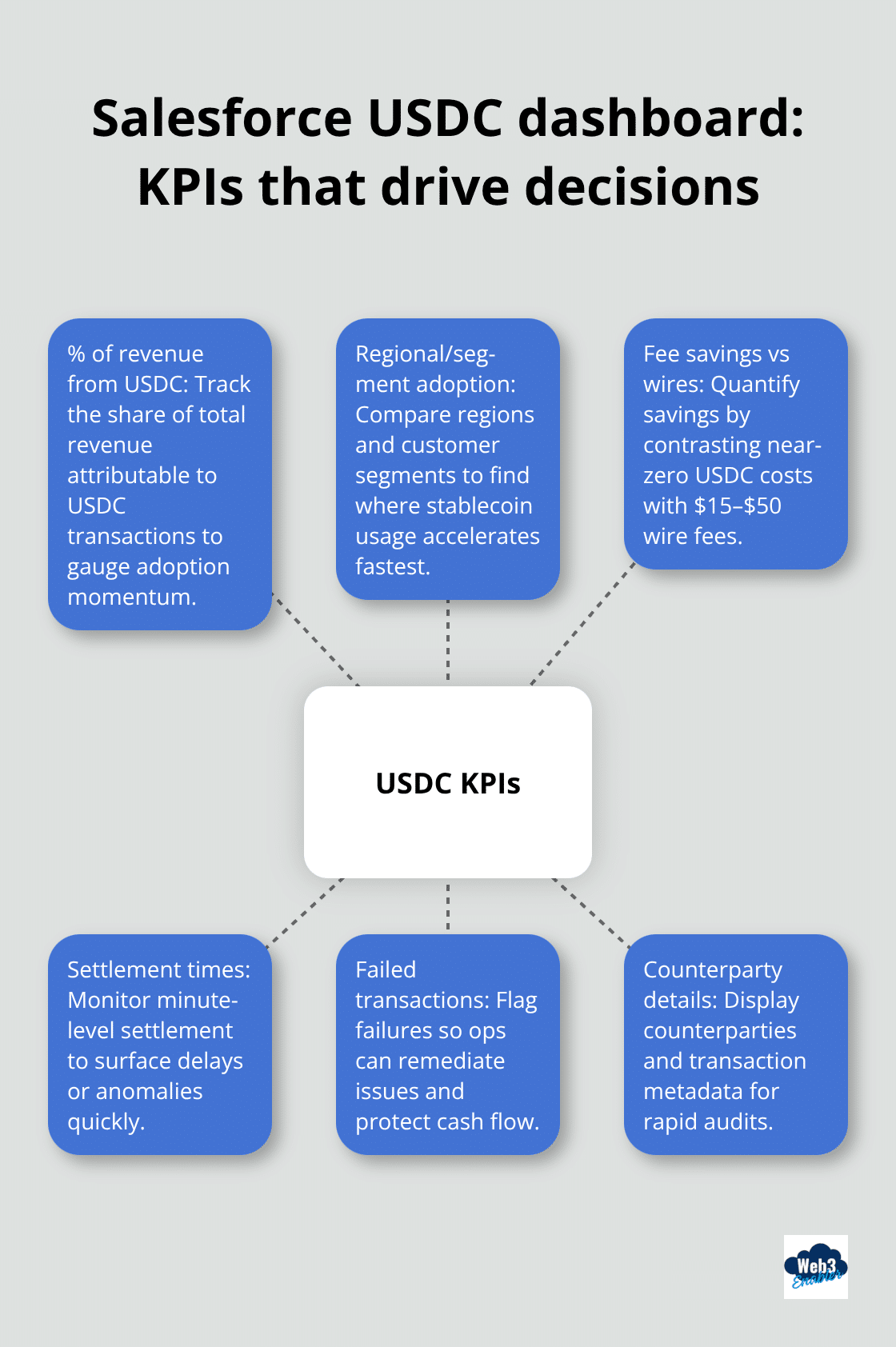
Track cost savings explicitly: if you process $1 million monthly in USDC payments at near-zero cost versus $15,000 in traditional wire fees, that’s $180,000 annually your dashboard should highlight to stakeholders. Build a secondary dashboard for your payments team that shows settlement times, failed transactions, and counterparty information so operational issues surface immediately. Include a field that tracks whether customers made purchases specifically because you accepted stablecoins, since more than half of surveyed users made stablecoin purchases when merchants offered that option. Your Salesforce setup should feed real-time data into these dashboards without manual refresh cycles, which means configuring scheduled API calls that pull transaction data every hour from your payment provider.
Connecting Payment Data to Your Existing Systems
Your payment infrastructure partner should integrate directly with Salesforce’s native APIs rather than forcing you to export and reimport data manually. Modern Treasury’s unified ledger captures both fiat and stablecoin transactions in one place, eliminating the need to stitch together multiple vendors and reconciliation spreadsheets. Stripe’s reporting tools (Sigma, Custom Reports, Data Pipeline) sync directly with Salesforce, so your revenue data updates automatically without human intervention. Test your integration thoroughly before going live: run a pilot with a small subset of USDC transactions, verify that settlement times and amounts match your payment provider’s records, and confirm that your Salesforce automation rules trigger correctly. Once you validate the connection, scale it across your entire payment volume. The goal is to make USDC payments as invisible to your finance team as credit card transactions-they arrive, they’re recorded, they’re reconciled, all without manual work.
Handling Edge Cases and Compliance
Stablecoin transactions create audit trails that traditional payments can’t match, but you still need to handle edge cases like failed settlements, partial refunds, and currency conversions. Set up Salesforce workflows that flag transactions outside your normal parameters (unusually large amounts, unfamiliar counterparties, or settlement delays) so your compliance team reviews them before they hit your books. Document your reconciliation process in Salesforce so auditors can trace every transaction from customer payment through final settlement. Store blockchain transaction hashes in custom Salesforce fields, creating a permanent link between your revenue records and the immutable ledger. This approach transforms compliance from a painful annual exercise into an ongoing, automated process that your team maintains throughout the year.
Your infrastructure is now ready to capture and analyze USDC payments at scale. The next step is understanding what that data actually tells you about your business-which customers drive adoption, which regions show the strongest momentum, and where your real cost savings hide.
What Your USDC Payment Data Actually Reveals About Your Business
Your Salesforce dashboard now tracks every USDC transaction in real-time, but raw data means nothing without context. The real intelligence emerges when you examine payment patterns across customers, regions, and time periods to spot where adoption accelerates and where friction points hide. Start with geographic segmentation of your USDC revenue because emerging markets show dramatically higher stablecoin adoption than developed economies. More than 60% of surveyed users in emerging markets made purchases specifically because merchants accepted stablecoins, compared to roughly 50% globally. This geographic variance tells you exactly where to focus expansion efforts and where traditional payment rails remain dominant. Create a Salesforce report that ranks your customer base by USDC transaction frequency and average transaction size, then cross-reference those customers with their lifetime value and retention rates. You’ll likely discover that stablecoin adopters show different purchasing patterns than traditional payment users, which means your marketing and product teams can tailor offerings accordingly. Track which product categories or service tiers drive the highest stablecoin adoption, since that data guides your roadmap decisions and helps you prioritize features that matter most to your forward-thinking customer segments.
Where Your Actual Cost Savings Live
Traditional wire transfers cost $15 to $50 per transaction with 1 to 3 business day settlement. USDC costs mere cents with minute-level settlement, yet most finance teams never quantify this advantage because the savings scatter across different budget lines. Calculate your monthly payment volume and multiply by your average wire fee, then compare that to your actual USDC transaction costs. A business processes $1 million monthly in payments through traditional wires at an average $25 fee and faces $300,000 in annual costs. Switch that same volume to USDC at near-zero marginal cost and you recover $300,000 annually, which compounds when you account for the working capital you gain from instant settlement instead of three-day delays. Build a Salesforce custom object that tracks payment method, transaction size, settlement time, and associated fees for every transaction, then create a dashboard that visualizes cumulative savings over time. This transparency transforms USDC adoption from a compliance initiative into a CFO-approved cost optimization project with measurable ROI. Your finance team should calculate the opportunity cost of delayed settlement too-if traditional wires tie up $100,000 for three days while USDC settles instantly, that freed capital can reduce debt service or fund growth initiatives immediately.
Forecasting Cash Flow With Certainty
USDC transactions settle instantly with permanent blockchain records, which means your cash flow forecasts gain accuracy that traditional banking can’t match. Traditional payments introduce uncertainty: a wire initiated Monday might settle Wednesday or Thursday depending on banking delays, creating forecasting blind spots. USDC eliminates that uncertainty entirely-you know the exact moment funds arrive and which customer they belong to. Build a Salesforce flow that captures the settlement timestamp for every USDC transaction, then analyze the pattern of inbound and outbound payments across your customer base. You’ll discover whether certain customer segments or regions show predictable payment timing, which lets you forecast daily and weekly cash positions with confidence traditional finance can’t achieve. Use this data to optimize your working capital strategy: if you know USDC payments from Enterprise customers arrive consistently within 24 hours of invoicing, you can reduce your cash reserve requirements for that segment and deploy capital elsewhere. Create a predictive model in Salesforce that incorporates historical USDC payment timing, customer segment, and regional patterns to forecast next month’s cash position with precision that surprises your CFO. This forecast accuracy translates directly into better financing decisions and reduced reliance on expensive bridge financing during cash flow valleys.
FAQ: USDC Payments Reporting in Salesforce
Why is reporting on USDC in Salesforce better than using a separate dashboard?
When your USDC revenue data lives directly in Salesforce, it is connected to your existing customer accounts, opportunities, and lead data. This allows you to see the full context of a transaction—such as which specific marketing campaign or sales region is driving stablecoin adoption. Relying on a separate dashboard creates data silos that require manual export/import cycles, leading to errors and delayed decision-making.
How does Salesforce handle the volatility of USDC for revenue reporting?
While USDC is pegged to the US Dollar, small fluctuations can occur between the time an invoice is sent and when it is settled. Salesforce automation rules can be configured to capture the exact USD value of the USDC at the precise moment of settlement. This ensures that your revenue recognition is accurate to the penny and eliminates the accounting “guesswork” associated with traditional crypto assets.
Can Salesforce generate audit-ready reports for USDC payments?
Yes. Because every USDC transaction is recorded on a blockchain, each record in Salesforce can include a permanent link (a transaction hash) to that immutable ledger. When an auditor asks for proof of payment, your finance team can pull a report that shows the Salesforce invoice alongside the blockchain verification. This level of transparency is actually superior to traditional banking, where “proof” often relies on fragmented bank statements.
What are the key KPIs I should track in my USDC dashboard?
A high-performing USDC dashboard should track three main metrics:
- Adoption Rate: The percentage of total revenue flowing through USDC vs. traditional rails.
- Cost Savings: The total amount saved on wire fees and FX markups.
- Settlement Velocity: The average time from invoice creation to funds arriving in your treasury, typically showing a massive reduction compared to the 3-5 day bank wire standard.
Do I need a custom integration to get Stripe or Modern Treasury data into Salesforce?
In 2026, many leading payment providers offer native Salesforce connectors or robust APIs that allow for direct data syncing. Using a partner like Web3 Enabler ensures these connections are “Salesforce Native,” meaning the data populates standard and custom objects correctly without requiring a team of developers to build custom “bridge” code.
Final Thoughts
Your finance team now has real-time visibility into USDC payments reporting in Salesforce, which means the spreadsheet era officially ends. Manual reconciliation, delayed settlement confirmations, and guesswork about cash flow belong in the past. Every transaction flows directly into your system with immutable blockchain records attached, turning crypto revenue from a compliance headache into a competitive advantage.
The numbers speak clearly: businesses processing $1 million monthly in USDC payments recover $300,000 annually in wire fees alone, plus the working capital gains from instant settlement instead of three-day delays. Your emerging market customers show 60% higher purchase intent when you accept stablecoins, which means geographic expansion becomes measurable and predictable. Salesforce integration eliminates the manual processes that introduce errors, consume hours, and frustrate your finance team.
The infrastructure exists today, and Web3 Enabler specializes in connecting blockchain technology with your existing Salesforce infrastructure through native solutions that help you accept stablecoin payments, send global payments faster, and gain visibility into crypto holdings without rebuilding your entire tech stack. Explore how Web3 Enabler can accelerate your USDC payments reporting and transform crypto revenue into actionable business intelligence.