



Most companies treating crypto payments as traditional transactions hit a wall. Revenue recognition breaks down when you’re dealing with volatile digital assets and manual reconciliation processes that create audit nightmares.
At Web3 Enabler, we’ve seen how stablecoins paired with Salesforce Revenue Cloud eliminate these friction points entirely. By automating revenue recognition for blockchain transactions, organizations can finally close their books faster and with complete compliance confidence.
Why Your Current Revenue Recognition Process Fails with Crypto
ASC 606 and IFRS 15 Were Never Built for Blockchain
The accounting standards governing revenue recognition, ASC 606 and IFRS 15, were written for traditional commerce. Neither framework anticipated the speed or complexity of blockchain transactions. When you process a stablecoin payment in Salesforce Revenue Cloud today, the system lacks native capability to recognize revenue from transactions that settle in minutes on a distributed ledger. You must manually reconcile on-chain settlement data with your accounting records instead. The gap widens further when volatile cryptocurrencies enter the picture. ASC 606 requires you to recognize revenue at a fixed amount, but if a customer pays you in Bitcoin, the dollar value fluctuates between invoice and settlement. Your finance team must decide which exchange rate to use and when to lock in the amount-a choice that creates audit risk. Auditors conducting substantive testing will demand detailed documentation of every conversion point, price source, and timing decision.
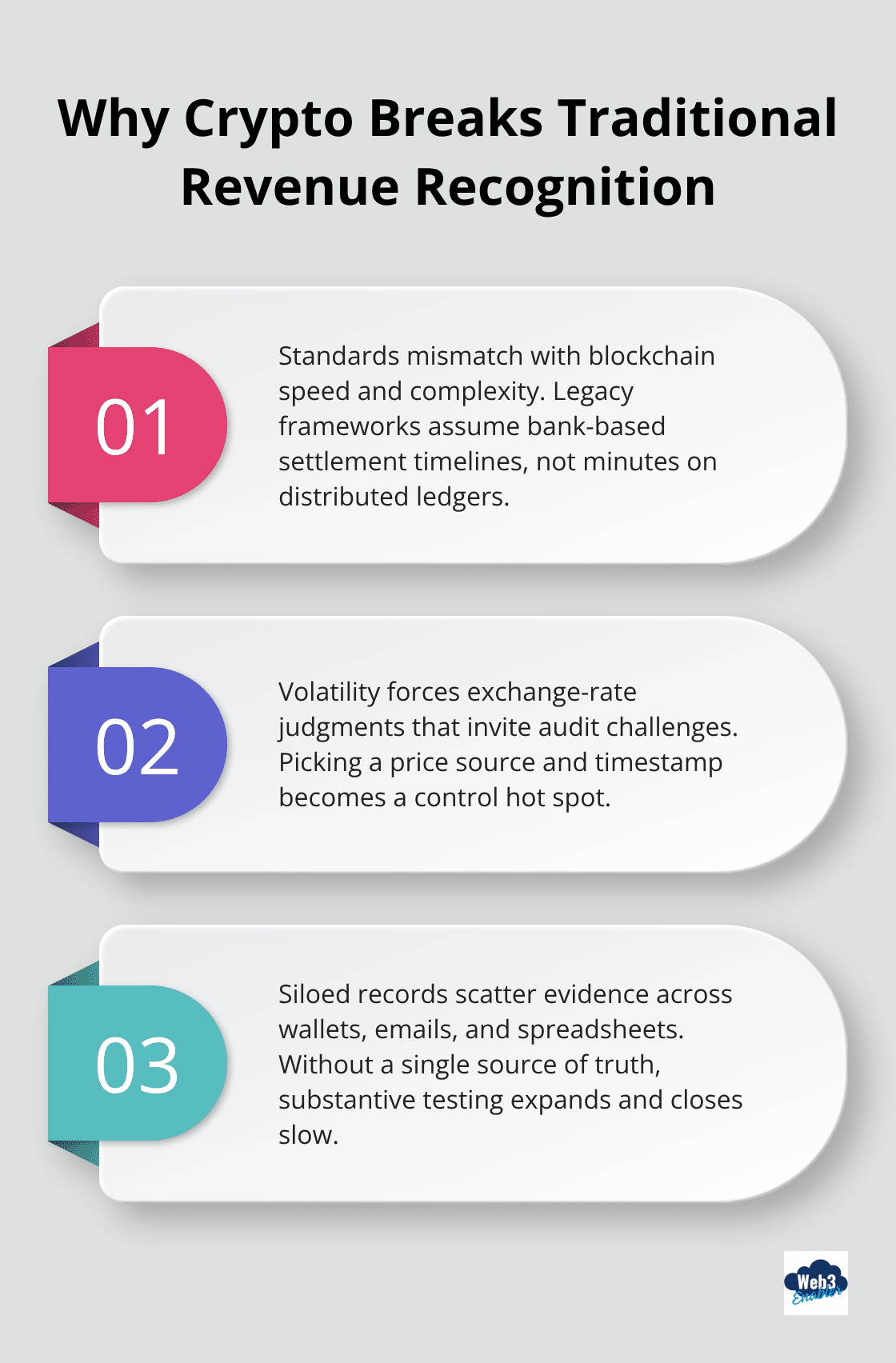
Yet your current tools provide no centralized record of this chain of events.
Manual Reconciliation Destroys Your Close Timeline
Most organizations handling crypto payments today rely on spreadsheets and manual journal entries to match blockchain transactions against revenue accounts. A customer sends stablecoins to your wallet, you receive a notification from your custodian or wallet provider, you record the transaction in your ERP, and then you cross-reference bank statements and on-chain data to confirm settlement. This three-step process introduces delays that compound across hundreds of transactions. During month-end close, your accounting team spends days tracing transactions instead of analyzing business performance. Without automation, scaling crypto payments means scaling manual work proportionally. Audit readiness also suffers. AU-C 230 Audit Documentation requires clear, accessible records of all revenue transactions and supporting contracts. If your crypto revenue evidence lives scattered across wallet interfaces, email confirmations, and spreadsheets, auditors will flag control weaknesses and potentially require extensive testing to validate your revenue figures.
Stablecoin Pegs Don’t Solve Your Timing Problem
Even though stablecoins maintain a 1:1 peg to fiat currencies like the US dollar, they don’t eliminate the timing problem. Under ASC 606, revenue must be recognized when control of goods or services transfers to the customer. For blockchain transactions, that moment of control is ambiguous. Does control transfer when the transaction is broadcast to the network, when it receives one confirmation, or when it becomes finalized across the blockchain? Different organizations interpret this differently, creating inconsistent revenue recognition policies and audit disputes. Payment finality determines when you can confidently record a transaction as settled. However, compliance with regulatory requirements doesn’t change the accounting challenge. Your auditors still need to verify that you applied a consistent, documented methodology for determining the transaction settlement point and that you captured all required contract terms (including token type and settlement method) in your revenue documentation. Without a system that automatically timestamps on-chain events and maps them to revenue accounts, you cannot demonstrate this consistency at scale.
What Happens When You Ignore These Gaps
Organizations that treat crypto payments as traditional transactions face mounting compliance risk. Your finance team spends more time reconciling than forecasting. Your auditors request additional substantive testing because your controls lack transparency. Your month-end close extends by days because manual processes cannot keep pace with transaction volume. The real cost isn’t just operational friction-it’s the inability to scale crypto payments without proportionally scaling your back-office burden. Stablecoins offer a path forward, but only if your revenue recognition system can capture on-chain settlement data in real time and map it directly to your accounting records. This is where automation in Revenue Cloud becomes essential.
How Stablecoins Fix Your Revenue Recognition Problem
Stablecoins Eliminate Exchange Rate Risk
The fundamental issue with volatile cryptocurrencies vanishes the moment you settle in stablecoins. A stablecoin pegged 1:1 to the US dollar means the exchange rate between transaction initiation and settlement never fluctuates. Under ASC 606, this removes the conversion-rate uncertainty that forces your accounting team to make judgment calls about which price to recognize. When a customer sends you USDC or USDT, the dollar amount locks at transaction time. No more debates with auditors about which exchange rate applies or when to record the conversion gain or loss.
Stablecoin regulations require US-issued stablecoins to maintain a 1:1 reserve backed by low-risk assets such as Treasury securities. This regulatory backing means your stablecoin receipts carry the same certainty as bank deposits for revenue recognition purposes. Your auditors conducting substantive testing will find stablecoin settlements far easier to validate than volatile asset transactions because the peg removes a major source of audit risk.
Real-Time Settlement Collapses Your Reconciliation Timeline
Real-time settlement on blockchain networks collapses the timing gap that currently forces manual reconciliation work. When a customer sends stablecoins to your wallet, the transaction settles in minutes rather than the 1–2 business days required for traditional ACH or wire transfers. Settlement finality is cryptographically certain. The blockchain provides an immutable record of when control transferred, removing ambiguity about the revenue recognition moment.
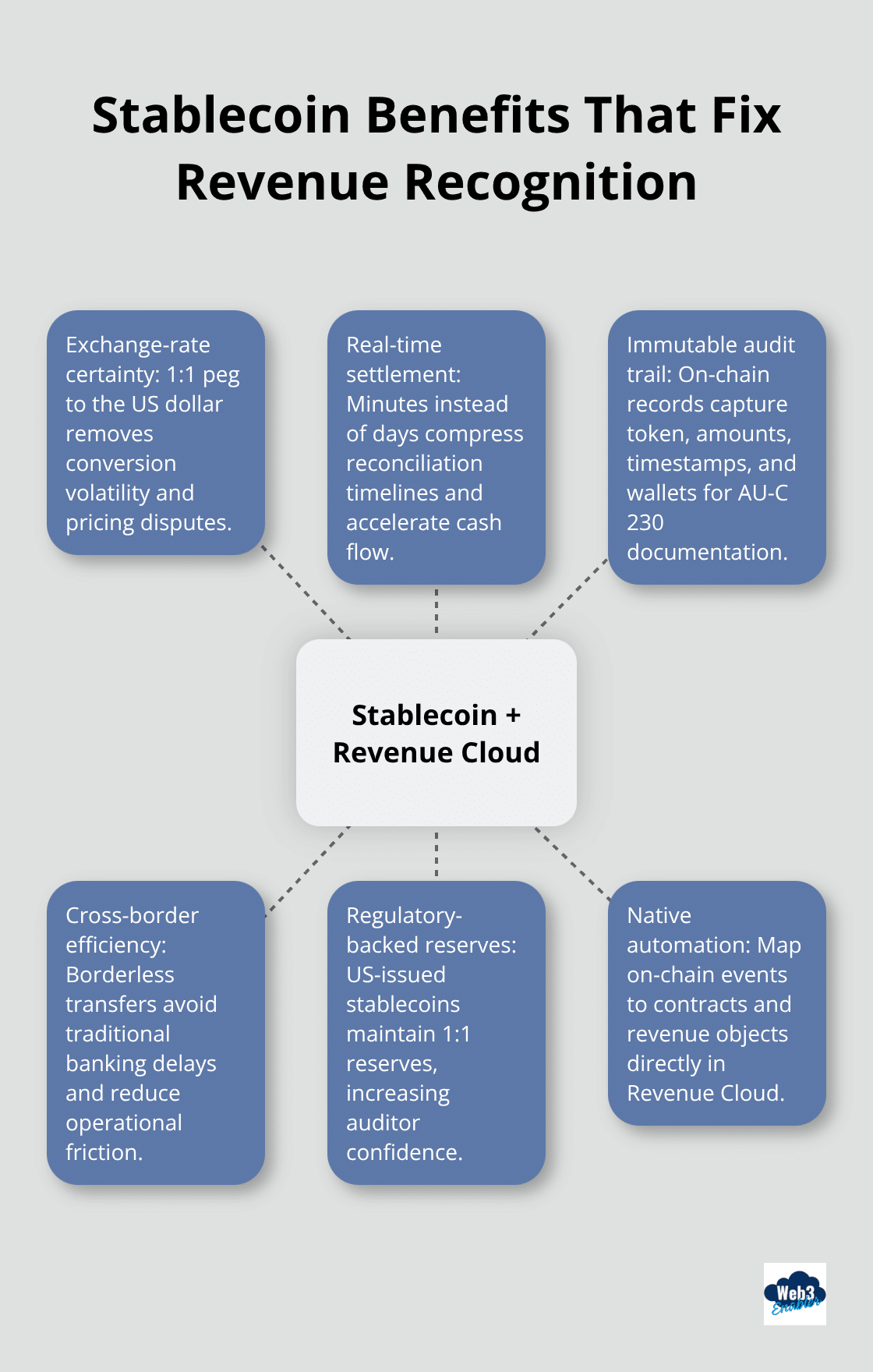
Your Revenue Cloud system can capture this on-chain timestamp automatically and map it directly to your revenue accounts without manual intervention. Manufacturing companies settling supplier invoices in stablecoins reduce payment processing time from days to minutes, accelerating cash flow and simplifying month-end reconciliation. Organizations handling cross-border payments see the largest gains here, as stablecoins operate across borders without the delays inherent in traditional banking rails.
Blockchain Transparency Satisfies Audit Documentation Requirements
The blockchain transparency that underpins stablecoin settlements satisfies AU-C 230 documentation requirements automatically. Every transaction leaves an immutable audit trail that records the token type, settlement method, timestamp, and wallet addresses involved. Your compliance team gains permanent, tamper-proof evidence of every revenue transaction without manually collecting screenshots or emails from wallet providers.
This transparency means auditors can verify your revenue figures with confidence and significantly reduce the scope of substantive testing required to validate your crypto revenue streams. Revenue Cloud enables this workflow natively within Salesforce, allowing your finance team to automate on-chain revenue recognition and settlement directly in the platform where your contracts and billing data already live. The immutable record that blockchain creates transforms how your organization approaches audit readiness-instead of scrambling to reconstruct transaction history, your system maintains a permanent, verifiable chain of evidence.
With stablecoin settlements providing certainty on exchange rates, finality on timing, and transparency for auditors, the path to automating revenue recognition becomes clear. The next step involves configuring your Revenue Cloud environment to capture on-chain data and map it directly to your accounting records.
Automating Stablecoin Revenue Recognition Inside Salesforce
Mapping On-Chain Data Directly to Revenue Objects
Revenue Cloud wasn’t designed for blockchain, but Salesforce’s native object architecture makes it straightforward to connect stablecoin settlement data to your revenue recognition workflow. The key is routing on-chain transaction events directly to your existing revenue objects without building custom middleware. When a customer sends USDC or USDT to your wallet, the transaction data flows directly into Revenue Cloud’s revenue recognition engine, where it matches against your existing contracts and billing records. No spreadsheets. No email confirmations. No three-day delay waiting for bank settlement. The blockchain timestamp becomes your revenue recognition moment, and Salesforce records it automatically.
Web3 Enabler connects stablecoin wallets and on-chain settlement data natively to Revenue Cloud, allowing your finance team to capture transaction timestamps, settlement amounts, and wallet addresses automatically within Salesforce. This eliminates the manual reconciliation step entirely.
Embedding Payment Terms in Your Quote Workflow
CPQ integration amplifies this automation by embedding stablecoin payment terms directly into your quote workflow. Your sales team configures payment method, settlement currency, and wallet address within the same CPQ interface where they specify product quantities and pricing. When the customer accepts the quote, those terms populate your revenue contract automatically, and your billing system knows exactly where to send the invoice and which wallet address to monitor for settlement.
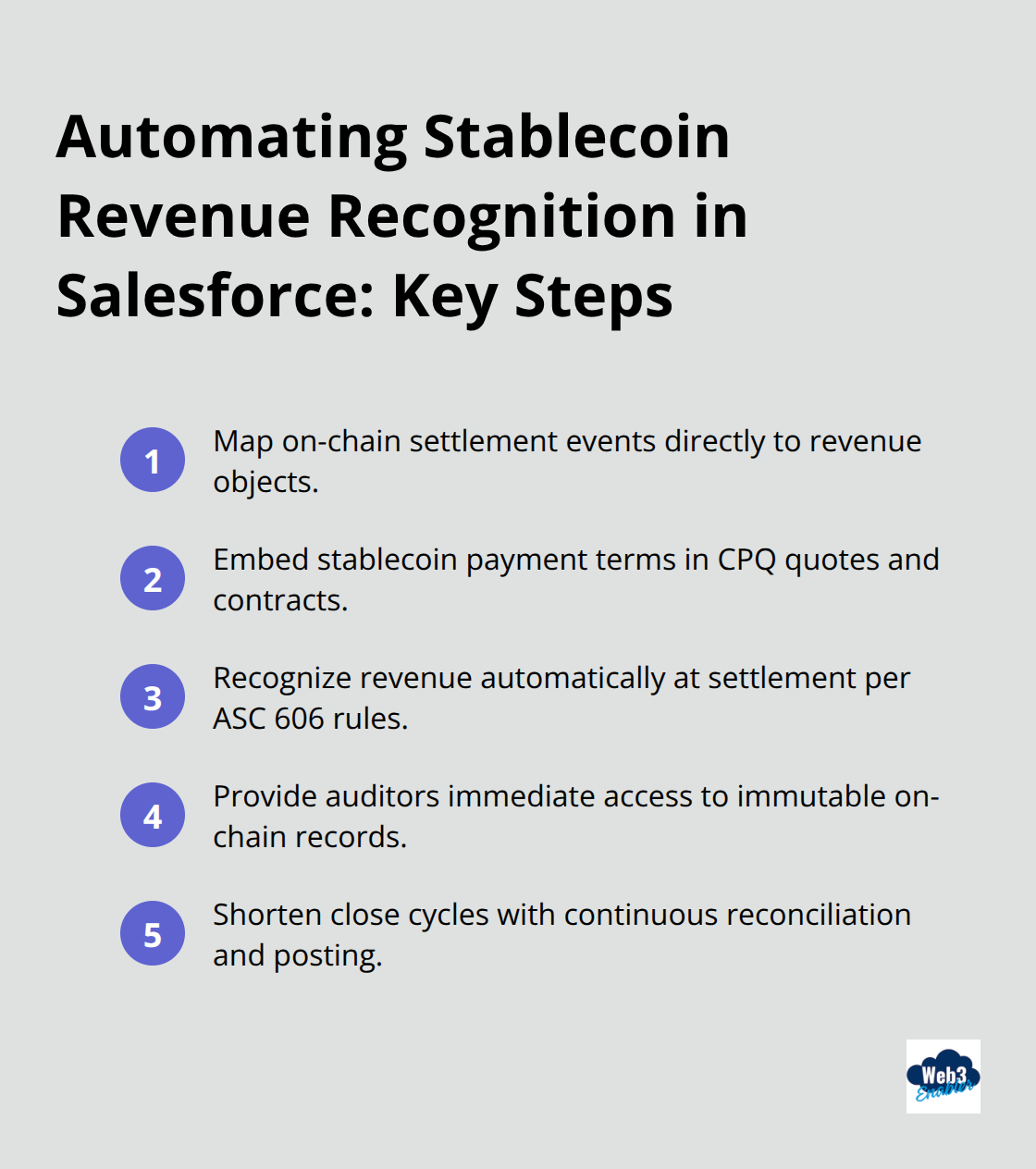
Manufacturing companies and cross-border service providers using this approach report closing their books faster because reconciliation happens in real time rather than at month end. The quote-to-cash cycle accelerates when payment instructions live inside your revenue contracts from the moment a customer accepts a proposal.
Automating Revenue Recognition at Settlement
Workflow automation in Revenue Cloud maps each stablecoin settlement event to the appropriate revenue account based on contract terms. Under ASC 606, revenue recognition depends on whether your contract specifies recognition at a point in time (upon final delivery) or over time (as performance obligations are satisfied). Your finance team no longer waits for month-end to reconcile transactions; instead, your system recognizes revenue continuously as on-chain events occur.
Your auditors conducting substantive testing gain immediate access to immutable on-chain settlement records, reducing the scope of testing required and eliminating the documentation gaps that currently trigger audit requests for additional evidence. The immutable record that blockchain creates combined with Salesforce’s native audit trail provides auditors with complete visibility into your revenue recognition decisions and supporting transaction data.
Final Thoughts
Stablecoins paired with Salesforce Revenue Cloud eliminate the manual friction that has plagued crypto revenue recognition since enterprises first accepted digital payments. Your finance team no longer spends days reconciling blockchain transactions against spreadsheets and bank statements. Instead, on-chain settlement data flows directly into your revenue accounts in real time, with audit documentation generated automatically by the blockchain itself.
Organizations adopting this approach gain measurable competitive advantage in digital commerce. Manufacturing companies settle cross-border supplier invoices in minutes instead of days, improving cash flow and reducing working capital needs. Service providers handling global clients accept stablecoin payments without currency conversion delays or banking intermediaries. E-commerce platforms expand into new markets when customers gain access to payment methods they actually prefer.
Web3 Enabler brings this capability directly into your Salesforce environment as a certified Salesforce ISV Partner. We offer the only native blockchain platform on the Salesforce AppExchange, enabling your organization to automate on-chain revenue recognition, settlement, and reconciliation without leaving Revenue Cloud. Explore how Web3 Enabler transforms your revenue operations and discover how stablecoins in Salesforce Revenue Cloud accelerate your close process.