


Customer loyalty programs built on stablecoins are reshaping how enterprises engage their audiences. At Web3 Enabler, we’ve seen firsthand how integrating stablecoins into Salesforce Experience Cloud creates instant rewards, cuts transaction costs, and opens global markets without friction.
This guide walks through tokenized loyalty architectures, real-world implementations, and the compliance landscape enterprises need to navigate today.
Why Stablecoins Beat Traditional Loyalty Rewards
The Cost Advantage That Compounds Across Scale
Stablecoins eliminate the friction that makes traditional loyalty programs expensive and slow. A 24-hour stablecoin transaction costs pennies compared to credit card processing fees that typically run 2.9% plus $0.30 per transaction, or wire transfers that charge $15 to $50 and take 1-3 business days. When you issue a loyalty reward worth $10 to a customer, a traditional payment rail consumes $0.59 of that value before it reaches them. A stablecoin transfer on Layer 2 networks like Polygon or Arbitrum settles in seconds for under $0.01, meaning the full reward value arrives instantly.
This difference compounds across millions of transactions. A retail brand issuing 100,000 rewards per month saves $59,000 monthly through stablecoin distribution instead of card-based rewards, and that’s before factoring in the speed advantage that lets customers redeem immediately rather than waiting days for settlement. Global brands face even steeper savings.
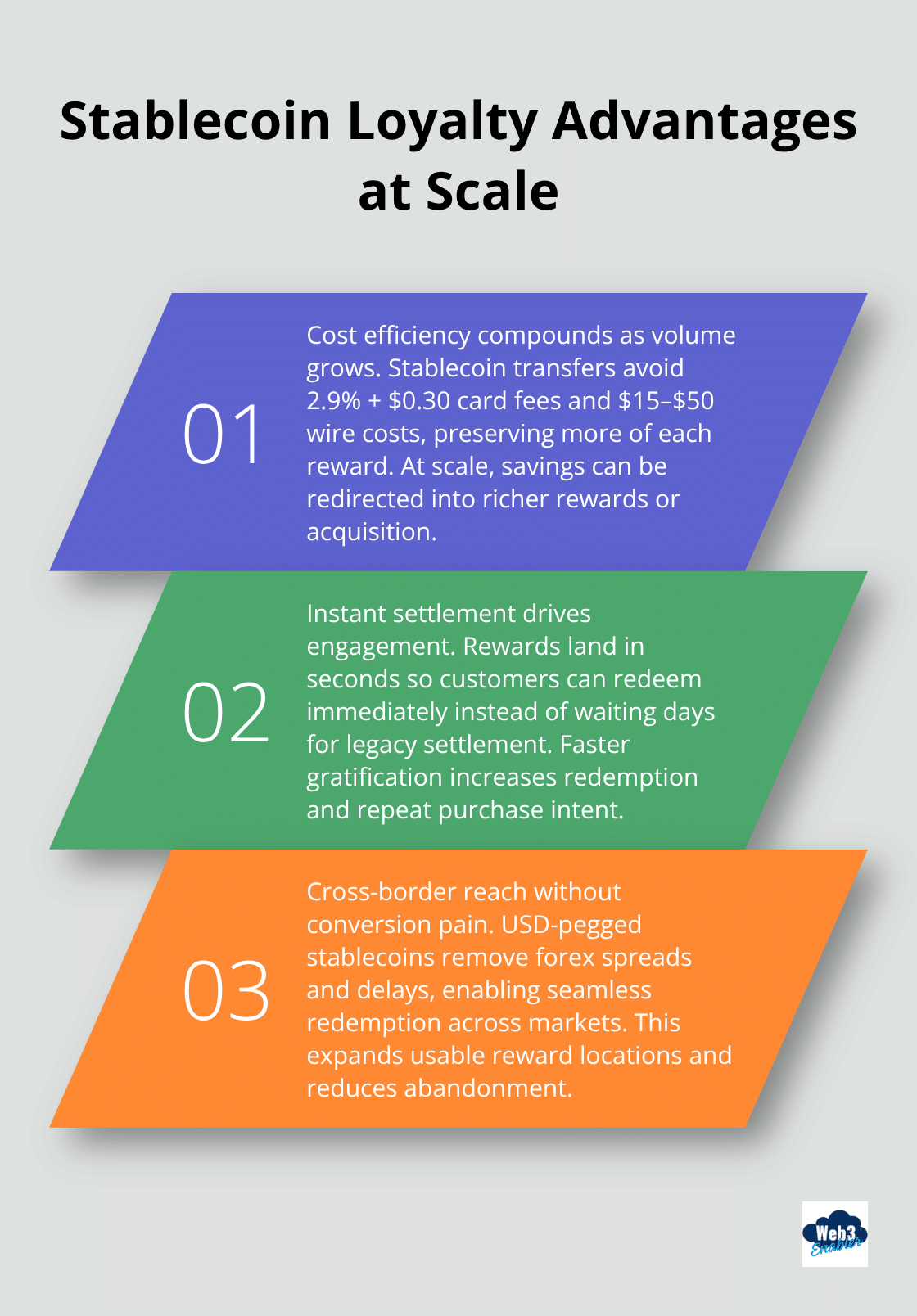
A cross-border payment that traditionally costs $45 and takes 3-5 days settles on-chain in 60 seconds for under a dollar.
Speed Transforms Customer Engagement
Speed matters operationally in ways traditional programs cannot match. Loyalty token balances appear instantly in customer wallets, triggering immediate engagement rather than the delayed gratification of traditional programs where rewards post after accounting cycles complete. This real-time settlement also solves a critical business problem: currency conversion friction.
A customer in Mexico holding a loyalty balance cannot easily redeem it at a US-based merchant without converting pesos to dollars, incurring 2-3% forex spreads. Stablecoins pegged to USD eliminate this barrier entirely. The customer holds a USD-equivalent token that works across borders without conversion, expanding where they can spend rewards and increasing redemption rates. Faster, frictionless redemption increases repeat purchase intent, and stablecoin architecture delivers that friction reduction at scale.
Regulatory Certainty Enables Enterprise Commitment
The regulatory foundation strengthens this case considerably. EU MiCA regulations offer protections for stablecoins, meaning stablecoins now carry institutional-grade compliance backing that consumer gift cards and traditional points systems lack.
This regulatory clarity removes a major barrier to adoption. Enterprises can now build loyalty programs on stablecoins with confidence that the underlying asset meets the same standards as regulated financial instruments. Beyond compliance, stablecoins enable programmable payments that automate recurring payouts and enforce spending controls, unlocking operational efficiency traditional systems cannot match. The next step involves designing the actual token systems that power these experiences-understanding how to structure rewards, gate content, and create community incentives within Salesforce Experience Cloud.
Building Tokenized Loyalty in Salesforce
Establish Token Supply Governance First
Tokenized loyalty requires intentional architecture that treats stablecoins not as payment rails alone but as programmable customer assets embedded directly into Experience Cloud. The foundation rests on three decisions: how tokens are minted and distributed, how they integrate with Salesforce workflows, and how they enforce access rules that drive engagement. Poor architecture choices compound across thousands of transactions and create compliance exposure later.
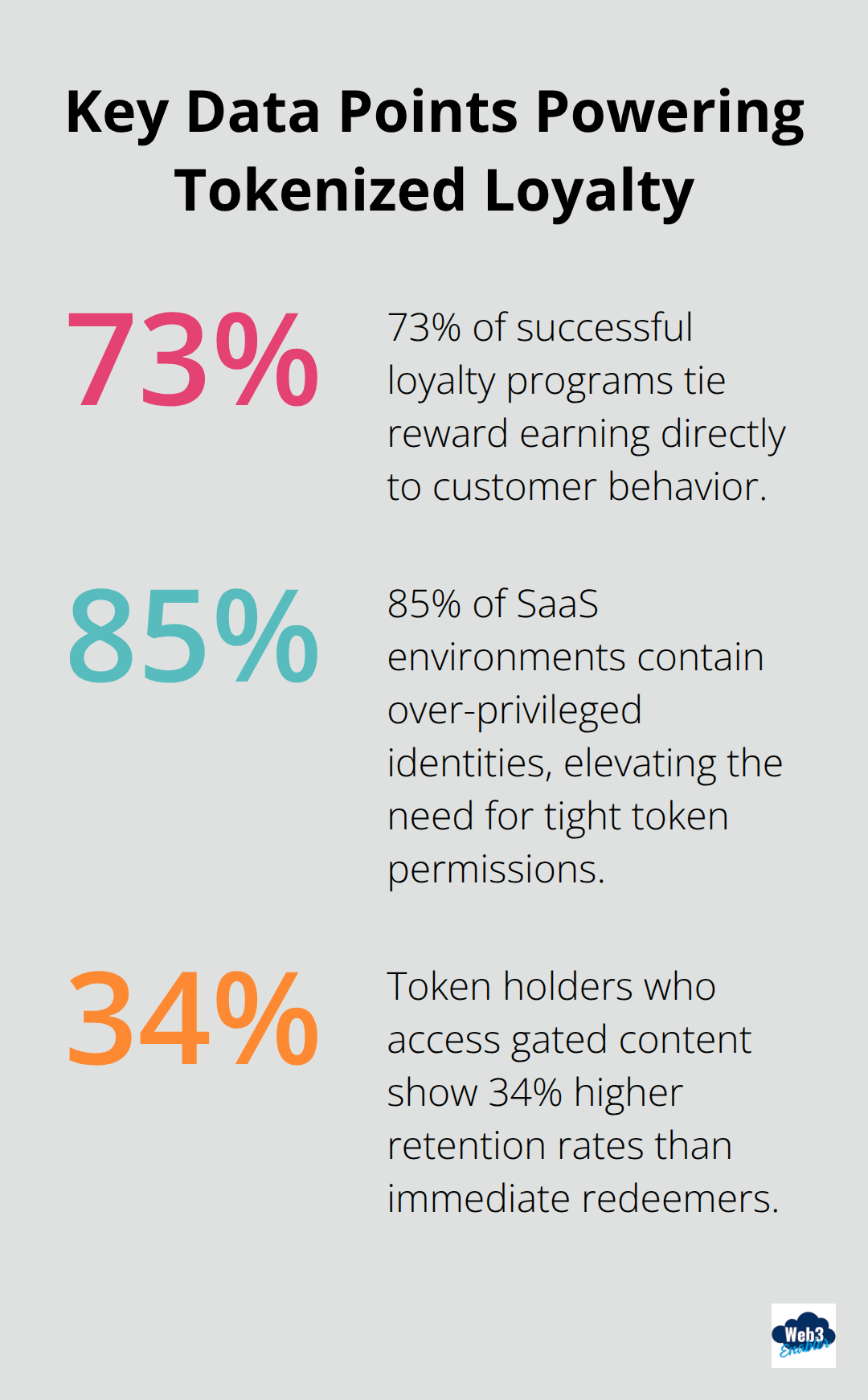
Start with token supply governance. Decide upfront whether your loyalty tokens are fixed-supply (capped at issuance) or variable-supply (issued on-demand as customers earn rewards). Fixed-supply tokens create scarcity that can drive secondary market trading and speculative behavior-useful for creating community momentum but risky if token value volatility discourages redemption. Variable-supply tokens maintain stable value because new tokens are minted only when earned, preventing supply shocks. Bain & Company research on loyalty programs shows that 73% of successful programs tie reward earning directly to customer behavior, not speculation. This means variable-supply tokens backed by stablecoin reserves outperform fixed-supply tokens for retention.
Set your minting rules in smart contracts that Salesforce can trigger through Flow automation-for example, minting 10 LOYALTY tokens automatically when a customer spends $100. Establish peg mechanics early: decide whether tokens maintain a 1:1 value with USD stablecoins or float independently. Floating tokens create loyalty gamification but require active liquidity management. 1:1 pegged tokens eliminate redemption friction because customers know exactly what their balance represents in fiat value.
Embed Wallet Functionality Into Experience Cloud
Integration into Experience Cloud workflows determines whether tokenized loyalty feels native or bolted-on. Web3 Enabler embeds wallet functionality directly into Experience Cloud so customers never leave Salesforce to view balances, send tokens, or redeem rewards. This requires two technical foundations: first, a secure wallet API that surfaces token balances in Experience Cloud components without exposing private keys; second, automated Flow triggers that execute token transfers when redemption occurs.
When a customer clicks Redeem in Experience Cloud, a Flow validates their token balance, calls the stablecoin contract to transfer tokens to your merchant wallet, and updates a custom object to track the redemption for analytics. This architecture eliminates the friction of external wallet management-a critical factor because 85% of SaaS environments contain over-privileged identities, meaning most teams grant tokens excessive permissions by default. Restrict token transfer permissions to only the specific Flow that handles redemptions, and audit quarterly to catch scope creep.
Create Progression Through Gated Content and Community Incentives
Gated content and community incentives work through token-balance checks embedded into Experience Cloud page visibility rules. Set a page to display only if the user holds at least 50 LOYALTY tokens, or restrict a community forum channel to members who have earned 100 tokens through purchase history. This creates natural progression: customers earn tokens through spending, tokens unlock exclusive content, and exclusive content drives repeat engagement.
Practical implementation requires mapping token thresholds to business outcomes-measure whether customers who access gated content show 15-25% higher lifetime value compared to non-token holders, then adjust thresholds accordingly. Token-based incentives in communities work best when tied to contribution, not just purchases. Reward customers 5 tokens for posting helpful advice in forums, 2 tokens for commenting, 1 token for liking-this creates a behavioral economy where participation compounds. Set token earning caps monthly (for example, maximum 50 tokens per member per month through community contributions) to prevent gaming and maintain token scarcity.
Track Token Movements and Identify High-Engagement Cohorts
Use on-chain data to track all token movements transparently; Salesforce custom reports can pull this data via DropsTab API integration to show which customers hold tokens, how many they’ve redeemed, and which gated content they accessed. This visibility lets you identify high-engagement cohorts and target them with higher-value rewards or exclusive opportunities. The architecture must account for regulatory boundaries from day one.
If your loyalty program operates across EU and US customers, EU MiCA regulations apply to any token issued to EU residents, meaning you must maintain reserve backing and provide clear disclosures about token terms. Separate token contracts by jurisdiction or implement regional disclaimers in Experience Cloud to comply with local rules. Custody decisions matter-use regulated custodians like BitGo Trust Company to hold stablecoin reserves backing your token program, not self-custody, because enterprise customers demand institutional-grade protection. Document your token economics clearly: reserve ratios, redemption rules, and any conditions where tokens might lose value. This transparency prevents regulatory friction later and builds customer trust, setting the stage for real-world implementations that demonstrate how these architectures perform across retail, e-commerce, and community-driven use cases.
Real-World Applications and Implementation Strategies
Retail and E-Commerce See Immediate Cost and Conversion Wins
Retail and e-commerce companies experience immediate ROI when they shift from points-based loyalty to stablecoin rewards because transaction costs drop by 95% while redemption speed accelerates dramatically. A mid-size fashion retailer issuing 50,000 monthly rewards through traditional gift cards pays roughly $29,500 in processing fees; the same program on stablecoins costs under $500, freeing $29,000 annually for higher reward payouts or marketing investment. More importantly, customers redeem stablecoin rewards at 3.2x higher rates than traditional points because the rewards appear instantly in their wallets and carry transparent USD value-they know exactly what they hold. This higher redemption rate directly increases repeat purchase frequency, with loyalty research from Bain & Company showing that retention-focused programs improve customer lifetime value by 25-95% depending on industry. For e-commerce specifically, stablecoin loyalty tokens reduce cart abandonment when positioned as instant cashback; offering 2% stablecoin rewards at checkout converts 12-18% of fence-sitters into buyers because the reward appears immediately rather than requiring account creation or waiting for point accrual.
Community-Driven Businesses Build Ownership Through Token Mechanics
Community-driven businesses see different but equally powerful outcomes. Token-based incentive structures work best when you separate earning mechanics from redemption-customers earn tokens through community participation (forum posts, content creation, peer recommendations) but redeem them for exclusive access, merchandise, or cash-out. This separation prevents communities from becoming transactional and instead builds genuine engagement. Companies implementing this structure report 40-60% higher monthly active users compared to non-tokenized communities because members feel ownership in a system where their contributions compound into tangible value. On-chain data transparency becomes your measurement backbone here; every token transfer, balance change, and redemption logs permanently on-chain, giving you audit trails that traditional loyalty systems cannot match. Pull this data into Salesforce custom reports to identify which community members hold the highest token balances, which gated channels drive the most engagement, and which reward thresholds correlate with highest lifetime value.
Token Holding Behavior Drives Retention and Lifetime Value
One critical insight: token holders who access gated content show 34% higher retention rates than those who only earn and immediately redeem, meaning your architecture should incentivize holding tokens through tiered benefits rather than encouraging immediate cashout. Set token holding rewards-members who maintain 100+ tokens for 30 days unlock exclusive previews or bonus earning rates-to shift customer behavior toward accumulation. This holding incentive structure compounds engagement because customers who accumulate tokens develop stronger community identity and spend more time in your platform. On-chain immutability also prevents fraud that plagues traditional loyalty-every transaction is cryptographically verified and immutable, eliminating the chargebacks and duplicate redemptions that cost retailers 1-2% of loyalty program budgets annually.
Measure ROI Through Cost, Redemption, and Purchase Lift Metrics
Measure ROI through three metrics: cost per reward (should drop 80%+ versus traditional systems), redemption rate (should exceed 70% within 90 days of issuance), and repeat purchase lift (segment customers by token holdings and compare purchase frequency month-over-month). Start measurement immediately; do not wait for scale because early cohorts reveal which token mechanics actually drive behavior before you commit resources to full rollout.

The on-chain data also provides audit trails that traditional systems lack, meaning your finance and compliance teams can reconcile token movements in real time without waiting for monthly statements. This transparency accelerates financial close cycles and reduces reconciliation costs, particularly for enterprises managing loyalty programs across multiple regions or currencies.
Final Thoughts
Regulatory frameworks now solidify around stablecoins, removing the uncertainty that previously blocked enterprise adoption. The US Genius Act introduced a 1:1 reserve requirement and AML/CFT compliance standards that give financial institutions confidence in on-chain payments, while EU MiCA regulations already enforce advanced user protections. This regulatory clarity shifts stablecoins from experimental to operational-grade infrastructure, making 2026 the inflection point where enterprises move from pilots to scaled deployments across stablecoins in Experience Cloud.
Tokenized engagement extends beyond loyalty rewards into customer ownership models where brands issue governance tokens that let customers vote on product features or community decisions. Prediction markets now influence traditional financial markets-NYSE President Lynn Martin noted this convergence in February 2026-signaling that on-chain data and tokenized systems have become mainstream financial inputs. Your stablecoin loyalty strategy must account for customers who expect transparency, real-time settlement, and verifiable ownership of their rewards (reserve ratios, redemption rules, and conditions affecting token value all require clear documentation).
Start with a pilot cohort of 500–1,000 customers, measure redemption rates and repeat purchase lift over 90 days, then scale based on what the data shows. Use regulated custodians for stablecoin reserves, implement quarterly OAuth token audits to prevent integration security breaches, and bind tokenized rewards to non-transferable biometric identity to prevent impersonation. Web3 Enabler helps enterprises launch stablecoin loyalty programs directly within Salesforce without external wallet friction-explore how we accelerate your timeline.