



Treasury teams managing crypto assets face a constant challenge: manual processes that slow down settlements and create visibility gaps. At Web3 Enabler, we’ve seen firsthand how stablecoin treasury automation in Salesforce transforms this landscape.
By automating stablecoin operations directly within your existing Salesforce environment, treasury teams gain real-time balance visibility and eliminate the operational friction that plagues traditional crypto management.
Why Treasury Teams Need Stablecoin Automation Now
Traditional Treasury Processes Create Friction and Cost
Treasury operations haven’t fundamentally changed in decades. Money moves through correspondent banking networks that settle in days, require multiple intermediaries, and charge 2–3% in processing fees. Your finance team spends hours reconciling transactions across spreadsheets, bank statements, and accounting systems. Traditional treasury processes force you to choose between speed and control-you rarely get both.
Stablecoin treasury automation flips this equation. Instead of waiting for T+2 or T+3 settlements, you get real-time confirmation on-chain. Instead of manual reconciliation, automated workflows match on-chain events directly to your Salesforce revenue or financial records. Organizations automating stablecoin operations eliminate intermediaries entirely, cutting operational overhead and freeing your team to focus on strategic decisions instead of data entry.
Real-Time Balance Visibility Cuts Risk Dramatically
The biggest vulnerability in traditional crypto treasury is the visibility gap. Your on-chain balances update in seconds, but your accounting records lag by hours or days. This creates exposure: you can’t accurately forecast liquidity, you can’t spot unauthorized transactions quickly, and you can’t reconcile positions reliably.
Real-time visibility into your on-chain balances and stablecoin holdings directly within Salesforce eliminates that gap. You see what you actually hold, where it’s held, and what it’s worth-instantly. This matters for compliance too. Regulatory frameworks require 1:1 reserve backing in cash and short-term Treasuries, meaning your auditors need immutable records. Native Salesforce integration gives you that audit trail automatically. Every balance update, every settlement, every price feed flows into Salesforce as an auditable record.
You can’t automate what you can’t see, and you can’t manage what you can’t measure.
Stablecoins Remove Volatility From Your Operations
Holding volatile crypto in a treasury operation is a distraction. Bitcoin swings 2–3% in a day, altcoins move faster, and your CFO shouldn’t need a crypto analyst just to manage cash reserves. Stablecoins like USDC and USDT trade within fractions of a cent of their peg, giving you the speed and cost benefits of blockchain without the price risk.
The real win is what you can do with that stability. Stablecoin reserves enable 24/7 settlement at fractional costs-no weekend delays, no holiday closures, no correspondent bank markup. Automated stablecoin treasury workflows in Salesforce convert a cost center into an efficiency engine. You settle cross-border payments in seconds instead of days, hold reserves in short-term Treasuries for yield instead of sitting on unproductive cash, and free your team from manual settlement reconciliation.
Modern Treasury’s integration with Paxos and the Global Dollar Network shows institutions building stablecoin rails into their core finance operations because the alternative-manual, slow, expensive traditional settlement-is becoming indefensible.
How Salesforce Native Integration Changes the Game
Web3 Enabler brings this automation directly into your Salesforce environment as a native platform on the AppExchange. Rather than juggling separate tools and manual data transfers, your treasury team works within the CRM they already use every day. Financial Services Cloud, Revenue Cloud, and Commerce Cloud all connect to real-time on-chain data without extra software or complex setup.
This native integration matters because it eliminates the data silos that plague traditional treasury operations. Your settlement events, balance updates, and compliance records live in one auditable system. Your team stops copying numbers between platforms and starts making faster, better-informed decisions. The next section shows exactly how this automation works in practice.
How Stablecoin Treasury Automation Integrates Into Salesforce
Eliminate Manual Handoffs Between Blockchain and Accounting
Stablecoin treasury automation in Salesforce works because it removes the manual handoff between blockchain and your accounting records. When you send a stablecoin payment, that transaction flows directly into Financial Services Cloud or Revenue Cloud as an auditable record. Your balance updates in real time. Your settlement confirmation arrives instantly. Your reconciliation happens automatically. Web3 Enabler connects on-chain events to Salesforce objects without requiring you to build custom integrations or manage separate dashboards.
A treasury manager sees a USDC transfer settle in seconds, watches the balance update in Salesforce, and the transaction matches automatically to the corresponding invoice or customer record. No spreadsheets. No manual data entry. No three-day lag waiting for a bank to confirm what already happened on-chain.
Unify Two Systems Into One Workflow
The practical advantage is speed and visibility combined. When you automate stablecoin settlement within Salesforce, your team stops managing two separate systems and starts managing one unified workflow. A payment instruction in Revenue Cloud triggers an on-chain settlement that completes in seconds, updates your balance in real time, and creates an immutable audit trail in your financial records.
This matters for compliance because regulators now require 1:1 reserve backing in cash and short-term Treasuries under frameworks like the CLARITY Act. Salesforce becomes your single source of truth, showing auditors exactly what reserves you hold, where they settle, and how they reconcile.
Accelerate Cross-Border Payments and Cash Flow Visibility
For cross-border payments, stablecoins settle transactions in minutes and operate around the clock. A subsidiary in Europe receives payment instantly instead of waiting days. Your cash flow forecasting improves because you see liquidity move in real time, not after settlement clears.
Organizations automating stablecoin treasury operations in Salesforce cut operational costs because your team handles fewer manual reconciliations, spends less time chasing confirmations, and focuses on strategic decisions instead of transaction tracking.
Strengthen Risk Management Through Real-Time Monitoring
The visibility advantage extends to risk management too. You spot unauthorized transactions immediately, monitor reserve levels continuously, and adjust liquidity positions before problems develop. This is not theoretical efficiency-this is operational reality for institutions moving stablecoin settlement into their core finance workflows.
The next section shows how this real-time automation translates into measurable business impact across settlements, costs, and liquidity control.
Real-World Impact of Stablecoin Treasury Automation
Settlement Speed Transforms Cash Position Management
Settlement speed directly affects your cash position. Traditional cross-border payments take three to five business days minimum, forcing you to hold buffer reserves and accept currency exposure during the settlement window. Stablecoin transactions settle in minutes, which means your subsidiary in Singapore receives payment instantly instead of waiting for correspondent bank confirmations. Intuit partnered with Circle to bring USDC capabilities to QuickBooks, TurboTax, and Credit Karma, demonstrating how major financial software now treats stablecoin settlement as core infrastructure rather than a specialty feature.
When you automate stablecoin operations within Salesforce, your finance team stops managing settlement delays and starts managing actual liquidity. This matters operationally because faster settlements reduce counterparty risk, improve cash forecasting accuracy, and let you deploy reserves more strategically instead of holding them idle. Modern Treasury’s integration with Paxos and the Global Dollar Network shows institutions actively moving stablecoin settlement into their core workflows because the alternative is defenseless-waiting days while your money sits in limbo.
Cost Reduction Through Intermediary Elimination
Cost reduction flows directly from elimination of intermediaries. Traditional cross-border payments charge 2–3% in processing fees across correspondent banks, currency conversion spreads, and nostro account markups.
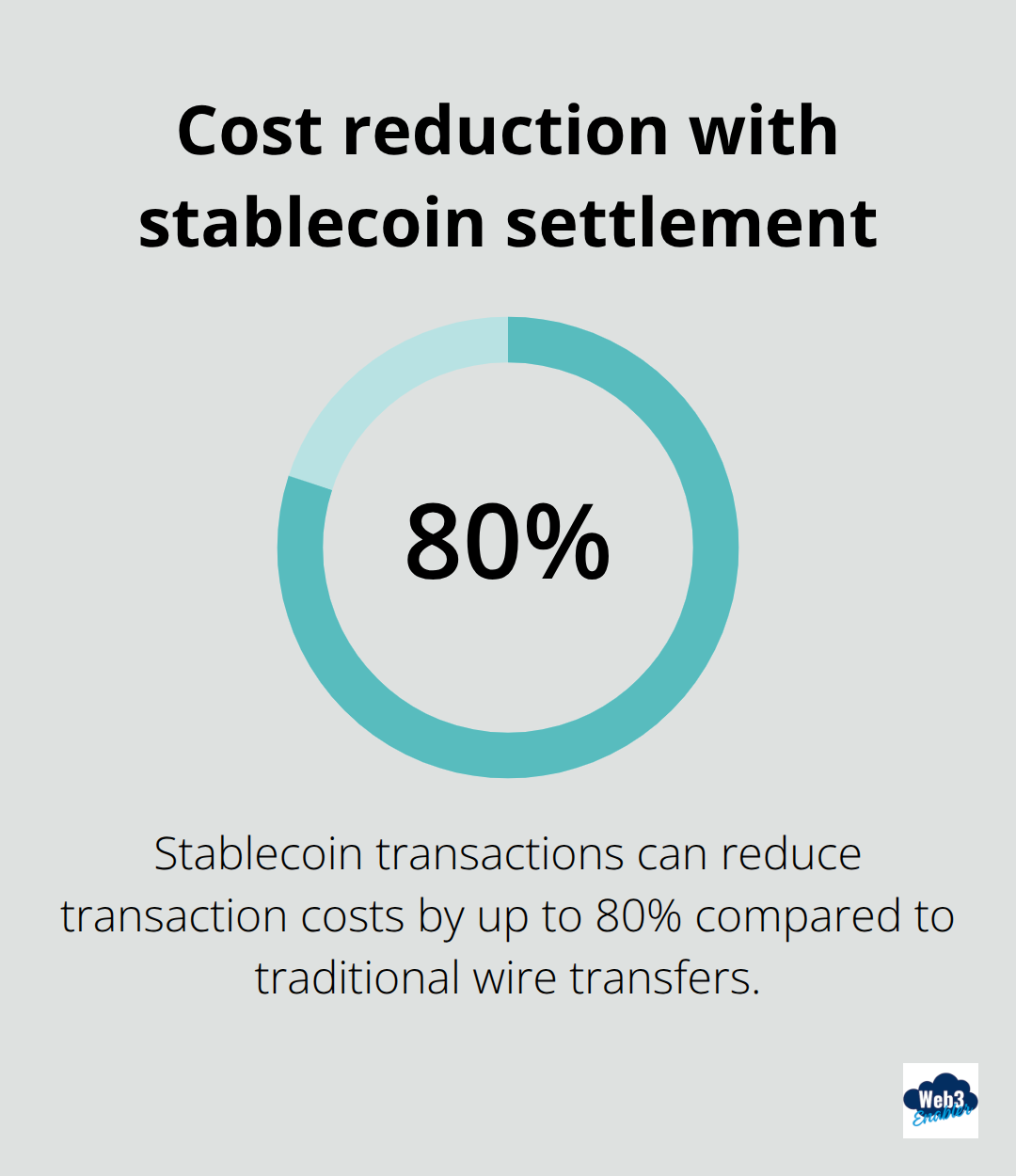
Stablecoin transactions can reduce transaction costs by up to 80% compared to traditional wire transfers, and you control the entire settlement path within Salesforce. Ripple’s $1 billion acquisition of GTreasury signals institutional appetite for this infrastructure because enterprises recognize that embedding stablecoin settlement into treasury systems transforms a cost center into an efficiency engine.
Your team stops spending hours reconciling transactions across spreadsheets and starts handling exceptions through automated workflows. When settlement events flow directly into Financial Services Cloud or Revenue Cloud, reconciliation happens automatically-your on-chain transaction matches to the corresponding invoice without manual intervention. This eliminates the operational drag that plagues traditional treasury, where your finance staff spends disproportionate time on data entry instead of analysis. SoFiUSD launched as the first national-bank-backed stablecoin on a public blockchain specifically because institutions needed 24/7 settlement at fractional costs without relying on legacy banking infrastructure.
Real-Time Visibility Optimizes Reserve Positioning
Liquidity management improves because real-time balance visibility lets you optimize reserve positioning continuously. You see exactly what you hold across all wallets and settlement channels within Salesforce, adjusting positions before problems develop rather than reacting after the fact. This operational precision remains unavailable in traditional treasury systems where balance visibility lags by hours (or longer, depending on your banking relationships). Web3 Enabler brings this real-time on-chain visibility directly into your Salesforce environment, enabling your finance team to make faster, more informed decisions about liquidity allocation and risk management.
Final Thoughts
Stablecoin treasury automation in Salesforce transforms how finance teams operate across global organizations. Your treasury staff already works within Salesforce daily, so adding native stablecoin automation means they stop switching between platforms and start managing everything in one unified system. Settlement events flow directly into Financial Services Cloud or Revenue Cloud, balance updates happen instantly, and reconciliation occurs automatically without manual intervention.
Web3 Enabler brings blockchain-powered payments directly into Salesforce as a native AppExchange application, enabling your organization to accept and send stablecoin payments while gaining real-time visibility into on-chain transactions. The platform integrates with Financial Services Cloud, Commerce Cloud, and Revenue Cloud, transforming your existing Salesforce investment into the foundation for modern treasury automation. Implementation requires no infrastructure rebuild-your team starts automating stablecoin operations immediately.
Your competitors are already evaluating stablecoin settlement infrastructure, and the organizations that move first capture the efficiency gains and cost savings. Start by exploring how Web3 Enabler integrates blockchain payments into your Salesforce environment and identifying your highest-impact use case for stablecoin treasury automation.