


Payment fragmentation costs businesses real money. When customer data lives in separate systems and payment channels operate independently, teams waste time reconciling information and customers face friction at checkout.
Salesforce payments integration solves this by connecting your payment infrastructure directly into your CRM ecosystem. At Web3 Enabler, we’ve seen organizations cut payment processing time by 40% and reduce manual reconciliation work significantly through proper integration.
This guide walks you through what integrated payments actually do, how they benefit your bottom line, and the practical steps to implement them without disrupting operations.
What Salesforce Payments Integration Actually Does
Salesforce Payments Integration connects payment processing directly into your CRM so that every transaction, customer interaction, and financial detail lives in one system instead of scattered across disconnected tools. The architecture works by embedding payment gateways-typically Stripe, Adyen, or PayPal-into Salesforce through native connectors or custom APIs, allowing your team to authorize, capture, and reconcile payments without leaving the platform. When a customer makes a purchase through your web store, mobile app, or point-of-sale system, that transaction data flows immediately into Salesforce records linked to the customer account, order history, and sales pipeline. This eliminates manual work of exporting payment data from one system, importing it into another, and reconciling mismatches. According to Salesforce’s State of Marketing 10th Edition, organizations with unified customer data are 42% more likely to respond promptly to payment inquiries because agents and systems have instant access to complete transaction history. The integration also supports tokenization, which stores encrypted payment credentials securely so customers don’t re-enter card details on repeat purchases, reducing checkout abandonment and friction across channels.
Real-world payment flows become faster and cheaper
When payments live inside your CRM, your operations team stops wasting hours on reconciliation. Instead of exporting CSV files from Stripe, uploading them to your accounting software, and manually matching them against Salesforce records, the system handles this automatically. A customer refund request now takes minutes instead of days because your support agent sees the full transaction record, customer lifetime value, and refund policy guidance in one place. Recurring billing becomes simpler too-your CRM automatically triggers payment captures on subscription renewal dates without manual intervention. The architecture also gives you real-time visibility into payment health metrics like acceptance rates, failed transactions, and settlement delays, which you monitor from a single dashboard instead of logging into multiple vendor portals. This visibility matters because high-performing companies track payment metrics as closely as they track sales metrics, and your payment system needs to support confirmations and status updates via email, SMS, and chat-all coordinated from within Salesforce.
Compliance and security are built into the structure
Integrating payments directly into Salesforce reduces your PCI-DSS compliance scope significantly because you no longer store raw card data in your own systems. Payment tokenization means Salesforce and your payment gateway handle sensitive data, while your team works only with tokens and transaction records. This approach also creates an audit trail automatically because every payment action logs as a Salesforce record with timestamps, user information, and status changes. If a customer disputes a charge or your team needs to investigate a failed transaction, the complete history appears immediately in your CRM instead of requiring separate logins to payment provider dashboards. Security also improves because payment credentials remain encrypted at rest and in transit, and your team members access payment information through Salesforce’s role-based permissions, meaning a junior support agent can see transaction status without viewing card details.
Moving beyond basic payment processing
The real power of integrated payments emerges when you connect transaction data to your broader business operations. Your sales team can see which customers have pending payments or failed transactions, allowing them to proactively reach out before deals stall. Your marketing team can segment customers based on payment behavior and purchase frequency, personalizing offers and renewal reminders. Your finance team gains instant visibility into cash flow and revenue recognition without manual reconciliation. This interconnected view transforms payments from a back-office function into a strategic asset that informs decisions across your entire organization. The next section explores how these capabilities translate into measurable business benefits and why integrated payment solutions matter for your bottom line.
How Integrated Payments Transform Your Business Operations
Integrated payment solutions deliver measurable financial returns within the first six months of deployment. Organizations that consolidate payment processing into their CRM report a 40% reduction in payment processing time and eliminate hours of weekly reconciliation work that previously required manual data entry across disconnected systems. According to Salesforce’s State of Marketing 10th Edition, companies with unified customer data are 42% more likely to respond promptly to customer inquiries, and this advantage extends directly to payment-related issues.
Speed Resolves Payment Friction Faster
When your support team accesses complete transaction history, customer lifetime value, and refund policies from a single interface, resolution time drops dramatically. A customer calling about a failed payment no longer triggers a support ticket that bounces between departments; instead, your agent sees the failed transaction, understands why it failed, checks the customer’s account status, and resolves the issue in minutes. This speed matters because payment friction directly impacts retention. Customers expect two-way conversations across channels about payment status, and 83% of marketers now prioritize bidirectional messaging through email, SMS, and chat for payment confirmations and inquiries.

Integrated solutions automatically route payment communications through the customer’s preferred channel without manual intervention, reducing the likelihood that payment reminders or confirmations get lost in email inboxes.
Finance Teams Stop Wasting Time on Reconciliation
Your accounting team stops spending 10-15 hours weekly exporting payment data from your gateway, importing it into accounting software, and reconciling mismatches against Salesforce records. Automated reconciliation eliminates this work entirely because transactions flow directly into your CRM with complete audit trails. Your finance team gains real-time visibility into cash flow, revenue recognition, and settlement timing without logging into multiple vendor dashboards. This unified view also improves forecasting accuracy because you see not just completed transactions but pending payments, failed attempts, and customer payment patterns in one system.
Subscription Billing Becomes Self-Managing
Your CRM automatically triggers payment captures on renewal dates and logs failed attempts with customer contact information so your retention team can intervene before customers churn. The data visibility advantage compounds over time as your team builds payment intelligence into broader business decisions. Your sales team proactively identifies customers with pending payments or failed transactions and reaches out before deals stall. Your marketing team segments customers based on payment behavior and purchase frequency, personalizing renewal reminders and upsell offers with higher conversion rates.
Payment Data Informs Strategic Decisions
Your product team analyzes which features correlate with payment failures and cancellations, informing roadmap decisions. This interconnected intelligence transforms payments from a back-office cost center into a strategic function that directly influences revenue growth and customer retention. The next section covers the practical steps required to implement these integrated payment systems without disrupting your current operations.
Getting Your Payment System Live Without Breaking Operations
Choose Your Payment Partner Based on Real Costs and Integration Speed
Your payment partner selection ranks as your most critical decision because the wrong choice locks you into technical debt and integration costs that compound for years. Stripe dominates for SaaS and e-commerce businesses because it offers native Salesforce connectors and excellent API documentation. Adyen performs better for multi-currency operations and global merchants processing in 150+ countries with lower cross-border fees. PayPal works well if your customers already use PayPal accounts, but its Salesforce integration requires more custom development than Stripe or Adyen.
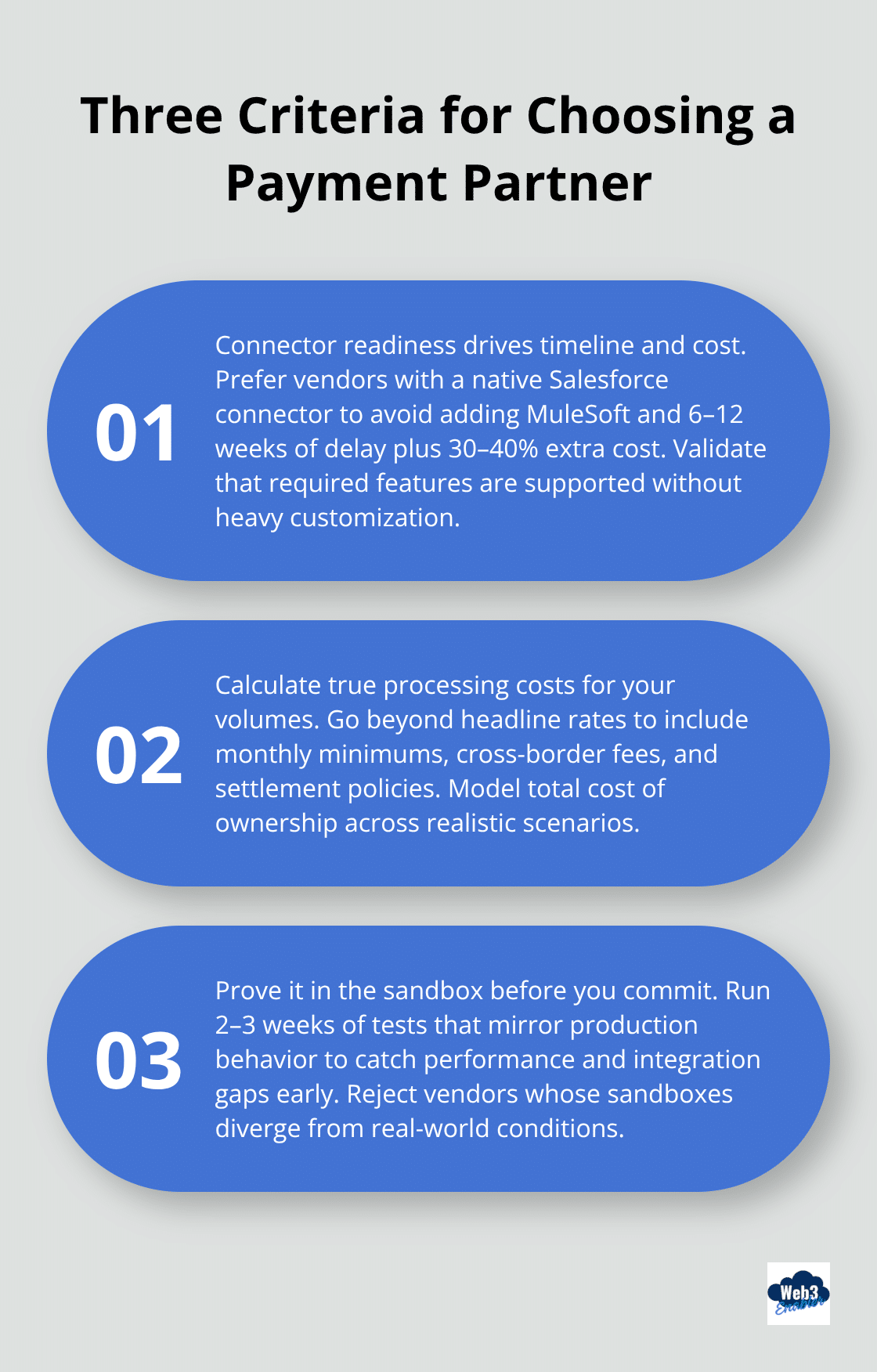
Evaluate partners on three concrete criteria. First, does the vendor offer a pre-built Salesforce connector or will you need MuleSoft integration middleware that adds 6-12 weeks to your timeline and increases costs by 30-40%? Second, what are their actual interchange rates and monthly fees for your transaction volume, not their advertised rates, because a vendor quoting 2.2% plus 30 cents per transaction might hit you with monthly minimums or settlement delays that competitors don’t charge. Third, test their sandbox environment for 2-3 weeks before committing because some vendors make their test environments so different from production that your testing reveals nothing about real-world performance.
If your business requires stablecoin payments and global payment speed, blockchain-native solutions complement traditional payment gateways rather than replacing them. This approach allows you to accept multiple payment types from a single Salesforce interface without abandoning established payment infrastructure.
Build Compliance Into Your Architecture From Day One
PCI-DSS violations result in fines up to $100,000 per incident and your acquiring bank can terminate your merchant account without warning if audits detect non-compliance. Store absolutely zero raw card data in Salesforce or your systems-your payment partner handles tokenization and you work only with tokens and transaction records.
Conduct a PCI scope assessment with your payment partner’s compliance team before implementation to document exactly which systems fall under PCI scope and which don’t. This assessment determines where you need encryption, access controls, and audit logging. Your implementation team must whitelist payment provider domains in Salesforce’s Content Security Policy and load payment processing libraries only from your gateway’s official CDN, never from third-party sources.
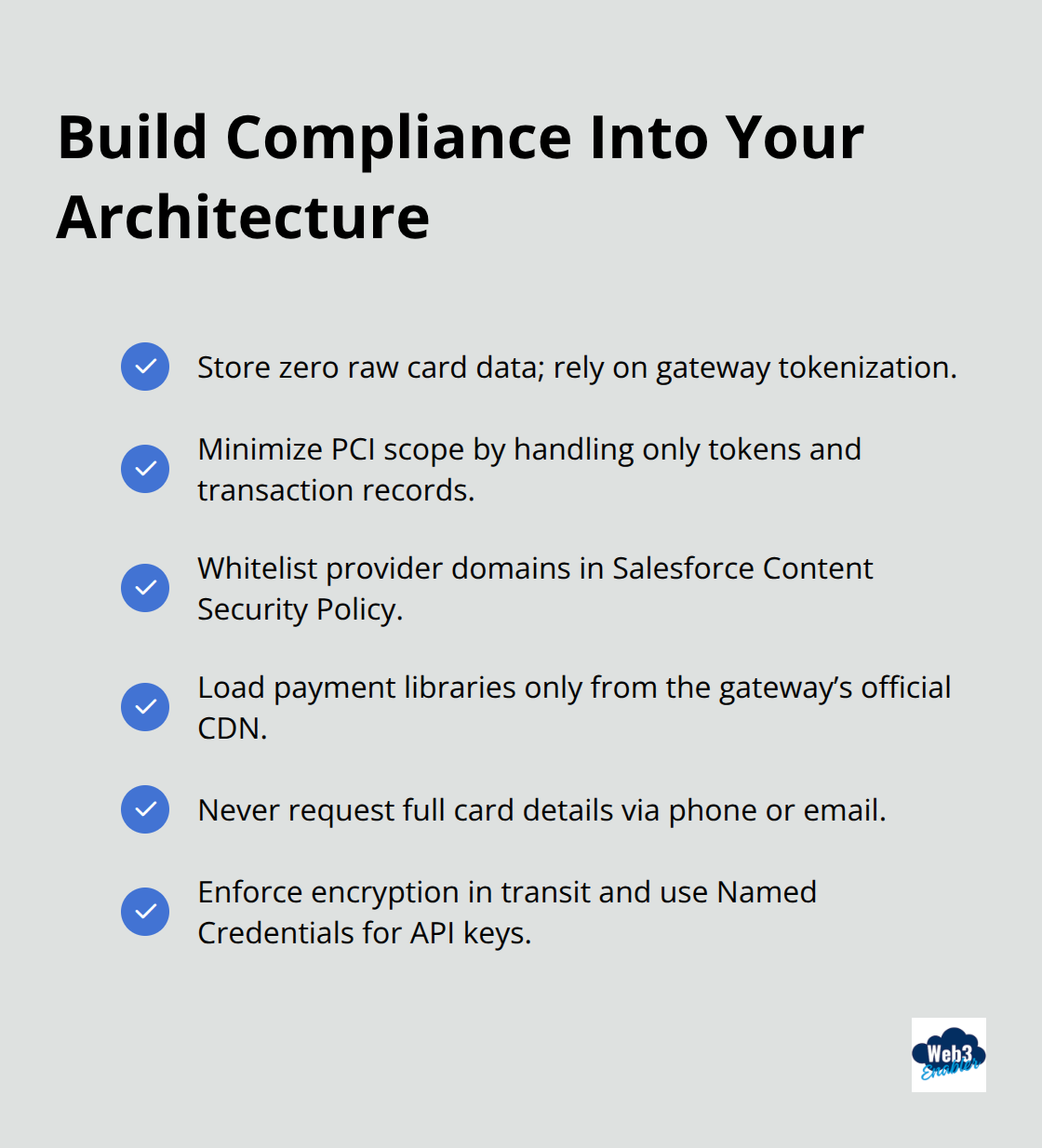
Train your support team that they never ask customers for full card details over phone or email. If a customer reports a payment issue, your agent retrieves the tokenized transaction record and works with the payment provider’s support team directly. Require encrypted connections for all payment data in transit and configure Salesforce Named Credentials to store payment gateway API keys securely rather than in custom code or configuration files.
Test Compliance Thoroughly Before Going Live
Test your compliance setup in sandbox for at least one month before going live, including failed payment scenarios, refund processing, and dispute handling. Real-world edge cases often reveal security gaps that static documentation misses. Your implementation timeline typically runs 8-12 weeks for basic integration and 16-20 weeks if you need multi-currency support or recurring billing, so plan accordingly and don’t compress timelines by skipping compliance reviews.
FAQ: Salesforce Payments Integration
How does Salesforce payments integration reduce my PCI-DSS compliance scope?
When you integrate a payment gateway like Stripe or Adyen into Salesforce, the system uses tokenization. This means your Salesforce environment never actually sees or stores raw credit card numbers; it only handles a secure “token” provided by the payment gateway. Because the sensitive data stays with the gateway, your business qualifies for a much simpler PCI compliance assessment (often the SAQ-A), significantly reducing your audit costs and security risks.
Can I accept both traditional credit cards and stablecoins in one Salesforce interface?
Yes. By using a solution like Web3 Enabler alongside a traditional gateway, you can provide customers with a unified checkout experience. Salesforce manages the order and customer records, while the underlying infrastructure routes the payment to either a traditional bank or a blockchain network like Solana or Ethereum. Your finance team sees all transactions—fiat or crypto—in one central Salesforce dashboard.
How much time will my finance team save on manual reconciliation?
Organizations typically see a 40% reduction in processing time and save 10 to 15 hours per week on manual data entry. In a non-integrated setup, finance teams must manually match bank deposits to Salesforce invoices. With integration, the payment gateway notifies Salesforce the moment a transaction is successful, automatically marking the invoice as paid and updating your cash flow reports in real time.
What is the typical timeline for a Salesforce payments implementation in 2026?
A standard integration for a single currency usually takes 8 to 12 weeks. If your business requires complex features like multi-currency support for 150+ countries, recurring subscription billing, or advanced dunning logic, the timeline typically extends to 16 to 20 weeks. This includes a mandatory sandbox testing phase of at least one month to ensure compliance and security protocols are airtight.
Will this integration help with failed payment recovery and churn?
Absolutely. One of the biggest advantages is automated dunning. When a credit card expires or a stablecoin payment is missed, Salesforce can automatically trigger a sequence of reminders via email, SMS, or WhatsApp. Because the payment system is tied to your CRM, these messages can be personalized based on the customer’s history, which significantly improves recovery rates compared to generic bank notifications.
Final Thoughts
Salesforce payments integration eliminates the operational friction that costs businesses thousands of dollars monthly in wasted reconciliation time and lost revenue from payment delays. Your team stops juggling disconnected systems, your customers experience faster checkout and resolution, and your finance department gains real-time visibility into cash flow without manual data entry. The 40% reduction in payment processing time translates directly to cost savings, while unified customer data enables your sales and support teams to resolve payment issues in minutes instead of days.
For business leaders, integrating payments into your CRM ranks as a competitive necessity rather than an optional upgrade. Your competitors are already consolidating payment infrastructure, and customers now expect two-way payment communications across email, SMS, and chat from a single interface. Organizations with unified customer data respond 42% faster to inquiries, and this advantage compounds when you apply it to payment operations. The compliance benefits matter equally because PCI-DSS violations carry six-figure fines, and integrated solutions reduce your compliance scope by eliminating raw card data storage in your systems.
Your implementation roadmap should start with clear partner selection based on actual integration timelines and costs, not marketing claims. Allocate 8-12 weeks for basic integration and 16-20 weeks if you need multi-currency or recurring billing support, then test thoroughly in sandbox before going live. If your business operates globally or accepts multiple payment types, blockchain solutions complement your traditional gateway to expand payment options without abandoning established infrastructure.