



Your Salesforce instance already holds all your business data. So why bolt on clunky third-party blockchain tools that create more problems than they solve?
Salesforce native blockchain apps built on AppExchange change that equation entirely. We at Web3 Enabler have seen firsthand how companies waste months integrating external solutions when the answer was sitting in their CRM all along. These apps work inside Salesforce, not around it, which means faster deployment and real security from day one.
Why Native Beats Bolted-On
The moment you try to stitch a third-party blockchain tool into Salesforce, you’re fighting physics. Data lives in Salesforce. Your workflows live in Salesforce. Your audit trails, compliance records, and customer history live in Salesforce. Plugging in external middleware means data bounces between systems, sync delays happen, and you’re suddenly managing two separate sources of truth instead of one. When blockchain runs natively inside Salesforce, there’s no translation layer, no API bottleneck, and no wondering whether your off-chain data matches what’s on the ledger. Native blockchain apps deliver the same principle: one system, one record, one version of reality.
Your Data Already Knows What to Do
Salesforce already tracks your leads, accounts, opportunities, and contracts with timestamps and audit trails. Native blockchain apps inherit that infrastructure. When you process a stablecoin payment through an AppExchange app, the transaction record lands directly in your opportunity, linked to the customer, with full compliance metadata attached. No manual data entry. No exports and imports. No spreadsheets reconciling what happened in blockchain versus what happened in your CRM. The Global CRM market size reached 58.82 billion dollars in 2022 and continues growing at 13.9% annually according to Grand View Research, partly because companies realize that fragmented tools drain revenue teams. Native apps eliminate that waste-your existing Salesforce data flows into blockchain workflows without friction. Your compliance officer audits a crypto transaction the same way they audit a regular order: pull the record, see the full history, verify the approvals.
Security That Doesn’t Require a PhD
Salesforce handles encryption, backup, and access control at scale. Native blockchain apps inherit that security posture. OwnBackup automates Salesforce backups of data and metadata with rapid restoration, and those same protections apply to blockchain records stored within your instance. You’re not relying on a startup’s security team or hoping a third-party service stays in business. You’re leveraging infrastructure that serves millions of enterprises and passes regular SOC 2 audits. Permissioned governance means only the right people see crypto transactions, stablecoin balances, or client holdings. If your financial advisors need visibility into client crypto without exposing the entire firm’s holdings, Salesforce role-based access controls handle that natively. Custom implementations let you design exactly who sees what, with audit trails that prove compliance.
The Real Cost of Bolted-On Solutions
External blockchain tools carry hidden expenses that native apps eliminate. You pay licensing fees for the third-party platform, then pay again for integration specialists to wire it into Salesforce. Sync failures require troubleshooting across two vendors. Data quality issues become finger-pointing exercises. Native apps collapse those costs into a single platform fee, with support teams that understand both blockchain and Salesforce deeply. Your IT team manages one system instead of two, which frees them to focus on strategy rather than firefighting integration problems. That’s where unified data means faster decisions and fewer bottlenecks.
What Happens Next
With native blockchain apps handling your payments, compliance, and client visibility, you’re ready to move beyond infrastructure and into the workflows that actually move business forward. The next section shows how real companies are using these apps to transform their operations.
How Blockchain Apps Actually Work Inside Salesforce
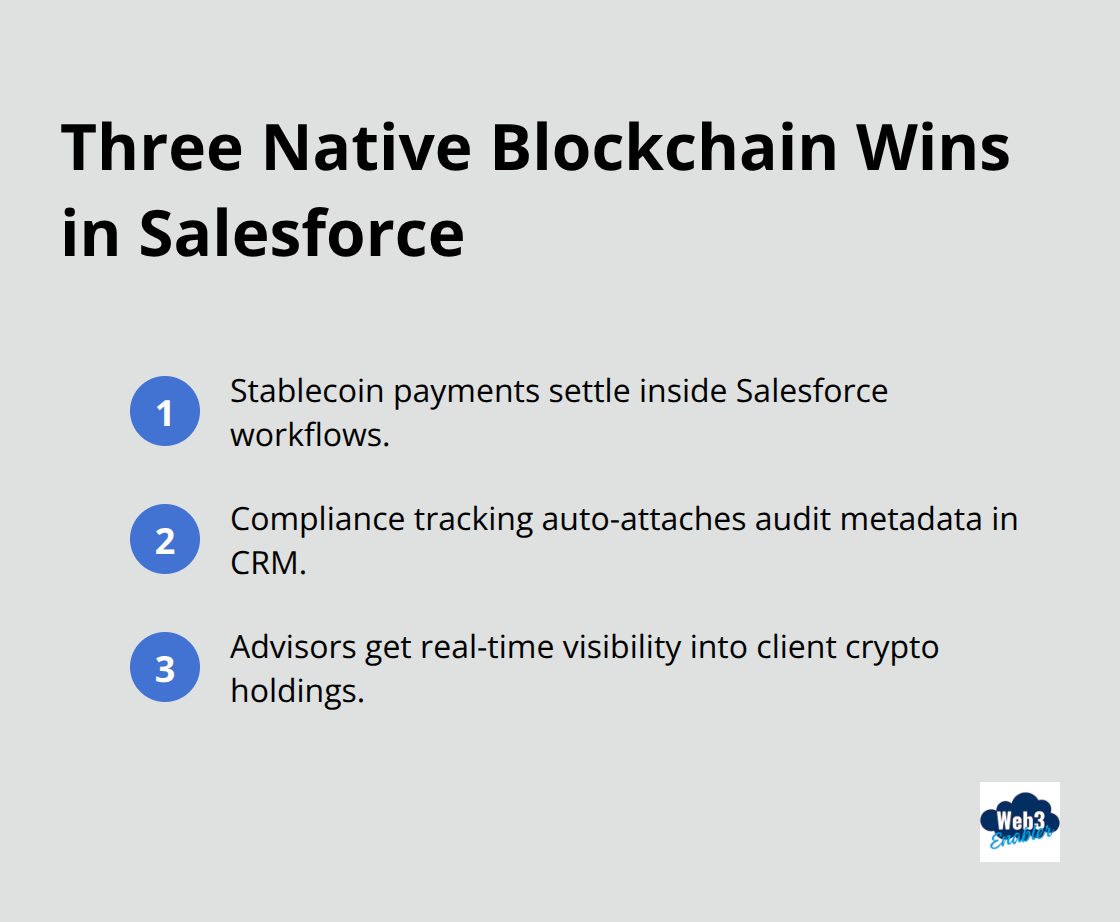
Native blockchain apps transform three critical business functions that companies currently handle through fragmented tools and manual workarounds. Stablecoin payments settle directly within Salesforce workflows instead of requiring separate payment processors and reconciliation spreadsheets. Compliance tracking happens automatically as transactions flow through your CRM, eliminating the audit preparation scramble that costs finance teams hours every quarter. Financial advisors gain real-time visibility into client crypto holdings without leaving Salesforce, turning what was once a data silo into actionable intelligence.
These aren’t theoretical improvements-they’re operational shifts that change how teams work and what finance leaders can actually measure.
Stablecoin Payments Eliminate International Banking Friction
Companies sending international payments lose 6 to 8 percent to wire fees and currency conversion spreads, according to remittance tracking services. Stablecoin payments through native Salesforce apps eliminate those intermediaries entirely. When a client pays an invoice using USDC or another stablecoin, the transaction settles in minutes rather than days, the payment lands directly in your accounts receivable, and conversion happens at market rates without bank markup. A software company billing European customers no longer waits for international wire transfers or pays correspondent banking fees. The payment hits your Salesforce record immediately, your revenue recognition updates in real time, and your cash flow forecast becomes accurate instead of guesswork.
MuleSoft Composer automates the downstream workflows-triggering fulfillment, updating customer records, and notifying your accounting system without manual intervention. This matters most for companies with high transaction volume or international operations where traditional banking costs compound quickly.
Compliance Tracking Happens Automatically
Regulatory reporting currently consumes enormous resources because transactions live in multiple systems that don’t speak to each other. A financial services firm tracks client transactions in one system, crypto holdings in another, and compliance records in a third, then spends days manually reconciling everything for quarterly audits. Native blockchain apps eliminate that fragmentation. Every stablecoin transaction, every client holding update, every approval creates an immutable record directly in Salesforce with full audit trail metadata attached.
When a regulator asks to verify client holdings or transaction history, your compliance officer pulls the record from Salesforce and shows the complete chain of custody with timestamps and approvals already documented. Permissioned access means different team members see only what they need-your trading desk sees execution details while your compliance team sees the full regulatory snapshot. This architecture also handles AML and KYC requirements natively since Salesforce already manages customer identity and verification workflows. Quarterly compliance reporting shrinks from weeks to days, and your team stops chasing data across disconnected platforms.
Advisors See the Complete Client Picture
Financial advisors currently manage client crypto holdings through email updates, spreadsheets, or separate portfolio dashboards that don’t connect to their CRM. This creates a fragmented client picture where an advisor sees investment accounts in Salesforce but has no visibility into crypto positions, making comprehensive wealth management impossible. Native Salesforce solutions bring crypto holdings directly into the client record so advisors see the complete picture without context switching.
An advisor reviewing a client’s net worth now sees traditional investments, real estate, and crypto holdings all in one place, enabling better advice and more informed conversations about rebalancing or risk management. Role-based access controls ensure that only authorized advisors see specific client holdings while compliance teams get the reporting view they need. This integration also supports client communication-advisors pull crypto performance data directly into client reports alongside traditional assets, making conversations about diversification and allocation far more productive. The transparency builds trust because clients see their advisors actually understand their full financial picture instead of treating crypto as a separate, misunderstood asset class.
With these three functions running natively inside Salesforce, your teams stop juggling disconnected tools and start working from a single source of truth. The next section shows why this native approach outperforms custom-built solutions that companies attempt to bolt together.
Why AppExchange Wins Against Building It Yourself
Custom Implementations Cost Far More Than You Think
Building a custom blockchain solution inside Salesforce sounds like control until you calculate what it actually costs. Companies that attempt custom implementations spend six to twelve months wrangling consultants, managing scope creep, and debugging integrations before they process a single transaction. AppExchange apps ship in weeks because they’re already built, tested, and hardened against real-world problems that custom teams discover the painful way.
A mid-market company building custom blockchain connectivity typically invests 150,000 to 300,000 dollars in initial development, then commits 40,000 to 60,000 dollars annually in maintenance and updates. AppExchange apps cost a fraction of that with predictable monthly pricing and zero maintenance burden.
Security and Compliance Come Pre-Built
A custom blockchain solution inside Salesforce requires your team to architect permissioned governance, audit trails, and compliance metadata from scratch. That means security reviews, regulatory validation, and ongoing maintenance that never ends. AppExchange apps handle these features out of the box because vendors have already solved them repeatedly across different industries.
DocuSign for Salesforce, Conga, and OwnBackup demonstrate how AppExchange apps integrate seamlessly with Salesforce governance, delivering audit trails and backup capabilities that custom solutions struggle to replicate without significant engineering. The moment Salesforce releases a platform update, custom code breaks and your team scrambles to fix it. AppExchange vendors push updates automatically with each Salesforce release, so your blockchain workflows stay current without engineering effort.
Support That Actually Understands Your Stack
AppExchange solutions come with vendor support that understands both Salesforce and blockchain deeply, not external consultants who treat your CRM as a data warehouse to bolt tools onto. When compliance questions arise or transaction volumes spike, you contact the app vendor who built the feature, not a custom development team scattered across your organization.
MuleSoft Composer automates downstream workflows triggered by blockchain transactions, eliminating the manual integration work that custom implementations require. Companies choosing AppExchange solutions gain access to vendors who’ve solved these problems repeatedly, bringing pattern knowledge and best practices that custom teams lack.
Your Team Focuses on Business, Not Infrastructure
More importantly, AppExchange solutions eliminate the maintenance burden that custom implementations create forever. Your team focuses on business logic instead of infrastructure, which means faster time to revenue and fewer firefighting emergencies that drain resources. When compliance questions arise or transaction volumes spike, you contact the app vendor who built the feature, not a custom development team scattered across your organization. The financial gap widens fast once you factor in total cost of ownership-AppExchange apps deliver predictable costs and vendor support that custom solutions simply cannot match.
Final Thoughts
Salesforce native blockchain apps represent the practical path forward for enterprises tired of wrestling with fragmented tools and integration nightmares. The choice between native solutions and custom implementations becomes obvious once you factor in deployment speed, total cost of ownership, and the ongoing maintenance burden that custom builds create. Native apps ship in weeks, cost a fraction of custom development, and come with vendor support that actually understands your stack instead of treating Salesforce as a data warehouse to bolt external tools onto.
Your business runs on Salesforce, so your blockchain workflows should too. Every month spent building custom connectivity is a month your competitors gain using AppExchange solutions that already handle payments, compliance, and client visibility. The security, audit trails, and governance features that custom teams struggle to architect from scratch come pre-built into AppExchange apps, tested across industries and hardened against real-world problems.
Start by identifying which business function matters most to your operation-eliminating international payment friction through stablecoin settlements, automating compliance tracking so your finance team stops drowning in manual reconciliation, or giving financial advisors the complete client picture they need to provide better advice. Choose an AppExchange solution that solves that specific problem, then expand from a foundation that actually works. Web3 Enabler connects blockchain technology with your existing Salesforce infrastructure through native solutions available on AppExchange, supporting stablecoin payments, global transactions, compliance automation, and financial advisor visibility into client crypto holdings.