

Revenue recognition blockchain integration is no longer a distant possibility-it’s becoming essential for finance teams managing global transactions. Manual reconciliation between payment systems and accounting records creates bottlenecks that slow down your close process and introduce costly errors.
We at Web3 Enabler built Blockchain Payments for Salesforce Revenue Cloud to eliminate these friction points. Real-time on-chain settlement gives you instant visibility into revenue while automated compliance reporting keeps your audit trail clean and complete.
Why Global Revenue Recognition Is Broken
The Timeline Mismatch That Costs You Days
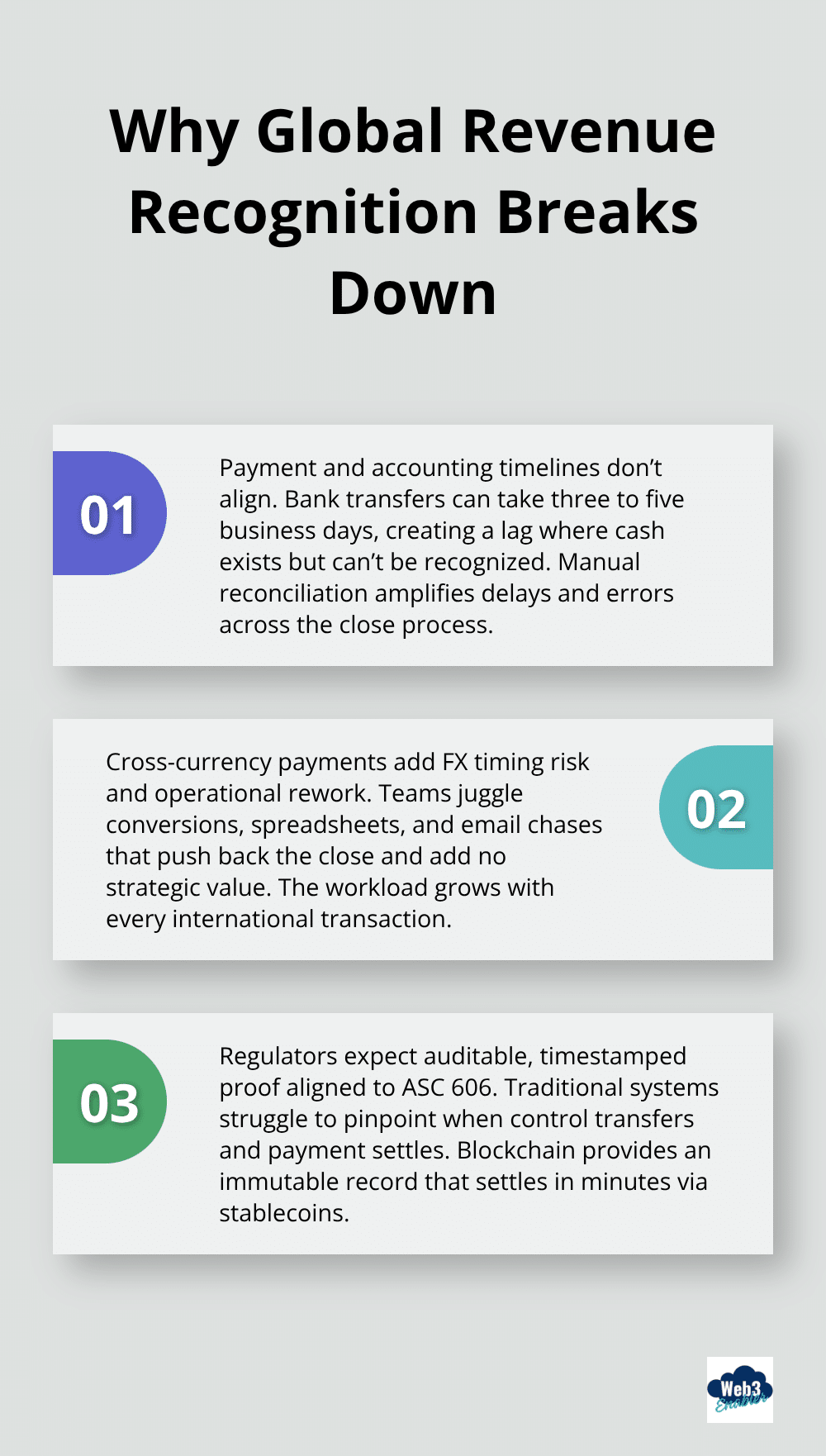
Finance teams managing cross-border transactions face a brutal reality: traditional payment systems and accounting records operate on completely different timelines. A customer in Singapore pays via bank transfer on Monday, but that payment doesn’t settle for three to five business days. Meanwhile, your accounting team waits to recognize revenue, creating a gap where cash exists but isn’t recorded. According to Salesforce’s State of Sales Report, manual reconciliation processes introduce delays and errors at every step.
Currency Conversion Adds Layers of Complexity
International payments compound this problem significantly. When you invoice a client in Mexico in USD but they pay in MXN, you manage currency conversion, FX timing risk, and settlement delays that stretch across weeks. Each friction point requires manual intervention, spreadsheet updates, and back-and-forth emails between finance and operations teams. The cost is real: delayed revenue recognition pushes back your close process, creates audit complications, and forces your team to spend hours on reconciliation work that adds no strategic value.
Regulators Demand Proof You Can’t Provide
Regulatory requirements make this even more critical. ASC 606 demands that you recognize revenue when control of goods or services transfers to the customer, not when payment arrives in your bank account. For global transactions, determining that exact moment becomes nearly impossible with traditional systems. Regulators and auditors expect auditable, timestamped proof of when obligations were fulfilled and when payment settled.
Blockchain solves this by creating an immutable record of every transaction the moment it occurs on-chain. Real-time settlement through stablecoins eliminates the three-to-five day waiting period entirely. When a customer pays in USDC or USDT, that transaction settles in minutes, giving you instant visibility into whether payment actually happened.
Connecting On-Chain Events to Revenue Cloud
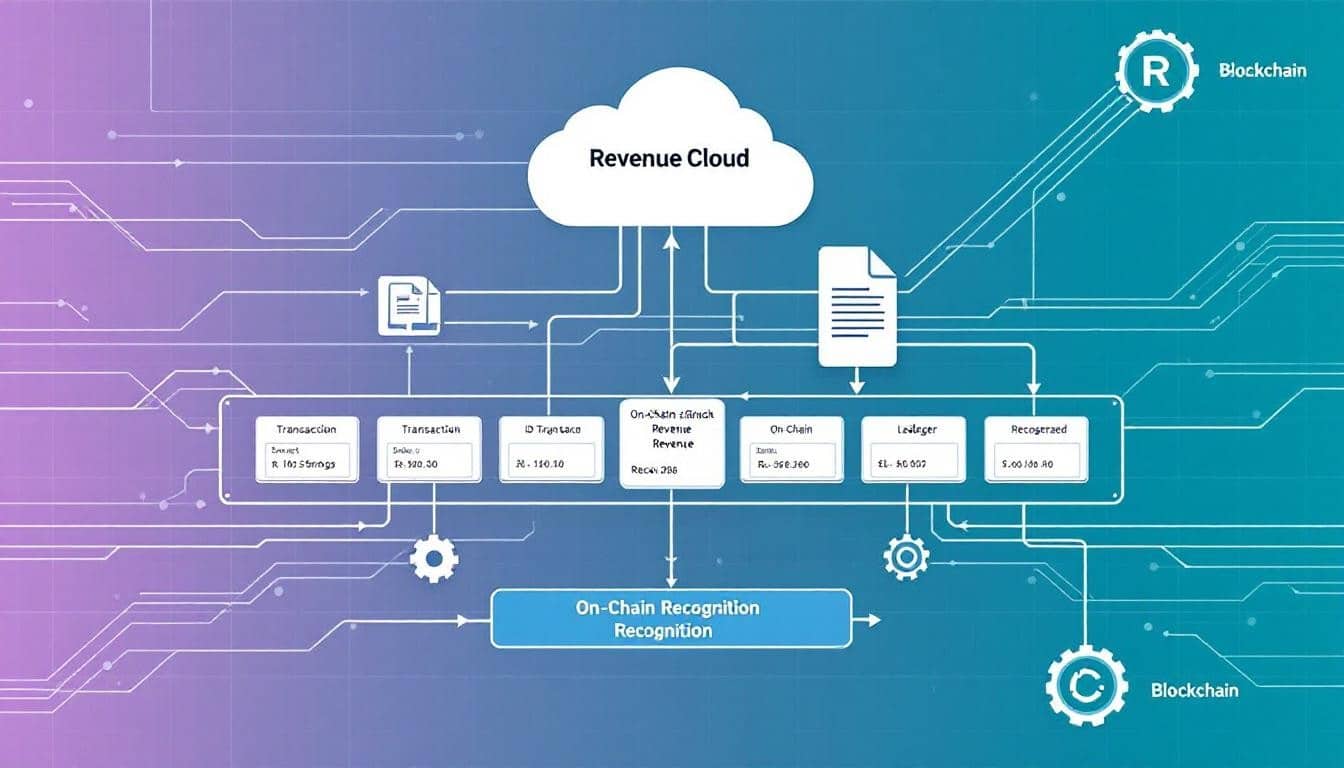
Web3 Enabler connects these on-chain events directly to Revenue Cloud, automatically triggering revenue recognition the moment your conditions are met. Your audit trail becomes a permanent, tamper-proof ledger instead of a collection of bank statements and email confirmations. This transforms revenue operations from a reactive, error-prone process into an automated, compliant workflow that your auditors can verify in seconds rather than days-setting the stage for how you actually implement this transformation.
How Blockchain Eliminates Revenue Recognition Delays
Settlement Happens in Minutes, Not Days
The moment a customer’s stablecoin payment hits the blockchain, your Revenue Cloud knows about it. Traditional payment rails force you to wait days for settlement confirmation, but on-chain transactions are final and visible immediately. When you accept USDC or USDT through Blockchain Payments for Salesforce, the transaction settles in minutes, not business days. Your finance team stops waiting for bank confirmations and starts recognizing revenue the instant payment actually occurs. This isn’t incremental improvement-it’s a fundamental shift in how fast your close process can move.
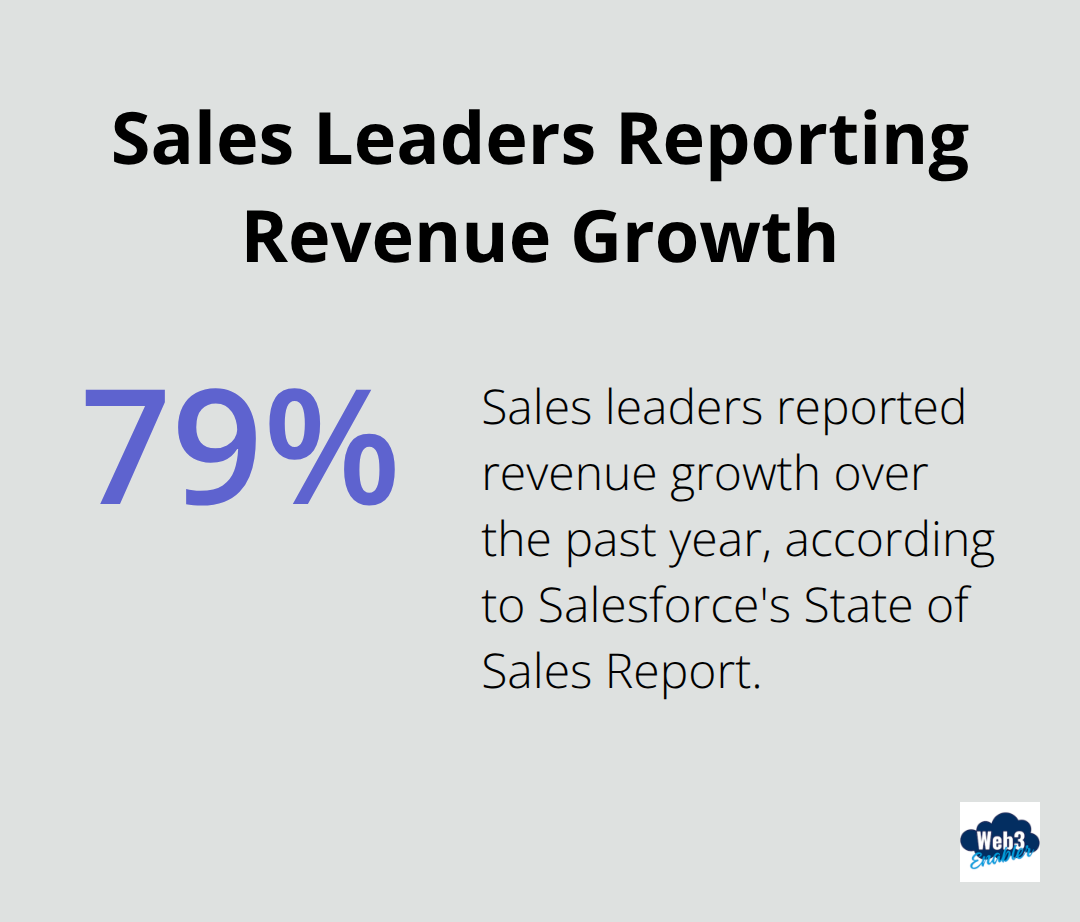
According to Salesforce’s State of Sales Report, 79% of sales leaders reported revenue growth over the past year. On-chain settlement removes the guesswork from ASC 606 compliance because the blockchain creates an immutable timestamp of when your customer’s obligation was fulfilled and when payment transferred. Your auditors see a permanent record instead of reconstructing events from bank statements months later.
Reconciliation Happens Automatically in Real Time
Reconciliation between payment systems and accounting records consumes weeks of manual work every quarter. Your team compares bank statements against Revenue Cloud records, hunts down missing transactions, investigates timing differences, and corrects errors. Blockchain Payments for Salesforce connects on-chain payment events directly to Revenue Cloud’s order and invoice data, so reconciliation happens in real time as transactions settle. When a payment arrives on-chain, it automatically matches against the corresponding invoice and triggers revenue recognition without human intervention.
Currency conversion happens at the moment of settlement using live exchange rates, eliminating the FX timing risk that plagues international transactions. Your compliance team gains visibility into every transaction through a single dashboard that shows both the on-chain settlement proof and the corresponding Revenue Cloud record. This means your quarterly close accelerates from weeks to days because reconciliation is already complete. The audit trail becomes self-documenting-every revenue event has a blockchain timestamp, a Salesforce record, and an automatic match between them. This level of automation reduces the error rate that plagues manual processes and frees your team to focus on revenue strategy instead of spreadsheet maintenance.
Audit Readiness Becomes Your Default State
Regulators and auditors expect you to prove that revenue recognition followed ASC 606 rules and that payment actually occurred. Traditional systems force you to reconstruct this proof by gathering emails, bank statements, and system logs. Blockchain changes this entirely because the on-chain record is permanent and tamper-proof from the moment settlement occurs. Your settlement proof lives directly in Revenue Cloud, so auditors can verify the complete chain of events without leaving your CRM.
When an auditor asks when a customer’s payment actually settled and when you recognized revenue, you show them the on-chain timestamp and the corresponding Revenue Cloud entry. No reconstruction needed, no gaps in the timeline, no questions about data integrity. This transparency also simplifies compliance with evolving regulations. The EU AI Act and similar frameworks increasingly require explainable, auditable decision-making in financial processes. Blockchain’s immutable ledger satisfies these requirements because every revenue event has a verifiable source and timestamp. Your compliance team stops spending time preparing audit responses and starts using that time to improve revenue operations.
Moving From Reactive to Proactive Finance
The shift from traditional payment systems to on-chain settlement transforms your entire finance operation. Instead of being audit-ready three months before your external review, you’re audit-ready every single day because your revenue data is continuously verified against the blockchain. This constant verification creates a foundation for the next critical step: actually implementing these capabilities within your Salesforce environment and seeing the operational impact firsthand.
Making Blockchain Payments Live in Revenue Cloud
Setting Up Your Stablecoin Payment Rails
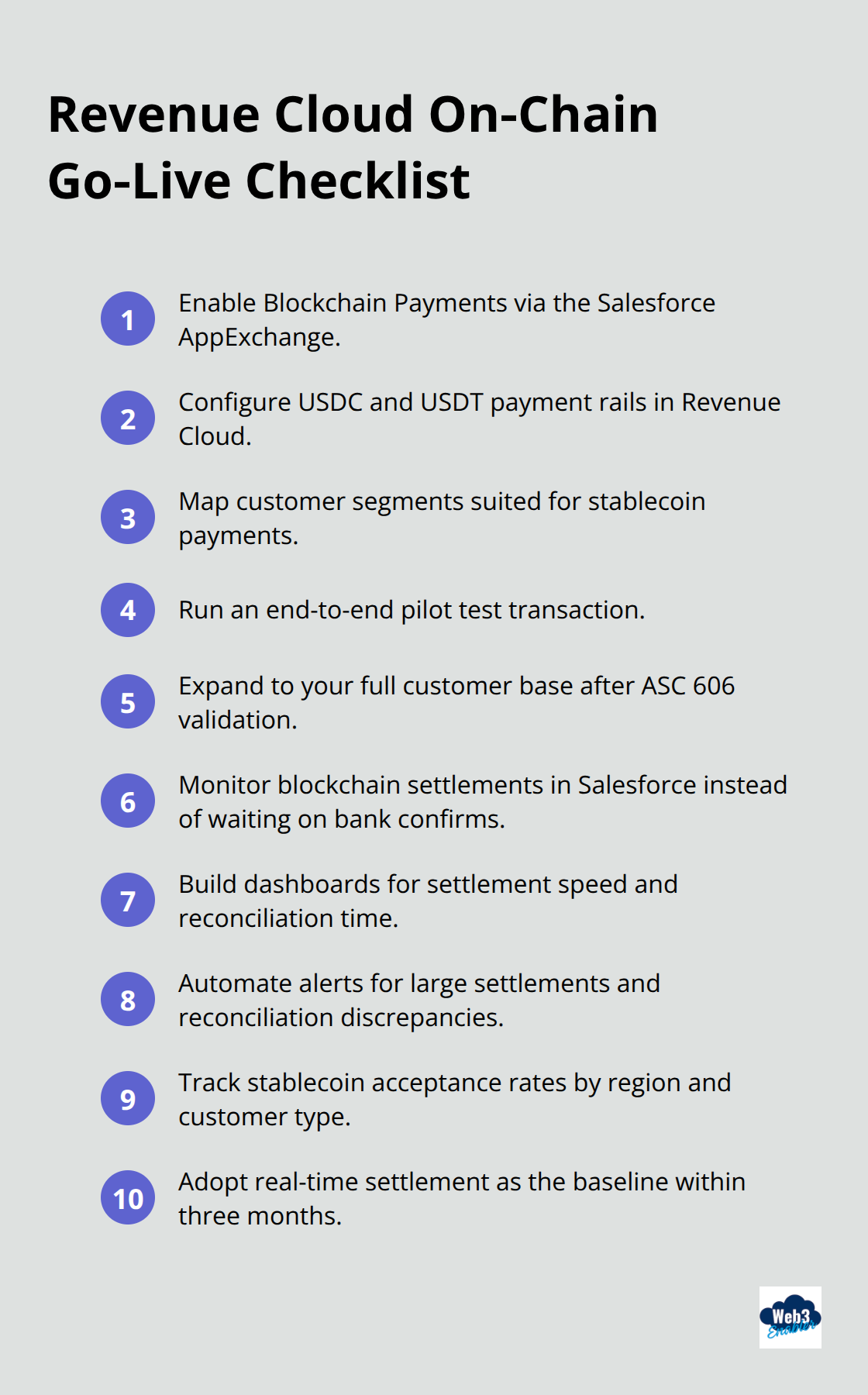
The technical setup for connecting blockchain payments to Revenue Cloud requires far less time than most finance leaders expect. Web3 Enabler’s integration connects directly to your existing Revenue Cloud instance without requiring custom development or system overhauls. Start by enabling Blockchain Payments for Salesforce through the AppExchange, then configure your stablecoin payment rails within Revenue Cloud’s order management system. The platform supports USDC and USDT payments, which settle in minutes rather than days. Your first step involves mapping which customer segments will pay via stablecoin-typically international clients where traditional cross-border payments create the most friction. Set up a test transaction with a pilot customer to verify the end-to-end flow: payment arrives on-chain, Revenue Cloud detects the settlement, and revenue recognition triggers automatically. This pilot phase takes one to two weeks and costs nothing beyond your existing Revenue Cloud license.
Expanding to Your Full Customer Base
Once the pilot confirms that on-chain transactions match your ASC 606 requirements, you expand to your full customer base. The key operational change is that your billing team stops waiting for bank confirmations and instead monitors the blockchain directly through your Salesforce dashboard. Invoice customers in USDC or USDT, and when they pay, the transaction settles immediately with full audit trail visibility. Your compliance team gains immediate visibility into which transactions have settled on-chain versus those still pending, enabling faster month-end closes and reducing the audit preparation workload.
Building Your Single Source of Truth
The monitoring dashboard becomes your single source of truth for global revenue operations. Revenue Cloud displays pending invoices, settled payments, and recognized revenue all in one view, with blockchain settlement data embedded directly alongside traditional Salesforce records. Create custom dashboards that track key metrics like settlement speed and reconciliation time. Finance leaders at organizations using on-chain settlement report closing their books faster than peers using traditional payment rails.
Automating Alerts and Monitoring
Set up automated alerts that notify your team when large transactions settle, when reconciliation discrepancies appear, or when revenue recognition rules need adjustment. These alerts prevent the manual status-check emails that consume hours each week. The dashboard also tracks your stablecoin acceptance rate across customer segments, showing which regions and customer types prefer blockchain payments versus traditional methods. This data informs your payment strategy and helps you forecast which customers will accelerate into on-chain settlement. Within three months of going live, your team stops treating payment delays as a normal part of the close process and starts treating real-time settlement as the baseline expectation.
Final Thoughts
Revenue recognition blockchain integration transforms how finance teams operate at scale. The shift from manual reconciliation to automated on-chain settlement eliminates delays that plague global finance. Your close process accelerates from weeks to days because payment confirmation and revenue recognition happen simultaneously on the blockchain, while auditors gain instant access to tamper-proof settlement records instead of reconstructing timelines from scattered documentation.
The competitive advantage belongs to organizations that move first. While your peers spend weeks reconciling cross-border transactions and managing currency conversion delays, your team closes the books in real time. Finance leaders using on-chain settlement report faster month-end closes, reduced audit preparation time, and dramatically lower error rates because blockchain creates the audit trail that regulators demand.
Starting this transformation requires less effort than most finance leaders expect. Web3 Enabler’s Blockchain Payments for Salesforce integrates directly into your existing Revenue Cloud environment without custom development or system overhauls, and your first pilot takes one to two weeks to demonstrate the operational impact.