


Your payment system is probably bleeding money right now. Hidden fees, slow cross-border transfers, and enough friction to make your finance team want to scream-it’s the tax you pay for outdated infrastructure.
At Web3 Enabler, we’ve watched forward-thinking companies ditch these headaches by moving to revenue cloud blockchain payments. No crypto casino vibes here, just practical ledger-backed transactions that actually work inside Salesforce.
Why Your Payment System Is Costing You More Than You Think
The Hidden Drain of Legacy Infrastructure
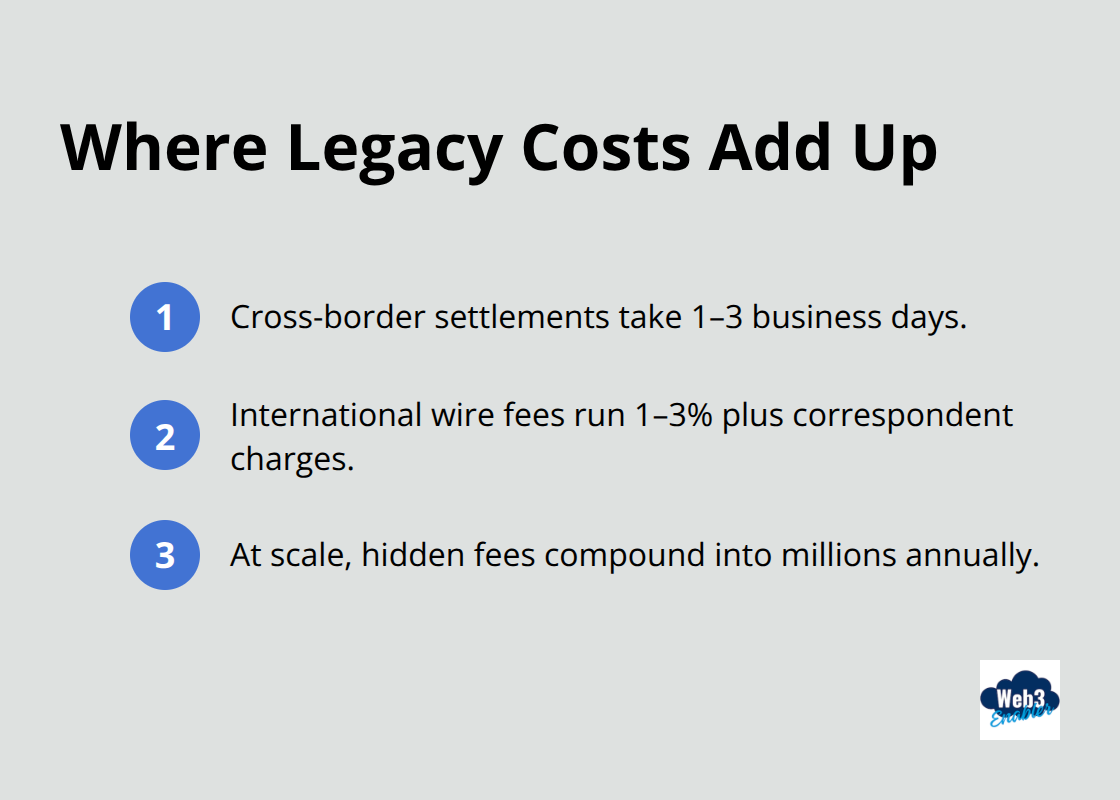
Legacy payment infrastructure doesn’t just move money slowly-it bleeds margins at every step. The B2B payments market is projected to grow from USD 11.69 trillion in 2024 to USD 15.88 trillion by 2030, yet the underlying settlement infrastructure remains stuck in batch processing. Your cross-border transactions settle in 1 to 3 business days while your cash sits frozen. Wire transfer fees for international payments typically run 1 to 3 percent of transaction value, and that’s before correspondent bank charges stack on top. For a company processing 100,000 monthly transactions across multiple countries, those hidden fees compound into millions annually.
Card networks lock you into their fee schedules with little room to negotiate. Chargebacks eat another 0.5 to 1 percent from high-volume merchants. The real damage isn’t just the direct fees-it’s the opportunity cost. Your finance team spends weeks reconciling payments across multiple systems, spotting discrepancies that shouldn’t exist in the first place.
Security Gaps That Keep You Vulnerable
Security vulnerabilities in legacy rails mean fraud exposure remains high. Merchants still absorb liability for unauthorized transactions that blockchain’s cryptographic verification could prevent outright. You’re essentially paying for a system that exposes you to risk while charging you for the privilege.
Cross-Border Payments: Where the Pain Gets Real
Cross-border payments represent the clearest pain point. The World Bank estimates that remittance corridors still cost 4 to 7 percent in fees and take days to settle, even though the actual transfer of value happens instantly on the sender’s end.
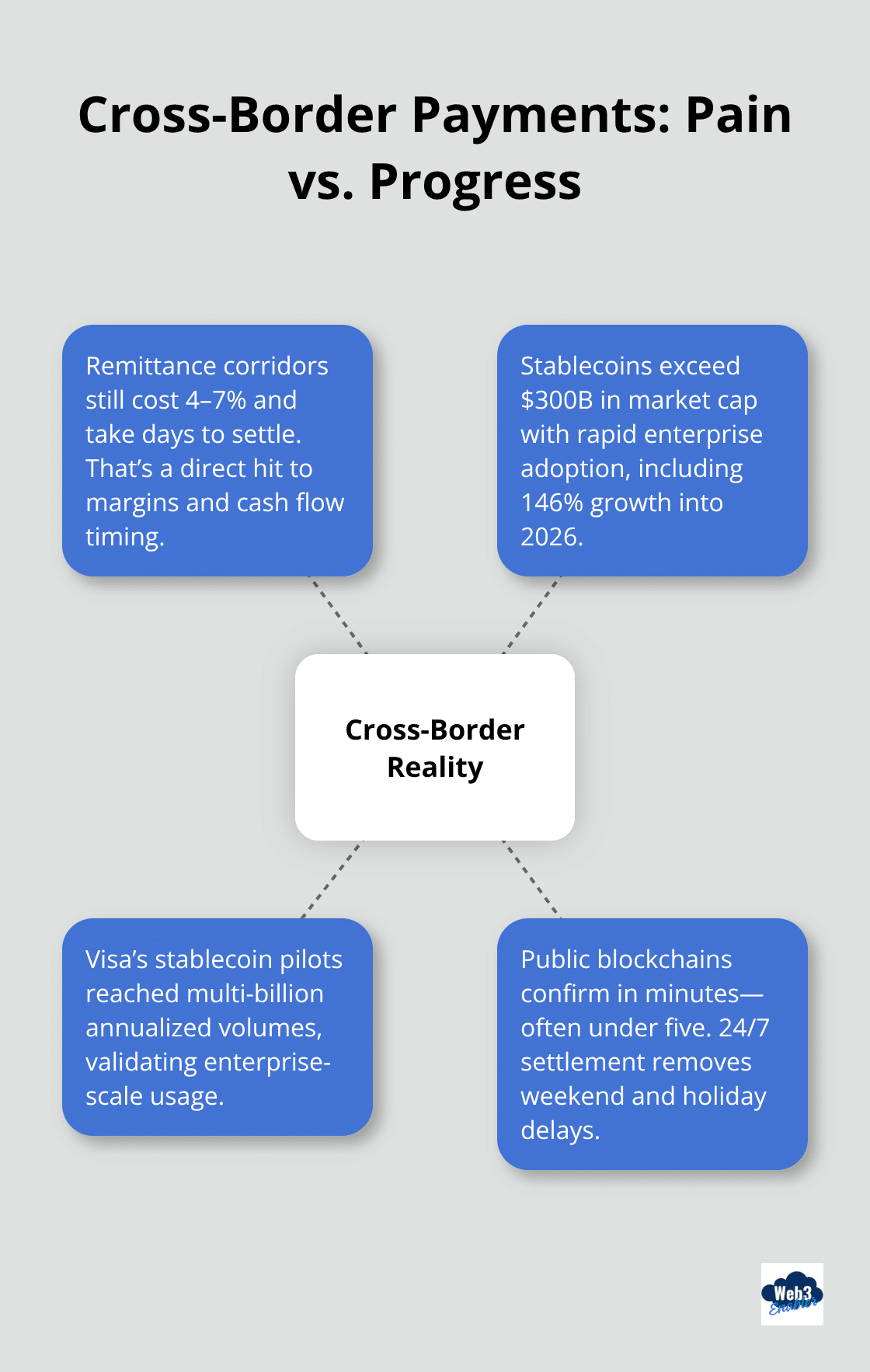
Stablecoins have already grown into a multi-hundred-billion market with over 300 billion dollars in market cap, and enterprise usage is expanding rapidly-some providers report about 146 percent growth in active stablecoin users into 2026.
Visa’s stablecoin settlement pilots have reached an annualized volume run rate in the billions, signaling real scale for cross-border settlement without the correspondent bank middleman. Public blockchains offer finality in minutes, with most settlements completing in under five minutes (enterprise systems typically settle in under an hour). That speed advantage compounds when you factor in 24/7 settlement capability-weekends and holidays don’t pause blockchain transactions.
Real-Time Visibility Replaces Batch Uncertainty
For companies managing treasury operations across time zones, real-time visibility into settlement status matters. You replace the current uncertainty of batch processing, where your team can’t confirm funds arrival until the next business day. The fintech blockchain market stands at 7.42 billion dollars in 2026 and is forecast to reach 11.06 billion dollars by 2031, according to Mordor Intelligence, driven largely by the shift from pilots to live deployments in financial institutions.
Competitors are already moving. The companies that wait will find themselves paying a premium for outdated infrastructure while their faster competitors capture margin. This shift toward ledger-backed settlement isn’t theoretical-it’s happening now, and the question isn’t whether blockchain payments work, but whether your organization can afford to stay behind.
How Blockchain Payments Integrate With Salesforce
Settlement Lands Directly in Your Revenue Records
When you connect blockchain settlement to Salesforce Revenue Cloud, your finance team stops juggling spreadsheets and starts working with real-time data. Salesforce-native solutions sit inside your existing workflow without requiring separate logins or clunky API bridges. A customer payment in stablecoins lands directly in your revenue records with full audit trails intact. No more reconciliation delays or wondering whether funds actually arrived. Stablecoins like USDC and USDT eliminate the volatility that makes cryptocurrency unpredictable for business operations, and they settle in minutes rather than days.
Real-Time Treasury Visibility Replaces Manual Tracking
Your treasury team gains immediate visibility into global balances, payment status, and compliance flags-all within the same interface where they already manage everything else. The architecture keeps your front-end customer experience unchanged while your back-end settlement layer moves at blockchain speed. This matters because Visa’s stablecoin pilots have reached a $4.5 billion annualized run rate, proving that enterprises can confidently route meaningful transaction volume through these rails. Automated compliance checks run on every transaction, catching regulatory issues before they become problems rather than after settlement completes.
Speed Advantages Compound Across High-Volume Operations
For companies processing high-volume international payments, this setup eliminates the correspondent bank delays that traditionally eat 2 to 3 business days and 1 to 3 percent in fees per transfer. Traditional cross-border payments require your finance team to track status across multiple systems, waiting for batch windows and hoping nothing gets stuck in intermediate banks. Blockchain settlements complete in minutes with cryptographic proof that funds arrived, and your Revenue Cloud records update automatically. You’re not replacing Salesforce-you’re upgrading how payments flow through it.
Month-End Closes Become Verification, Not Investigation
Companies piloting this approach report cleaner month-end closes because reconciliation becomes verification rather than investigation. Your CFO gets real-time revenue visibility across geographies without waiting for wire confirmations. The compliance layer runs continuously rather than as a manual check, which means audit teams stop asking for exception reports and start asking for strategic insights instead. This shift from reactive to proactive compliance is why the fintech blockchain market is accelerating toward production deployments rather than staying in pilot limbo.
The practical advantage emerges when you compare what happens next: your finance operations transform from managing payment uncertainty to managing actual business growth.
Where Companies Actually Save Money
The Math Behind Margin Recovery
A mid-market exporter processing 50,000 monthly cross-border transactions at an average 2.5 percent fee per wire transfer loses roughly 1.25 million dollars annually to correspondent bank charges alone. Switching to stablecoin settlement cuts that fee to under 0.5 percent, recovering over 1 million dollars yearly on transaction costs alone.

The World Bank data shows that traditional remittance corridors still consume 4 to 7 percent in fees, yet blockchain-settled payments operate at a fraction of that cost. Companies with distributed operations across Asia, Europe, and North America report settlement acceleration from 2 to 5 business days down to under an hour, which means working capital deploys faster instead of sitting frozen in transit. Fintech platforms integrating stablecoin rails saw payment volumes surge over 150 percent in 2025, driven largely by customers chasing these exact efficiency gains.
The China-led mBridge cross-border digital currency platform processed over 55 billion dollars in transactions, proving that enterprises at massive scale trust ledger-backed settlement for real money flows. Your finance team stops burning hours on manual reconciliation because blockchain transactions include cryptographic proof of settlement. That reconciliation work-typically consuming 10 to 15 percent of a finance operations budget-shifts from exception management to routine verification.
Fraud Prevention Through Real-Time Visibility
Real-time transaction visibility means your compliance team catches suspicious patterns instantly rather than discovering them during month-end audits. Traditional payment systems show settlement status only after the fact, forcing your team into reactive investigation mode. Blockchain settlements provide immutable transaction records with timestamps and digital signatures, creating audit trails that regulators actually want to see. Companies running high-volume B2B operations report that transparent on-chain payment records reduce dispute resolution time from weeks to days because all parties see identical transaction data.
Your treasury team gains immediate visibility into global payment status across every subsidiary and vendor relationship, eliminating the opacity that currently forces conservative cash positioning. Stablecoins eliminate the currency volatility that makes cryptocurrency unpredictable, while the ledger-backed settlement structure provides the transparency that makes it trustworthy. When Visa’s stablecoin pilots reached multi-billion-dollar annualized volumes, enterprise customers voted with their transaction flow-they wanted faster settlement and better visibility more than they wanted to stick with legacy infrastructure.
Final Thoughts
Blockchain payments aren’t speculative crypto theater-they represent practical business infrastructure that moves money faster, costs less, and hands your finance team visibility they’ve never possessed. Revenue Cloud blockchain payments work because they attack real problems: correspondent bank delays, hidden fees, reconciliation nightmares, and the constant friction of legacy settlement rails. Your competitors are already routing stablecoin payments through Salesforce, watching settlement happen in minutes instead of days, and recovering millions in annual fees.
The math works because you don’t need to rip out Salesforce and rebuild from scratch. Salesforce-native solutions sit inside your existing workflow, eliminating the integration headaches that kill most blockchain initiatives. Your revenue records update automatically, your compliance checks run continuously, and your treasury team gains real-time visibility without learning new systems. Visa’s pilots hit multi-billion-dollar volumes, enterprise stablecoin adoption grew 146 percent into 2026, and the fintech blockchain market accelerated from pilots to live deployments because enterprises voted with their transaction flow.
We at Web3 Enabler built our platform around this reality-connecting blockchain technology with your existing corporate infrastructure through 100% Salesforce Native solutions. Explore how Web3 Enabler can modernize your payment infrastructure and start capturing the competitive advantages your faster competitors are already enjoying.