



Your business probably moves money the same way it did ten years ago: slow, expensive, and through middlemen who take a cut.
Payment rails stablecoins change that. They’re the practical answer to how companies actually move value across borders and between systems without the friction of traditional banking.
At Web3 Enabler, we’ve watched businesses stop treating blockchain as a speculative playground and start using it to fix real operational problems. This post shows you how.
Why Your Current Payment System Costs More Than You Think
Traditional banking infrastructure moves money at a glacial pace, and that slowness carries a price tag. When you send money internationally through correspondent banks, settlement stretches across days, not hours. A cross-border wire transfer typically takes three to five business days, during which your cash sits in limbo with zero visibility into its location. You pay multiple fees at each step: originating bank fees, correspondent bank fees, receiving bank fees, and currency conversion spreads that consume two to four percent of the transaction value. For companies moving significant volumes across borders, those percentage points compound into serious money.
How Stablecoins Eliminate the Middleman Tax
Stablecoins eliminate most of that friction. A stablecoin payment settles in minutes, not days, because it moves directly across blockchain rails without intermediaries routing the transaction through their systems. The daily stablecoin trading volume reaches around 100 billion dollars-a figure that would’ve seemed impossible five years ago-and that liquidity means you can move substantial amounts without slippage. USDC and USDT process billions in daily volume, primarily for cross-border transfers and remittance flows that settle faster and cheaper than traditional banking channels. You also know exactly what you pay upfront. On-chain fees appear transparent and visible before you hit send, eliminating the surprise charges that legacy systems love to spring on you after the transaction completes.
For merchants and payment service providers, this transparency matters enormously because you forecast costs accurately and pass those savings directly to customers.
The Real Advantage Isn’t Speed-It’s Certainty
Most businesses focus on the speed benefit and miss the bigger win. Yes, stablecoins settle faster, but the real operational advantage is that you know the total cost and timeline before you commit. With traditional cross-border payments, you submit a wire, hope it goes through without rejection, and then wait while your money bounces between correspondent banks in different time zones. Stablecoins remove that uncertainty. You see the on-chain fee, you see the settlement time measured in minutes, and you control the transaction completely because it lives on an auditable ledger. That ledger also means regulators, auditors, and your finance team can see exactly what happened and when, eliminating reconciliation headaches that plague traditional banking workflows.
Why Volatile Markets Make Stablecoins Essential for Commerce
In markets where currency volatility runs high, stablecoins let you lock in value at the moment of payment instead of gambling on exchange rates. A merchant in an emerging market can accept payment in USDC, immediately convert to local currency if needed, or hold the stablecoin and capture yield before converting later. That flexibility doesn’t exist with traditional banking because you face forced immediate conversion at whatever rate the bank offers that day. The programmability angle matters too. Future stablecoin rails will embed tax calculation, invoice matching, and compliance tagging directly into transactions, turning stablecoins from cheap pipes into smart infrastructure that handles complexity automatically.
Building Bridges Between Blockchain and Your Existing Systems
This is where the practical integration happens. Companies don’t want to rip out their existing infrastructure and start from scratch. They want stablecoin payments to work alongside Salesforce, their ERP systems, and their current accounting workflows. Solutions like those offered by Web3 Enabler-a Salesforce ISV partner specializing in connecting blockchain technology with corporate infrastructure-make this possible. You can accept stablecoin payments, send global payments faster and more securely, and maintain full visibility into transactions without abandoning the systems your team already knows. That integration capability separates theoretical blockchain enthusiasm from actual business implementation.
From Crypto Speculation to Operational Reality
The Mindset Shift That Changes Everything
The shift happening right now isn’t subtle. Businesses move stablecoin payments conversations from trading desks to finance operations, from speculation about future value to immediate questions about how to integrate payments into existing workflows. The crypto market still attracts speculators, but serious companies have stopped waiting for blockchain to become mainstream and started treating it as infrastructure that solves specific operational problems today. That mindset change matters because it forces stablecoin platforms and payment service providers to build integration-first, not hype-first. When your CFO asks whether stablecoin payments work with your existing accounting software, you need a real answer, not a whitepaper.
Why Integration Separates Winners from Failures
Most blockchain projects fail at the integration challenge. They build beautiful on-chain infrastructure and then hit a wall when companies ask how to connect it to Salesforce, their ERP systems, or their accounting platforms. Web3 Enabler addresses this directly as a Salesforce ISV partner specializing in blockchain integration within corporate infrastructure. The company offers 100% Salesforce native blockchain solutions available on the Salesforce AppExchange, which means businesses can accept stablecoin payments, send global payments faster, and track transactions without abandoning the systems their teams already use daily.
This matters enormously because your finance team doesn’t want to learn a new interface. They want stablecoin payments to appear in their existing dashboards, reconciliation processes, and audit trails. When integration happens cleanly, adoption accelerates because the friction disappears. A company moving cross-border payments through stablecoins can now see those transactions inside Salesforce alongside customer records, invoice data, and payment history, creating a single source of truth that eliminates manual reconciliation work. Financial advisors gain visibility into client crypto holdings directly within their Salesforce interface, turning what was once a black box into managed portfolio information.
How Real Commerce Uses Stablecoin Rails Today
Merchants processing cross-border digital goods sales through stablecoins report that settlement happens within minutes rather than days, which means they can convert to local currency immediately or hold the stablecoin to capture yield before converting later. In emerging markets where currency volatility runs high, this flexibility becomes genuinely valuable because merchants lock in value at the moment of payment instead of facing forced conversion at whatever rate their bank dictates. Companies handling multiple currencies across regions find that stablecoin rails reduce their FX exposure dramatically because they move value without touching traditional banking corridors that introduce spread costs and currency conversion delays.
The Compliance Win Nobody Talks About
The on-chain audit trail satisfies compliance requirements that would normally require extensive manual documentation. Regulators see exactly what happened, when it happened, and at what cost, which eliminates the reconciliation nightmares that plague traditional banking workflows. This transparency isn’t just nice to have; it’s operationally cheaper because your compliance team spends less time chasing down transaction details and more time on actual risk management. That operational visibility is what separates real business adoption from experimental pilots.
What Comes Next
The companies that move fastest aren’t the ones building the flashiest blockchain technology. They’re the ones solving the integration problem first, making stablecoin payments feel like a natural extension of existing business systems rather than a separate experiment. That’s where the real competitive advantage lives, and it’s where the conversation shifts from whether stablecoins matter to how your business actually implements them.
Building Scalable Payment Infrastructure Today
The infrastructure you choose determines whether stablecoin payments feel like a natural extension of your business or a painful experiment that your team resents. Most platforms fail because they prioritize blockchain elegance over operational reality. They build beautiful on-chain systems and ignore the actual friction points: How does this connect to my accounting software? Can my finance team see transactions in real time? What happens when settlement fails? The platforms that win answer these questions first and worry about blockchain purity later.
What Your Payment Infrastructure Actually Needs
You need three things working together: a stablecoin platform that supports the currencies you actually use, integration with your existing systems so your team doesn’t learn new interfaces, and operational controls that satisfy your compliance requirements without creating manual overhead. USDC and USDT dominate for good reasons-they process substantial daily volume, maintain transparent reserve attestations, and integrate with major payment networks including Visa’s settlement programs. That liquidity depth matters because it means you can move substantial amounts without slippage or waiting for counterparties to appear.
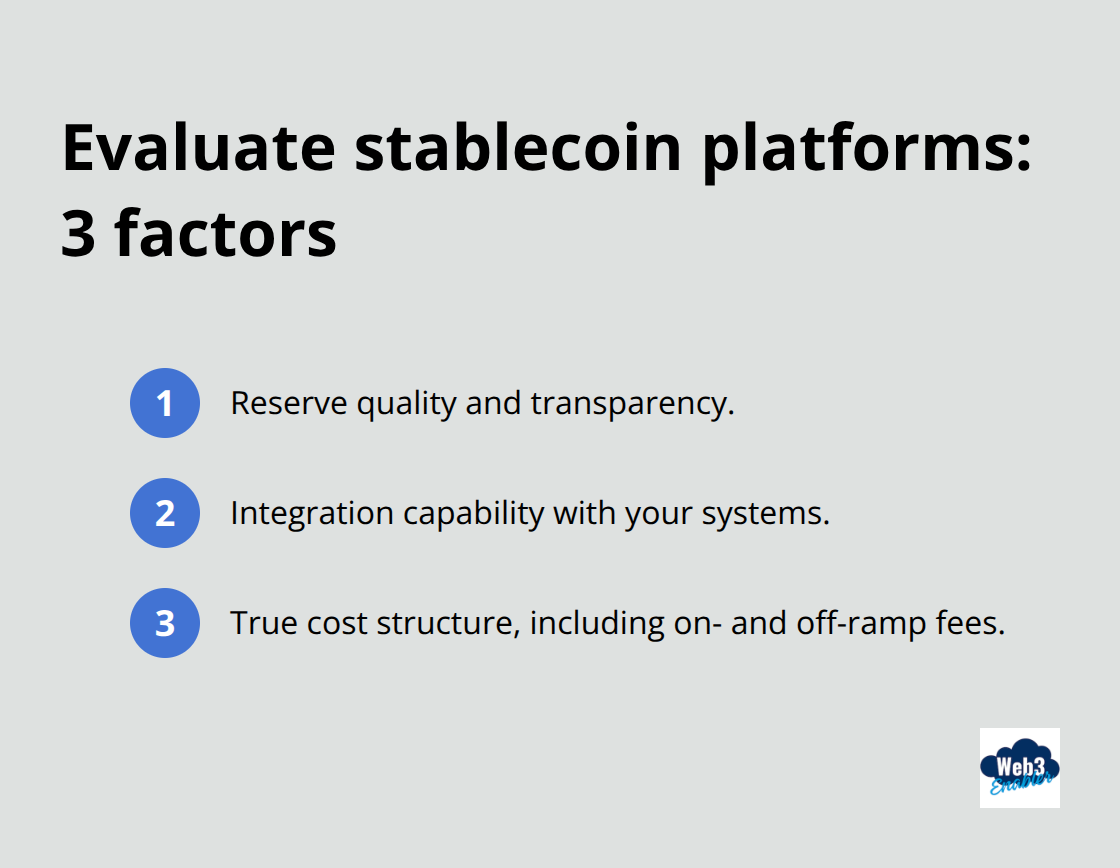
Evaluating Stablecoin Platforms: Three Concrete Factors
Your evaluation should focus on three concrete factors: reserve quality and transparency, integration capability with your specific systems, and the actual cost structure including on-ramp and off-ramp fees. Many platforms quote you zero transaction fees and hide the real cost in conversion spreads, so demand itemized pricing before you commit.
Web3 Enabler stands apart as a Salesforce ISV partner because it solves the integration problem that kills most stablecoin projects. Rather than forcing your finance team to learn a separate interface, stablecoin payments flow directly into Salesforce where they connect to customer records, invoices, and existing workflows. That integration means your team sees cross-border payments appear alongside customer data and payment history, eliminating manual reconciliation work that traditionally consumes hours every month.
Starting Your Implementation: Narrow and Specific
Implementation should start narrow and specific. Pick one payment corridor-say, sending payments to vendors in a single country-and run a pilot with real transaction volume before expanding. Set success metrics around settlement speed (you should see minutes, not hours), cost reduction compared to your current banking fees, and reconciliation time saved in your accounting process. Demand visibility into transaction status in real time rather than waiting for batch reports. The companies that scale stablecoin payments fastest don’t build elaborate compliance frameworks upfront; they start with basic KYC controls and add complexity only as volume grows. Your first month should focus on moving maybe five to ten transactions through the system to understand the actual workflow your team experiences. That hands-on experience reveals problems that spreadsheets and demos never surface.
Critical Questions for Your Platform Provider
Talk directly to your potential platform provider about their off-ramp and on-ramp integration-how your stablecoins convert back to local currency and whether that conversion happens automatically or requires manual intervention. The best platforms support multiple off-ramp partners so you don’t depend on a single conversion provider. Also ask about their regulatory roadmap because frameworks like the GENIUS Act in the US and MiCA in Europe are tightening reserve requirements and disclosure standards. A platform built on solid regulatory foundations today won’t force you to migrate your infrastructure when rules shift tomorrow.
Final Thoughts
The conversation around blockchain has fundamentally shifted. Five years ago, companies asked whether stablecoins mattered. Today, they ask how to implement payment rails stablecoins into their operations. That shift reflects reality: stablecoin infrastructure solves actual business problems that traditional banking cannot address without friction, delay, and hidden costs.
The companies winning right now move forward with practical infrastructure that connects blockchain to their existing operations instead of waiting for perfect regulatory clarity or flawless technology. Merchants lock in value at payment time rather than gambling on exchange rates. Finance teams watch cross-border transactions settle in minutes rather than days. Compliance teams gain audit trails that satisfy regulators without manual documentation overhead, and these outcomes have become standard business practice rather than edge cases.
Pick one specific payment corridor and run a real pilot with actual transaction volume to start your implementation. Web3 Enabler specializes in this challenge as a Salesforce ISV partner, connecting blockchain technology directly to your existing corporate infrastructure so your team accepts stablecoin payments, sends global payments faster, and maintains full visibility without abandoning systems you already use. Get started with payment rails stablecoins built for your business.