



Your crypto wallet is loaded, but your credit card bill isn’t going anywhere. The good news? You can actually pay credit card with crypto these days, and it’s easier than you think.
We at Web3 Enabler see more people making this switch every month. From crypto debit cards to direct payment apps, the options keep growing.
The trick is knowing which method works best for your situation and wallet size.
Direct Crypto-to-Credit Card Payment Methods
Crypto Debit Cards from Major Providers
Crypto debit cards from major providers like Coinbase and Gemini offer the most straightforward path to pay your credit card bills. The Coinbase Visa debit card converts your crypto at checkout automatically, while Gemini’s card lets you earn crypto rewards on purchases. These cards work anywhere Visa or Mastercard are accepted, which makes them perfect for credit card payments through your bank’s online portal or mobile app. Coinbase charges no annual fee but takes a conversion fee, while Gemini waives foreign transaction fees entirely.
Direct Payment Apps and Platforms
Direct payment platforms like Zypto and BitPay handle the heavy work by accepting over 100 cryptocurrencies for bill payments (credit cards included). Zypto operates in 126 countries and processes payments within 48 hours, with charges of 3% plus $5 per transaction. BitPay focuses on merchant integration and offers lower fees for businesses but requires setup through participating credit card companies.
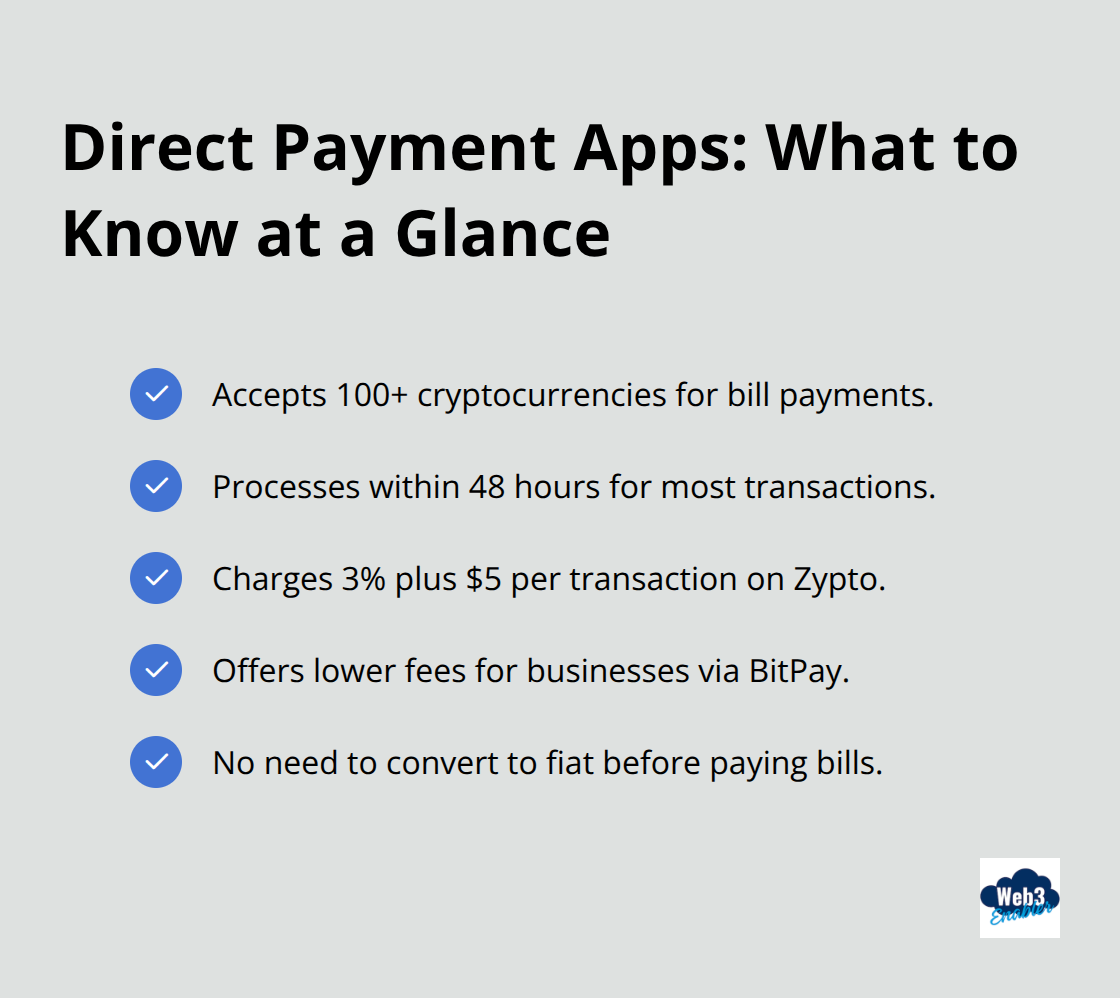
Both platforms eliminate the need to convert crypto to fiat first, though you’ll still pay network gas fees on top of their processing charges.
Bank Integration Services
Several banks now integrate directly with crypto exchanges, though the options remain limited. JPMorgan Chase partners with select crypto platforms for institutional clients, while smaller credit unions like Navy Federal experiment with crypto payment acceptance. Bank of America blocks most crypto-related transactions, which makes direct integration impossible for their customers. Most major banks still treat crypto transactions as cash advances (triggering higher interest rates and fees). Your established crypto debit cards remain the better choice rather than traditional payment methods that haven’t caught up yet.
The direct payment route works well for immediate needs, but what happens when you want more control over conversion rates and timing?
Converting Crypto to Fiat for Credit Card Payments
Converting crypto to fiat before you pay credit cards gives you complete control over exchange rates and market conditions, though it adds extra steps to the process. Major exchanges like Coinbase Pro and Kraken charge between 0.25% to 0.5% per trade, while smaller platforms like Gemini Active Trader offer zero fees for maker orders. The key advantage lies in your ability to time conversions when crypto prices peak rather than accept whatever rate your credit card processor offers at payment time.
Cryptocurrency Exchange Platforms
Coinbase charges 1.49% for instant bank transfers but drops to 0.5% if you wait 3-5 business days for ACH transfers. Kraken beats most competitors with 0.26% fees and same-day wire transfers for $5. Binance.US offers the lowest fees at 0.1% for trades over $50,000 but requires extensive verification that takes weeks to complete.

Your best strategy involves limit orders during market volatility rather than market orders that execute immediately at worse rates.
Peer-to-Peer Trading Options
P2P platforms like LocalBitcoins and Paxful connect you directly with buyers who pay cash or bank transfers. These platforms charge 1% to 3% fees but offer better rates than traditional exchanges during market downturns. You control the entire transaction timeline and can negotiate rates that beat exchange prices by 2-5%. The downside? You need to verify buyer credentials and handle disputes manually (which can take days to resolve).
Automated Conversion Services
Services like Swan Bitcoin and River Financial automate conversion strategies but charge 0.99% to 1.25% premiums over spot prices. Manual exchange trades save significant money but require active market monitoring. Automated conversion works better for consistent monthly payments, while manual trades maximize savings on large one-time credit card payoffs. Most automated services connect directly to bank accounts and eliminate the need to time transfers around crypto market movements.
The conversion route offers maximum control, but what about the hidden costs that can eat into your savings?
Fees, Security, and Tax Implications
Credit card payments with crypto involve three major cost layers that can quickly eat into your savings if you’re not careful. Exchange fees range from 0.1% on Binance.US to 1.49% on Coinbase for instant transfers, while crypto debit cards add conversion spreads of 1-3% on top of their advertised rates. Network gas fees create the biggest surprise costs, with Ethereum transactions hitting $50+ during peak congestion while BNB Smart Chain stays under $0.10 per transaction. Smart timing saves serious money – Kraken’s 0.26% fees beat Coinbase’s 1.49% by over $12 on every $1,000 transaction.
Transaction Fees and Exchange Rates
Different payment methods stack fees in ways that can shock your wallet. Crypto debit cards hide conversion spreads behind “no fee” marketing (you’ll pay 2-3% above market rates anyway). Direct payment platforms like Zypto charge 3% plus $5 per transaction, which makes small payments expensive but large payments relatively cheap. Exchange conversions offer the most control – Kraken Pro charges 0.16% for maker orders while Coinbase Pro hits you with 0.5% regardless of order type.
Security Best Practices and Risk Management
Public WiFi kills crypto security faster than anything else, so never initiate payments from coffee shops or airports. Two-factor authentication through apps like Google Authenticator beats SMS codes because phone number porting scams happen daily. Test transactions with small amounts first – sending $10 before your $1,000 payment catches address errors that cost thousands.
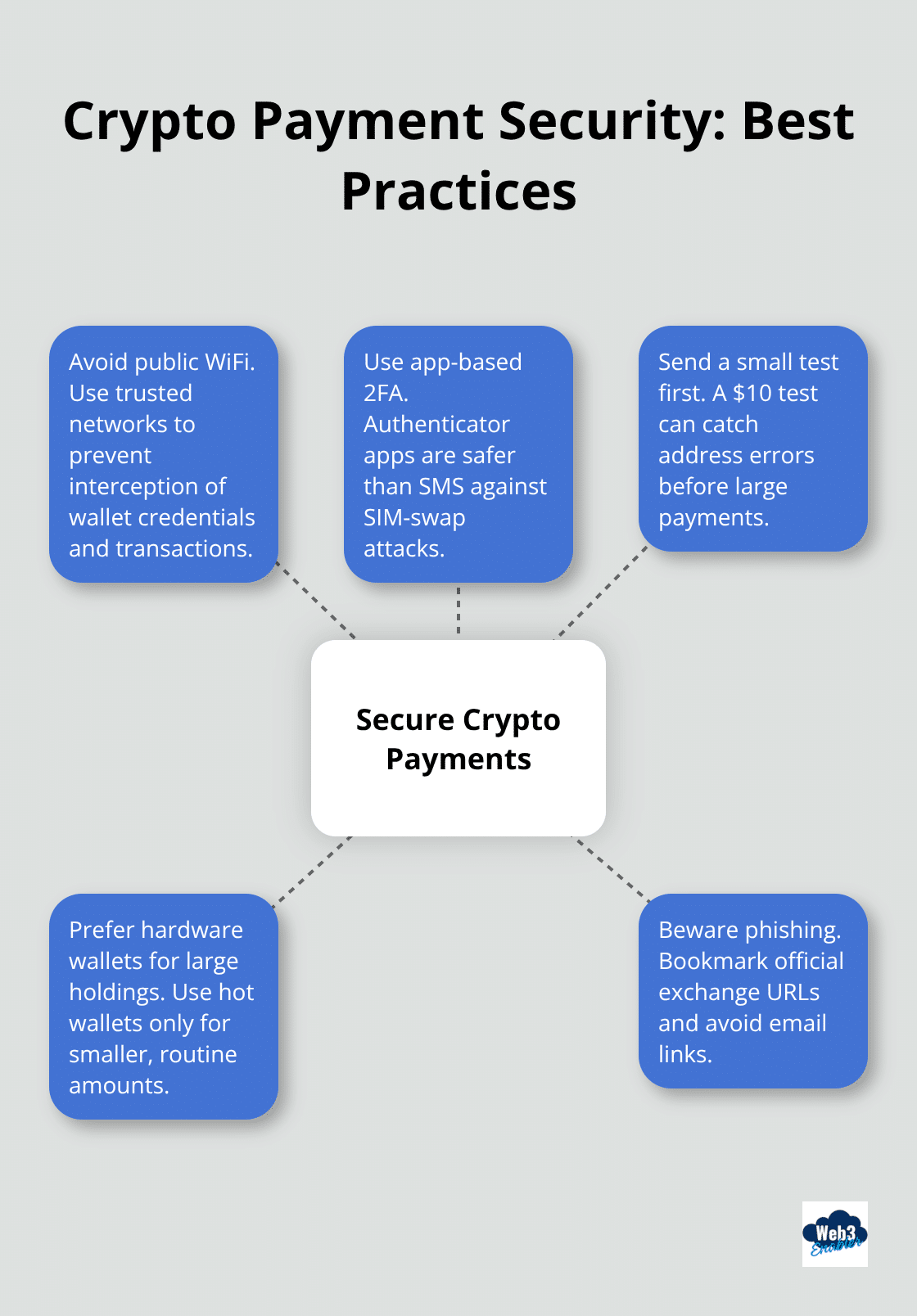
Hardware wallets like Ledger provide maximum security for large holdings, while hot wallets work fine for monthly payment amounts under $5,000. Phishing sites copy legitimate exchange URLs perfectly, so bookmark your real exchange pages and never click email links to access accounts.
Tax Reporting Requirements and Documentation
The IRS treats crypto as property that triggers capital gains taxes on every transaction. Short-term holdings under one year face tax rates up to 37%, while long-term holdings over one year qualify for reduced rates of 0%, 15%, or 20% based on income levels. Starting in 2025, crypto exchanges must report digital asset sales on Form 1099-DA, which means the IRS will automatically receive transaction data. Keep detailed records including purchase dates, amounts, exchange rates, and payment purposes because the IRS can audit crypto transactions up to six years later. Tax-loss harvesting helps offset gains when crypto values drop, allowing up to $3,000 in losses to reduce ordinary income annually.
Final Thoughts
Crypto debit cards win for convenience but cost you 2-3% in hidden conversion spreads. Direct payment platforms like Zypto work great for large bills despite their 3% plus $5 fees. Exchange conversions offer the best rates at 0.1-0.5% but require manual timing and extra steps.
The future looks bright for crypto payments. Major banks slowly warm up to blockchain integration, while stablecoin adoption eliminates volatility concerns. Payment processors reduce fees as competition heats up, and regulatory clarity continues to improve across most jurisdictions (especially in crypto-friendly states like Wyoming and Texas).
Start small with a crypto debit card for monthly payments under $1,000. Graduate to exchange conversions for larger amounts once you understand the fee structures. For businesses ready to pay credit card with crypto at scale, Web3 Enabler provides solutions that handle payments and compliance without the speculation drama.