



Your Salesforce instance handles customer data like a vault. Add crypto payments to the mix, and suddenly compliance becomes non-negotiable.
KYC for crypto Salesforce isn’t just regulatory theater-it’s the difference between scaling confidently and facing fines. We at Web3 Enabler have seen businesses rush into crypto payments only to stumble on compliance basics.
This guide walks you through the practical steps to embed KYC directly into your existing workflows, turning compliance from a headache into something that actually works.
Why KYC Actually Protects Your Bottom Line
Regulators aren’t playing around with crypto payments. The FCA fined Nationwide and Monzo for weak KYC controls-these weren’t edge cases but wake-up calls about what happens when compliance gets sloppy. If you move stablecoin payments through Salesforce, KYC isn’t a box to tick. It’s the difference between operating legally and operating dangerously.
Crypto’s regulatory landscape shifted hard in 2025. The World Economic Forum’s Global Cybersecurity Outlook made clear that layered identity verification-combining identity proofing, fraud signals, and device intelligence-is now table stakes. The IRS treats cryptocurrency as property, meaning every crypto payment your team processes triggers ordinary income recognition at fair market value on receipt. That means tax reporting on Form W-2 for employees and Form 1099-NEC for contractors. Miss the reporting, and you’re looking at audit exposure that makes compliance headaches look quaint.
Cross-Border Complexity Demands Local Currency Alignment
Cross-border payments amplify the stakes significantly. Many jurisdictions legally require wages to be denominated or paid in local currency, so crypto-only salaries can breach employment law in those regions. Stablecoins pegged to local currencies-USDC for USD workers, EURC for Eurozone staff-sidestep these landmines by staying currency-matched to wage requirements.
Without proper KYC layered into your Salesforce workflows, you’re also exposed to fraud and identity theft at scale. Real-time verification powered by continuous identity checks catches suspicious activity before it bleeds into your settlement process. Automated remediation tools shorten KYC gap cycle times, keeping your payment rails flowing without regulatory friction.
Speed Wins When You Build KYC Right
Most teams assume KYC slows everything down. It doesn’t, if you build it right. Digital workflows cut notarization turnaround times by up to 90% compared to paper processes, and platforms using fully digital onboarding report 99% fewer errors requiring re-execution.
Embedding KYC directly in Salesforce through native integrations means compliance checks run in parallel with your payment workflows, not after them. When identity verification and fraud detection live inside your CRM, customers complete KYC without leaving the transaction flow. Remote Online Notarization works 24/7 across every timezone, meaning your global teams verify identities instantly without waiting for office hours.
The math is compelling: notarization products report average cycle-time reductions of about 21 days, with internal cost savings of $97–$103 per transaction. That’s not theoretical-that’s real operational efficiency that compounds across thousands of transactions.
Trust Becomes Your Competitive Advantage
Customers trust platforms that verify them properly. Higher transaction and withdrawal limits unlock for verified users, and access to fiat on/off-ramps becomes possible. For your business, KYC transforms crypto payments from a fringe experiment into a legitimate payment channel that banks and regulators actually cooperate with.
Persistent identity-backed trust signals endure beyond onboarding, supporting ongoing compliance during every crypto interaction. A unified platform combining eSign, identity verification, fraud detection, notarization, and audit trails reduces vendor fragmentation and integration overhead. That single source of truth means your compliance team sees everything in one place, audits become faster, and reconciliation stops being a nightmare.
When your Salesforce instance holds both customer data and verified identity evidence, you’ve built infrastructure that regulators respect. This foundation matters because the next step-actually implementing KYC inside your Salesforce environment-requires knowing exactly where your compliance data lives and how it flows through your payment processes.
Wiring KYC Into Your Salesforce Payment Flows
Getting KYC into Salesforce means mapping your identity verification data directly into the objects where transactions live-Account, Opportunity, Lead, Contact-so compliance and payment workflows operate as one integrated process. When a customer initiates a stablecoin payment through Salesforce, their identity verification, fraud signals, and device intelligence attach to their record automatically. This layered approach, recommended by the World Economic Forum’s Global Cybersecurity Outlook, catches risk before settlement happens.
Native Salesforce integrations let you embed identity checks and eSign capabilities without jumping between platforms, cutting the manual handoffs that typically introduce delays and errors. Digital notarization embedded in your CRM works 24/7, meaning a customer in Singapore and another in Berlin complete their KYC verification at their own pace without waiting for office hours. Remote Online Notarization cuts turnaround times significantly and reduces re-execution errors when you move from paper to fully digital workflows.
Currency-Matched Identity Data Powers Stablecoin Settlement
The moment you settle payments in USDC, EURC, or any other stablecoin, your KYC scope expands beyond basic identity. Crypto’s regulatory environment now demands that you track which currency a payment settles in and verify it aligns with the customer’s jurisdiction and wage laws. For USD-denominated transactions, USDC works cleanly because it maintains a 1:1 peg with the dollar. For Eurozone customers, EURC does the same with the euro, eliminating conversion slippage and regulatory friction.
Your Salesforce instance should capture the settlement currency, the valuation date, and the exchange rate at transaction time-then tie all of that to the customer’s verified identity. Automated remediation tools shorten the cycle time for fixing KYC gaps, so if a customer’s risk profile changes or new sanctions data surfaces, your compliance team can reassess and resolve issues without stalling the payment.
Continuous Screening Replaces One-Time Verification
Continuous screening, not just one-time verification, means your system flags suspicious activity as transaction patterns shift over time. This persistent monitoring lives inside Salesforce, not in a separate compliance platform that nobody actually checks until audit season. Batch KYC processing-where you collect customer data and run verification checks once a day or once a week-belongs in filing cabinets, not modern payment infrastructure.
Event-driven KYC moves you to real-time risk reassessment the moment a customer’s activity changes. A customer’s transaction limit increases, a new device appears, or sanctions data updates? Your Salesforce instance flags it instantly and either approves, pauses, or escalates the payment based on your risk rules.
Real-Time Verification Eliminates Blind Spots
Networked KYC platforms that integrate with Salesforce via REST APIs or native connectors pull world-class data from multiple providers simultaneously, reducing blind spots in dynamic crypto markets. The precision matching these platforms deliver catches false positives faster than manual review ever could, which means fewer legitimate customers get blocked by overzealous compliance rules.
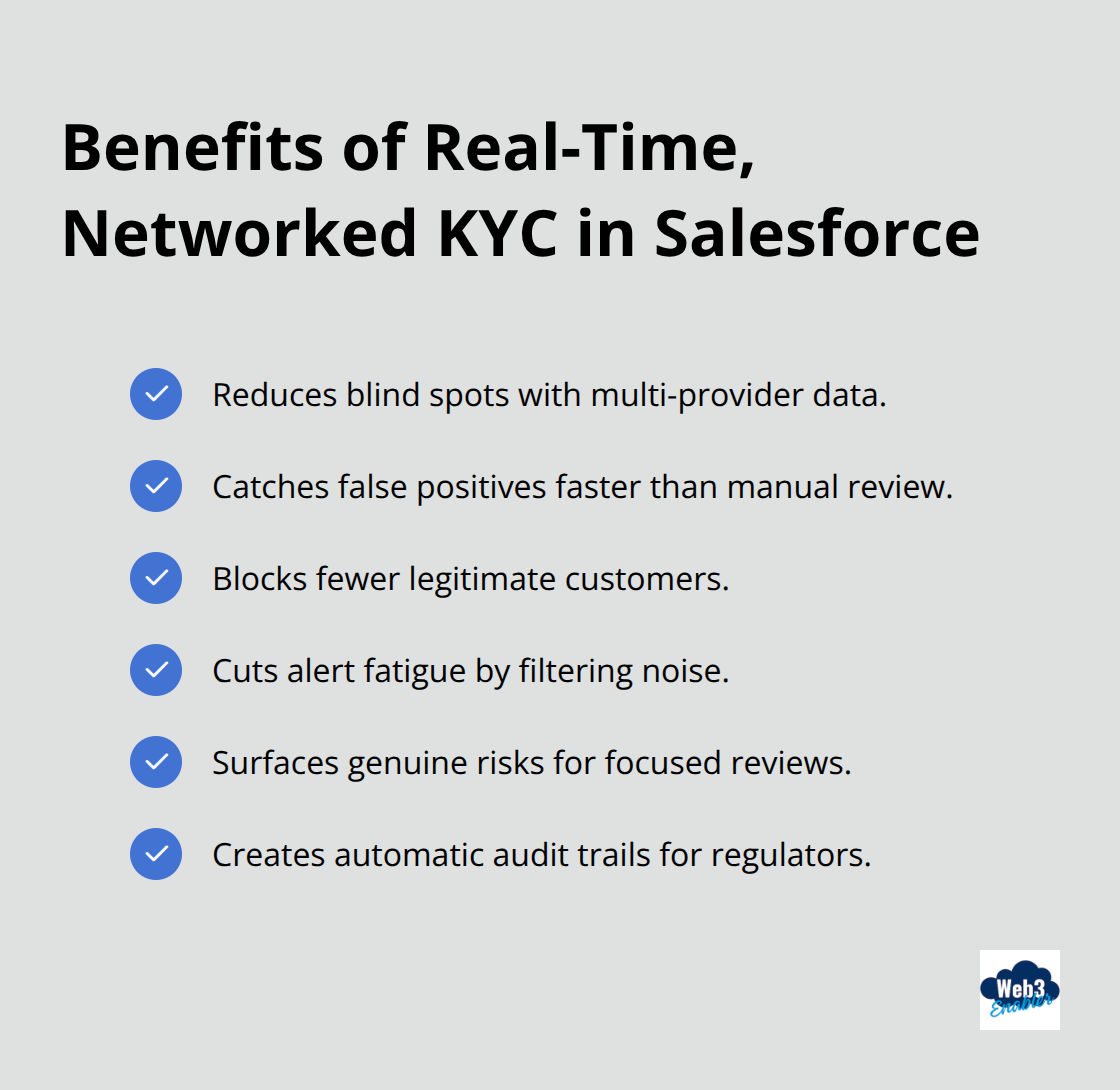
St Lawrence Management and ONE Fund Management both reported measurable efficiency gains after moving to this kind of integrated, real-time screening. Your compliance team stops drowning in alerts because the system already filtered out noise and surfaced only genuine risk. Audit trails become automatic-Salesforce logs every verification, every data point, every decision point, creating the chain of custody that regulators actually want to see.
With KYC wired into your Salesforce environment and real-time verification running continuously, you’ve built the foundation for compliant crypto payments. But even the cleanest setup hits friction points-false positives that block good customers, regulatory rules that conflict across borders, and the constant tension between moving fast and staying safe. The next chapter tackles these real-world challenges and shows you how to navigate them without sacrificing either speed or compliance.
Common KYC Challenges and How to Overcome Them
Real-world KYC implementation hits three walls simultaneously: regulators in different countries demand contradictory rules, your compliance system flags legitimate customers as suspicious, and every verification step adds friction that makes customers abandon transactions. The tension between moving payments fast and staying compliant feels irreconcilable until you stop treating speed and safety as opposites. They’re not. A system designed to verify identity in real time actually moves faster than one that batches checks daily and catches fraud after settlement happens.
False Positives Block Good Customers
The false positive problem destroys customer experience faster than anything else. Precision matching technology reduces noise dramatically, but oversensitive rules still block valid transactions. A customer in Berlin uses a VPN while traveling and triggers device intelligence flags that look like fraud. Another customer’s name matches a sanctions list with 87% confidence-high enough to feel risky, low enough that manual review takes hours. The solution isn’t relaxing your rules. It’s automating the remediation workflow so your compliance team resolves these cases in minutes, not days. Salesforce’s event-driven architecture lets you flag the transaction, notify the customer immediately, and ask for clarification without stalling their payment. That responsiveness converts friction into trust. When a customer receives a message within minutes asking them to verify their travel or confirm their identity, they comply because the system feels smart, not suspicious. Platforms using fully automated onboarding combined with continuous screening report 99% fewer errors that require re-execution compared to manual processes, according to industry benchmarks. That efficiency compounds across thousands of transactions.
Multiple Jurisdictions Demand Currency-Specific Strategies
Managing regulatory requirements across borders forces a choice: either standardize on rules that satisfy the strictest jurisdiction, or build jurisdiction-specific workflows inside Salesforce. The first approach kills your business in permissive markets. The second requires mapping your KYC rules to the customer’s location before they initiate payment. A transaction from a USD-based customer follows different verification requirements than one from a Eurozone customer. USDC works seamlessly for USD transactions because regulators understand dollar-pegged stablecoins. EURC serves the same function for euro-denominated payments, maintains a 1:1 peg with the euro, and eliminates conversion losses that complicate compliance reporting. Your Salesforce instance should automatically route customers to the currency-matched stablecoin based on their jurisdiction, then apply the regulatory ruleset for that region. The Crypto Travel Rule requires entities transferring crypto to carry identifying information with transfers to stay compliant with global standards. That means your KYC data must travel with the payment itself, not sit in Salesforce while settlement happens elsewhere. Integrating blockchain directly into your payment workflow prevents the blind spots that regulators now scrutinize heavily.
Real-Time Verification Eliminates Delays
Batch processing KYC once daily belongs in the past. Real-time verification means identity checks, fraud signals, and device intelligence all run the moment a customer initiates payment. Remote Online Notarization works 24/7 globally, eliminates the office-hours bottleneck that forces customers to wait, and cuts notarization turnaround times by up to 90% compared to paper processes. Moving from manual to fully digital notarization workflows saves $97–$103 per transaction according to notarization product benchmarks. That’s not overhead reduction-that’s margin improvement. Your compliance team should never manually request the same KYC data twice. Customer Lifecycle Management platforms integrated with Salesforce create a single source of truth so repeat customers skip verification entirely on subsequent transactions. St Lawrence Management and ONE Fund Management both reported measurable efficiency gains after moving to integrated, real-time screening, proving that automation doesn’t sacrifice compliance rigor. The key is embedding continuous screening inside Salesforce so your team sees persistent risk signals, not one-time snapshots from weeks ago. When a customer’s transaction pattern shifts or new sanctions data surfaces, event-driven reviews reassess their risk profile automatically. Your compliance team investigates only genuine alerts, not noise.
Final Thoughts
KYC for crypto Salesforce transforms compliance from a regulatory burden into operational advantage. Map your KYC data fields to Salesforce objects, activate automated identity checks that run in real time, and incorporate Travel Rule data with transfers to stay compliant across borders. Start with one payment corridor-perhaps USD stablecoin transactions to a single geography-then expand once your team experiences how real-time verification accelerates payments instead of slowing them down.
Digital workflows cut notarization turnaround times by up to 90%, fully automated onboarding eliminates 99% of re-execution errors, and integrated platforms save $97–$103 per transaction. These numbers represent the difference between scaling crypto payments profitably and drowning in manual compliance work. The regulatory environment won’t pause, and crypto payments will only become more central to how businesses operate globally.
We at Web3 Enabler provide 100% Salesforce Native blockchain solutions that connect stablecoin payments, compliance automation, and global settlement directly into your existing CRM. Visit Web3 Enabler to explore how their tools handle integration complexity so your team focuses on business outcomes instead of technical plumbing. The teams that move first-the ones embedding KYC into Salesforce today-will own the competitive advantage tomorrow.