



Digital assets represent a $2.3 trillion market opportunity that continues expanding rapidly. Creating digital assets has become a strategic priority for businesses seeking new revenue streams and competitive advantages.
We at Web3 Enabler see companies struggling with the technical complexity and market positioning challenges. This guide provides actionable steps to build, launch, and manage digital assets successfully.
What Digital Assets Drive Real Revenue
Digital assets fall into three categories that generate measurable returns. Payment infrastructure assets like stablecoins and blockchain networks processed $32 trillion globally in 2025, with enterprises that save 60-90% on cross-border transaction costs compared to traditional banks. Revenue-generating assets include NFTs, digital collectibles, and tokenized real estate, where platforms like OpenSea facilitated over $20 billion in trades. Utility tokens and governance assets provide access to services and decision-making rights within digital ecosystems.
Revenue Models That Actually Work
The eLearning market reached $203.30 billion in 2025, driven by digital courses and membership platforms. Creators who use platforms like Thinkific generate passive income through automated delivery systems. Stock media creators monetize their work repeatedly without additional effort per sale.
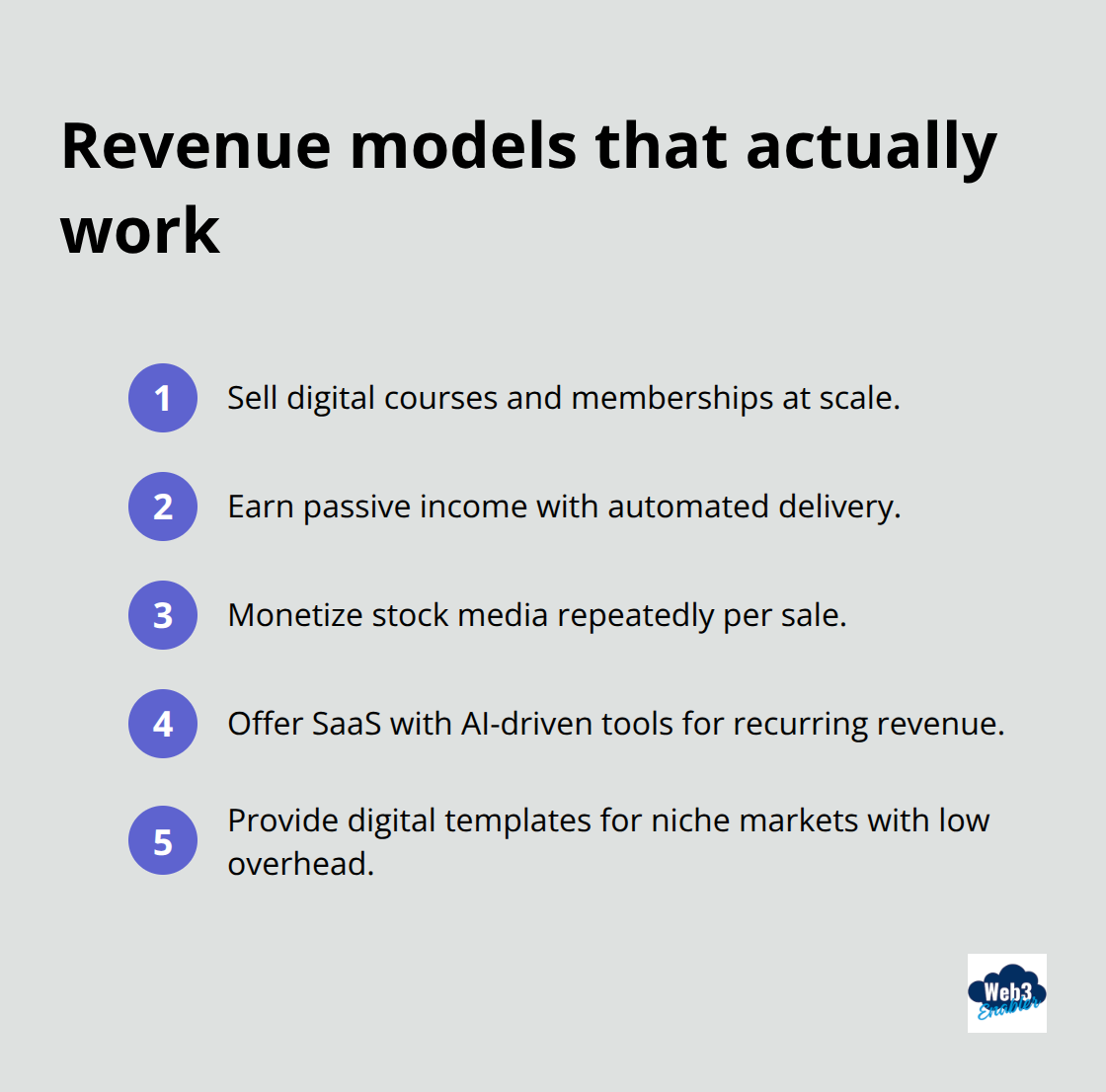
SaaS models with AI-driven tools offer recurring revenue streams, while digital templates serve niche markets with minimal overhead costs.
Companies that process over $10 million monthly in cross-border payments benefit most from digital asset infrastructure. Fortune 500 firms reduce trapped liquidity by millions through near-instant settlement systems (often within seconds rather than days).
Technical Foundation Requirements
Success depends on enterprise-grade infrastructure with proven transaction volumes. Multi-jurisdiction licenses support cross-border operations while they minimize regulatory risks. Real-time settlement capabilities eliminate correspondent bank fees and reduce transaction times from days to seconds.
Automated processes enhance operational efficiency, while seamless integration with existing systems prevents workflow disruption. Security frameworks with AML and KYC compliance remain non-negotiable for institutional adoption (particularly for organizations that handle large transaction volumes).

Implementation Considerations
Organizations must evaluate vendors based on production scale and transaction history. A phased approach works best: education first, then controlled expansion, followed by full integration. This strategy reduces risks during transition periods.
Companies should prioritize providers with extensive stablecoin capabilities and 24/7 liquidity management. The ability to execute urgent payments outside traditional hours maintains business continuity across international operations.
The next step involves identifying your target audience and understanding their specific needs before you select the right technology platform.
How Do You Build Digital Assets That Generate Revenue?
Market research drives every successful digital asset project. Companies that analyze transaction patterns identify the most profitable opportunities. JPMorgan Chase processed $1 billion in blockchain transactions during their 2023 pilot program with six Indian banks, which proved institutional demand for faster settlement systems.
Accenture research shows logistics companies save billions through blockchain transparency, while Deloitte found media companies prevent piracy losses worth millions through immutable ownership records. Target audiences with monthly cross-border payment volumes that exceed $10 million represent the highest-value prospects for payment infrastructure assets.
Technology Selection Determines Long-Term Success
Enterprise-grade platforms with proven transaction histories outperform experimental solutions. Companies that process over $25 billion annually, like established payment providers, demonstrate the infrastructure reliability that institutions need for adoption. Multi-jurisdiction licenses prevent regulatory roadblocks during expansion.
Integration complexity varies dramatically between platforms. Native Salesforce solutions eliminate the technical overhead that separate systems create, while they maintain full auditability through existing CRM workflows. Organizations that use Financial Services Cloud, Commerce Cloud, or Revenue Cloud benefit from unified environments where finance teams access real-time transaction data without platform switches.
Budget Framework Allocation
Budget frameworks should allocate 40% for technology infrastructure, 30% for compliance and security measures, and 30% for market validation and initial deployment phases. Companies that underfund security measures face regulatory penalties that can exceed initial development costs (particularly in jurisdictions with strict financial regulations).

Infrastructure costs scale with transaction volume, but fixed compliance expenses remain constant regardless of usage. Organizations should factor ongoing maintenance costs that typically represent 15-20% of initial development investment annually.
Platform Integration Strategies
Web3 Enabler provides native blockchain capabilities within Salesforce environments, which eliminates the complexity that third-party integrations create. Finance teams gain real-time visibility into on-chain transactions without workflow disruption. This approach reduces implementation time from months to weeks while it maintains enterprise security standards.
The next phase requires you to establish robust security protocols and develop comprehensive distribution strategies that maximize market reach.
How Do You Protect and Scale Digital Assets Effectively?
Security Architecture That Prevents Losses
Security frameworks with multi-layered protection prevent the $8.8 billion in losses that Americans faced from investment scams in 2022. Enterprise-grade platforms require hardware security modules, multi-signature wallets, and continuous monitoring systems that detect anomalous transaction patterns.
Companies like Xage Security enhance cybersecurity through blockchain-based multi-factor authentication for IoT applications. IBM’s Hyperledger Fabric combines traditional cybersecurity with blockchain technology for enterprise organizations. Organizations must implement AML and KYC compliance processes that satisfy regulatory requirements across multiple jurisdictions (particularly for institutions that handle large transaction volumes exceeding $10 million monthly).
Distribution Strategies for High-Value Markets
Distribution strategies that target high-value customer segments generate measurable returns through reduced acquisition costs and higher conversion rates. Companies that integrate stablecoin payment capabilities tap into customer segments with greater purchasing intent.
Platforms like BVNK process over $25 billion annually across 130+ markets through enterprise-grade infrastructure. Organizations should focus on markets where traditional banking infrastructure creates bottlenecks or delays that blockchain solutions can eliminate.
Performance Monitoring and Optimization
Performance monitoring requires real-time tracking of transaction volumes, settlement times, and cost savings compared to traditional payment methods. Organizations should measure liquidity optimization by tracking trapped capital freed through near-instant settlement systems.
Cross-border payment cost reductions typically range from 60-90% compared to correspondent banking fees. Treasury teams must evaluate vendor performance based on production scale, transaction history, and 24/7 operational capabilities that maintain business continuity across international operations.
Scalability Through Native Integration
Native platform integration eliminates the complexity that third-party solutions create while maintaining enterprise security standards. Organizations that use unified environments gain real-time visibility into transactions without workflow disruption (reducing implementation time from months to weeks).
Digital asset management in Salesforce provides comprehensive solutions for enterprises seeking to streamline their operations while maintaining security protocols.
Final Thoughts
Creating digital assets successfully demands strategic planning, robust security frameworks, and proven technology infrastructure. Organizations that process over $10 million monthly in cross-border payments achieve the highest returns through 60-90% cost reductions and near-instant settlement capabilities. The most important success factors include selecting enterprise-grade platforms with multi-jurisdiction licenses, implementing comprehensive AML and KYC compliance processes, and maintaining real-time transaction visibility.
Companies that underestimate security requirements or choose experimental platforms face regulatory penalties that exceed development costs. Common pitfalls include inadequate budget allocation for compliance measures, poor vendor evaluation based on production scale, and complex third-party integrations that disrupt existing workflows. Organizations should avoid platforms without proven transaction histories that exceed billions in processed volume.
Implementation success depends on phased approaches that begin with education, progress through controlled expansion, and conclude with full integration. Native platform solutions eliminate technical complexity while they maintain enterprise security standards (particularly for institutions handling large transaction volumes). Web3 Enabler provides native blockchain capabilities within Salesforce environments, enabling organizations to accept stablecoin payments and streamline global settlements directly within Financial Services Cloud, Commerce Cloud, and Revenue Cloud without workflow disruption.