

Revenue management has become a competitive advantage for businesses managing complex sales cycles and subscription models. At Web3 Enabler, we’ve seen firsthand how Salesforce Revenue Cloud benefits organizations by automating quote-to-cash workflows and improving financial forecasting.
This guide walks through the core capabilities that make Revenue Cloud essential for enterprises, real-world applications across industries, and practical steps for implementation.
What Revenue Cloud Actually Does
Salesforce Revenue Cloud consolidates four distinct capabilities into a single platform: Configure-Price-Quote (CPQ), Revenue Management, Contract Lifecycle Management (CLM), and Subscription Billing.
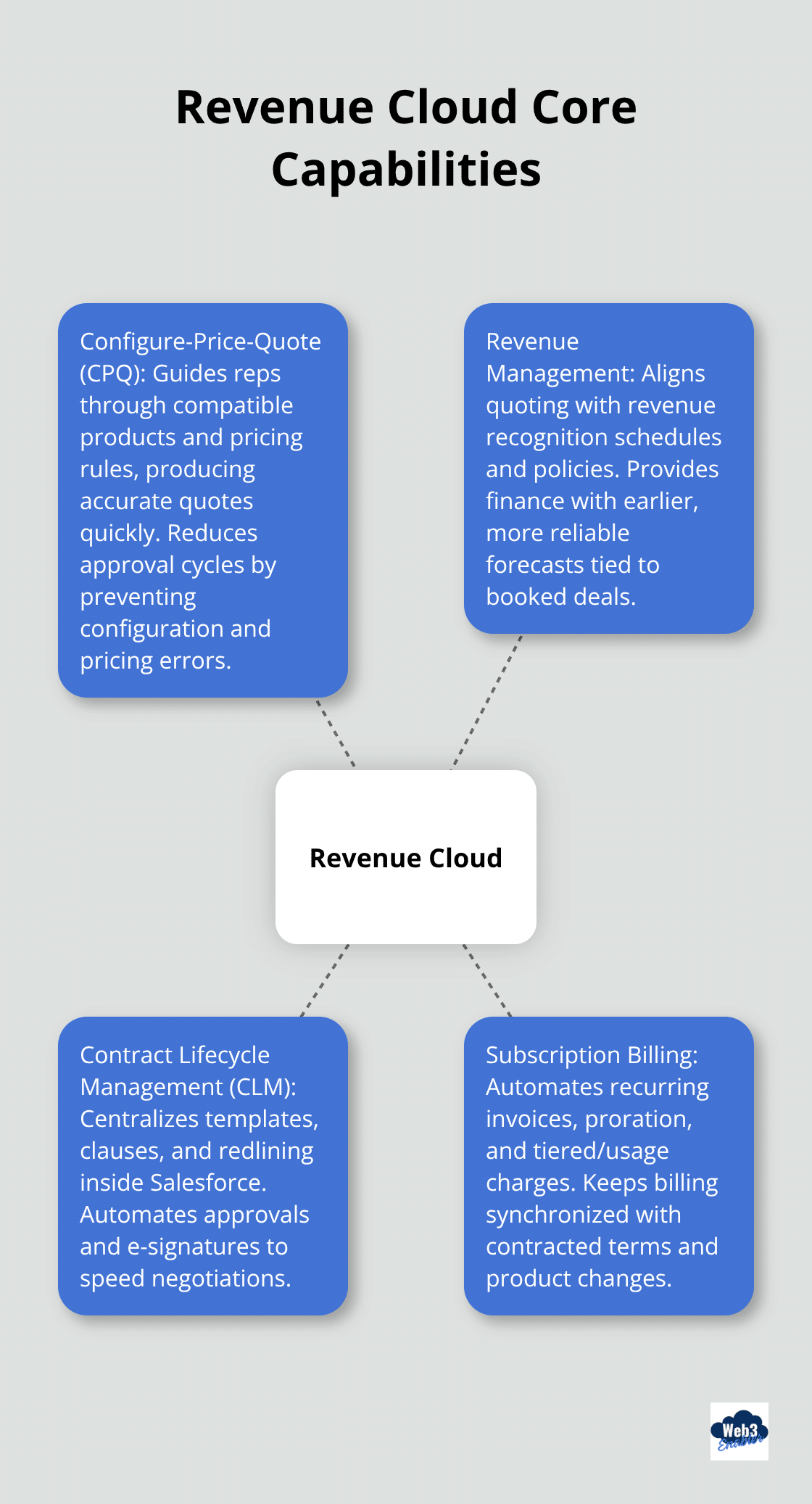
According to G2, users cite streamlined workflows and efficiency gains as the top benefits, with 104 mentions of ease of use in daily operations. The platform connects your entire revenue cycle from initial quote through cash collection, eliminating the fragmented spreadsheet-and-email workflows that plague most organizations.
How CLM Transforms Contract Management
Contracts historically lived outside Salesforce in document repositories, legal systems, or email threads-creating blind spots for sales, finance, and operations teams. Revenue Cloud CLM brings contracts into Salesforce, tying them directly to your CRM data, quoting system, and revenue recognition processes. Modern contract workflows with CLM reduce manual touchpoints dramatically: pre-approved templates accelerate drafting, centralized clause libraries ensure consistency, and structured redlining speeds negotiations. Approval workflows become automated rather than email chains, and electronic signatures eliminate delays. Post-execution, the system tracks renewal dates, amendment milestones, and obligations-feeding this intelligence back to your sales team for proactive renewal management.
The alternative remains painful. Legal drafts contracts outside Salesforce, approvals happen via email redlines, final signatures arrive by attachment, and renewal tracking lives in a spreadsheet nobody trusts. This fragmentation costs time and creates revenue leakage.
Revenue Cloud vs. Point Solutions
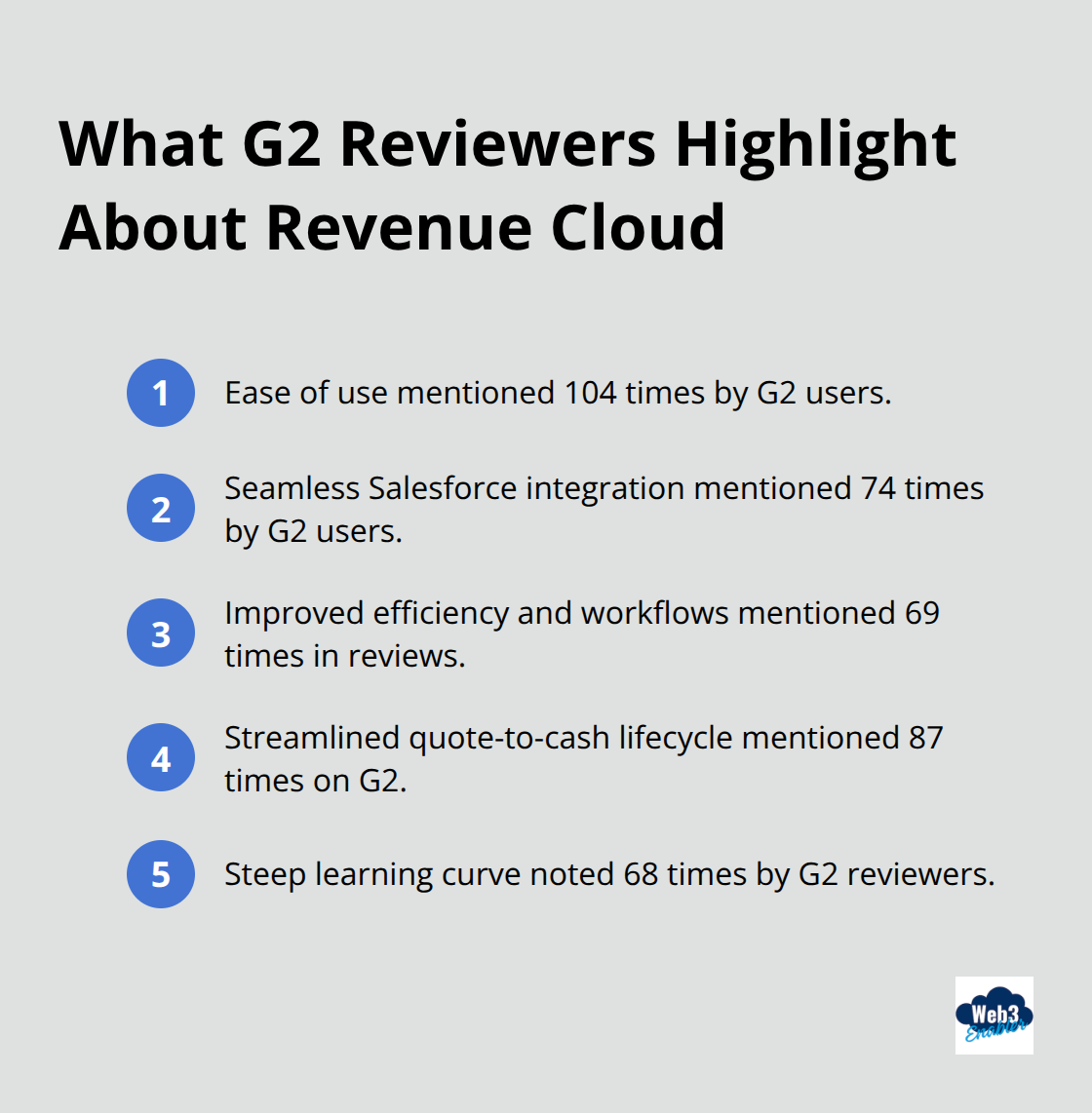
Competitors like Zuora (rated 3.9/5 on G2 from 292 reviews) and Chargebee (4.4/5 from 920 reviews) excel at specific functions-subscription billing or usage-based pricing-but they sit outside your Salesforce ecosystem. Revenue Cloud integrates natively within Salesforce, consolidating business processes including sales tracking, customer communication, task management, and performance analytics. G2 users specifically praise seamless integration with the Salesforce ecosystem and automation across the revenue lifecycle, with 74 mentions of this benefit.
When your quote feeds directly into billing, and billing data flows back to your revenue forecast, your finance team gains visibility into cash flow weeks earlier than traditional setups. Enterprise and mid-market customers report that Revenue Cloud automation helps close deals faster and saves significant time on manual order processing.
Understanding the Learning Curve Trade-Off
The platform’s weakness-a steep learning curve due to extensive features and customization options, noted 68 times on G2-is real, but phased rollouts starting with core modules like CPQ and contract management mitigate this risk. Implementation complexity exists because the product covers so much ground, not because it’s poorly designed. Small businesses with limited budgets sometimes find Revenue Cloud expensive compared to standalone solutions, but the operational efficiency gains typically justify the investment for organizations processing more than 50 quotes monthly or managing subscription renewals at scale.
These operational gains extend beyond cost savings. Your teams gain access to real-time revenue data, predictable renewal forecasts, and cross-functional visibility that transforms how you manage growth. The next section explores how these capabilities translate into measurable business outcomes across different industries and company sizes.
How Revenue Cloud Transforms Your Financial Visibility
Centralizing Data Across Your Organization
Revenue Cloud consolidates data that typically scatters across sales, finance, and operations systems, creating a single source of truth for cash flow forecasting. According to G2 reviews, users highlight improved efficiency and streamlined workflows across revenue management with 69 mentions, while 87 mentions specifically reference the streamlined revenue lifecycle from quote to cash. Your finance team can now predict cash inflow weeks earlier than traditional setups.
When a sales rep creates a quote in Revenue Cloud, that data immediately connects to billing projections, revenue recognition schedules, and renewal forecasts. A finance director at an enterprise using Revenue Cloud gains real-time visibility into which deals will convert to cash and when, rather than waiting for spreadsheet updates from sales leadership.
Tracking Usage and Expansion Opportunities
Usage-based pricing models add another layer of visibility to your revenue operations. Revenue Cloud tracks consumption automatically, adjusts invoices accordingly, and alerts your team to expansion opportunities before customers even request price changes. This real-time intelligence eliminates the guesswork that plagues organizations relying on manual tracking or disconnected tools. Your finance team stops chasing sales for updates and instead receives accurate, automated data feeds that reflect actual customer behavior.
Automating Quote-to-Order Workflows
Accelerating deal closure happens through automation, not wishful thinking. Revenue Cloud automates the entire quote-to-order workflow, reducing manual handoffs where deals stall. Pre-built quote templates cut quoting time from days to hours, while approval workflows route deals to the right stakeholders instantly instead of bouncing through email chains.
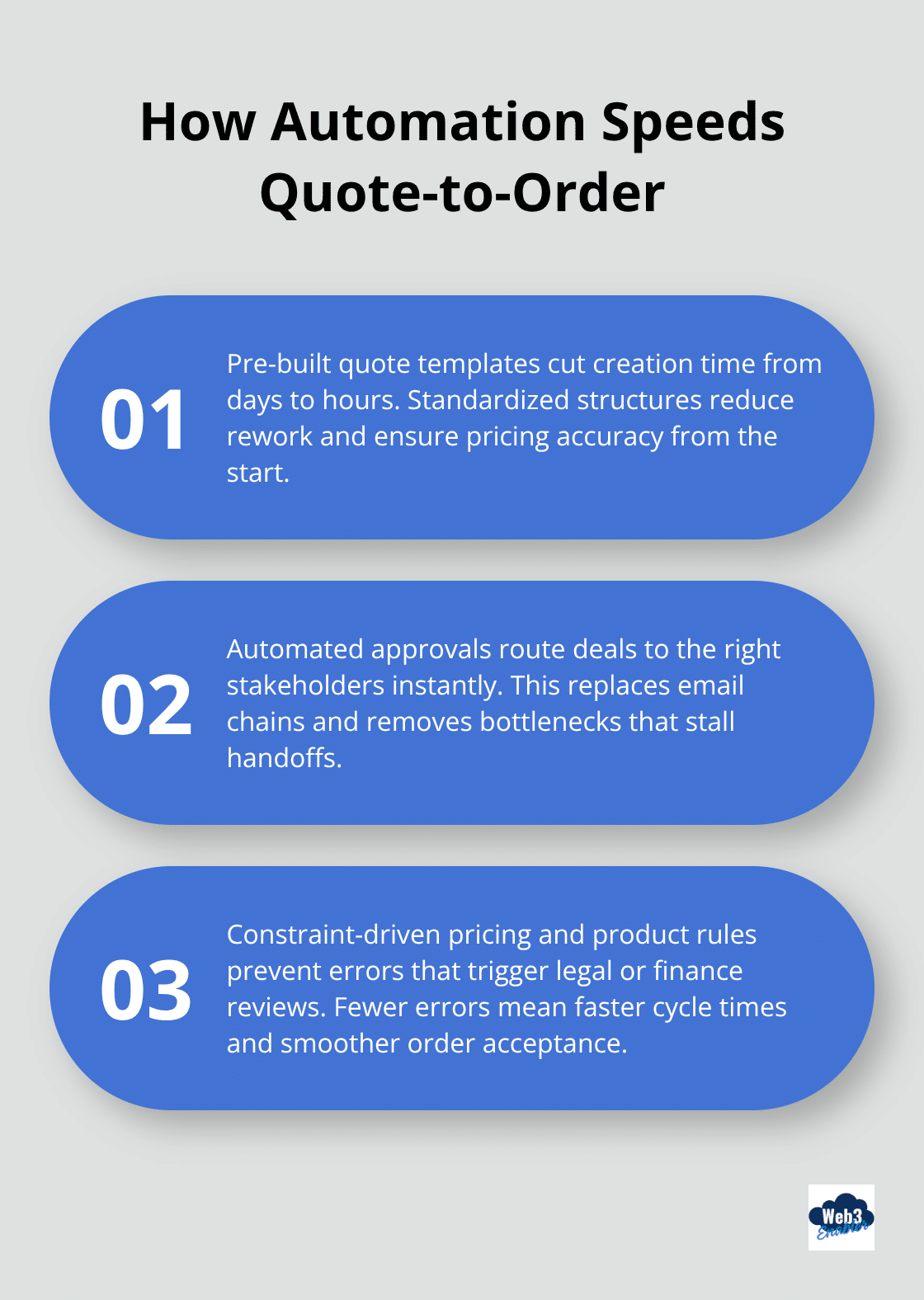
Enterprise and mid-market customers report that Revenue Cloud automation helps close deals faster and saves significant time on manual processes.
For businesses managing complex products with multiple pricing tiers (hardware bundled with software subscriptions plus usage-based overage fees, for instance), Revenue Cloud’s constraint modeling eliminates pricing errors that typically delay deal closure by forcing legal or finance reviews. Your team avoids the back-and-forth that kills momentum.
Accelerating Subscription Renewals
Subscription renewals accelerate through automated alerts tied to contract data. Your customer success team receives renewal notifications 90 days before expiration rather than discovering lapses in a quarterly spreadsheet review. Organizations processing more than 50 quotes monthly typically see quote-to-cash cycles compress by 30 to 40 percent within six months of implementation, translating directly to faster revenue recognition and improved cash flow timing. This operational efficiency compounds over time as your team redirects energy from administrative tasks to strategic revenue expansion activities.
Where Revenue Cloud Delivers Real Impact Across Industries
Manufacturing and Complex Product Sales
Manufacturing and enterprise organizations running complex, multi-product sales cycles benefit most from Revenue Cloud because the platform handles configurable products, nested pricing structures, and asset lifecycle management that traditional billing systems cannot support. A hardware manufacturer selling equipment bundled with software subscriptions and usage-based overage fees needs constraint modeling to prevent pricing errors that delay deals. Revenue Cloud enforces product dependencies and bundle rules automatically, eliminating the manual validation that typically adds days to quote approval cycles. Robotics companies selling configurable hardware with tiered service contracts see quote-to-cash cycles compress by 30 to 40 percent within six months of implementation because approval workflows route deals to stakeholders instantly instead of stalling in email chains.
Financial Services and Subscription Renewals
Financial services firms managing subscription models and recurring billing gain immediate advantage through automated renewal alerts tied to contract data, reducing the administrative overhead that customer success teams waste on spreadsheet tracking. When a contract renewal date approaches, Revenue Cloud notifies your team 90 days in advance rather than surfacing lapses during quarterly reviews, which gives you time to address churn proactively. Subscription billing automation handles proration, free allowances, tiered overage pricing, and invoice generation without manual intervention-a critical capability when you process more than 50 quotes monthly across multiple customer segments. Enterprise and mid-market customers consistently highlight that Revenue Cloud automation saves significant time on manual order processing and helps close deals faster, which translates to improved cash flow timing and earlier revenue recognition for finance teams.
Technology and SaaS Expansion Opportunities
Technology and SaaS companies benefit differently because their revenue complexity stems from usage-based pricing and multi-tier offerings rather than hardware configuration. Revenue Cloud tracks consumption automatically, adjusts invoices in real time, and alerts sales teams to expansion opportunities before customers request price changes. A SaaS company offering tiered access with consumption-based overage fees gains visibility into which accounts are approaching upgrade triggers, enabling proactive upsell conversations instead of reactive responses. The platform consolidates CPQ, billing, and revenue recognition into a single system, eliminating the data fragmentation that typically causes forecast inaccuracy and delays financial reporting. Organizations implementing Revenue Cloud report that their finance teams can predict cash inflow weeks earlier than traditional setups because quote data flows directly into billing projections and revenue recognition schedules without manual reconciliation steps.
Final Thoughts
Salesforce Revenue Cloud benefits organizations by consolidating fragmented revenue processes into a unified system that accelerates deal closure, improves financial forecasting, and eliminates manual handoffs. Whether you manage complex hardware bundles, subscription renewals, or usage-based pricing models, the platform adapts to your business model instead of forcing you into rigid workflows. Your sales, finance, and operations teams work from the same data rather than competing spreadsheets, which transforms how you manage growth.
Implementation requires honest assessment of your current state. If your organization processes more than 50 quotes monthly or manages subscription renewals across multiple customer segments, the operational efficiency gains typically justify the investment within six months. Start with core modules like CPQ and contract management rather than attempting full deployment at once, which reduces training burden and lets your team build confidence before expanding to billing and revenue recognition components.
If contracts live outside Salesforce, approvals happen via email, and renewals track in spreadsheets, Revenue Cloud CLM alone delivers immediate value. Consider engaging implementation partners who understand both Salesforce architecture and your industry’s specific requirements to modernize your entire quote-to-cash process. Visit Web3 Enabler to explore how modern Salesforce implementations accelerate your revenue operations.