



Your stablecoin onboarding process is probably still stuck in 2015. Manual verification, compliance checks, and legacy system handoffs are eating your team’s time and your customers’ patience.
Automation for crypto onboarding changes that. We at Web3 Enabler have seen businesses cut their onboarding timelines from weeks to minutes by ditching manual processes and letting smart systems handle the heavy lifting.
What’s Really Eating Your Onboarding Timeline
The Manual Verification Trap
Your compliance team screens wallets against sanctions lists by hand. Your operations person copy-pastes customer data between three different systems. Your developer writes custom scripts to reconcile transactions because your legacy banking platform doesn’t talk to your crypto rails. This isn’t a compliance problem or a tech problem-it’s a productivity hemorrhage. Manual onboarding for stablecoins typically takes time from application to first transaction.

That delay costs you customers who get impatient and walk to competitors offering instant activation. It also costs your team thousands in labor hours spent on repetitive verification tasks that a system could complete in under five minutes.
Where Human Error Hits Hardest
Human error makes the problem worse. When your team manually reviews KYC documents, screens wallets, and updates compliance records across disconnected tools, mistakes happen. A misplaced decimal in transaction limits, a missed sanctions flag, or a wallet address entered incorrectly during setup can trigger costly compliance violations or disputes. Your current stack wasn’t built for blockchain. Your Salesforce instance doesn’t natively understand wallet addresses or on-chain risk signals. Your payment processor doesn’t know how to handle real-time settlement on Ethereum or USDC transfers. So your teams improvise with manual workarounds, spreadsheets, and custom integrations that break every time a vendor updates their API.
The Hidden Cost in Your Approval Rates
The real damage shows up in your approval rates and customer acquisition costs. Merchants that could generate significant stablecoin payment volume get rejected or delayed because your team lacks the tools to assess corridor risk quickly or implement dynamic transaction limits that scale with proven behavior. You’re either approving too conservatively and losing revenue, or approving without proper monitoring and facing compliance surprises. Legacy systems also create invisible friction between your teams. Compliance can’t see what operations approved. Operations doesn’t know what finance is settling. Finance can’t reconcile what compliance flagged. This fragmentation means your organization runs three separate onboarding processes instead of one, and merchants experience frustrating delays while your teams chase each other for information.
The Scaling Problem Gets Worse
The cost compounds. Businesses that lack automated risk tiers and dynamic limits end up either overloading their compliance teams with manual reviews or enabling merchants with excessive transaction caps that create unnecessary exposure. Neither option scales. A financial services company that onboards merchants across multiple countries faces even steeper manual costs because they need to verify compliance rules for each jurisdiction, manage different KYB documentation thresholds, and track refund policies across regions. Doing that manually means hiring more compliance staff or accepting longer timelines that damage your competitive position.
The question isn’t whether you can afford to automate-it’s whether you can afford not to. The businesses winning right now aren’t the ones with the biggest compliance teams. They’re the ones whose systems work together.
How Automation Flips Your Onboarding Economics
Real-Time Risk Detection Replaces Slow Manual Screening
Automated compliance systems don’t just save time-they fundamentally change what your business can accomplish with the same headcount. When KYC and AML screening happen in minutes instead of days, your team shifts from processing applications to actually analyzing risk. Real-time wallet screening across 270+ risk indicators means you catch sanctions exposure, mixer activity, and darknet connections instantly rather than discovering problems after you’ve already approved a merchant. Fidelity Investments introduced its FIDD stablecoin on Ethereum, and JPMorgan Chase launched JPMD for institutional clients on Ethereum’s Base layer-both moves that only work at scale if onboarding automation handles the volume.
Risk-Tiered Approval Accelerates Your Conversion
Your approval rates improve dramatically because automated systems implement risk-tiered onboarding, meaning low-risk merchants get instant green lights while higher-risk corridors trigger enhanced due diligence without manual delay. Merchants that would have waited weeks for approval elsewhere go live with you in 48 hours. Your customer acquisition cost per merchant drops because faster activation means lower abandonment rates.
Integration Eliminates System Fragmentation
Integration with your existing business tools eliminates the spreadsheet chaos. Your compliance data, customer records, and transaction monitoring live in one system instead of scattered across disconnected platforms. Your operations team stops copy-pasting wallet addresses and customer data between tools. Your finance team sees settlement reconciliation automatically instead of chasing transaction records. Your compliance team tracks continuous AML monitoring, wallet readiness checks, and sanctions screening without manual list management.
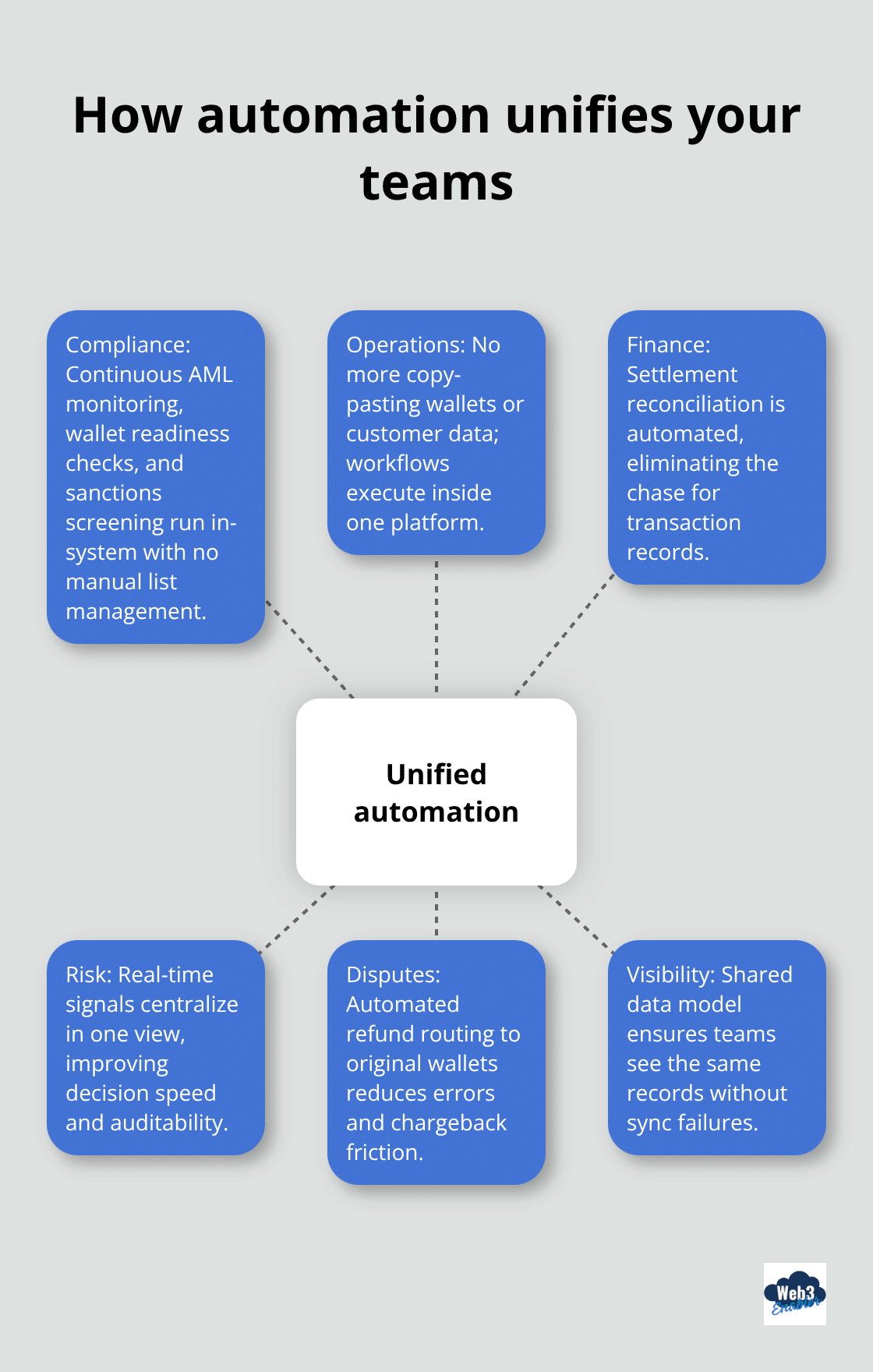
Automated refund routing to original wallets reduces disputes compared to manual processing because the system enforces consistent policy rather than relying on your team to remember which refund method to use.
Dynamic Limits Scale Confidence with Behavior
Dynamic transaction limits that adjust based on merchant behavior, activation time, and transaction success rates mean you can confidently approve merchants with higher initial caps because the system automatically scales limits up as behavior proves clean. Corridor risk assessment happens automatically-the system flags high-risk geographies, unusual volume spikes, and rapid wallet churn without your team manually reviewing transaction logs. Real-time monitoring replaces batch reviews, so suspicious activity gets flagged before it becomes a compliance problem.
Measurable SLAs Drive Operational Excellence
Your onboarding SLAs improve measurably: time from application to first decision shrinks from weeks to hours, approval rates by tier become predictable, and time to live transactions drops because wallet setup, address whitelisting, and settlement testing all happen automatically. Settlement reliability increases because automated systems handle refund policy enforcement, transaction reference tracking, and wallet compromise protocols consistently. Your compliance team focuses on strategy and investigation instead of data entry.
These operational gains create the foundation for scaling merchant onboarding across multiple corridors and stablecoins-but only if you structure your implementation correctly from the start.
Building Your Automation Stack Without Breaking What Works
Your current infrastructure matters more than finding the fanciest compliance tool. The businesses that nail automation fastest aren’t the ones that rip out their entire tech stack and start over-they’re the ones that layer automation on top of what already works. If your team lives in Salesforce, your automation solution needs to live there too. Web3 Enabler builds 100% Salesforce native blockchain solutions available on the Salesforce AppExchange specifically because your compliance team already knows Salesforce, your operations team manages customer records there, and your finance team runs reporting from there. Forcing your team to jump between Salesforce and a separate compliance platform means you haven’t actually solved the fragmentation problem-you’ve just added another tool to the chaos.
Choose Solutions That Integrate Natively
The vendors worth considering are the ones that integrate directly into your existing systems rather than demanding you adopt their platform as your single source of truth. When you evaluate solutions, ask whether they require API integrations that need constant maintenance or whether they plug in natively. Native integration means your KYC data, wallet screening results, and transaction monitoring all flow directly into the systems your team already uses daily. This matters because every integration point is a place where data breaks, syncs fail, or your team has to manually push information between systems. Merchants waiting for approval don’t care that your compliance data lives in one place and your customer records live in another-they just know they’re waiting.
Start Small with a Single Corridor
Start with a single stablecoin, one blockchain, and one low-risk corridor before you attempt global scale. Most businesses fail at automation not because the technology doesn’t work, but because they try to automate everything at once and then panic when something breaks. Your pilot should onboard 50 to 200 merchants across a single geography-perhaps the United States with USDC on Ethereum-with daily transaction volume caps that keep exposure manageable while you watch the system run. This pilot phase typically takes 4 to 8 weeks and tells you whether your wallet readiness checks catch the merchants that cause problems, whether your dynamic limits actually prevent fraud, and whether your team can handle real-time monitoring without burning out.
Measure What Matters During Your Pilot
During the pilot, measure three things obsessively: time from application to approval decision, approval rate by risk tier, and fraud loss rate. If your time to approval still stretches across days, your automation isn’t configured correctly. If your approval rates by tier aren’t consistent, your risk model needs refinement.
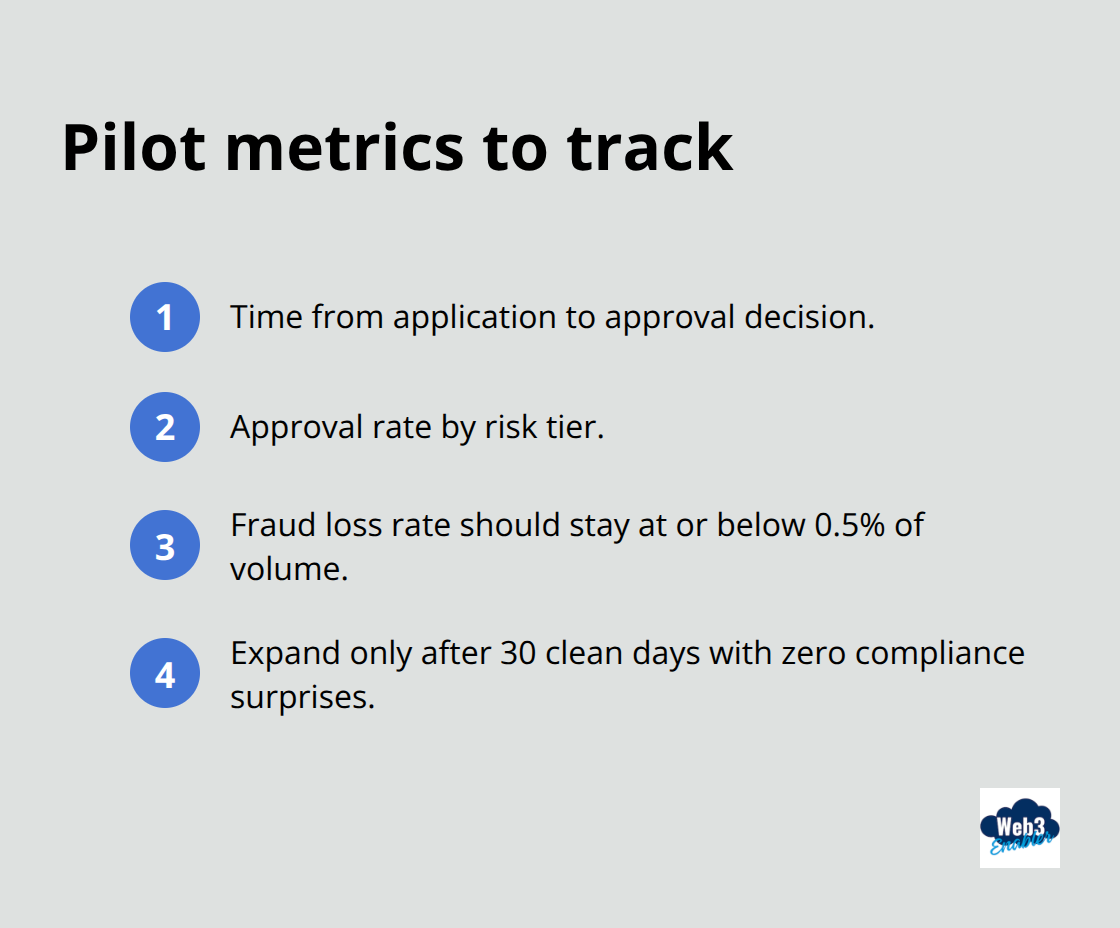
If fraud losses exceed 0.5% of volume, your monitoring rules aren’t catching the right signals. Only after you’ve run clean for 30 consecutive days with zero compliance surprises should you expand to a second stablecoin or a new corridor.
Expand Deliberately After Proving Stability
This staged approach feels slow, but it’s the fastest way to reach scale because it prevents the compliance disasters that force you to shut down merchant onboarding entirely while your team investigates what went wrong. Each expansion phase (adding a new stablecoin, opening a new corridor, or increasing transaction caps) should follow the same pattern: run the new configuration with a small merchant cohort for 30 days, confirm your metrics stay clean, and only then roll out to your full merchant base.
Final Thoughts
Automation for crypto onboarding isn’t a luxury feature anymore-it’s the difference between businesses that scale and businesses that get stuck. The merchants you lose right now aren’t going to your competitors because those competitors have better compliance teams. They’re going because those competitors approve them in 48 hours instead of three weeks. Manual processes create a ceiling on your growth that your compliance team, operations team, and finance team simply cannot break through without hiring exponentially more staff.
JPMorgan Chase didn’t wait for perfect regulatory clarity before launching JPMD on Ethereum’s Base layer, and Fidelity didn’t hesitate before introducing FIDD. They automated their onboarding processes, proved the model worked, and scaled confidently. Your window to build that competitive advantage closes every month you delay, because more of your competitors figure out that automation actually works and start capturing the merchants you should have won.
The future of payments moves faster when you stop treating onboarding as a compliance bottleneck and start treating it as a competitive weapon. That shift happens when your systems work together instead of fighting each other, when your team focuses on strategy instead of data entry, and when merchants experience approval in hours instead of weeks. Explore how Web3 Enabler can accelerate your stablecoin onboarding and turn your compliance process into a growth engine.