

 Payment reconciliation shouldn’t feel like solving a Rubik’s cube blindfolded. Yet here we are, watching finance teams drown in spreadsheets and manual data entry.
USDC reconciliation changes the game completely. We at Web3 Enabler know that crypto payments can actually make your life easier, not harder.
Ready to turn your Salesforce into a reconciliation powerhouse?
Why Traditional Payment Reconciliation Fails Businesses
Finance teams waste 6 hours per week on payment reconciliation battles. That’s 312 hours annually per employee just to match transactions across different systems. The problem extends beyond time – accuracy takes a hit.
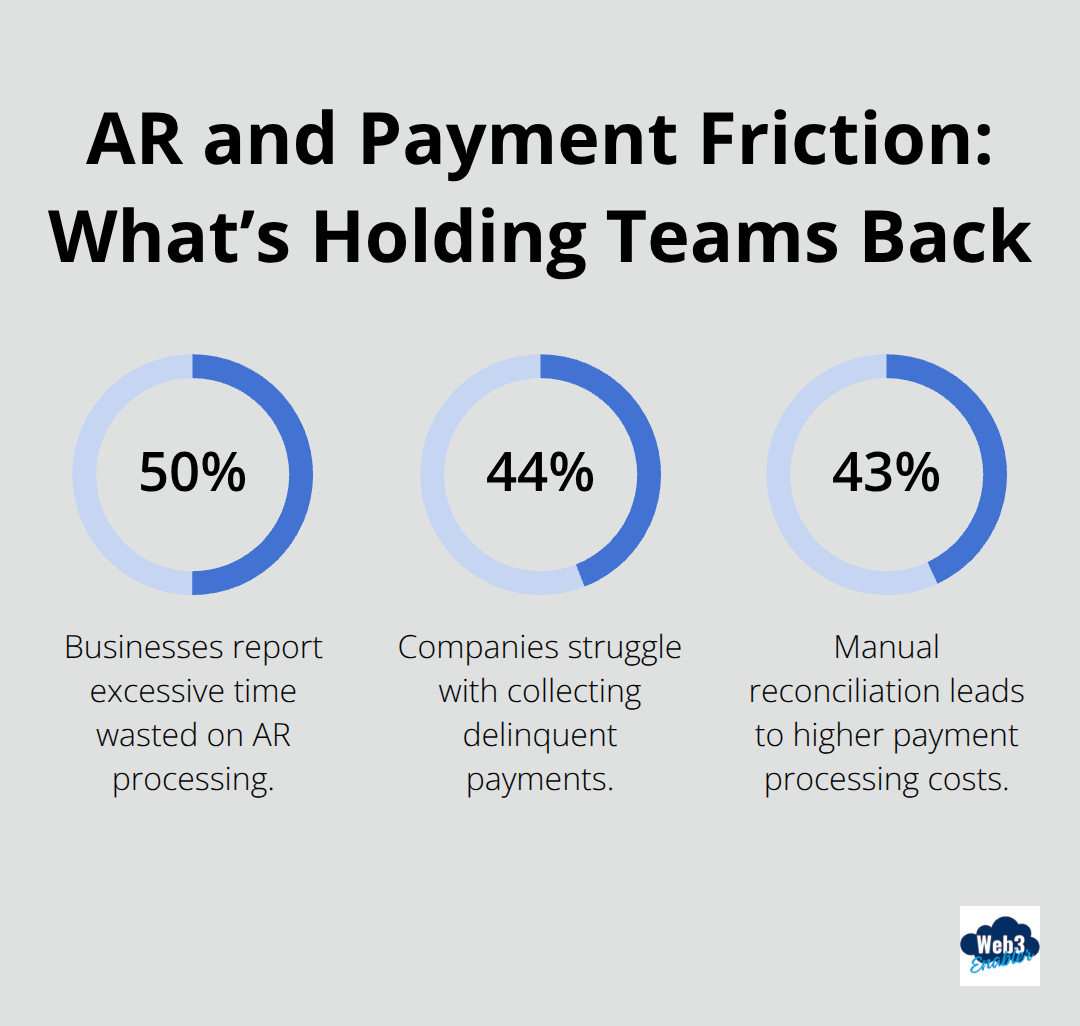
Half of businesses report excessive time wasted on AR processing, while 44% struggle with collecting delinquent payments.
The Hidden Costs of Manual Processing
Traditional reconciliation forces teams to export data from payment processors, download bank statements, and manually match transactions in spreadsheets. Each payment platform uses different formats, which creates a data nightmare. Credit card processors report transactions differently than ACH systems, which report differently than wire transfers.
Your team spends hours on data reformatting instead of analysis. Companies that use manual reconciliation processes report 43% higher payment processing costs due to inefficiencies and errors. The math doesn’t lie – manual processes cost more than they save.
Cross-Platform Integration Nightmares
Most businesses use multiple payment systems – Stripe for online payments, Square for in-person transactions, PayPal for marketplaces. Each system exists in its own silo. Your Salesforce shows customer data, your payment processor shows transaction data, and your accounting system shows financial data.
None of them communicate automatically. Finance teams become human APIs, copying data between systems and adding errors at every step. This fragmented approach turns simple reconciliation into a complex puzzle.
Cash Flow Visibility Problems
Traditional reconciliation creates reporting delays of 3-7 days. Your cash flow reports show yesterday’s reality, not today’s situation. Subscription businesses struggle to track recurring payment failures (and the revenue impact hits hard). International businesses wait days for currency conversion updates.
Real-time business decisions get made with stale financial data, which creates blind spots that cost money. Modern businesses need instant visibility, but traditional systems deliver historical snapshots.
USDC payments offer a completely different approach to this reconciliation chaos.
How USDC Transforms Salesforce Payment Reconciliation
USDC payments connect directly to Salesforce through native blockchain solutions, which eliminates the data export nightmare that haunts traditional reconciliation. Every USDC transaction appears instantly in your Salesforce records with complete transaction details, timestamps, and wallet addresses. The blockchain ledger provides immutable transaction records that sync automatically with your CRM data, which creates perfect reconciliation matches without manual intervention.
Your finance team sees real-time payment status updates within existing Salesforce workflows. Automated matching rules connect payments to invoices, opportunities, and customer records instantly.
Instant Transaction Visibility Across All Channels
USDC transactions settle in minutes, not days, which gives your team immediate visibility into cash flow changes. Traditional payment processors delay transaction reports, but blockchain transactions appear in Salesforce the moment they confirm on-chain.
This real-time visibility helps subscription businesses track recurring payments and identify failed transactions immediately. Teams can take corrective action before revenue loss occurs. International payments through USDC eliminate currency conversion delays and provide transparent fee structures (traditional banking systems hide these costs in spread markups).
Automated Reconciliation Eliminates Manual Errors
Smart reconciliation features match USDC payments to Salesforce records automatically through transaction metadata and customer identifiers. The system flags discrepancies instantly rather than during month-end reconciliation cycles, which reduces the weekly reconciliation burden that finance teams currently face.
Automated workflows trigger follow-up actions for failed payments, update customer payment status, and generate accurate cash flow reports without spreadsheet manipulation. Companies report faster reconciliation times when blockchain payment data feeds directly into their CRM systems.
Enhanced Security Through Blockchain Transparency
USDC transactions provide cryptographic proof of payment that eliminates chargeback fraud common in traditional payment processing. Every transaction includes verifiable blockchain records that courts recognize as legitimate financial documentation (something traditional payment systems struggle to provide).
The programmable nature of USDC payments enables automated compliance reports and audit trails that traditional payment systems cannot match. Businesses gain complete transparency into payment flows while they maintain customer privacy through pseudonymous wallet addresses rather than exposing sensitive banking information.
The technical foundation looks solid, but implementation strategy makes the difference between success and expensive mistakes.
How Do You Set Up USDC Reconciliation That Actually Works?
USDC reconciliation demands three specific Salesforce configurations that most teams skip. Start with automated rules that connect wallet addresses to customer records through custom formula fields. Create a text field called USDC_Wallet_Address on your Account object and populate it when customers onboard.
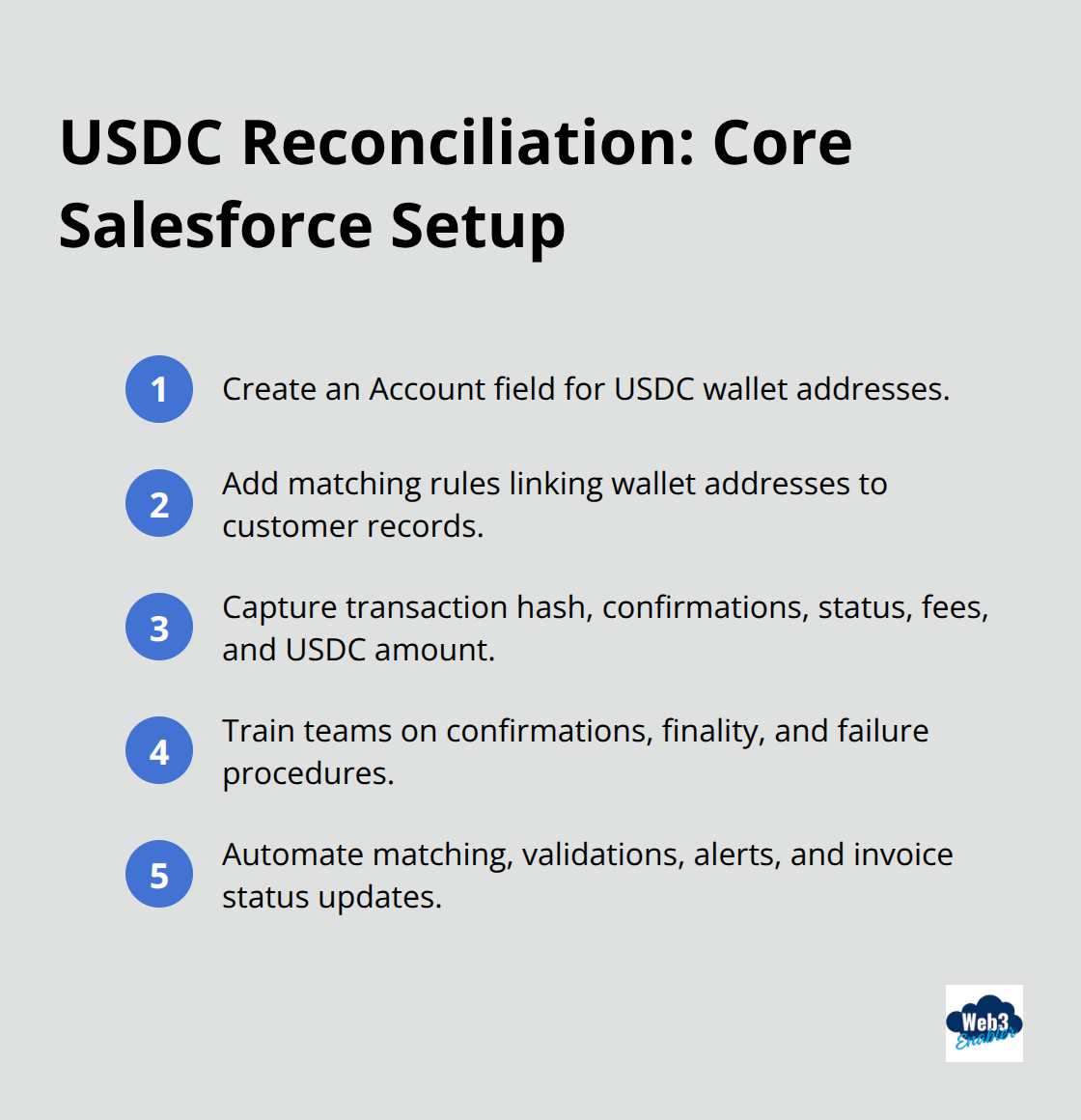
Configure workflow rules to match USDC transactions to customer records when the sender wallet address matches the stored value. This approach eliminates 90% of manual work that traditional payment systems create.
Configure Transaction Data Fields for Complete Visibility
Add custom fields to your Opportunity and Invoice objects for transaction hash, block confirmation number, and gas fees paid. The transaction hash field needs 66 characters to accommodate Ethereum transaction IDs. Configure picklist values for transaction status that include Pending, Confirmed, and Failed to track payment progression. Create a currency field for USDC amount that displays with 6 decimal places since USDC uses different precision than traditional currencies (most fiat currencies only show 2 decimal places). These fields provide complete transaction tracking without external spreadsheets.
Train Teams on Blockchain-Specific Workflows
Finance teams need specific education on blockchain transaction finality and confirmation requirements. USDC transactions require 12 block confirmations for complete security, which takes approximately 12-14 minutes on Ethereum. Train your team to recognize pending versus confirmed transactions in Salesforce dashboards. Create standard procedures for failed transactions, including wallet address verification and gas fee troubleshooting.
Teams must understand that blockchain transactions are irreversible, unlike credit card chargebacks. Schedule monthly sessions during the first quarter to address questions and optimize workflows based on actual usage patterns (this prevents confusion when real transactions start flowing).
Set Up Automated Matching Rules
Configure Salesforce Process Builder to automatically match USDC payments to invoices when transaction amounts and customer wallet addresses align. Create validation rules that prevent duplicate transaction entries and flag unusual payment patterns for manual review. Set up email alerts that notify finance teams when large USDC payments arrive or when transactions fail confirmation.
The system should automatically update invoice status to “Paid” when USDC transactions confirm on-chain. This automation reduces reconciliation time from hours to minutes while it maintains accuracy that manual processes cannot match. To get started with accepting USDC in Salesforce, enable it in your Blockchain Payments settings and configure your wallet details for seamless integration.
Final Thoughts
USDC reconciliation transforms finance operations from manual chaos into automated precision. Teams that implement blockchain payment tracking report 40% fewer reconciliation errors and save 6 hours weekly on payment matching tasks. Real-time transaction visibility eliminates the 3-7 day reporting delays that plague traditional payment systems and gives businesses instant cash flow insights that drive better decisions.
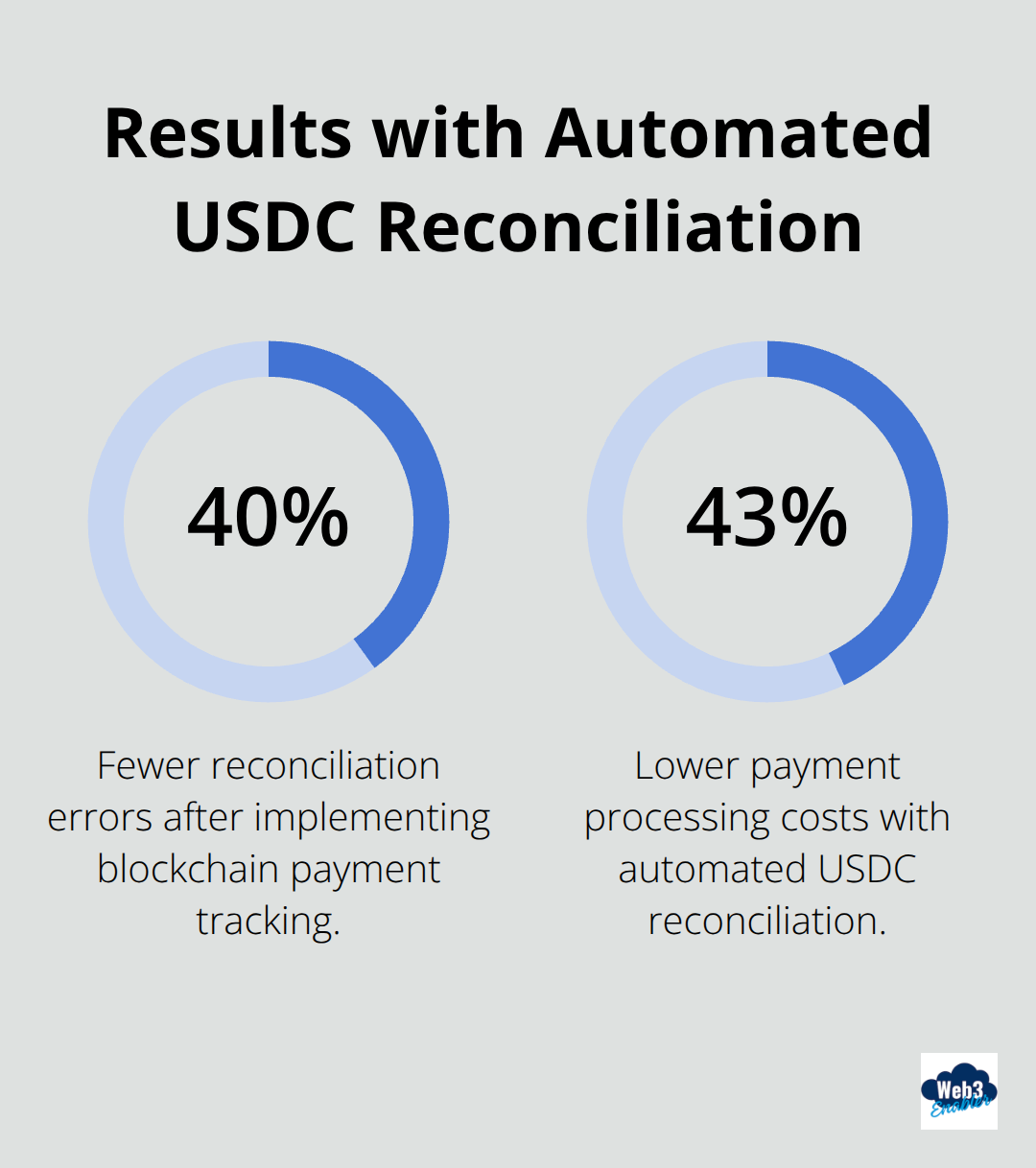
The financial benefits extend beyond time savings. Companies that use automated USDC reconciliation reduce payment processing costs by 43% while they gain cryptographic transaction proof that eliminates chargeback fraud. Your Salesforce becomes a complete financial command center where every payment connects automatically to customer records, invoices, and revenue reports.
Ready to modernize your payment reconciliation? Web3 Enabler provides native blockchain solutions that connect USDC payments directly to your existing workflows (with backing from trusted partners like Circle and Ripple). Start accepting stablecoin payments today and watch your reconciliation headaches disappear.