



Stablecoins are reshaping how businesses handle money, and frankly, it’s about time. These digital currencies pegged to traditional assets offer the speed of crypto without the wild price swings that make CFOs break out in cold sweats.
We at Web3 Enabler see companies discovering that each stablecoin use case solves real problems – from instant cross-border payments to streamlined treasury management. The question isn’t whether your business should consider stablecoins, but which applications will transform your operations first.
How Do Stablecoins Transform Business Operations
Cross-border payments just received their biggest upgrade since the invention of wire transfers. Stablecoins process international transactions in minutes rather than the 3-5 business days traditional banks require, and companies like Shadeform boosted revenue by 10% after stablecoin payments reached nearly 20% of their transaction volume. The math is simple: when you eliminate correspondent bank fees and currency conversion costs, businesses save anywhere from 40-80% on international transfer expenses.
Instant Global Payments Change Everything
Traditional wire transfers cost businesses $15-50 per transaction plus hidden exchange rate markups that can reach 4%. Stablecoins flip this model entirely. Your treasury team can send $100,000 to suppliers in Asia for under $5 in network fees, with funds that arrive within 10 minutes instead of next Tuesday. Companies that manage global payroll see immediate cash flow improvements since they can pay international contractors the same day work completes rather than plan payment schedules around bank delays.
Treasury Management Gets a Major Upgrade
Smart treasury managers park operational cash in yield-bearing stablecoin protocols rather than let funds sit idle in zero-interest accounts. With traditional money market accounts that offer 0.5-1% returns, stablecoins backed by U.S. Treasury securities provide 4-5% yields while they maintain instant liquidity.

Companies like Stripe actively use stablecoins to modernize treasury operations and eliminate correspondent bank delays. The transparency advantage is massive too – every transaction creates an immutable record, which makes month-end reconciliation a breeze instead of a nightmare.
Supply Chain Payments Finally Work Properly
Manufacturing companies switch to stablecoin payments for vendor relations because traditional trade finance is broken. Letters of credit take weeks to process and cost 1-3% of transaction value, while stablecoin payments with programmable conditions settle automatically when shipment tracking confirms delivery. This eliminates the cash flow gaps that kill small suppliers and reduces working capital requirements by 15-25% (according to recent implementation studies). Cryptocurrency eliminates the 2.9-4.5% transaction fees and 3-5 day settlement delays that drain enterprise resources from supplier payments.
These operational improvements set the foundation for even more sophisticated financial applications that extend far beyond basic payment processing.
How Do Stablecoins Transform Investment Operations
Financial institutions that embrace stablecoins gain massive competitive advantages in portfolio management and operations. Digital asset managers process trades 24/7 without weekend delays, while stablecoin-based portfolios provide instant liquidity that traditional money markets cannot match. Stablecoins are growing in popularity among major firms due to their operational benefits, and portfolio rebalancing that once took days now completes in minutes.
Trading Desks Get Real-Time Settlement
Professional operations use stablecoins as base assets because they eliminate the T+2 settlement delays that tie up capital and create counterparty risks. When portfolio managers need to move $50 million between asset classes, stablecoin transactions settle within 10 minutes rather than the 2-3 business days that traditional wire transfers require. Investment firms report that stablecoin liquidity allows them to capture arbitrage opportunities that disappear before traditional settlement completes.
Stablecoin Protocols Beat Traditional Banks
Corporate platforms offer 8-12% annual returns compared to the 2-3% yields from traditional corporate bonds, and borrowers access capital in hours rather than weeks. Companies with strong balance sheets lend excess capital through decentralized protocols that provide transparent, automated interest payments every block rather than quarterly distributions. The over-collateralization requirements actually reduce default risks below traditional corporate loans, while smart contract automation eliminates the administrative costs that make small business loans unprofitable for banks.
Risk Management Becomes Transparent
Every loan position remains visible on-chain, and automated liquidation prevents the cascading defaults that plague traditional credit markets. Risk officers can monitor exposure in real-time rather than wait for monthly reports, while automated protocols execute predetermined risk parameters without human intervention. This transparency creates accountability that traditional banking systems cannot match (since every transaction creates an immutable audit trail).
The insurance sector faces similar transformation as stablecoins enable new risk management solutions that traditional policies cannot provide.
How Do You Actually Implement Stablecoins in Your Business
Most companies fail at stablecoin implementation because they treat it like software installation instead of financial workflow reconstruction. The GENIUS Act signed in July 2025 created regulatory clarity, but successful adoption requires strategic plans that start with your existing payment infrastructure. Companies that rush implementation without proper integration assessment waste 6-12 months on compatibility fixes that proper evaluation prevents.
Start With Your Current Payment Stack
Your existing payment systems determine implementation complexity and timeline. While legacy ERP systems require custom middleware that extends timelines to 3-6 months, with Blockchain Payments for Salesforce, the process can be completed in a couple of days. The key decision involves public blockchain integration (which offers transparency and cost reduction) or private blockchain solutions that provide enterprise control but limit interoperability.
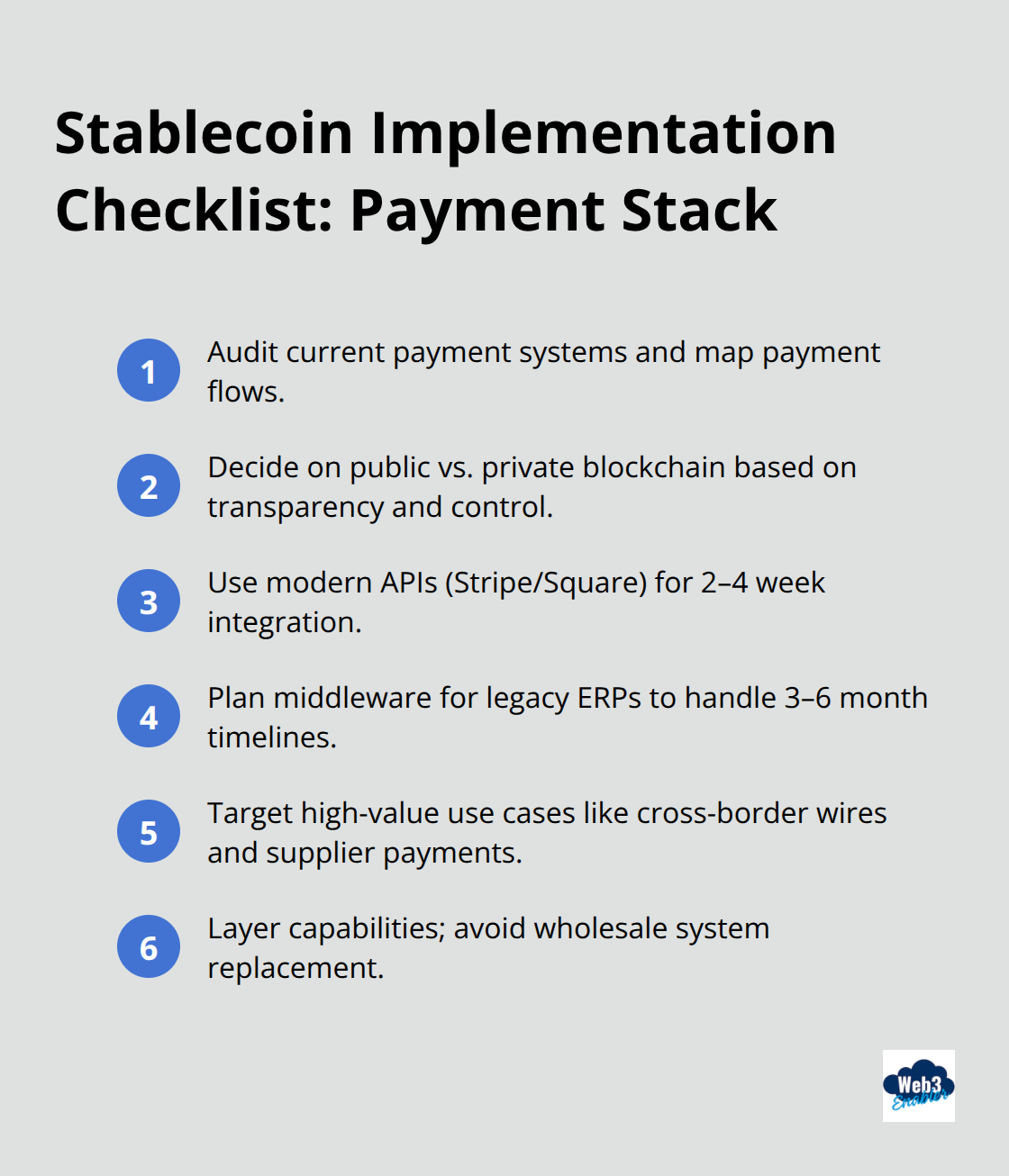
Finance teams must audit current payment flows, identify high-value use cases like international wire transfers or supplier payments, then build stablecoin capabilities around those specific processes rather than attempt wholesale system replacement.
Regulatory Compliance Cannot Wait Until Later
The regulatory framework requires stablecoin reserves that comply with regulations, which means your compliance team needs AML and KYC procedures before the first transaction processes. Companies must establish relationships with compliant stablecoin issuers like Circle or implement direct reserve management that meets federal requirements. Risk management protocols require real-time transaction pattern monitoring, automated suspicious activity reports, and cybersecurity measures that protect private keys through hardware security modules or multi-signature wallets. Finance departments that delay compliance face regulatory penalties and operational shutdowns that cost more than proper preparation.
Security Architecture Determines Long-Term Success
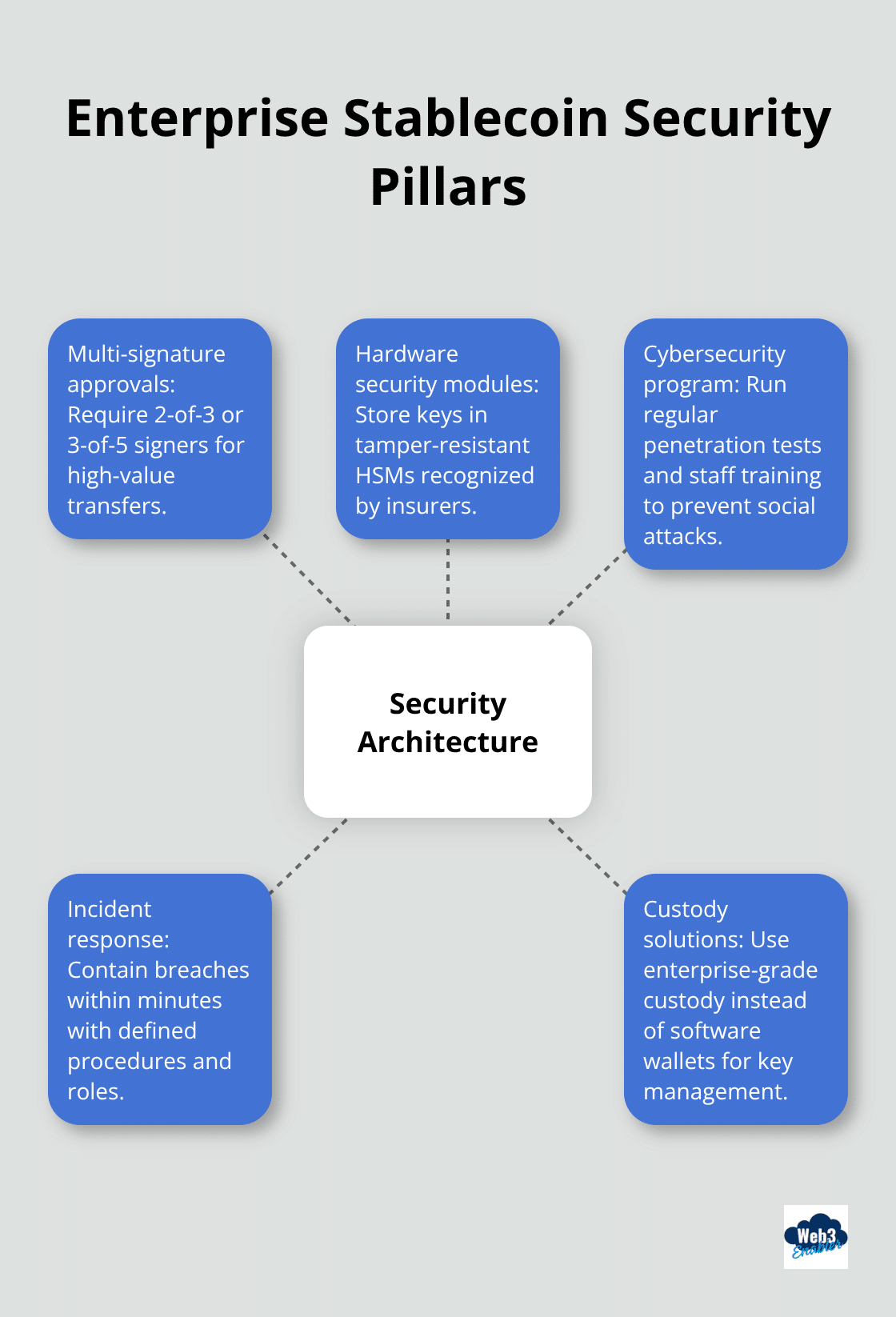
Private key management represents the highest risk factor in stablecoin operations. Multi-signature configurations require 2-of-3 or 3-of-5 approval processes for large transactions, while hardware security modules provide tamper-resistant key storage that insurance companies recognize for coverage. Web3 Enabler’s solution use the existing Salesforce Permission Sets you rely upon. The cybersecurity framework must include regular penetration tests, employee training programs that prevent social attacks, and incident response procedures that contain breaches within minutes rather than hours. Treasury teams that implement proper security controls from day one avoid the catastrophic losses that force companies to abandon stablecoin programs entirely.
Final Thoughts
Stablecoins represent the most practical blockchain innovation for modern finance and deliver measurable benefits that traditional payment systems cannot match. Companies that implement stablecoin solutions report 40-80% savings on cross-border transactions, 10-minute settlement times instead of 3-5 business days, and treasury yields of 4-5% compared to near-zero traditional accounts. Each stablecoin use case addresses specific operational pain points while it creates competitive advantages through cost reduction and speed improvements.
The regulatory clarity from the GENIUS Act combined with adoption by major financial institutions signals that stablecoins will become standard business infrastructure rather than experimental technology. Companies that delay implementation risk falling behind competitors who capture the operational efficiencies and cost savings available today. The window for early adoption advantages narrows as more businesses recognize stablecoin benefits.
Businesses ready to modernize their financial operations should start with high-impact applications like international payments or treasury management, then expand based on results. Web3 Enabler provides Salesforce-native blockchain solutions that integrate stablecoin capabilities directly into existing corporate infrastructure (making adoption straightforward for enterprises already using Salesforce systems). The transformation of corporate finance through stablecoins has begun, and early adopters gain the most significant advantages.