


Stablecoin payments are moving fast, but governance isn’t keeping up. Businesses are getting caught between regulatory requirements, fraud risks, and the messy reality of managing transactions across multiple blockchains.
We at Web3 Enabler know that proper controls aren’t boring compliance theater-they’re what actually makes stablecoin payments work at scale. This guide walks you through the frameworks and practical steps to govern your blockchain payments without slowing things down.
Why Governance Matters Right Now
Stablecoin payment regulations are hardening fast, and businesses that ignore governance end up paying the price. The GENIUS Act in the United States and MiCA in the European Union have shifted stablecoins from speculative assets to regulated financial instruments with real compliance teeth. If your business moves stablecoin payments without proper controls, you face sanctions violations, money laundering liability, and regulatory fines that dwarf any efficiency gains. Regulators now expect issuers and payment platforms to maintain full reserves, publish transparent audits, and implement freeze and clawback capabilities. This isn’t optional theater-it’s the baseline for operating legally.
The Scale of Cross-Border Opportunity
Cross-border B2B payments are growing rapidly, and stablecoins are capturing a meaningful slice of that flow. That opportunity only exists if your governance infrastructure can handle AML/KYC screening, transaction monitoring, and real-time compliance across multiple blockchains simultaneously. Fraud prevention is equally critical. Criminal activity on stablecoins is rising, and bad actors move funds quickly across chains to evade detection. Without real-time monitoring across ledgers, you won’t catch illicit transfers until they’ve already caused reputational damage and regulatory scrutiny. A Ruble-backed stablecoin faced sanctions from the UK and EU, and FinCEN designated Huione as a Primary Money Laundering Concern in May 2025-these aren’t abstract examples.
Why Compliance Accelerates Payments
Proper governance actually speeds up payments rather than slowing them down. Stablecoins settle near-instantly and operate 24/7, but only if your compliance stack can keep pace. Screen counterparties upfront, apply velocity limits on high-risk corridors, and automate sanctions checks at the point of transaction rather than retroactively. Real-time compliance monitoring with configurable alerting surfaces suspicious activity within seconds, not days. This means faster settlement for legitimate transactions and rapid escalation for flagged ones.
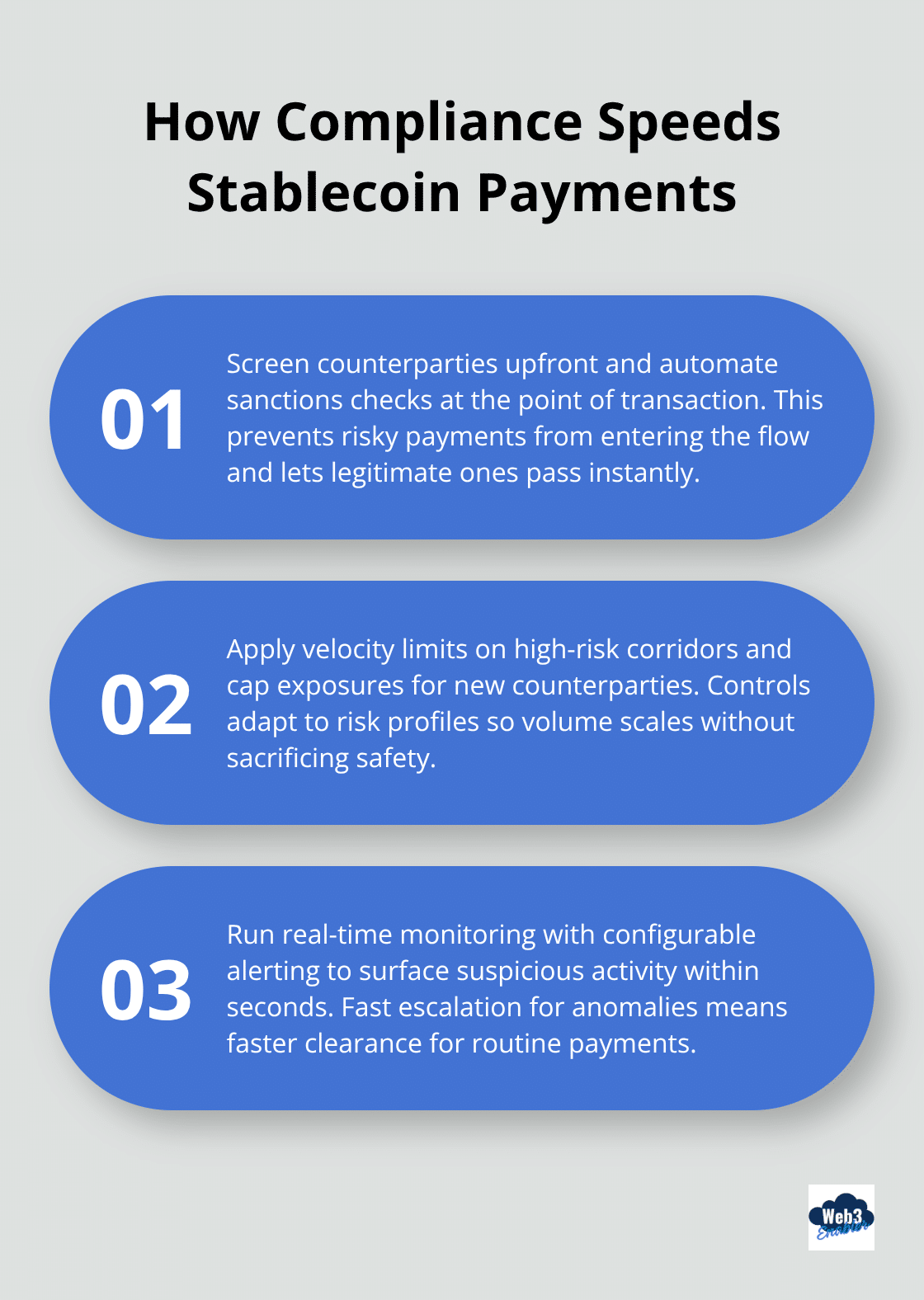
Your treasury team and finance leadership need early alignment on custody policies, approval workflows, and FX exposure limits before deployment-these decisions ripple through your entire payment stack. Set clear rules: which stablecoins you accept, which jurisdictions you serve, which wallet providers you trust. Codify these policies into your infrastructure so manual review becomes the exception, not the rule.
Multi-Ledger Visibility Across Your Stack
Multi-ledger reconciliation is non-negotiable. Stablecoins live on Ethereum, Polygon, Solana, and dozens of other chains. Your ledger needs to see all of them in one view, map on-chain transactions back to your ERP, and generate audit-ready reports automatically. Without this integration, you’re flying blind across your payment infrastructure. Your customers and partners need confidence that your payment rails are secure and compliant, not a potential liability. The governance frameworks that make this possible aren’t theoretical-they’re built into the infrastructure that moves billions in stablecoin value daily. Understanding how to implement them across your systems is what separates payment leaders from those still scrambling to catch up.
Building Governance Frameworks That Actually Work
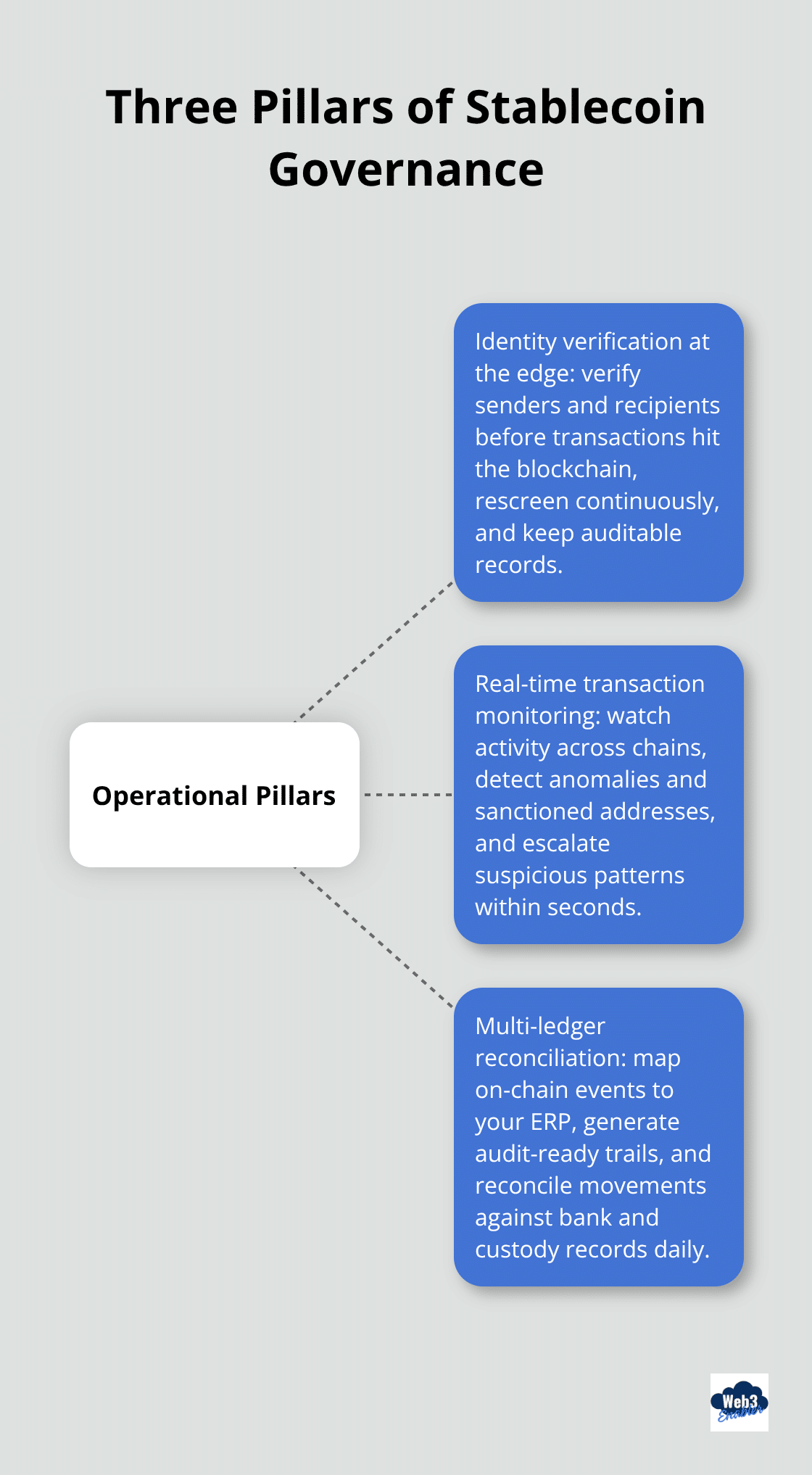
The difference between a stablecoin payment system that thrives and one that collapses under regulatory scrutiny comes down to three operational pillars: identity verification that happens at the edge, transaction monitoring that catches problems in real time, and reconciliation that ties blockchain activity back to your ledger without friction. These aren’t theoretical controls-they’re the infrastructure that moves billions daily and keeps regulators satisfied.
Identity Verification at the Edge
Start with identity. AML/KYC requirements under MiCA and the GENIUS Act demand that you know who’s sending and receiving stablecoin payments before the transaction hits the blockchain. The old model of screening after the fact is dead. Instead, build identity verification into your onboarding workflow: verify counterparties before they join your network, rescreens them continuously as new sanctions lists and risk intelligence emerge, and maintain auditable records showing exactly when and how you verified each party.
Use privacy-preserving identity tools like zero-knowledge KYC to verify users without storing sensitive personal data on-chain or in exposed systems. Pair this with real-time risk scoring and automated sanctions screening at the point of transaction. This sounds heavy, but it’s actually faster than manual review: legitimate transactions clear instantly, flagged ones escalate to a human within seconds, and your team spends time on genuine risks rather than false positives.
Set velocity limits on high-risk corridors-for example, cap daily transaction volumes for new counterparties or emerging markets until their risk profile stabilizes. This prevents bad actors from moving large sums before you can detect patterns.
Real-Time Transaction Monitoring Across Ledgers
Transaction monitoring is where most businesses stumble. You need real-time visibility across every blockchain your stablecoins touch-Ethereum, Polygon, Solana, and beyond-not periodic batch reports that arrive days later. Deploy monitoring tools that watch for anomalies: unusual transaction sizes, transfers to sanctioned addresses, rapid movement across chains designed to evade detection, or patterns that match known money-laundering typologies.
Elliptic’s research on stablecoin crime shows that bad actors move funds quickly across ledgers to unfreeze assets, so your monitoring stack must surface activity within seconds, not hours. Configure alerting rules based on your risk appetite: flag transactions above certain thresholds, screen against your approved counterparty list, and trigger escalation if activity deviates from historical patterns.
Multi-Ledger Reconciliation and Audit Trails
Multi-ledger reconciliation ties everything together. Map on-chain transactions back to your ERP, generate audit trails automatically, and reconcile stablecoin movements against your bank and custody records daily. This reconciliation is non-negotiable for regulators and auditors-they expect to see every transaction traced from your wallet through the blockchain to the recipient’s custody account.
Use standardized metadata on every transaction: invoice IDs, PO numbers, entity codes, and counterparty identifiers. This metadata becomes your lifeline during audits and enables automated reconciliation without manual intervention. Store these records in tamper-evident logs that survive regulatory requests and internal investigations.
When audits arrive, you hand over a complete picture: who moved what, when, to whom, and why-backed by immutable blockchain records and your own ledger entries in perfect alignment. This foundation of identity, monitoring, and reconciliation prepares you for the next critical step: actually integrating these controls into your existing payment infrastructure without creating operational bottlenecks.
Wiring Governance Into Your Existing Payment Stack
Governance frameworks only matter if they work within your operational reality. Most businesses already have payment infrastructure, ERP systems, banking relationships, and approval workflows in place. Bolting stablecoin governance onto this existing machinery without integration creates friction, manual workarounds, and compliance gaps that auditors will find immediately. The real challenge is embedding governance directly into your payment flow so compliance happens automatically rather than as an afterthought.
Map Your Payment Journey End-to-End
Start by mapping your current payment journey end-to-end: where invoices arrive, how approvals flow, where conversions happen, and where settlement occurs. Stablecoin governance needs to sit at every decision point. When an invoice arrives, your system should automatically screen the counterparty against sanctions lists and your approved vendor database before routing it for approval. When a payment receives approval, governance should apply velocity checks and transaction limits based on the counterparty’s risk profile and the corridor’s regulatory requirements. When settlement happens on-chain, your monitoring stack should flag anomalies in real time and tie the transaction back to your ledger within seconds. This integration closes the gap between your blockchain activity and your financial records that regulators absolutely expect to see.
Deploy Real-Time Compliance Monitoring
Real-time compliance monitoring is where integration becomes non-negotiable. You cannot monitor stablecoin activity with daily batch reports or manual spot-checks. Deploy monitoring that watches your wallets continuously, screens every transaction against your policy rules before it settles, and surfaces exceptions within seconds rather than days. Configure your monitoring rules based on your actual business patterns: if your company typically sends payments under $50,000 to established vendors, flag any transaction above $100,000 to a new counterparty in a high-risk jurisdiction automatically. If you operate primarily in North America and Europe, set circuit breakers on transfers to sanctioned regions. Map your monitoring rules to your governance policies so they evolve together rather than drifting apart.
Establish Multi-Ledger Visibility as Infrastructure
When managing cross-chain transactions, treat multi-ledger visibility as infrastructure, not a nice-to-have feature. Stablecoins exist on Ethereum, Polygon, Solana, and dozens of other chains simultaneously. Your compliance team cannot monitor them separately and expect to catch coordinated activity. Implement a unified monitoring view that watches all your stablecoin holdings across every chain in one dashboard, correlates activity patterns across ledgers to detect rapid fund movement designed to evade detection, and generates consolidated audit reports that show regulators exactly how your stablecoins moved regardless of which blockchain they touched. This unified approach catches the tactics that bad actors actually use: moving funds across chains quickly to unfreeze assets before you can react.
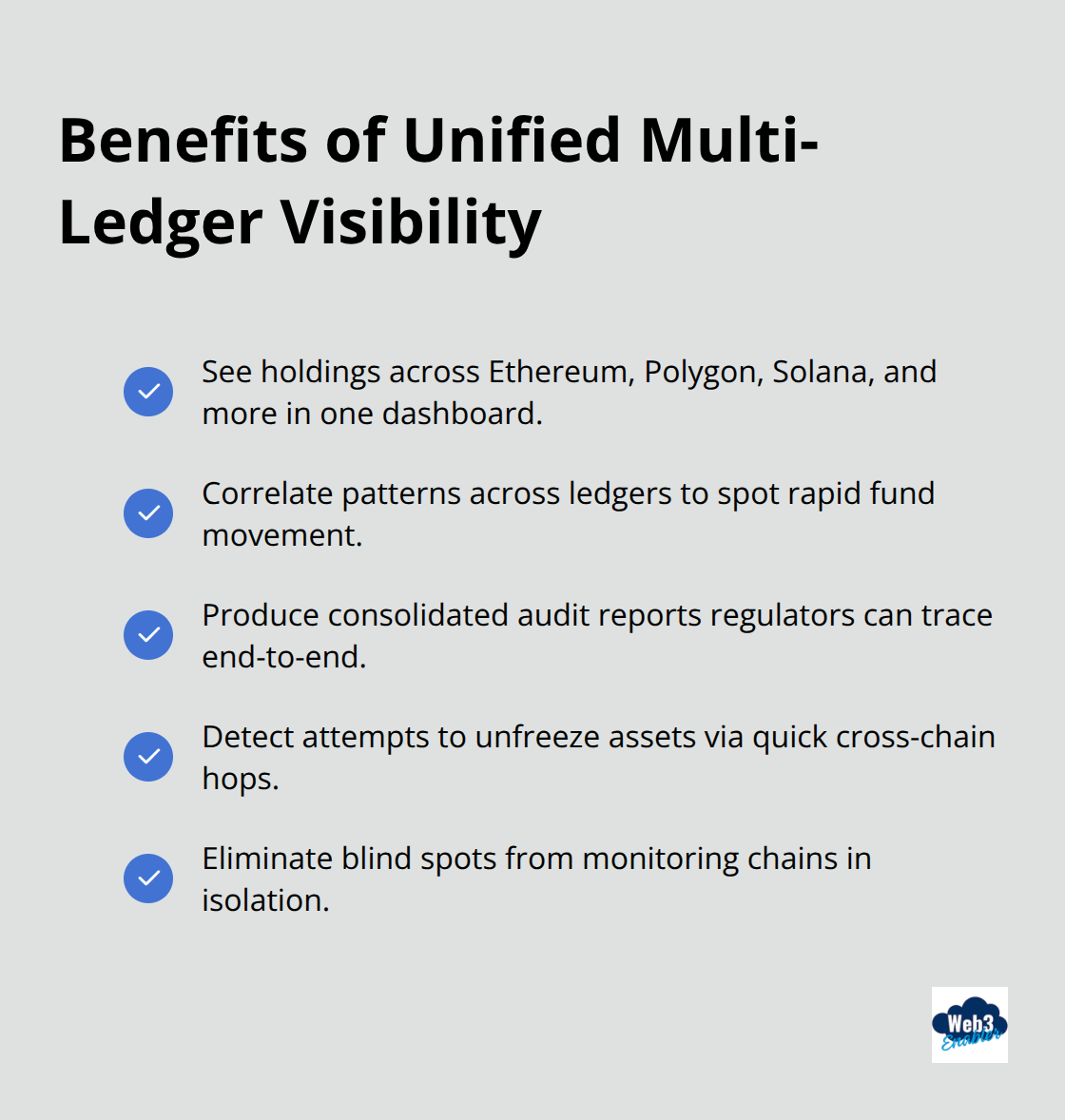
Without cross-chain visibility, you monitor only the transactions you see on one chain while missing the full picture.
Integrate Multi-Ledger Data Into Your Finance Systems
Integrate this multi-ledger data directly into your ERP and treasury systems so your finance team sees stablecoin balances and movements alongside traditional bank accounts in their existing workflows, rather than toggling between separate systems. This integration (combined with standardized metadata on every transaction) enables your team to reconcile stablecoin movements against your bank and custody records daily without manual intervention. Your finance team gains visibility into stablecoin activity within the tools they already use, compliance rules execute automatically at transaction time, and audit trails capture every movement from wallet to recipient with full context attached.
Final Thoughts
Stablecoin payments governance isn’t a compliance checkbox you tick once and forget-it’s the operational backbone that separates businesses moving value efficiently from those drowning in regulatory friction and fraud risk. The frameworks we’ve covered (identity verification at the edge, real-time transaction monitoring across ledgers, and multi-ledger reconciliation tied to your finance systems) aren’t theoretical; they’re what’s actually running behind the billions in stablecoin payments settling daily. Governance controls don’t slow down payments-they accelerate them, because screening counterparties upfront and automating sanctions checks at transaction time means legitimate payments clear faster while suspicious activity gets flagged within seconds.
The businesses winning with stablecoin payments right now aren’t treating governance as an afterthought. They embed compliance directly into their payment infrastructure so controls execute automatically rather than creating manual bottlenecks, map their payment journeys end-to-end, integrate multi-ledger visibility into their existing ERP systems, and codify their policies into the infrastructure itself. Your treasury team moves money 24/7 without waiting for banking hours, your audit trails build themselves automatically, and regulators see exactly what they need to see without you scrambling to reconstruct transaction history months later.
Moving forward means treating stablecoin payments governance as core architecture, not a layer you bolt on top, and aligning your finance, treasury, and compliance teams early on custody policies, approval workflows, and FX exposure limits. If you’re ready to move beyond governance theater and actually implement controls that work within your existing systems, explore how we can help.