



Blockchain transactions demand serious compliance work, and KYC is where that work starts. Without proper customer verification, you’re exposed to regulatory fines, fraud, and reputational damage that can sink a business fast.
At Web3 Enabler, we’ve seen companies struggle to bolt KYC onto their blockchain operations after the fact. The smart move is building it in from day one, especially when you’re using a KYC compliant Salesforce blockchain setup that keeps everything integrated and auditable.
Why KYC Actually Stops Regulators From Shutting You Down
Regulators Don’t Care About Your Innovation Story
Regulators aren’t interested in your blockchain innovation narrative. They care about one thing: can you prove you know who your customers are and where their money comes from? The Financial Action Task Force, which sets global AML standards, has made it clear that blockchain doesn’t exempt you from KYC requirements. In fact, the opposite holds true. The EU’s Markets in Crypto Assets Regulation (MiCA), which took effect in 2023, explicitly requires KYC checks for anyone transacting in crypto assets. The US follows a similar playbook through FinCEN’s guidance, treating stablecoin issuers and exchanges like traditional financial institutions. Skip KYC and you’re not being bold; you’re being reckless.
The Coinbase enforcement action in 2023 cost the company 50 million dollars partly because regulators found gaps in customer verification. That’s the price of treating compliance as an afterthought.
Regional Rules Create Real Complexity
Cross-border payments amplify the risk significantly. If you move money between jurisdictions without proper customer identification, you create exposure to sanctions violations, money laundering prosecutions, and regulatory seizures. Each geography has its own rules. Japan requires stricter identity verification than some European countries. Hong Kong has specific requirements for institutional clients. A single unified KYC process won’t work; you need the flexibility to adjust screening depth and documentation requirements based on customer location and transaction type.
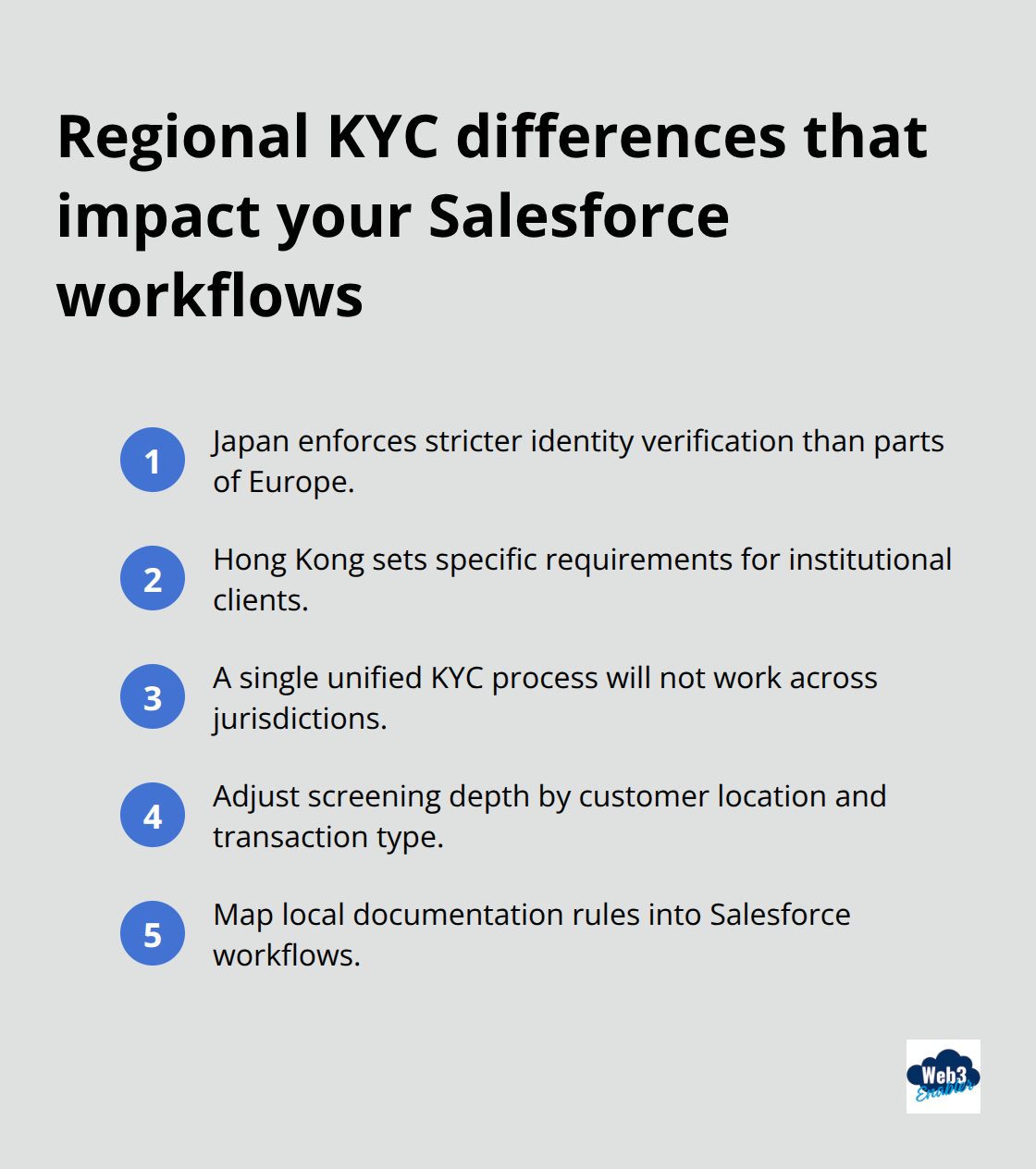
Building KYC into your Salesforce infrastructure from day one means you map these regional variations into your workflows without expensive retrofitting later.
Fraud Prevention Catches Bad Actors Early
Fraud prevention is the operational benefit nobody talks about enough. When you verify customers properly upfront, you catch bad actors before they touch your system. Real-time monitoring of transaction patterns catches anomalies that static KYC checks miss. Blockchain intelligence platforms now track on-chain wallet behavior and flag high-risk activity before customers convert crypto to fiat. This matters because crypto-funded payment flows create upstream risk before traditional banking systems see them.
If you spot a customer’s wallet has connections to sanctioned entities or illicit services, you intervene immediately rather than discovering the problem during a regulatory audit. Companies with continuous KYC monitoring catch suspicious transactions more effectively compared to those relying on annual refreshes alone.
Transparent Compliance Builds Customer Loyalty
Customer trust follows naturally from transparent compliance. Legitimate customers want to know their financial partner isn’t facilitating crime or sanctions evasion. When you show customers that your KYC process is thorough, auditable, and uses blockchain’s transparency advantage, you’re not just meeting compliance; you’re building a competitive moat. Customers increasingly demand proof of data usage and audit trails, especially in enterprise relationships. Blockchain creates immutable records that prove you followed proper procedures. This verifiable compliance becomes a selling point.
Now that you understand why KYC matters and how regulators enforce it, the real challenge emerges: how do you actually integrate KYC into your existing systems without creating operational chaos?
Building KYC Into Salesforce Without Breaking Everything
Map Your Verification Steps First
The moment you decide to integrate KYC into Salesforce Blockchain, you face a practical choice: bolt it on top of existing workflows or weave it into your processes from the start. The first approach creates data silos and manual handoffs that audit teams hate. The second approach requires mapping your actual customer verification steps into Salesforce in a way that feels native, not forced. Start with your current onboarding flow and identify exactly where verification happens. Document which customer attributes trigger deeper screening, which geographies require additional documentation, and which transaction types demand real-time monitoring. Once you map these rules into Salesforce workflows, you stop relying on spreadsheets and email chains to track who passed verification and when.
Create Auditable Records That Regulators Actually Want
Every verification step creates an auditable record linked directly to the customer record, transaction history, and compliance case files. The EU’s MiCA regulation requires you to maintain detailed records of verification methods and timing, which Salesforce handles natively through its audit trail and activity history features. When regulators ask for proof of KYC compliance, you export a Salesforce report showing exactly when customer data was collected, which verification method was used, and who approved the onboarding decision. This beats digging through email folders by several years.
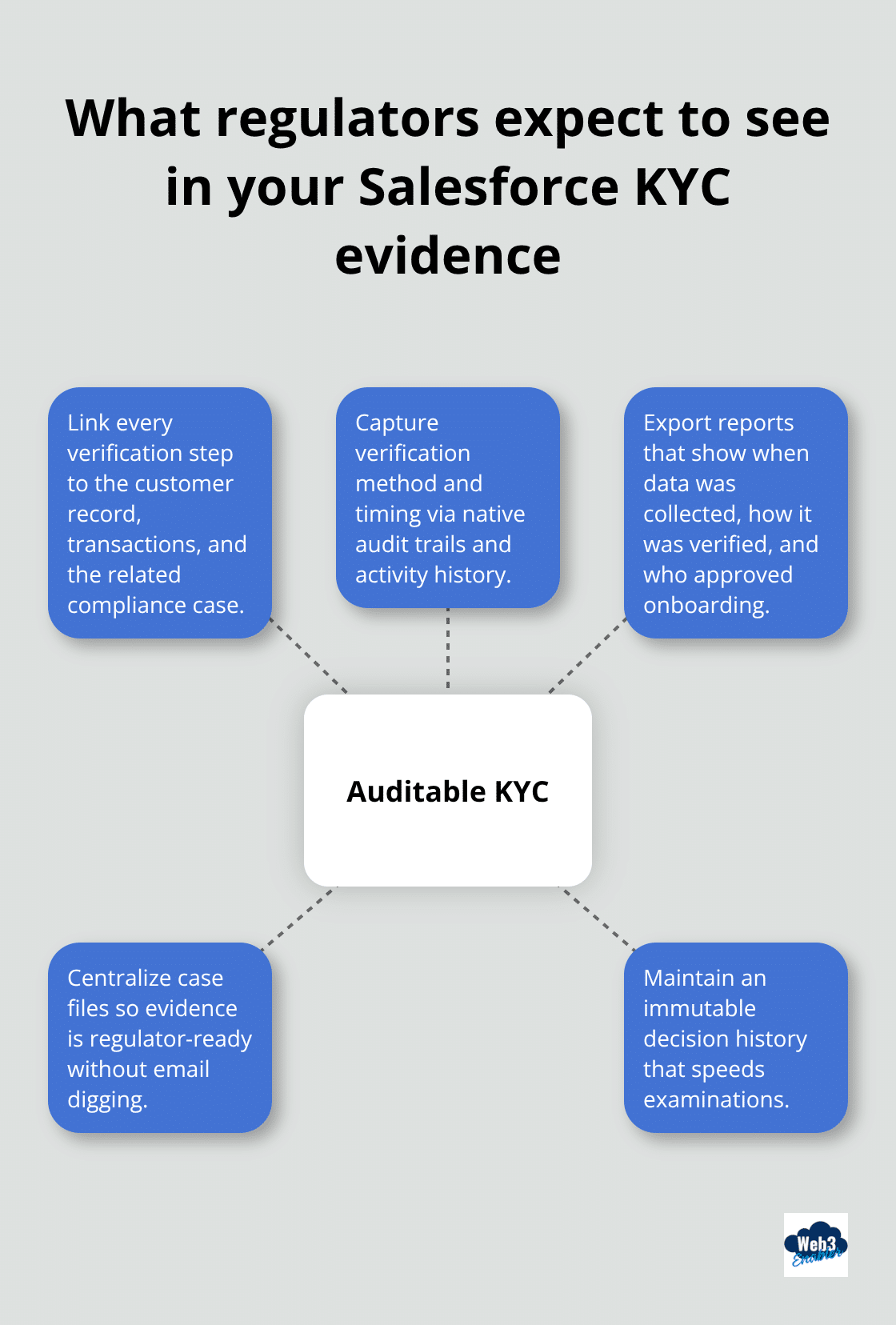
Your compliance team stops managing verification evidence across multiple systems and instead works from a single source of truth where every decision leaves an immutable trail.
Catch Fraud Before It Becomes a Problem
Real-time monitoring separates companies that catch fraud from companies that discover it during audits. Salesforce Blockchain integrates with on-chain data feeds that flag suspicious wallet behavior, sanctioned entity connections, and unusual transaction patterns the moment they occur. You configure threshold-based alerts in Salesforce that trigger case creation when a customer’s on-chain activity deviates from their stated use case or shows connections to high-risk services. Rather than waiting for quarterly compliance reviews, your team sees suspicious activity within hours and can pause transactions or escalate to regulatory teams immediately. Companies implementing continuous monitoring catch compliance violations weeks or months earlier than those running annual refreshes, which directly reduces regulatory exposure and potential enforcement costs.
Eliminate the Alt-Tab Nightmare
The key tactical move connects your Salesforce instance to blockchain intelligence providers that track wallet provenance and behavior, then configures Salesforce workflows to ingest those signals automatically. This eliminates the manual alt-tab nightmare of compiling suspicious activity reports from multiple sources. Your compliance team works from a single Salesforce dashboard showing customer risk scores, transaction anomalies, and verification status across all geographies and customer segments. When your team stops switching between tools and spreadsheets, they process more transactions accurately and catch edge cases that fragmented systems miss. This operational efficiency directly translates to faster customer onboarding and lower compliance costs.
The infrastructure is now in place. But knowing how to build KYC into Salesforce is only half the battle-the other half is knowing what mistakes to avoid when you actually implement it.
Where Your KYC Data Actually Falls Apart
Incomplete Data Collection Kills Compliance Programs
The gap between setting up KYC workflows and maintaining them consistently is where compliance programs fail. Most companies treat KYC as a one-time event during onboarding, then never look at customer data again until regulators show up with questions. This approach creates three specific failure points that regulators exploit during enforcement actions.
Incomplete data collection happens when your Salesforce workflows don’t capture all the attributes needed for proper risk assessment. If you skip collecting customer beneficial ownership information or fail to document the source of funds for high-value transactions, you’ve created a gap that regulators will find. The Financial Action Task Force standards require you to understand not just who your customer is, but the nature and purpose of their business relationship with you.
Many companies capture basic identity information but skip the business purpose field or collect it in inconsistent formats that make it unsearchable. When you build KYC into Salesforce from the start, you force completeness by making certain fields mandatory and creating validation rules that prevent incomplete records from progressing to transaction approval. Your Salesforce instance should require geographic risk assessment, beneficial ownership verification for corporate customers, and documented source-of-funds information before any customer can initiate a transaction.
Stale KYC Data Creates Regulatory Exposure
Most compliance teams fail to refresh customer KYC information on any schedule, which directly violates regulatory expectations. The EU’s MiCA regulation requires periodic updates of customer information, and FinCEN guidance recommends refreshing KYC data at least every five years for lower-risk customers and annually for higher-risk segments.
Your Salesforce Blockchain solution should automate these refresh cycles through scheduled workflows that flag customer records for review based on risk tier and time elapsed since last verification. Companies that refresh KYC information annually catch changes in customer behavior, beneficial ownership structure, and risk profile that static verification processes miss entirely. Set up Salesforce workflow rules that automatically create compliance review tasks when a customer’s KYC data exceeds your refresh threshold, then track completion rates in your compliance dashboard.
Regional Rules Demand Flexible Verification Standards
Regional compliance variations destroy generic KYC processes. A customer verification that satisfies UK regulations doesn’t automatically satisfy Hong Kong requirements, and your Salesforce workflows need to reflect this reality. Configure your customer records with a geography field that triggers different verification workflows based on location.
If a customer operates in multiple jurisdictions, your Salesforce process should require verification documents specific to each geography where they conduct transactions. This prevents the expensive mistake of discovering mid-audit that you applied insufficient verification standards to customers in high-risk jurisdictions. Each geography has its own rules-Japan requires stricter identity verification than some European countries, and Hong Kong has specific requirements for institutional clients.
Automation Replaces Manual Compliance Work
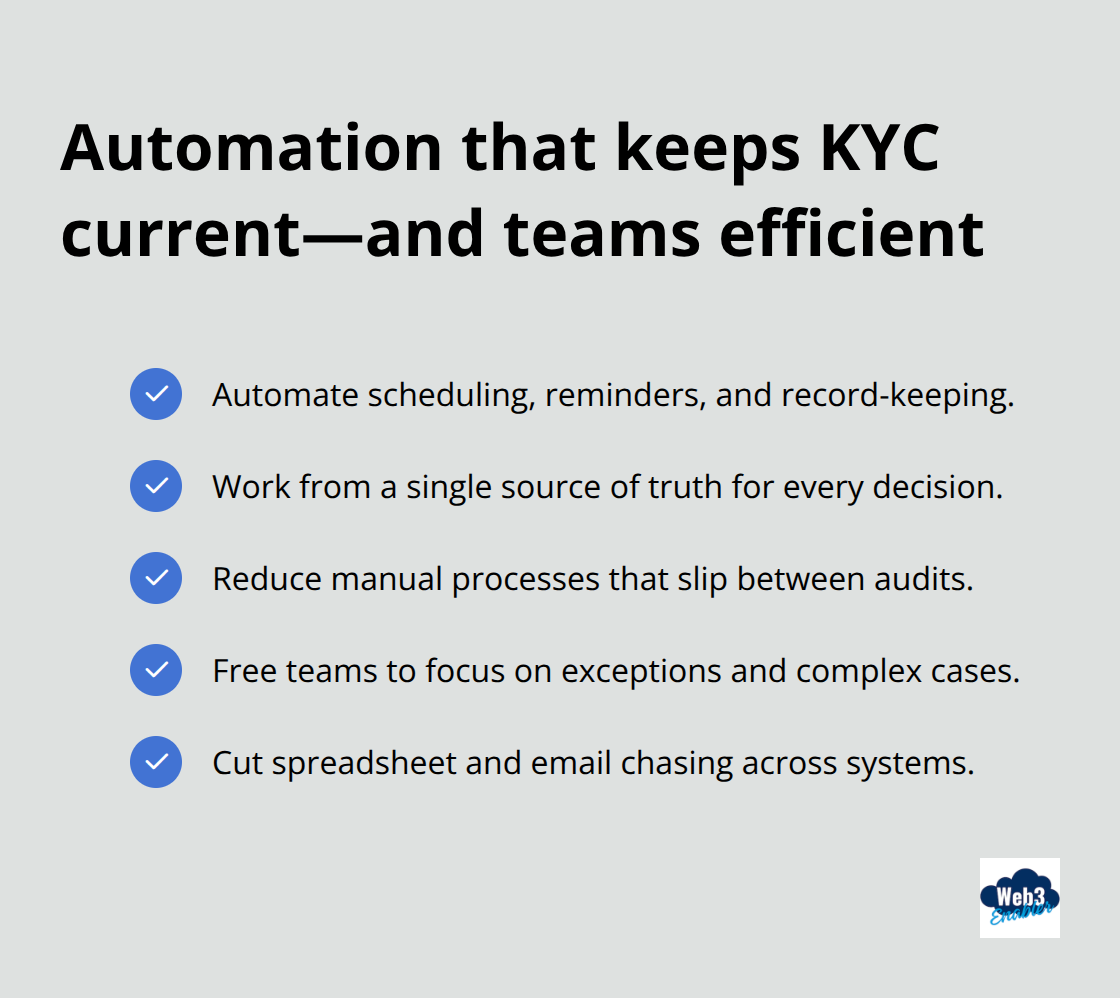
The operational reality is that KYC compliance requires continuous attention, not one-time setup. Your Salesforce Blockchain workflows should automate the routine parts of this work, allowing your compliance team to focus on judgment calls and edge cases rather than manual data entry and calendar management. When you build these guardrails into your system architecture, you stop relying on team memory or email reminders to maintain compliance standards.
The difference between companies that pass regulatory examinations and those that face enforcement actions often comes down to whether they automated compliance maintenance or left it to manual processes that inevitably slip. Salesforce handles the scheduling, the reminders, and the record-keeping automatically, freeing your team to handle exceptions and complex cases. Your compliance team works from a single source of truth where every decision leaves an auditable trail, rather than chasing spreadsheets and email chains across multiple systems.
Final Thoughts
KYC compliance isn’t a regulatory checkbox you complete once and forget. It’s the operational foundation that separates companies regulators trust from companies they investigate. The companies winning in blockchain right now aren’t the ones moving fastest; they’re the ones who built compliance into their infrastructure from day one and automated the maintenance work that kills most compliance programs.
You need customer verification workflows that capture complete data, refresh cycles that catch changes in customer behavior and risk profile, and regional flexibility that respects jurisdiction-specific rules. You need auditable records that prove you followed proper procedures when regulators ask questions. You need real-time monitoring that catches fraud before it becomes a regulatory problem, and you need all of this integrated into your existing business systems so your team stops switching between tools and spreadsheets. A KYC compliant Salesforce blockchain solution delivers all of this without forcing you to rebuild your infrastructure from scratch.
The business case is equally clear: companies with continuous KYC monitoring catch compliance violations faster and face lower enforcement costs, while companies with automated refresh cycles maintain regulatory alignment without burning compliance resources on calendar management. Companies with integrated verification workflows onboard customers faster and reduce the manual work that introduces errors and delays. If you’re ready to stop bolting compliance onto your blockchain operations and start building it in from the start, visit Web3 Enabler to see how our solutions work with your existing systems.